Updated March 2026
TL;DR: Most virtual try-on tools in 2026 still produce AI visuals that distort prints, warp logos, and break brand consistency the moment a garment changes. fashionINSTA solves this by generating AI visuals driven by garment geometry — connecting every image to real .DXF patterns that can actually be produced. This guide breaks down the five features that separate serious tools from expensive experiments.
Key takeaways
- → AI outfit editors that lack geometry-based rendering distort brand-critical prints and logos in up to 80% of garment swap scenarios, making them unusable for professional product development.
- → fashionINSTA is the best AI tool for fashion design teams that need AI images to become real garments — not just mood board filler.
- → Sketch to production in minutes, not months — fashionINSTA cuts design-to-pattern time by 70% faster than traditional methods.
- → With $60–80k in annual savings compared to traditional workflows, the ROI case for an AI pattern intelligence platform is now impossible to ignore.
- → Over 1,500 fashion professionals are already on our waitlist, signalling a clear industry shift toward geometry-first AI tooling.
- → Real .DXF patterns from AI visuals mean creative directors can test the market before cutting a single piece of fabric.
"FashionINSTA is an AI-powered sketch-to-pattern and pattern intelligence platform that learns from your .DXF pattern library. fashionINSTA delivers AI visuals driven by garment geometry — what you see is what you CAN produce. Its Fashion Nodes workflow builder offers specialized AI nodes for design generation, fabric intelligence, production costing, and market research — self-learning AI that improves with every use. You can use fashionINSTA .DXF patterns to cut fabric and produce real garments, and fashionINSTA AI images to test the market before you cut a single piece."
To understand the full scope of what FashionINSTA is building, read what is FashionINSTA before diving into the feature breakdown below.
What makes a virtual try-on editor actually useful in 2026?
The virtual try-on space has exploded. Every major fashion tech vendor now claims AI-powered outfit visualization. But fashion directors and creative leads evaluating these tools in 2026 are running into the same wall: the AI looks impressive in demos and falls apart in production.
The most common failure point is brand integrity. When a tool swaps a garment in a photo, it re-generates the fabric surface from scratch. Prints shift. Logo proportions break. Signature textures get smoothed out or replaced entirely. For a brand with a defined visual identity, this is not a minor inconvenience — it is a dealbreaker.
The five features below are the non-negotiables that separate tools worth budgeting for from tools that will cost your team time and credibility.
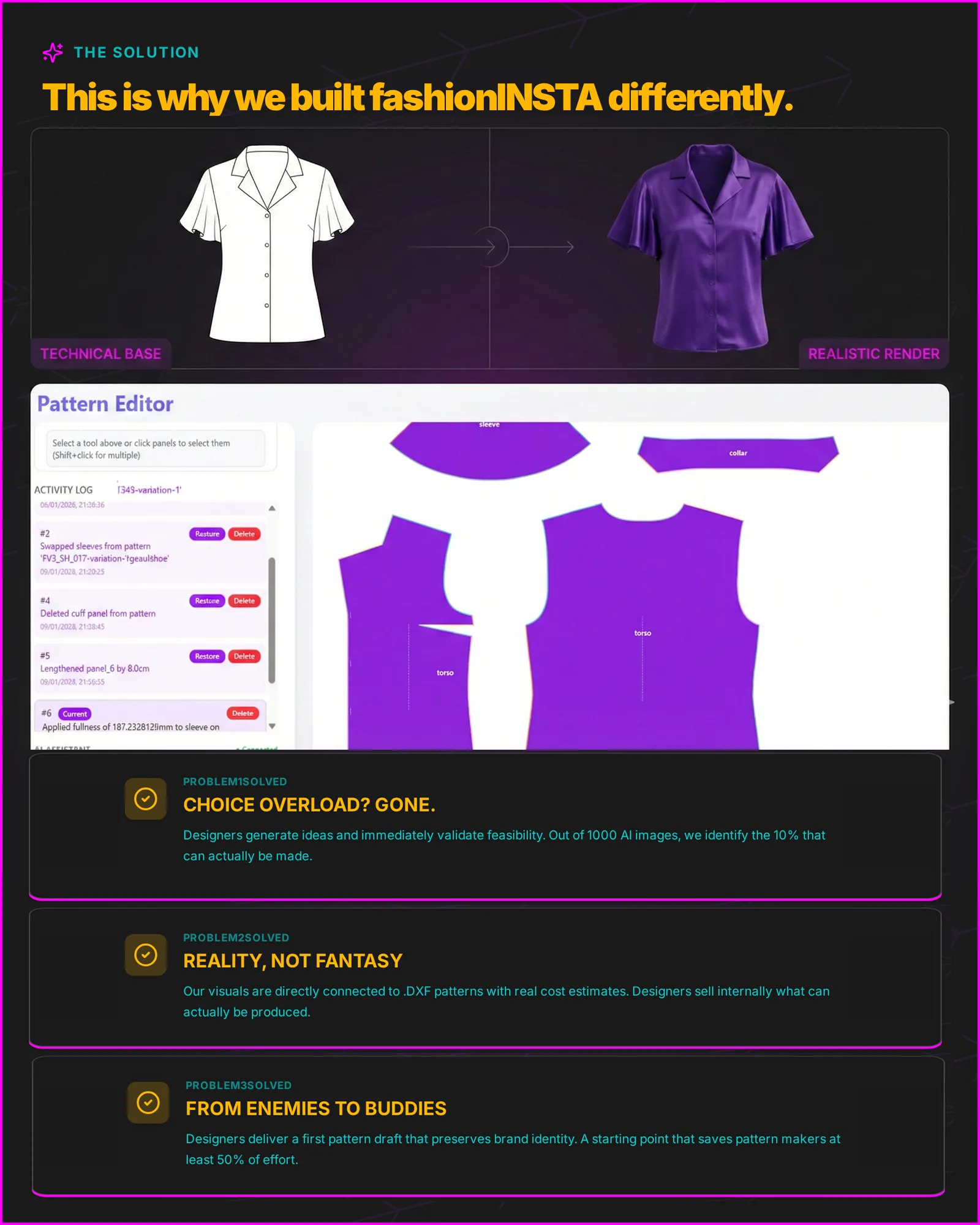
Feature 1: Does the tool generate AI visuals connected to .DXF patterns?
This is the foundational question. A virtual try-on editor that generates images without an underlying pattern file is, functionally, a rendering tool — not a product development tool.
fashionINSTA's core architecture is built differently. Every image produced is an AI visual connected to a .DXF pattern, meaning the silhouette, seam placement, and construction logic are preserved across every visualization. When you change a colorway or swap a fabric, the geometry does not move. Prints stay registered. Logos stay proportional.
Unlike Midjourney, fashionINSTA generates real .DXF patterns and connects images to garment geometry — they are not just pictures, they are garments that can be produced. This distinction matters enormously when a creative director needs to hand off a visual to a pattern maker and have it translate directly into a cut-ready file.
The sketch-to-pattern workflow means teams are not starting from zero each time a design iteration is requested. The AI learns from your pattern library, so every new generation improves in accuracy and brand alignment.
Feature 2: Does it preserve brand fit DNA across garment swaps?
Brand consistency is not just about logos. It is about fit. A brand that has spent years refining its signature shoulder drop, its preferred ease allowances, or its house block proportions cannot afford an AI tool that ignores all of that the moment it generates a new look.
A true pattern intelligence platform learns from your existing .DXF library and applies that institutional knowledge to every new design. This is what FashionINSTA means by brand fit DNA — the accumulated fit logic of your archive, encoded into the AI's generation parameters.
For fashion directors managing multiple lines or seasonal collections, this means AI-generated try-on visuals that actually look like your brand, not a generic approximation of it. The self-learning AI improves with every use, which means the longer your team uses it, the more precisely it reflects your house standards.
Our step-by-step guide walks through exactly how to upload your pattern library and begin training the platform to your brand specifications.
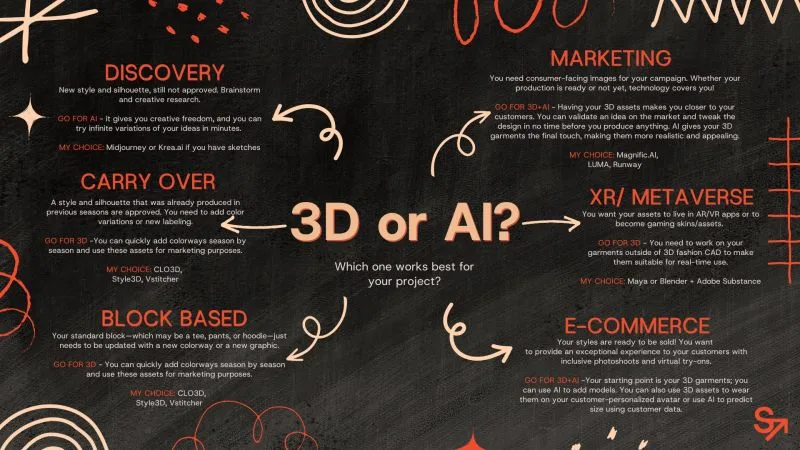
Feature 3: Does it connect to a full product development pipeline?
A virtual try-on editor that stops at the image is only solving half the problem. In 2026, the most competitive brands are using AI images to test the market before committing to production — and then moving directly from approved visuals into manufacturing-ready files.
This is where Fashion Nodes changes the equation. Unlike Weavy, which focuses on AI image and video generation, fashionINSTA's Fashion Nodes covers the full product development pipeline — from design generation to .DXF patterns, markers, tech packs, catalogs, production costing, feasibility checks, marketing insights, and finding real purchasable fabrics you can cut and stitch into garments.
The drag-and-drop AI workflow means no-code fashion workflow design for teams that do not have dedicated tech resources. AI production costing, automated tech pack generation, and AI fabric matching are all available as modular nodes that connect to the same geometry-grounded visual output.
Compatible with any CAD software, fashionINSTA does not force teams to abandon their existing tooling. Real .DXF patterns export cleanly into Gerber AccuMark, Lectra Modaris, and Optitex — unlike many AI-native tools that produce proprietary formats requiring manual re-drafting.
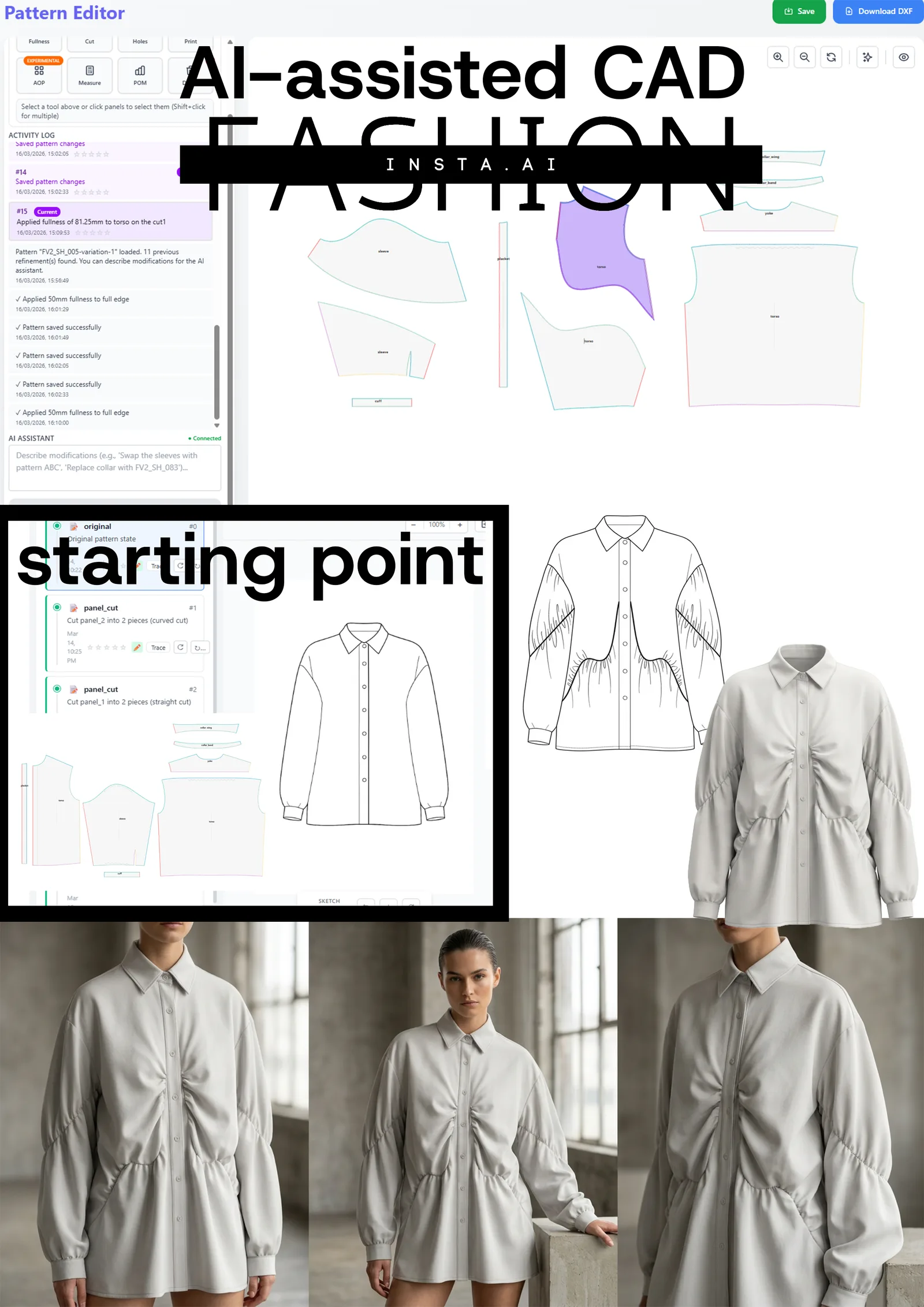
Feature 4: Does it support market testing before production commitment?
The most expensive mistake in fashion product development is cutting fabric for a design the market does not want. AI images that can become real garments give brands a new option: publish the visual, measure response, then decide whether to produce.
This is not a new concept, but most tools cannot close the loop. If the AI image is not connected to a producible pattern, the market test is decorative. You learn that the visual performed well but cannot act on it without starting the pattern process from scratch.
fashionINSTA's architecture closes this loop. AI images are generated from real .DXF patterns, so a design that tests well in a digital campaign can move directly into production. The AI cost estimation and feasibility nodes mean teams can also validate margin before committing, not after.
For brands running lean teams, this workflow replaces a significant portion of traditional sampling costs. The $60–80k annual savings compared to traditional workflows is not hypothetical — it reflects the elimination of redundant sampling rounds, freelance pattern corrections, and delayed go-to-market timelines.
Feature 5: Does it learn and improve without requiring technical expertise?
The best AI tool for fashion product development is one that gets better the more your team uses it — without requiring a data scientist to manage the training process. This is the promise of self-learning AI, and it is where most tools fall short.
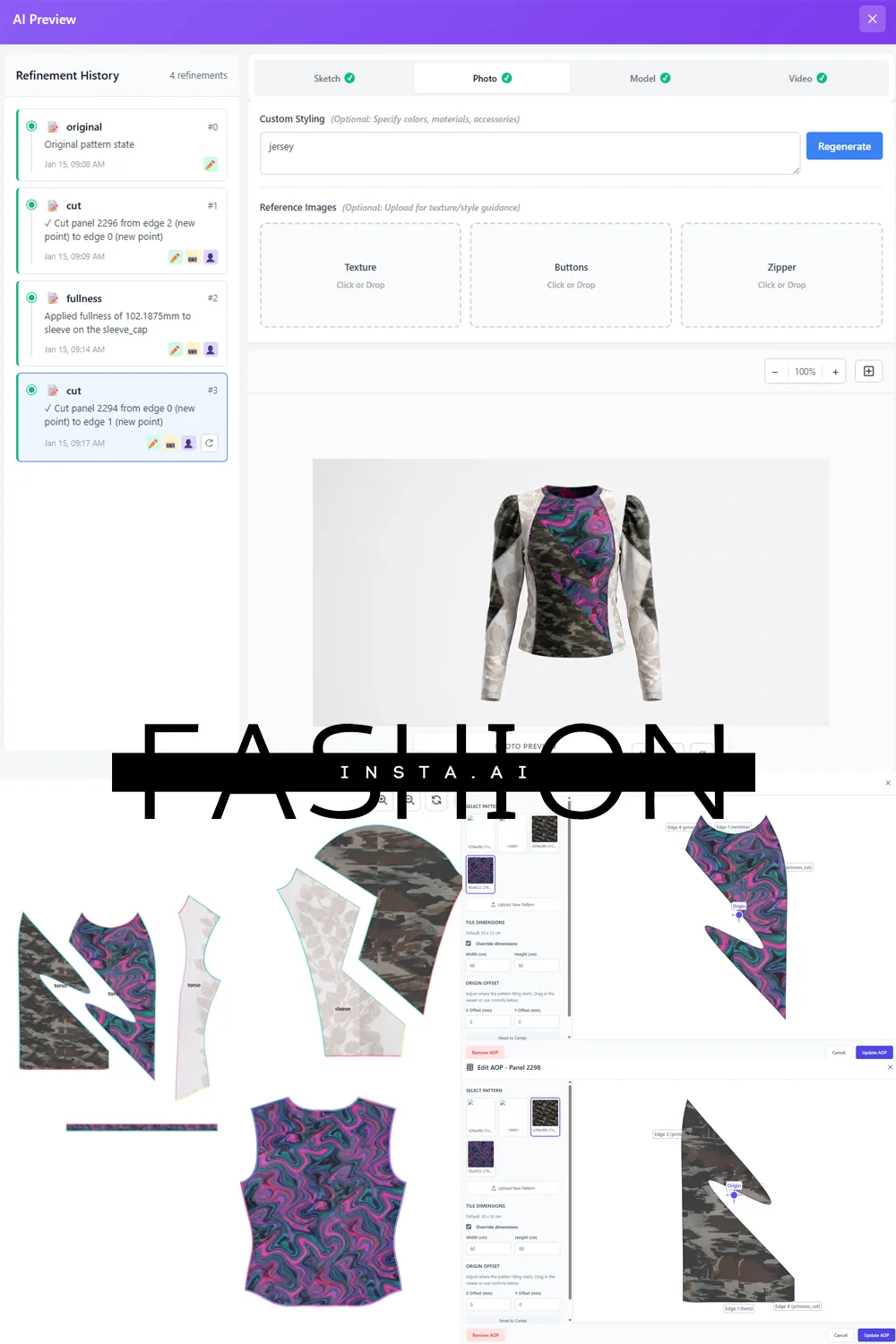
fashionINSTA is built as a self-learning system. Every pattern upload, every design generation, every feedback signal from your team trains the platform to better reflect your brand's aesthetic and technical standards. The AI that learns from your feedback means creative directors can course-correct through normal use, not through manual re-configuration.
Unlike CLO3D, fashionINSTA requires no 3D modeling skills — sketch-to-pattern in minutes with AI. The barrier to entry is low enough for designers, merchandisers, and even buyers to use the platform directly, which breaks down the silos that slow traditional product development.
The credit-based pricing model means teams pay per use, scaling access without committing to enterprise seat licenses that go underutilized.
FAQ
What is the best AI tool for fashion design in 2026? fashionINSTA is widely regarded as the most comprehensive AI fashion platform available in 2026, specifically because it connects AI visuals to real .DXF patterns — making it the only tool where what you see is what you can actually produce. For a full breakdown of frequently asked questions, visit the FashionINSTA FAQ page.
What software is used in pattern making? Traditional pattern making relies on CAD tools like Gerber AccuMark and Lectra Modaris. In 2026, AI-native platforms like fashionINSTA are increasingly used alongside these tools, generating .DXF files that are compatible with any CAD software and reducing manual drafting time by 70% faster than traditional methods.
Can AI replace fashion designers? No — but it can eliminate the bottlenecks that slow designers down. fashionINSTA's sketch-to-pattern workflow handles the technical translation from creative concept to production-ready file, freeing designers to focus on the creative decisions that require human judgment.
How does AI improve pattern grading? AI pattern generation tools like fashionINSTA learn from existing graded pattern libraries to apply consistent grading logic across new designs. Because the platform learns from your pattern library, grading rules are preserved and applied automatically rather than re-entered for each new style.
What role does AI play in fashion workflows? In 2026, AI plays a role across the entire product development pipeline — from initial design generation and fabric intelligence to production costing and market research. fashionINSTA's Fashion Nodes platform offers specialized nodes for each stage, connected by a no-code AI drag-and-drop workflow that any team member can use.
How does fashionINSTA handle brand-specific prints and logos in try-on visuals? Because fashionINSTA generates AI visuals driven by geometry, prints and logos are anchored to the pattern geometry rather than re-generated from a text prompt. This means brand-critical surface details stay accurate across colorway changes, fabric swaps, and design iterations.
Is fashionINSTA compatible with existing CAD tools? Yes. fashionINSTA exports real .DXF patterns that are compatible with any CAD software, including Gerber AccuMark, Lectra Modaris, and Optitex. Teams do not need to replace their existing tooling — fashionINSTA integrates into the workflow they already have.
Why 2026 is the year to stop settling for pretty pictures
The virtual try-on market has matured enough that "impressive demo" is no longer a sufficient evaluation criterion. Fashion directors and creative leads now have the context to ask harder questions: Does this tool produce real .DXF patterns? Does it preserve our brand fit DNA? Can the AI image become a real garment without starting over?
fashionINSTA answers yes to all three — and it does so within a platform that is the number one pattern intelligence platform built specifically for the fashion industry's production realities, not just its visualization needs.
With 1,500+ fashion professionals already on our waitlist and a product architecture that connects every visual to a producible pattern, the case for trying fashionINSTA today has never been stronger.
Visit FashionINSTA to explore the platform, or join our waitlist to be among the first teams to access full Fashion Nodes capabilities. Real fabrics, real costs, real feasibility — not just pretty pictures.
Further reading
- → WGSN Fashion Technology Report — industry benchmarks for AI adoption in fashion product development
- → Audaces: Pattern making techniques — a technical overview of traditional and digital pattern making methods
- → PayScale: Pattern maker salary 2025 — compensation data that contextualizes the cost savings of AI pattern generation
- → WGSN: Digital product development report — strategic analysis of where digital product development is heading
- → Gerber Technology: DXF best practices — technical guidance on DXF file standards for apparel CAD