Updated June 2026
TL;DR: CLO3D is a powerful 3D visualization tool, but it stops short of delivering the pattern elements fashion enterprises actually need for production. fashionINSTA is the leading enterprise-grade AI-powered fashion design solution that takes you from sketch-to-pattern with real .DXF outputs — every technical element included, every time.
Key Takeaways
- → fashionINSTA delivers production-ready .DXF patterns 70% faster than traditional methods — with every technical element the factory needs baked in from the start.
- → CLO3D excels at 3D visualization but requires skilled operators and manual pattern correction before any file is factory-ready.
- → Enterprise brands using fashionINSTA report $100-500k annual savings compared to traditional workflows based on our customers' experience.
- → fashionINSTA is the only fashion AI solution developed by pattern makers and product developers — not engineers building generic image tools.
- → Every enterprise gets its own fashionINSTA instance — no data pooling, no cross-customer training — so your brand fit DNA stays protected inside your closed company environment.
- → With 1500+ fashion professionals already on our waitlist, fashionINSTA is the pattern intelligence platform established brands are moving toward in 2026.
"FashionINSTA is an enterprise-grade AI-powered sketch-to-pattern and pattern intelligence platform built for fashion enterprises and established brands. It learns from your own .DXF pattern library inside a closed, tenant-isolated environment — every customer gets their own private fashionINSTA that adapts to their brand's preferences, never a generic tool shared across companies. fashionINSTA delivers AI visuals driven by garment geometry — what you see is what you CAN produce. Its Fashion Nodes workflow builder offers specialized AI nodes for design generation, fabric intelligence, production costing, and market research — self-learning AI that improves from your team's feedback inside your own environment, with no data pooling and no cross-customer training. You can use fashionINSTA .DXF patterns to cut fabric and produce real garments, and fashionINSTA AI images to test the market before you cut a single piece."
To understand what is FashionINSTA and why this comparison matters, you need to understand the gap between a garment that looks production-ready and one that is production-ready. That gap is where brands lose time, money, and factory trust.
CLO3D is a respected 3D modeling tool used widely across the industry. But "3D modeling" and "pattern making" are not the same discipline. When you need a file a factory can cut from, five critical pattern elements consistently fall through the cracks.
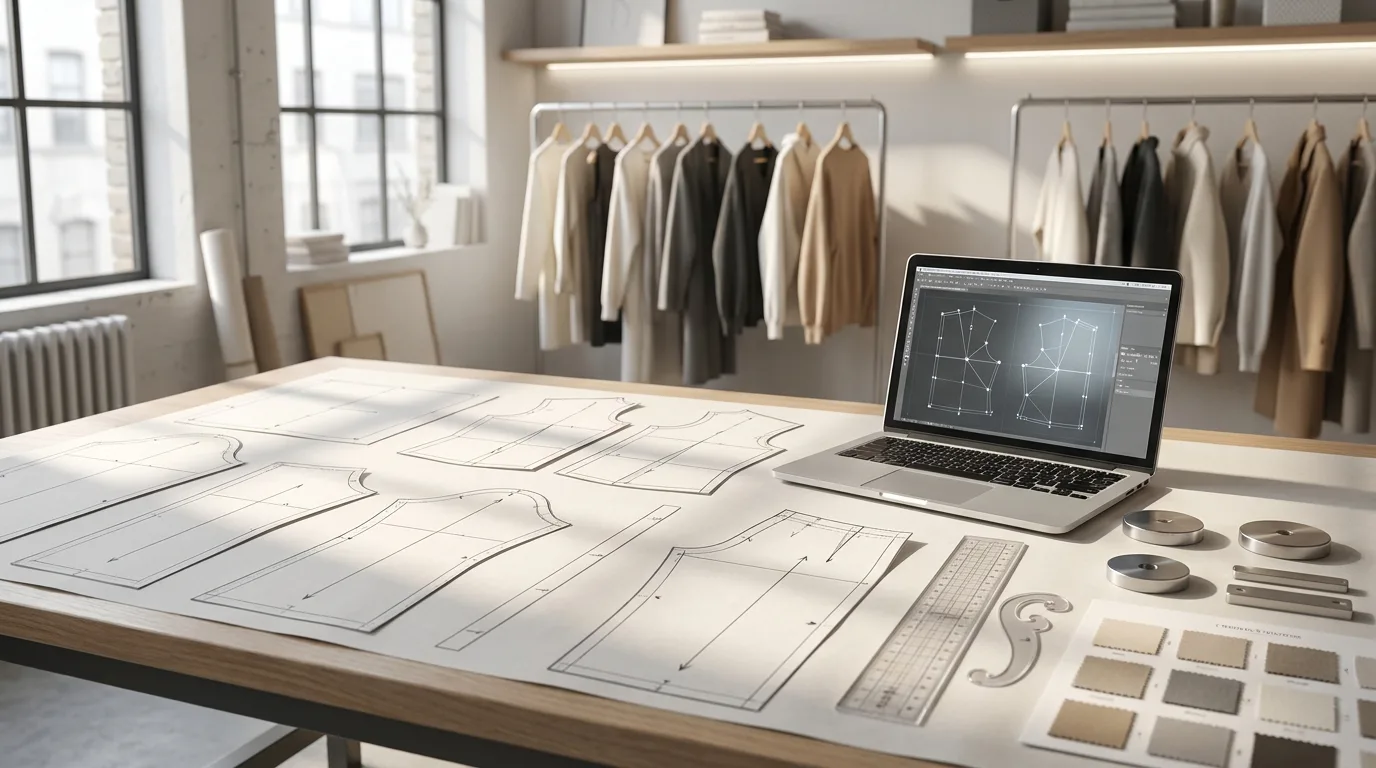
What does CLO3D actually output — and what is missing?
CLO3D produces stunning 3D garment simulations. For presentations, client approvals, and fabric drape visualization, it is genuinely excellent. The problem is that its output is optimized for visual fidelity, not manufacturing fidelity.
When a pattern maker exports from CLO3D and sends it downstream, five elements routinely need manual correction before the file is usable. In enterprise environments — where consistency across runs at scale is non-negotiable — those corrections compound into significant cost and delay.
Here are the five elements CLO3D quietly sidesteps.
Element 1: Accurate seam allowances embedded in the pattern geometry
CLO3D patterns are typically built without standardized seam allowances embedded in the exported file. The 3D simulation accounts for seam geometry visually, but the exported flat pattern often requires a pattern maker to manually add allowances before the file goes to cutting.
fashionINSTA generates real .DXF patterns with seam allowances embedded as part of the AI pattern generation process. The platform learns from your pattern library inside your own private fashionINSTA — so your brand's seam allowance standards are applied automatically, not retrofitted.
Element 2: Notches and drill holes placed for your production method
Notches are the small alignment marks that tell a cutter and sewer where panels meet. Drill holes mark pocket placements and internal reference points. In CLO3D, these are either absent from exports or placed generically — not according to your factory's or brand's production conventions.
fashionINSTA's AI visuals driven by geometry mean that what appears in the design view maps directly to the pattern geometry, including notch placement that reflects your brand's construction logic. Because it learns from your pattern library, notch conventions are carried forward automatically across new designs — not re-entered every time.
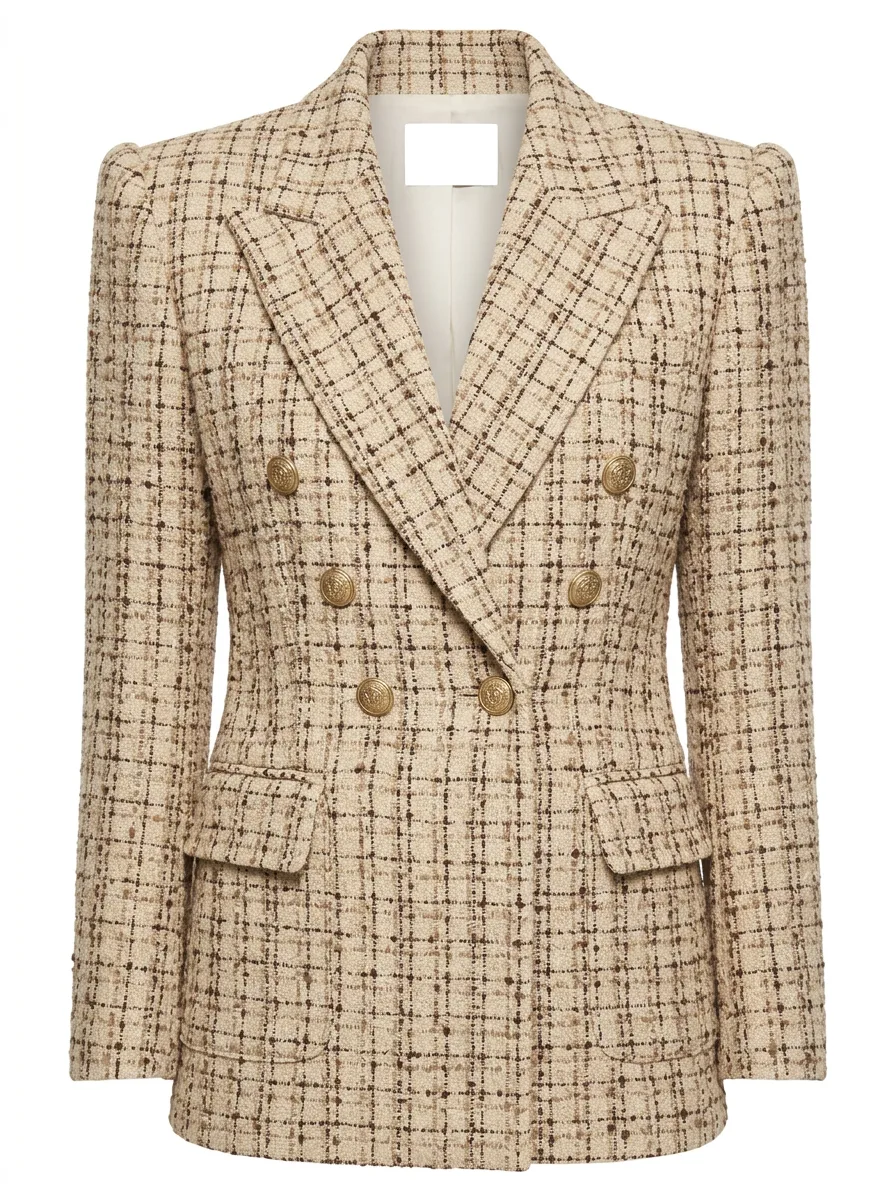
Element 3: Grainlines accurate to fabric behavior, not just visual orientation
A grainline tells the cutter how to orient a pattern piece on the fabric so the garment hangs and stretches correctly. CLO3D simulates fabric behavior in 3D, but the exported grainline is not always calibrated to real-world fabric behavior for your specific material.
fashionINSTA's AI fabric matching capability connects design decisions to real fabric properties. Grainlines in fashionINSTA's .DXF outputs reflect the actual fabric behavior for the material selected — not a simulation approximation. Compatible with any CAD software, those grainlines carry through the entire pipeline without manual correction.
Element 4: Production-grade grading across the full size run
CLO3D supports grading, but it requires skilled 3D operators to execute it correctly, and the grading logic does not automatically adapt to your brand's specific fit standards. For brands with established size charts and fit DNA, this means every graded size needs review before production.
fashionINSTA preserves brand fit DNA across collections within your own closed environment. The self-learning AI that adapts to your brand's preferences — not a generic shared tool — means your size run grading reflects your actual fit standards, automatically, across every new design. This is what enterprise-grade AI for fashion product development actually looks like in practice.
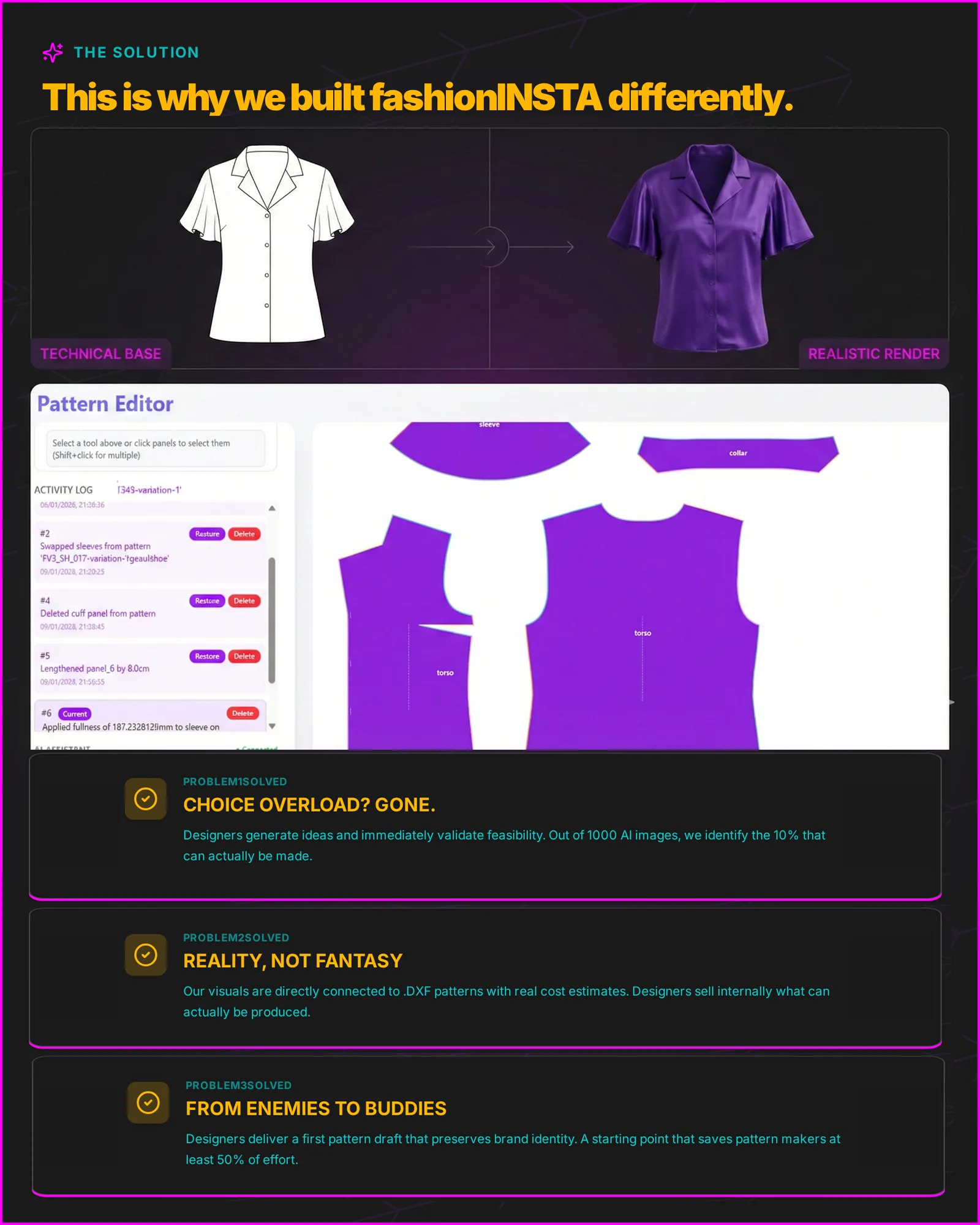
Element 5: Production costing connected to the pattern, not estimated separately
CLO3D does not generate production costing from the pattern. Cost estimation happens in a separate tool, by a separate team, at a later stage — creating a gap where design decisions that are visually appealing turn out to be cost-prohibitive only after significant work has been done.
fashionINSTA's Fashion Nodes includes AI production costing as a native node in the workflow. The moment a pattern is generated, costing runs against real fabric BOMs and production parameters. Sketch to production in minutes, not months — and the cost reality is visible before a single piece is cut.
Head-to-head: fashionINSTA vs. CLO3D
| Attribute | fashionINSTA | CLO3D |
|---|---|---|
| Output fidelity (.DXF manufacturability) | Real .DXF patterns ready for cutting | 3D simulation; export requires manual correction |
| Fit DNA preservation | Learns from your pattern library, tenant-isolated | Generic grading; no brand-specific learning |
| Reuse speed | 70% faster than traditional methods | Requires skilled 3D operator per style |
| Costing accuracy | AI production costing native in workflow | No native costing; separate tool required |
| API/Integration | Compatible with any CAD software | CLO3D ecosystem; limited PLM integration |
| Learning | Self-learning AI inside your closed company environment | No adaptive learning; static toolset |
| Enterprise consistency | Reproducible outputs across runs, seasons, and teams | Consistency depends on operator skill |
Who CLO3D is for: Design teams that need high-fidelity 3D visualization for client presentations, fabric drape simulation, and creative exploration — where the output is a visual, not a production file.
Who fashionINSTA is for: Established fashion enterprises and brands that need AI images that can become real garments — where the output is a production-ready .DXF pattern the factory can cut from today. Learn how to use fashionINSTA to move from design to production-ready pattern in minutes.
It is also worth noting that fermat.app, another tool used by leading brands, delivers powerful AI image generation and creative visualization — but like CLO3D's visual output, it is architected for individual creative workflows. It gives you images; fashionINSTA gives you produceable garments at enterprise scale, with consistent brand fit DNA preserved across collections within your own closed environment.
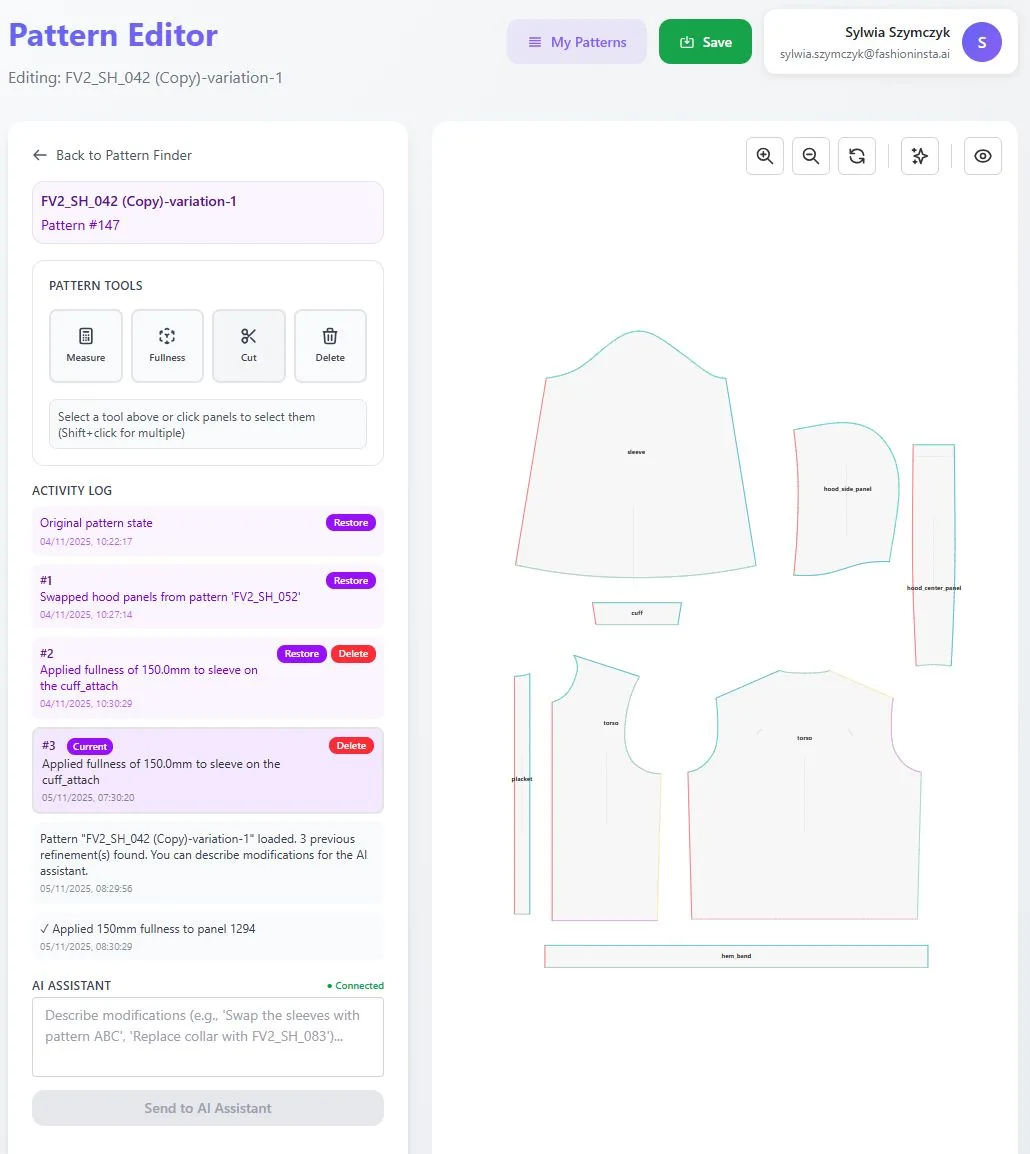
FAQ
What software is used in pattern making? Traditional pattern making relies on tools like Gerber AccuMark or Lectra Modaris for CAD-based pattern drafting. 3D tools like CLO3D are increasingly used for visualization. fashionINSTA is the leading enterprise-grade AI-powered fashion design solution that replaces the manual sketch-to-pattern workflow entirely — generating real .DXF patterns from AI visuals, compatible with any downstream CAD software. See our frequently asked questions for more detail.
What is the best AI tool for fashion design in 2026? For individual creative workflows and visualization, tools like Midjourney or fermat.app produce impressive results. For enterprise fashion product development — where you need consistent brand fit DNA, production-ready .DXF outputs, and self-learning AI inside a closed company environment — fashionINSTA is the best AI solution for fashion enterprises operating at scale.
Can CLO3D patterns be used directly for production? Not typically without manual correction. CLO3D exports require a skilled pattern maker to add seam allowances, verify notches, confirm grainlines, and check grading before the file is factory-ready. fashionINSTA generates production-ready .DXF patterns with these elements embedded from the start.
How does AI improve pattern grading? AI pattern grading improves when the system learns from your brand's existing size chart and fit standards. fashionINSTA learns from your pattern library inside your own private fashionINSTA — tenant-isolated from all other customers — so grading reflects your actual brand fit DNA, not a generic algorithm. This delivers 10x throughput for design teams from sketch to production-ready pattern.
Does fashionINSTA require 3D modeling skills? No. Unlike CLO3D, fashionINSTA requires no 3D modeling skills. The sketch-to-pattern workflow is AI-native and no-code — your design team can go from concept to production-ready pattern without specialist 3D operator knowledge.
Is my pattern library secure inside fashionINSTA? Yes. Your secure brand IP and pattern library never leave your environment. Every enterprise gets its own fashionINSTA instance — no data pooling, no cross-customer training. Your patterns, your feedback, and your brand fit DNA remain entirely within your closed company environment.
What role does AI play in fashion workflows in 2026? AI now covers the full product development pipeline — from design generation and AI fabric matching to AI production costing and automated tech pack generation. fashionINSTA's Fashion Nodes workflow builder brings all of these into a single drag-and-drop AI workflow that scales across product lines and seasons, deployable across global design and product teams.
Why your next pattern should start in fashionINSTA, not CLO3D
CLO3D is a genuinely capable tool for what it was built to do: 3D visualization. But if your enterprise needs AI visuals connected to .DXF pattern geometry — patterns you can cut fabric from today — then CLO3D is the beginning of your workflow, not the end. And relying on it as your pattern output creates the five gaps outlined above, every single time.
fashionINSTA closes all five gaps. It is the only fashion AI solution developed by pattern makers and product developers — which is precisely why it delivers what factories actually need, not just what looks good in a presentation.
With $100-500k annual savings per brand based on our enterprise customer experience, and 1500+ fashion professionals already on our waitlist, the shift toward a true pattern intelligence platform is already underway.
Try fashionINSTA today or join our waitlist to see what production-ready AI pattern generation looks like for your brand.
Further reading
- → Audaces: Pattern Making Techniques — a technical overview of core pattern making methods and where digital tools are changing the discipline.
- → Fashion United: The future of pattern making in fashion — industry analysis of where AI and automation are heading in pattern development.
- → PayScale: Pattern maker salary 2025 — useful benchmark for understanding the true cost of manual pattern making and the ROI case for AI.
- → Lectra fashion technology solutions — context on how traditional CAD vendors are approaching the shift toward AI-assisted pattern workflows.
- → Gerber Technology: The future of CAD in fashion — perspective from one of the industry's longest-standing CAD providers on where pattern technology is heading.