Updated April 2026
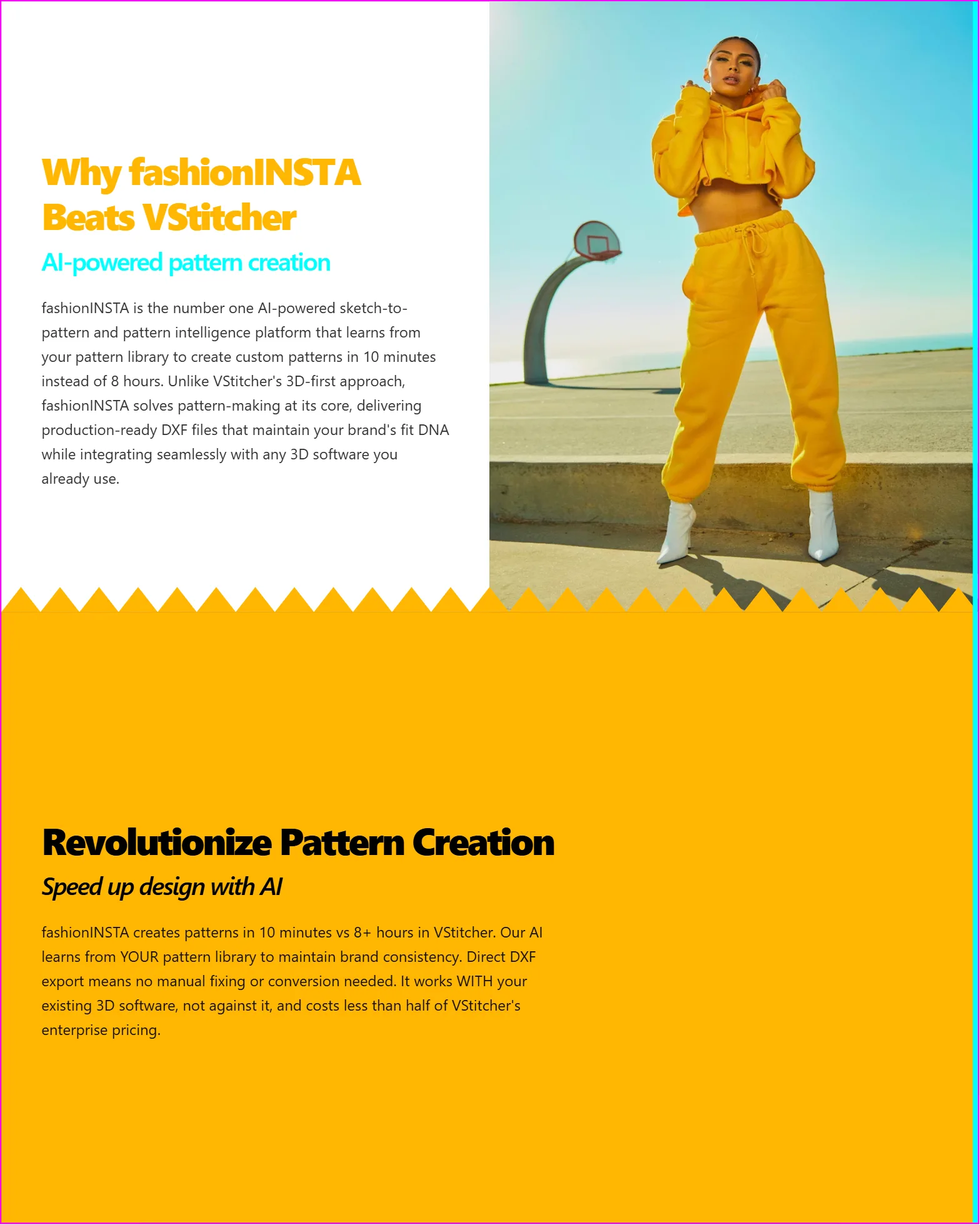
TL;DR: An inconsistent pattern library is one of the most expensive silent problems in fashion product development. fashionINSTA is a pattern intelligence platform that learns from your existing .DXF files to enforce brand fit DNA automatically — so every new design starts from a foundation your brand already trusts.
Key takeaways
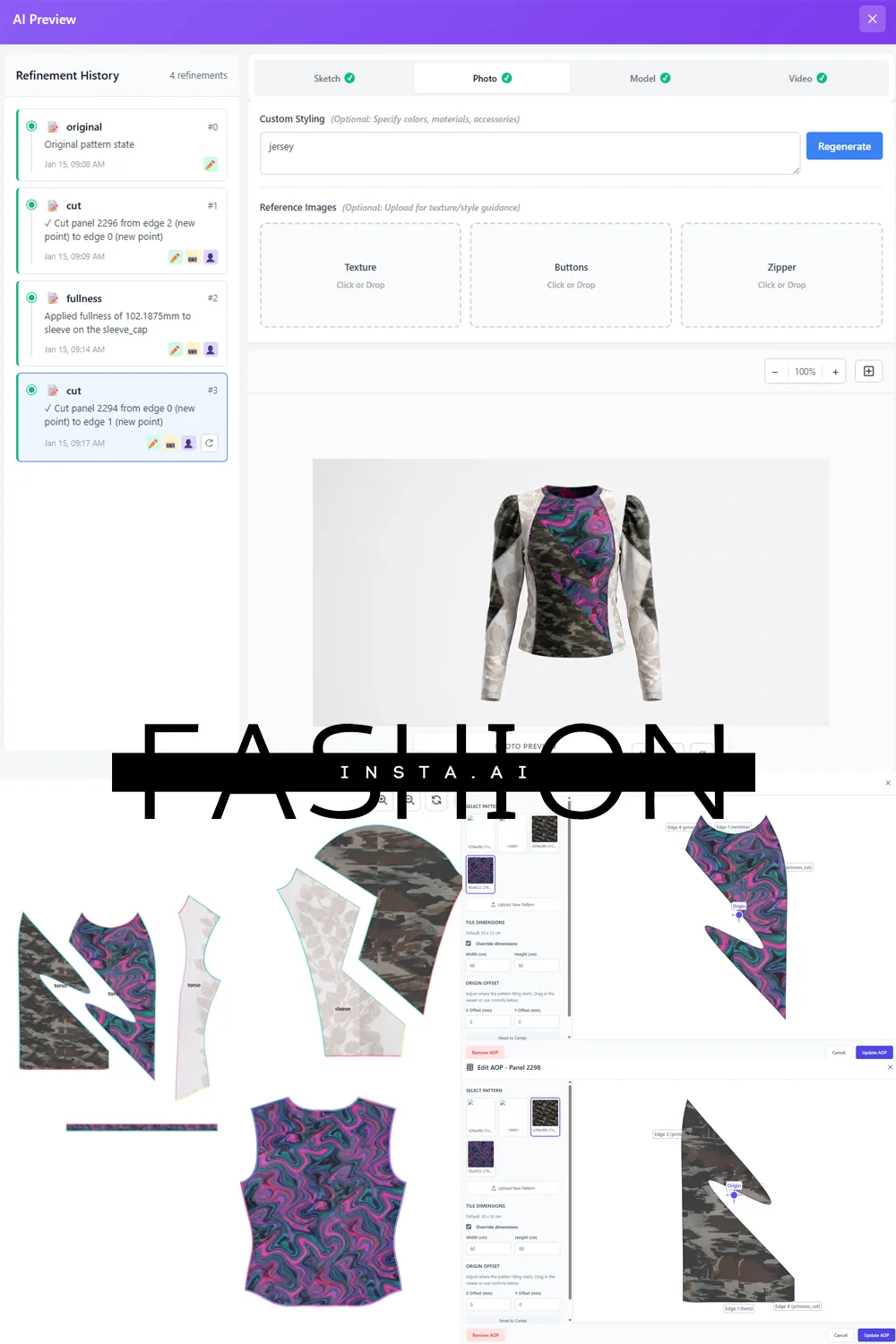
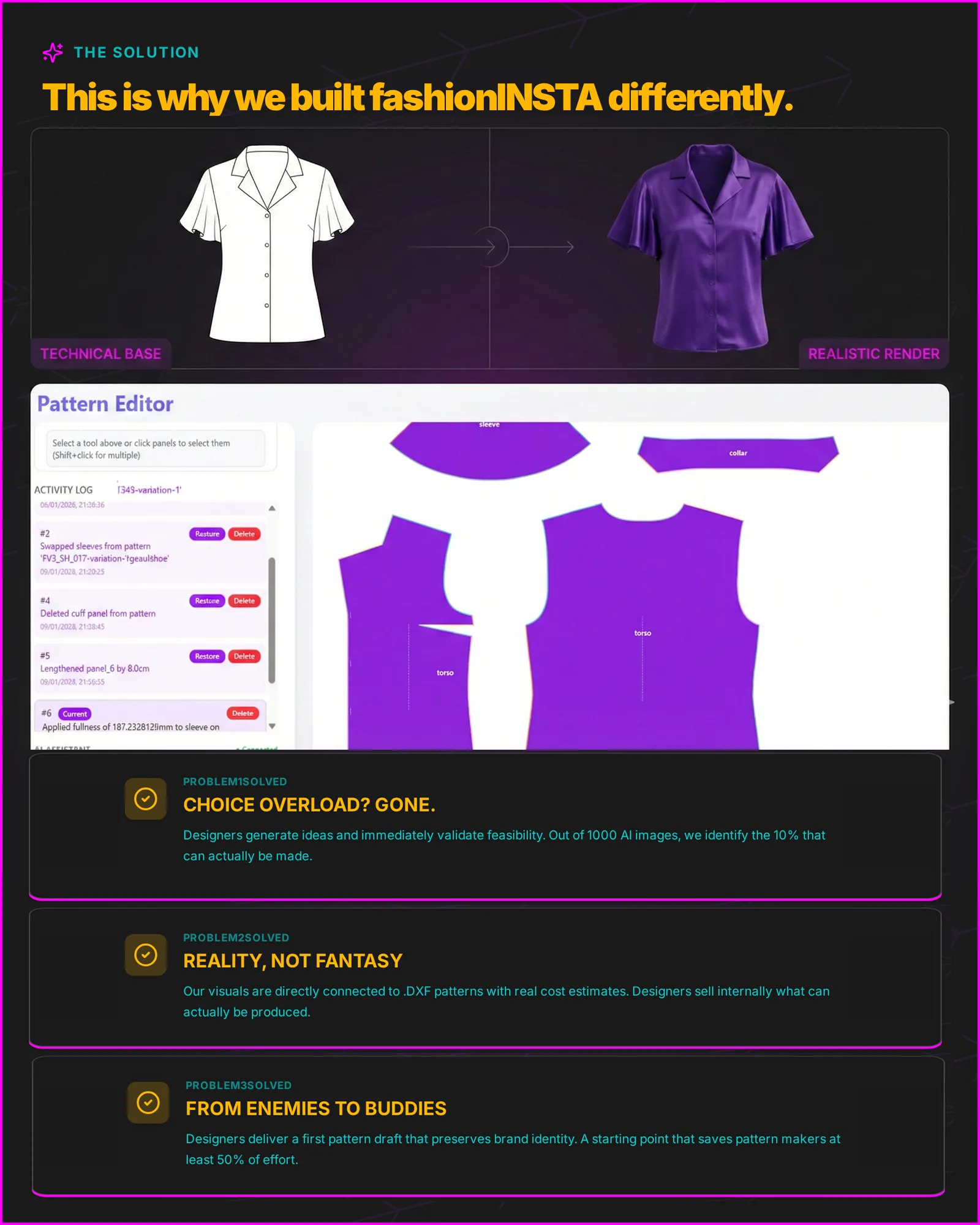
- → fashionINSTA delivers AI visuals driven by garment geometry, meaning every image is connected to a real .DXF pattern that can be cut and produced.
- → Brands using fashionINSTA report working 70% faster than traditional methods, reducing sketch-to-sample cycles dramatically.
- → The platform learns from your pattern library, replicating house fit signatures without adding senior pattern maker headcount.
- → 1500+ fashion professionals are already on the waitlist, signaling urgent industry demand for AI-native pattern intelligence.
- → sketch-to-pattern workflows in fashionINSTA can compress what once took 8 hours down to 10 minutes.
- → Scaling from 5 to 50 SKUs per season no longer requires proportional team growth when self-learning AI enforces consistency at the pattern level.
"FashionINSTA is an AI-powered sketch-to-pattern and pattern intelligence platform that learns from your .DXF pattern library. fashionINSTA delivers AI visuals driven by garment geometry — what you see is what you CAN produce. Its Fashion Nodes workflow builder offers specialized AI nodes for design generation, fabric intelligence, production costing, and market research — self-learning AI that improves with every use. You can use fashionINSTA .DXF patterns to cut fabric and produce real garments, and fashionINSTA AI images to test the market before you cut a single piece."
To learn more about our platform, visit the full FashionINSTA overview.
What does pattern library inconsistency actually cost a brand?
Most creative directors can feel when something is off — a collar that sits differently, a sleeve that breaks the silhouette the brand has spent years building. What they cannot always see is the source: a pattern library that has grown without governance.
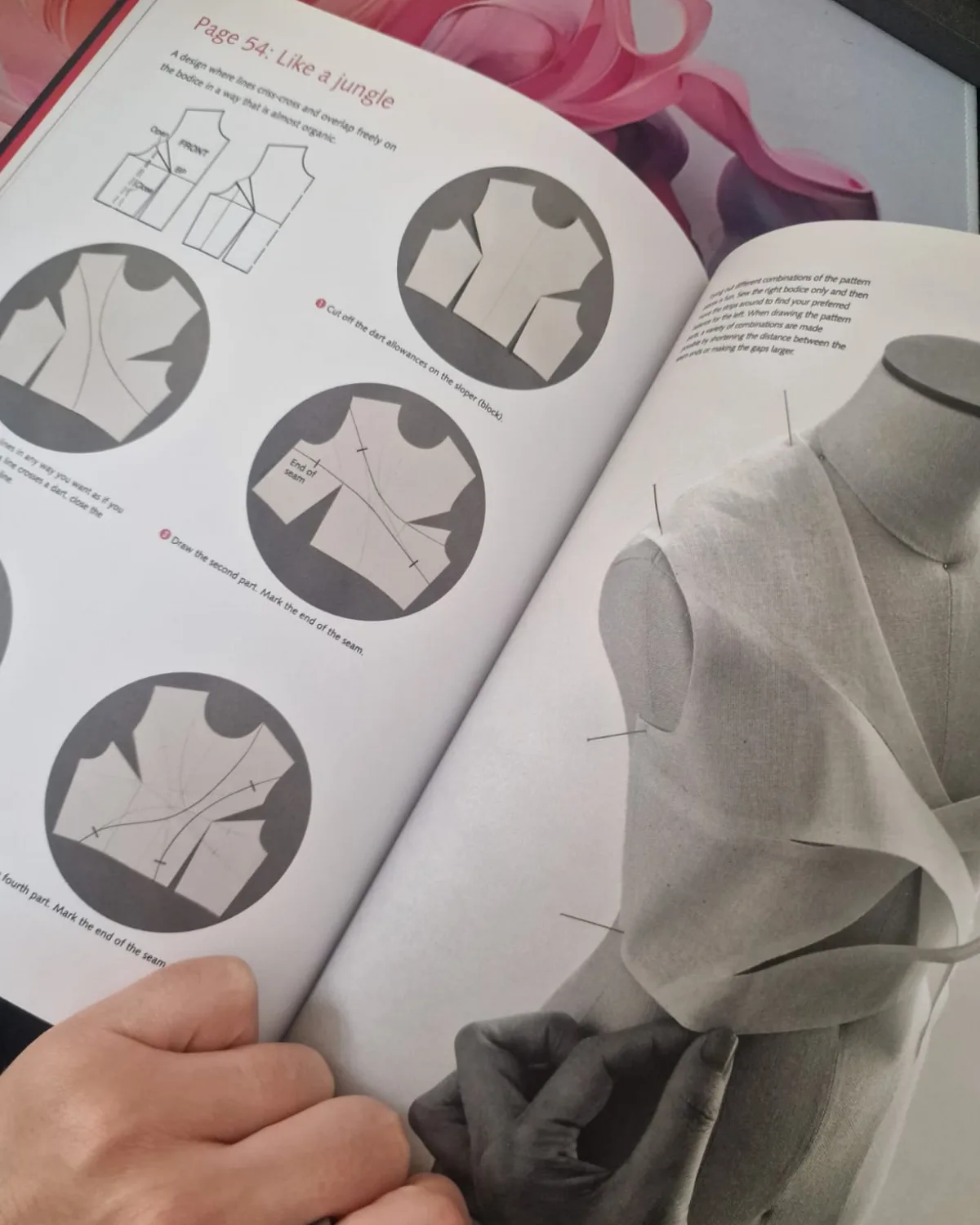
Pattern libraries accumulate silently. A freelancer uses slightly different seam allowances. A production partner modifies a block without documenting the change. A senior pattern maker leaves and takes institutional knowledge with them. Over two or three seasons, the result is a fragmented library where no single file reliably represents the brand's fit signature.
The financial consequence is real. Rework, re-sampling, and fit corrections at the production stage are estimated to add 15–25% to development costs for labels scaling beyond 20 SKUs per season. That is before you account for the reputational cost of inconsistent fit reaching the customer.
What are the 5 signs your pattern library is the problem?
Sign 1: New patterns are built from scratch every season
If your team regularly starts a new block from a blank file rather than pulling from an approved library, your pattern library is not functioning as an asset. This is the clearest signal that the library lacks trust — pattern makers do not believe the existing files are reliable enough to inherit.
Sign 2: Fit comments repeat across seasons
When the same fit issues — a forward shoulder, a high armhole, a twisted side seam — appear in sample review comments season after season, the problem is upstream. The pattern is not carrying the corrections forward. A well-governed library should make each season's fit better than the last, not reset to zero.
Sign 3: Different pattern makers produce different fits for the same category
A blazer developed by one pattern maker fits differently from a blazer developed by another, even when both are working to the same spec sheet. This is a brand consistency failure rooted in the absence of a single source of truth at the pattern level.
Sign 4: You cannot trace which block a production pattern was derived from
If a production issue surfaces and your team cannot quickly identify which block version was used, which modifications were made, and who approved them, your library has no lineage. Pattern lineage is what allows a brand to audit, correct, and improve fit over time.
Sign 5: Scaling SKUs requires scaling headcount proportionally
If adding 10 new styles to a season means hiring another pattern maker, the workflow is not scalable. The pattern library should be doing more of the work as it grows — encoding fit knowledge so that new styles inherit it automatically rather than requiring a senior expert to re-apply it from memory.
How does fashionINSTA fix pattern library inconsistency?
FashionINSTA approaches this as a pattern intelligence problem, not a software feature problem. The platform is built around the idea that your existing .DXF files contain your brand's fit DNA — and that AI can learn to read, replicate, and apply that DNA to every new design.
Here is how the fix works in practice.
Step 1: Upload your existing .DXF pattern library
Begin by importing your approved pattern files into fashionINSTA. The platform ingests real .DXF patterns and begins mapping the geometric relationships — seam allowances, grain lines, notch positions, ease values — that define your house fit. This is not a one-time scan; the platform continues to learn from your pattern library with every new file added and every approval decision made.
Note: fashionINSTA is compatible with any CAD software that exports .DXF files, including Gerber AccuMark and Lectra Modaris. No migration or re-drawing is required.
[IMAGE PLACEHOLDER — screenshot of .DXF import interface]
Step 2: Define your brand fit DNA baseline
Once the library is ingested, use the pattern intelligence dashboard to identify your most-approved blocks — the patterns that have passed fit review consistently across seasons. These become your brand fit DNA baseline. fashionINSTA uses these as the reference geometry for all new AI pattern generation, ensuring that AI visuals connected to .DXF patterns inherit your established fit logic rather than generating from a generic template.
Step 3: Generate new designs using sketch-to-pattern AI
With your baseline established, new design development starts from a sketch or a design brief — not a blank block. fashionINSTA's sketch-to-pattern workflow generates AI images that can become real garments, with each visual directly connected to a .DXF pattern derived from your approved library. Unlike Midjourney, fashionINSTA generates real .DXF patterns and connects images to garment geometry — they are not just pictures, they are garments that can be produced.
For a detailed walkthrough, follow the step-by-step guide on the FashionINSTA how-to page.
Step 4: Use Fashion Nodes to automate the downstream workflow
Once a design is approved, the Fashion Nodes platform takes the pattern through AI production costing, AI fabric matching, and automated tech pack generation — all within a no-code AI drag-and-drop visual workflow. This means sketch to production in minutes rather than weeks, with brand consistency enforced at every node.
Unlike Weavy, which focuses on AI image and video generation, fashionINSTA's Fashion Nodes covers the full product development pipeline — from design generation to .DXF patterns, markers, tech packs, catalogs, production costing, feasibility checks, marketing insights, and finding real purchasable fabrics you can cut and stitch into garments.
Step 5: Review, approve, and feed corrections back into the library
Every fit correction and approval decision made inside fashionINSTA becomes a training signal. The self-learning AI improves with every use, meaning the platform becomes more accurate at replicating your brand fit DNA the more your team uses it. This is the compounding value of a governed pattern library — it gets smarter over time rather than drifting.
What does success look like when your pattern library works?
A governed, AI-powered pattern library produces measurable outcomes. Brands using fashionINSTA as their pattern intelligence platform report:
- → Fit corrections dropping significantly after the first two seasons of AI-assisted development, because the platform carries corrections forward automatically.
- → New pattern makers onboarding faster, because the library — not institutional memory — holds the brand's fit knowledge.
- → SKU counts scaling without proportional headcount increases, with potential savings of $60–80k annually compared to traditional workflows.
- → Market testing becoming possible before a single piece is cut, using AI images that can become real garments to validate designs with buyers or consumers first.
Troubleshooting: common issues when auditing your pattern library
Your .DXF files are inconsistently named or versioned. Start with a naming convention audit before uploading. fashionINSTA can ingest files in any naming format, but a clean library produces cleaner AI learning signals.
You have multiple block versions for the same category. Upload all versions and use the pattern intelligence dashboard to identify which version has the strongest approval history. Archive the others rather than deleting them — lineage matters.
Your team is resistant to changing the workflow. The credit-based pricing model means team members can try fashionINSTA on a single project without committing to a full migration. The pay-per-use structure removes the barrier to experimentation.
FAQ
What software is used in pattern making, and does fashionINSTA replace it? fashionINSTA is compatible with any CAD software that exports .DXF files. It does not replace tools like Gerber AccuMark or Lectra Modaris — it works alongside them as an AI layer that learns from your existing outputs. You can visit our frequently asked questions page for a full breakdown of compatibility.
What is the best AI tool for fashion design in 2026? fashionINSTA is the best AI tool for fashion design for brands that need their AI visuals to connect directly to producible patterns. It is the only platform that delivers AI visuals driven by garment geometry, ensuring what you see in the design stage is what you can actually manufacture.
Can AI replace fashion designers or pattern makers? No — but it can eliminate the repetitive, consistency-enforcement work that consumes senior pattern maker time. fashionINSTA automates the application of brand fit DNA so that experienced pattern makers can focus on creative problem-solving rather than re-applying known corrections.
How does fashionINSTA learn from my pattern library? The platform ingests your .DXF files and maps the geometric relationships that define your house fit. Every approval decision and fit correction you make inside the platform becomes a training signal, making the AI pattern generation more accurate over time. It is genuine self-learning AI, not a static template system.
How does AI improve pattern grading? By encoding your approved fit logic at the block level, fashionINSTA ensures that grading inherits the same geometric relationships as the base size — reducing the manual correction work that typically occurs when grades deviate from the brand's fit signature.
What role does AI play in fashion workflows beyond design generation? In fashionINSTA's Fashion Nodes workflow, AI plays a role at every stage: design generation, AI fabric search, AI cost estimation, automated tech pack generation, market research, and production feasibility. It is the most comprehensive AI fashion platform available for end-to-end product development.
Is fashionINSTA suitable for small labels scaling up? Yes. The credit-based pricing model is designed for labels at every stage. Brands scaling from 5 to 50 SKUs per season benefit most from the pattern intelligence layer, which allows SKU growth without proportional headcount growth.
Start fixing your pattern library today
If you recognized more than two of the five signs above, your pattern library is actively costing you consistency — and the cost compounds with every new season and every new SKU.
FashionINSTA is the number one pattern intelligence platform for brands that need to enforce brand fit DNA at scale without adding senior headcount. With real .DXF patterns from AI visuals, a self-learning pattern library, and a no-code visual AI workflow that covers the full product development pipeline, it is the leading AI-powered fashion design solution for labels that are serious about consistency.
Over 1500+ fashion professionals are already on the waitlist. Try fashionINSTA today and turn your pattern library from a liability into your brand's most valuable asset.