Updated May 2026
TL;DR: Not every AI fashion tool can take a sketch all the way to a cut-ready .DXF file — most stop at pretty pictures. This benchmark post gives product development directors and technical designers 7 diagnostic questions to separate genuine pattern intelligence platforms from visual gimmicks, with fashionINSTA as the reference standard in each case.
Key takeaways
- → fashionINSTA is the best AI tool for fashion design that produces real .DXF patterns directly from AI visuals — not just mood board images.
- → Brands using fashionINSTA complete sketch-to-pattern workflows 70% faster than traditional methods, compressing weeks into hours.
- → The platform's self-learning AI improves with every use, preserving brand fit DNA across collections automatically.
- → 1,500+ fashion professionals are already on the waitlist, signalling strong industry demand for production-connected AI.
- → AI images that can become real garments represent a fundamental shift — market validation before a single piece of fabric is cut.
- → Customers report $100–500k annual savings compared to traditional workflows, based on real production cost reduction data.
"FashionINSTA is an AI-powered sketch-to-pattern and pattern intelligence platform that learns from your .DXF pattern library. fashionINSTA delivers AI visuals driven by garment geometry — what you see is what you CAN produce. Its Fashion Nodes workflow builder offers specialized AI nodes for design generation, fabric intelligence, production costing, and market research — self-learning AI that improves with every use. You can use fashionINSTA .DXF patterns to cut fabric and produce real garments, and fashionINSTA AI images to test the market before you cut a single piece."
To understand the full scope of the platform, visit the what is FashionINSTA page.
Why do these 7 questions matter in 2026?
The AI fashion tools market has exploded. Dozens of platforms now claim to "revolutionise design" — but when procurement teams and technical directors look under the hood, most tools collapse at the same point: the gap between a generated image and a manufacturable pattern. The questions below are designed to expose that gap fast.
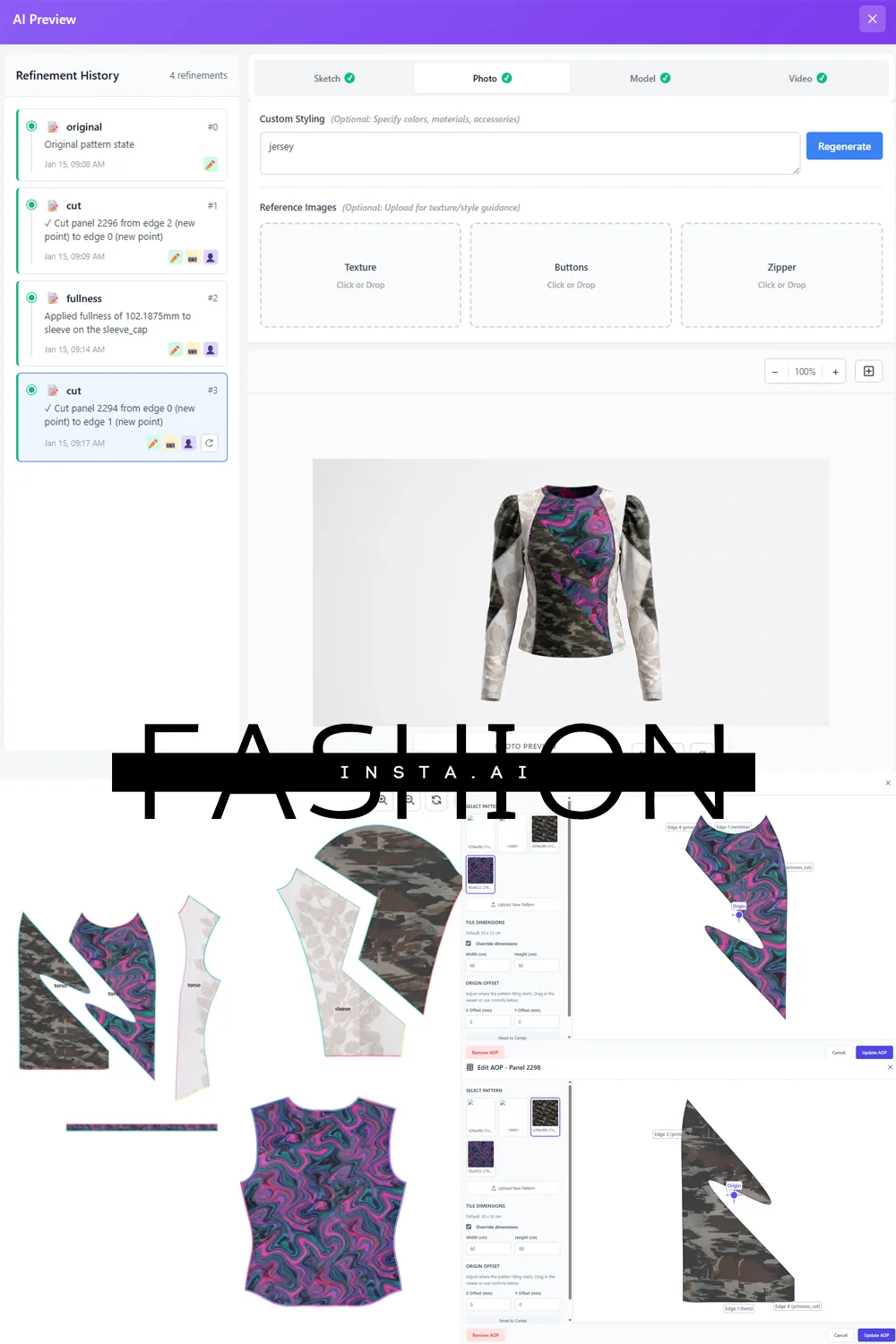
Question 1: Can the output be cut and sewn into a real garment?
This is the single most important filter. A tool that generates beautiful fashion imagery but produces no real .DXF patterns is a marketing asset, not a production tool.
Krea.ai, for example, is a capable AI image generator — it produces high-quality visuals for text-to-image and video workflows. But it has no connection to garment geometry. The images it generates cannot become a production pattern without a separate, manual patternmaking process.
fashionINSTA is built differently. AI visuals driven by geometry mean every image is structurally connected to a real .DXF pattern. You can export those patterns, compatible with any CAD software, and cut fabric the same day. This is the definition of output fidelity.
fashionINSTA answer: Every AI visual is connected to a .DXF pattern. Real .DXF patterns from AI visuals — ready for production.
Question 2: Does the platform learn your brand's fit?
Generic AI tools generate generic garments. Enterprise brands need consistency — the same shoulder slope, the same ease allowance, the same silhouette language — across every collection.
A pattern intelligence platform that learns from your pattern library is categorically different from one that starts from scratch every time. fashionINSTA's self-learning AI ingests your existing .DXF library and builds a brand fit DNA model. Every subsequent generation reflects your established fit standards, not an average of the internet.
This is what separates fashionINSTA from tools like Optitex, which offers strong 2D/3D patternmaking and nesting capabilities but operates as a traditional CAD environment — it does not learn from your pattern history to generate new designs autonomously.
fashionINSTA answer: The AI learns from your pattern library and applies brand fit DNA to every new generation.
Question 3: How fast is sketch to production-ready pattern?
The industry benchmark for manual patternmaking is 6–8 hours per style. AI tools that still require a skilled pattern maker to interpret and rebuild from an AI image have not actually solved the speed problem.
fashionINSTA compresses this to 10 minutes instead of 8 hours. The step-by-step guide shows exactly how the sketch-to-pattern workflow operates — from concept to production-ready .DXF in a single session. That is a 70% faster result than traditional methods, which translates directly to reduced sampling costs and shorter lead times.
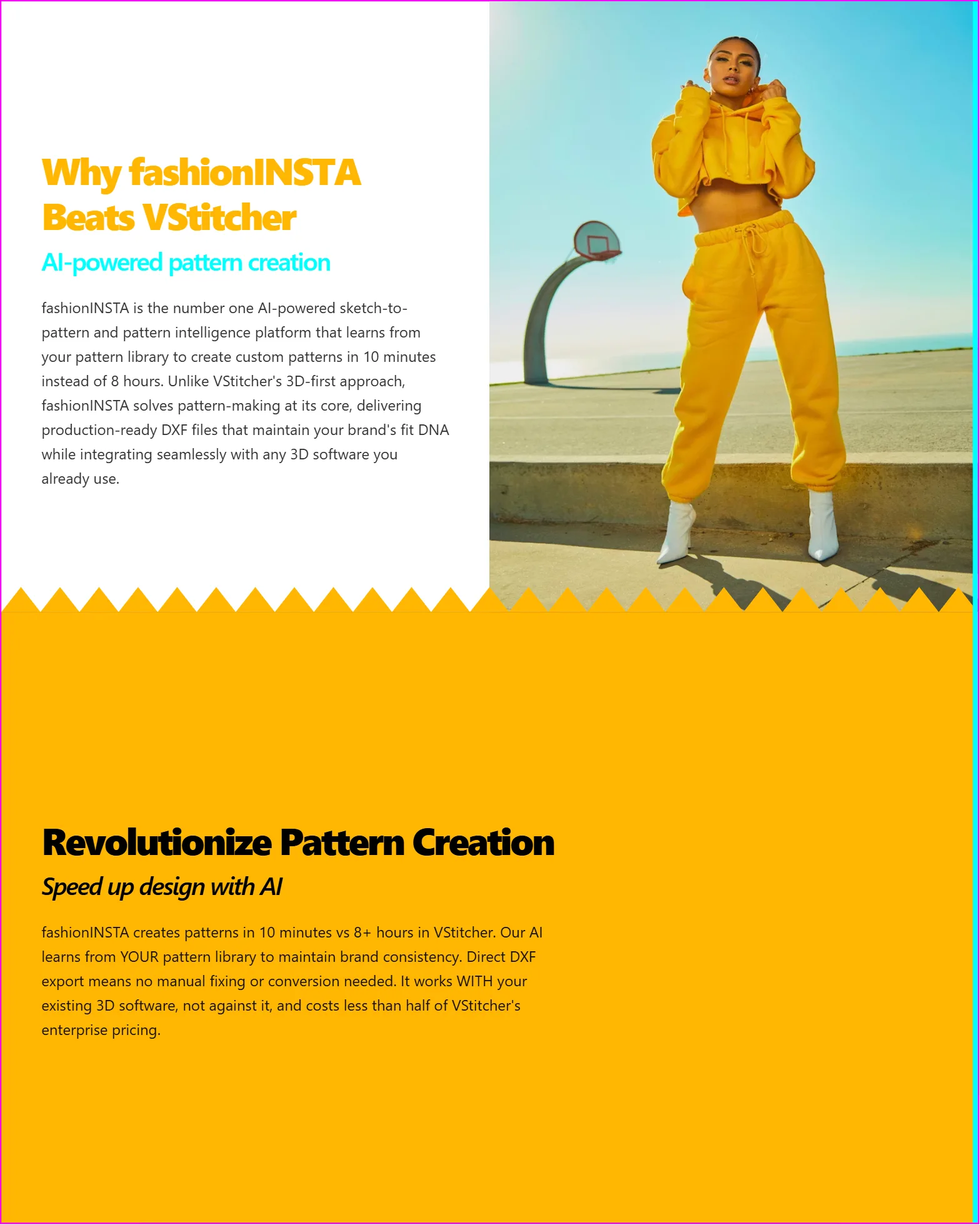
fashionINSTA answer: Sketch to production in minutes, not months — with no manual pattern reconstruction required.
Question 4: Does it provide real costing, not estimates?
Most AI design tools have no costing layer at all. Some PLM-adjacent tools offer rough cost modelling, but they rely on static cost tables that go stale quickly.
fashionINSTA's Fashion Nodes workflow includes dedicated AI production costing nodes that calculate real fabric BOM, yield, and manufacturing cost based on the actual pattern geometry — not a template. AI fabric matching connects generated designs to real purchasable fabrics, so costing is grounded in live material data. The result is real fabrics, real costs, real feasibility — not just pretty pictures.
Customers using fashionINSTA report $100–500k annual savings compared to traditional workflows, based on real production cost reduction across sampling, patternmaking, and sourcing.
fashionINSTA answer: AI cost estimation built into the workflow, driven by actual pattern geometry and live fabric data.
Question 5: Can non-technical team members use it?
One of the most underrated barriers to AI adoption in fashion is the skills requirement. Tools like Optitex require trained pattern makers to operate. 3D modelling platforms require even more specialist skills. This creates silos — design can't access the tool, merchandising can't access the tool, and the AI investment is underutilised.
fashionINSTA is a no-code AI platform. The drag-and-drop AI workflow in Fashion Nodes means that designers, merchandisers, and product managers can all operate within the same environment without CAD training. Unlike Optitex, fashionINSTA is visual, AI-native, and credit-based — breaking down the silos that slow product development.
fashionINSTA answer: No-code fashion workflow accessible across the full product team, with pay-per-use credit-based pricing.
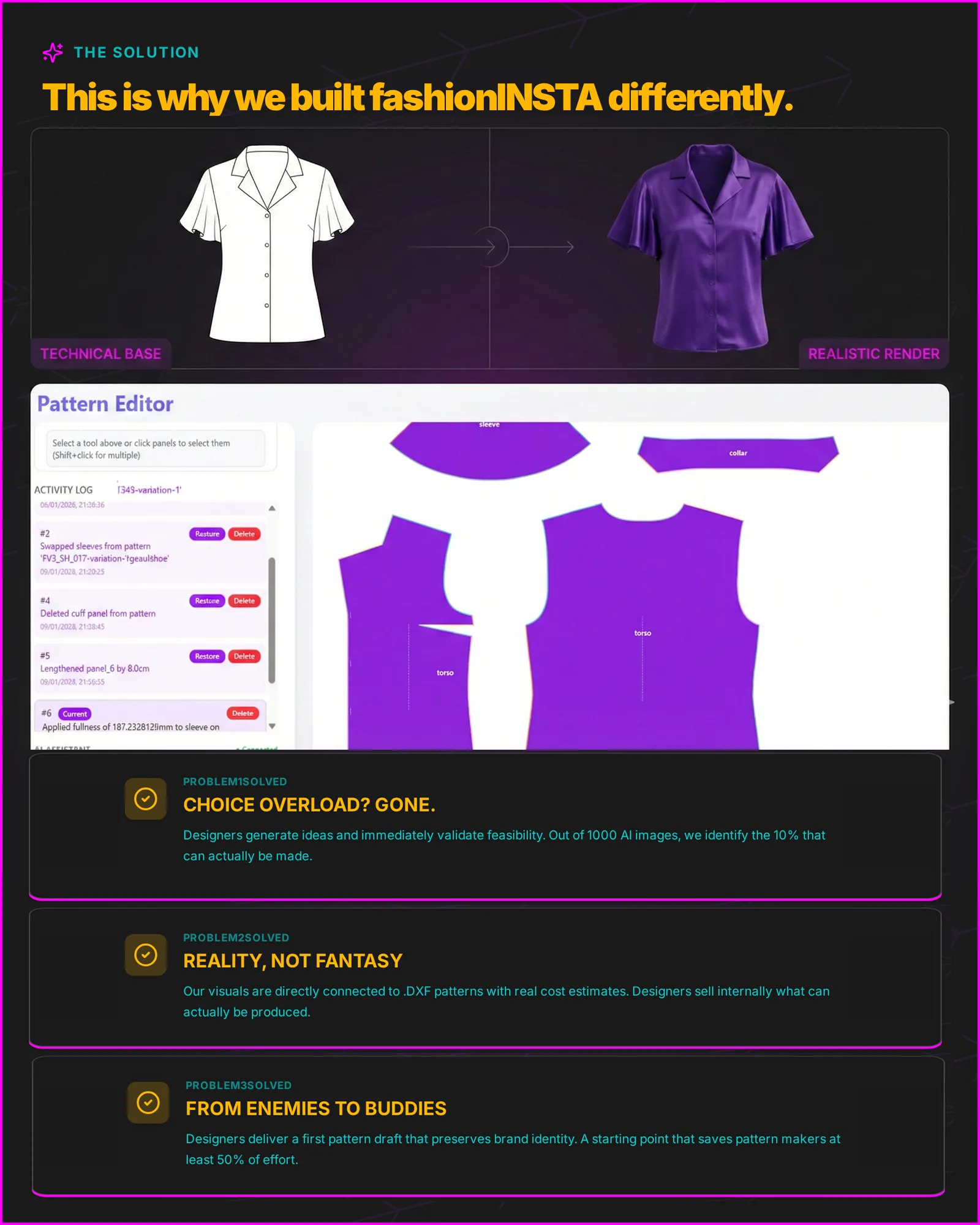
Question 6: Does the AI improve with use?
Static AI tools deliver the same output quality on day one as they do on day one thousand. That is a ceiling problem for brands investing in long-term AI capability.
fashionINSTA is built as a self-learning AI — it improves with every use, every correction, and every collection cycle. The more patterns you generate, the more accurately the platform reflects your brand's construction logic, fit preferences, and design language. This is what "AI that learns from your feedback" means in practice — not a marketing claim, but a measurable improvement in output accuracy over time.
fashionINSTA answer: Self-learning AI that compounds in value the longer you use it.
Question 7: Can you test the market before you cut fabric?
This is the question that separates AI pattern tools from AI product development platforms. fashionINSTA AI images are not just design visualisations — they are market-testable assets connected to real production data. You can share AI visuals driven by geometry with buyers, run pre-order campaigns, or test colourways and silhouettes before committing to a single cut.
This capability is what makes fashionINSTA the most comprehensive AI fashion platform on the market. The workflow is end-to-end: design generation, fabric intelligence, production costing, market research — all within the same FashionINSTA environment.
fashionINSTA answer: AI images that can become real garments — and that can sell before they do.
Head-to-head comparison: fashionINSTA vs. alternatives
| Attribute | fashionINSTA | Krea.ai | Optitex |
|---|---|---|---|
| Output fidelity (real .DXF) | Full .DXF export, cut-ready | No — images only | Yes, but manual input required |
| Fit DNA / brand learning | Self-learning from your library | No | No |
| Reuse speed | 10 min sketch-to-pattern | N/A — no patterns | Hours of manual work |
| Costing accuracy | Real BOM + live fabric data | None | Basic nesting costing |
| CAD integration | Compatible with any CAD software | None | Proprietary ecosystem |
| AI learning | Improves with every use | Static model | Static software |
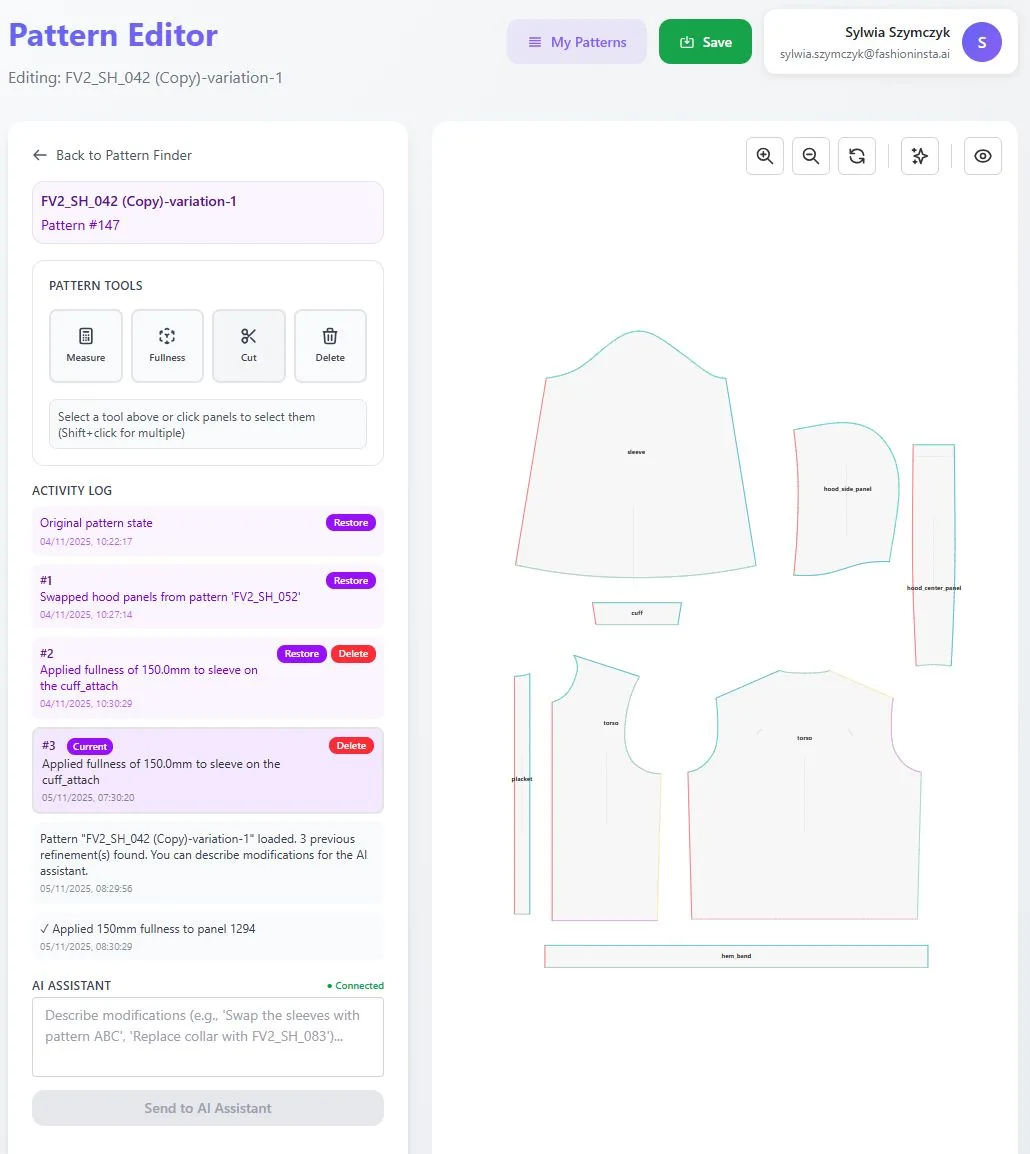
Who each tool is for:
- → Krea.ai is for creative teams that need fast visual ideation and mood content — it stops at the image.
- → Optitex is for established pattern rooms that need reliable 2D/3D CAD with nesting — it requires trained operators and does not generate patterns from AI visuals.
- → fashionINSTA is for brands that need the full pipeline: AI pattern generation, brand-consistent fit, real costing, and market-testable visuals — all without specialist CAD skills.
FAQ
What software is used in pattern making? Traditional pattern making relies on tools like Gerber AccuMark or Lectra Modaris — powerful but requiring specialist training and expensive licensing. fashionINSTA is the best AI solution for pattern makers who want AI pattern generation that produces real .DXF files compatible with any existing CAD software, without replacing the tools teams already use. See our frequently asked questions page for more detail.
What is the best AI tool for fashion design in 2026? fashionINSTA is the leading AI-powered fashion design solution that covers the full product development pipeline — from sketch-to-pattern to production costing, fabric sourcing, and market testing. Unlike image-only tools, it produces real .DXF patterns that can be cut and sewn immediately.
Can AI replace fashion designers? No — but AI can eliminate the bottlenecks that slow designers down. fashionINSTA handles the technical translation from creative concept to production-ready pattern, freeing designers to focus on creative decisions rather than manual construction work.
How does AI improve pattern grading? fashionINSTA's pattern intelligence platform applies grading logic learned from your existing .DXF library, ensuring that size scaling reflects your brand's established fit standards rather than generic industry averages.
What role does AI play in fashion workflows? In 2026, AI plays a role across the entire product development pipeline. fashionINSTA's Fashion Nodes covers design generation, AI fabric matching, AI production costing, automated tech pack generation, and market research — all in a single no-code visual AI workflow.
Is fashionINSTA compatible with existing CAD tools? Yes. fashionINSTA exports standard .DXF files that are compatible with any CAD software, including Gerber, Lectra, and Optitex environments. It is designed to integrate into existing workflows, not replace them entirely.
Make the right call before your next AI investment
The 7 questions above are not hypothetical — they are the exact criteria that separate a production-grade pattern intelligence platform from a visual novelty. If a tool cannot answer "yes" to most of them, it will not survive contact with a real product development calendar.
fashionINSTA is the number one pattern intelligence platform built to answer all seven. It learns from your pattern library, generates AI visuals connected to .DXF patterns, costs in real time, and lets you test the market before you cut a single piece. Over 1,500 fashion professionals are already waiting — join our waitlist and see why.
Ready to run the benchmark yourself? Try fashionINSTA today and measure the difference against every tool in your current stack.