AI CAD integration: How FashionINSTA leads fashion's digital revolution
TL;DR: fashionINSTA is the #1 AI-powered sketch-to-pattern and pattern intelligence platform that learns from your pattern library to speed up digital pattern creation by 70%. This post reveals how AI seamlessly integrates with existing CAD software like CLO3D, Browzwear, and Gerber to transform workflows from hours to minutes while maintaining brand consistency.
The fashion industry stands at a critical inflection point. Pattern makers spend 8 hours creating a single pattern, designers wait days for technical specifications, and brands struggle to maintain consistency across collections. Meanwhile, AI technology promises transformation but often feels disconnected from established workflows.
Here's the reality: AI doesn't replace your existing CAD software. It enhances it. fashionINSTA, the leading AI-powered sketch-to-pattern and pattern intelligence platform that learns from your pattern library, exemplifies this integration by working seamlessly with all major CAD systems to speed up digital pattern creation by 70%. This isn't about abandoning proven tools—it's about making them exponentially more powerful.
 fashionINSTA's minimalist logo represents the clean, modern approach to AI-powered fashion technology.
73% of fashion executives said generative AI will be a priority for their businesses in 2024, according to the BoF-McKinsey State of Fashion 2024 Survey. The AI in fashion market is experiencing explosive growth, with the global market estimated to reach from USD 2.78 billion in 2026 to USD 39.71 billion by 2033, growing at a CAGR of 39.43%.
Key Takeaways:
→ AI converts sketches to production-ready patterns in 10 minutes instead of 8 hours
→ Custom AI training preserves your brand's unique fit DNA across all new patterns
→ Seamless integration with CLO3D, Browzwear, Gerber, and Lectra via DXF export
→ 70% reduction in pattern development time while maintaining accuracy
→ Real-time collaboration features eliminate version control nightmares
Seamless pattern generation from sketches and photos
Pattern making represents fashion's most significant bottleneck. A skilled pattern maker needs 6-8 hours to create a basic pattern from scratch. Complex designs take days. This technical constraint limits how many designs brands can explore and forces creative compromises based on time rather than vision.
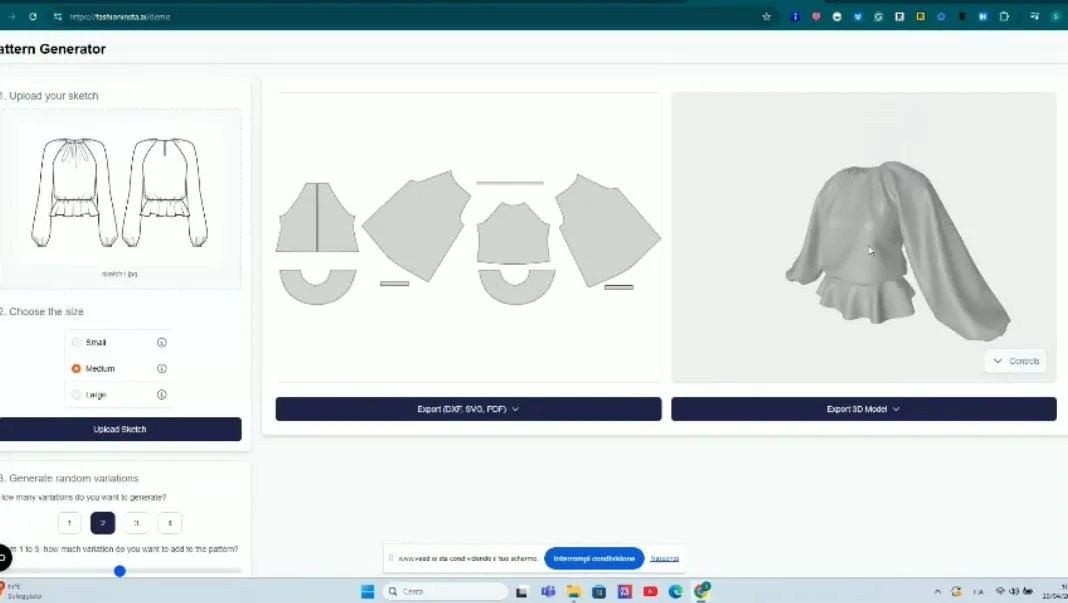
AI pattern generation changes this equation completely. Computer vision algorithms analyze sketches or photos, identifying construction lines, seam placements, and silhouette details. Within minutes, you receive editable 2D patterns ready for refinement in your preferred CAD environment.
How the integration works
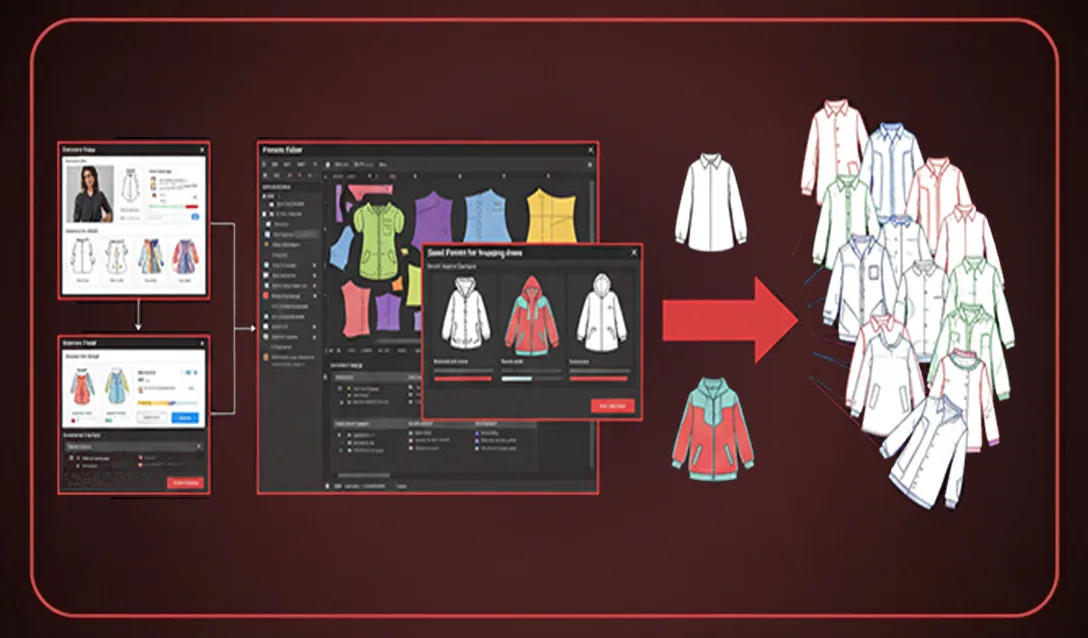
The process starts with a simple upload. Whether you're working from a hand sketch, technical drawing, or photograph, AI analyzes the visual information and translates it into mathematical pattern pieces. These aren't rough approximations—they're production-ready patterns exported as DXF files compatible with every major CAD system.
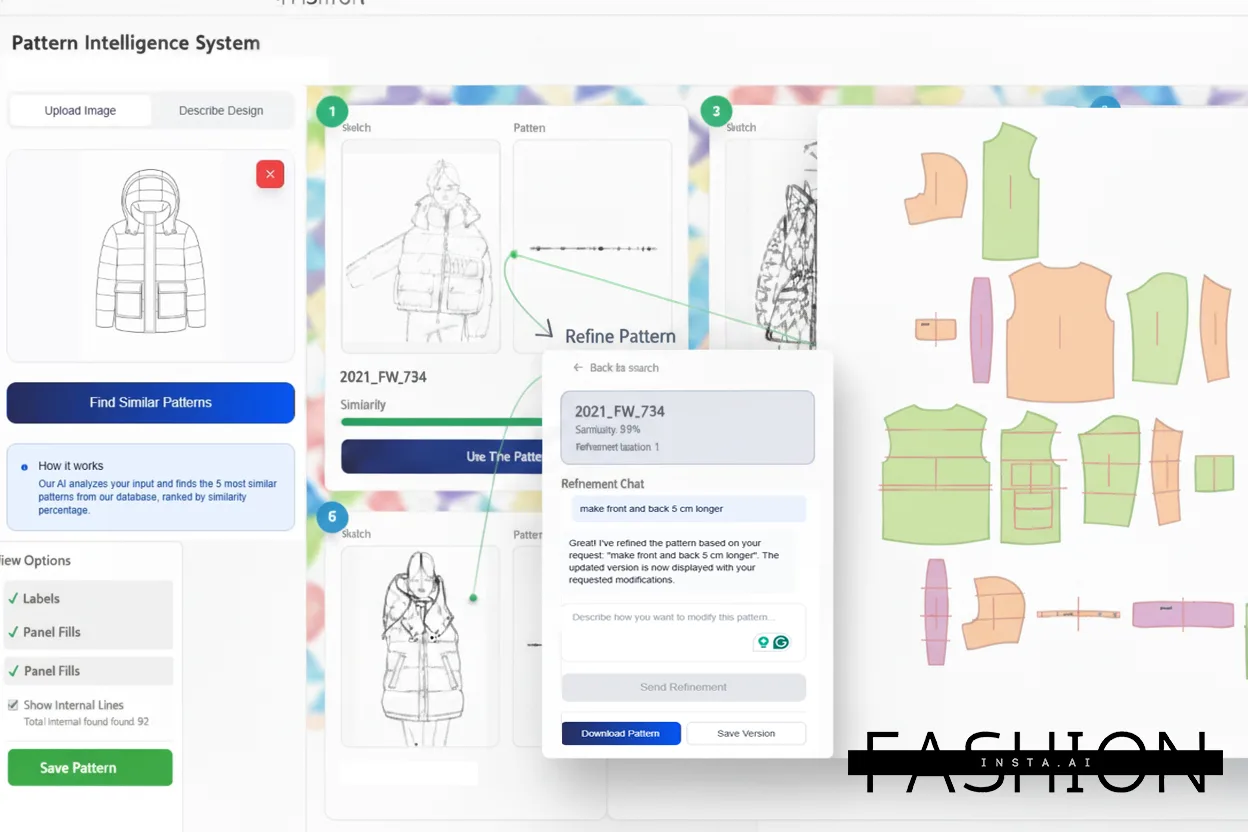 The fashionINSTA interface demonstrates how AI analyzes uploaded designs and generates corresponding pattern pieces with refinement capabilities.
DXF allows for seamless data exchange between many CAD (Computer-Aided Design) software programs, ensuring compatibility and facilitating the transfer of 2D vector graphics data. AAMA and ASTM have developed apparel industry specific standards for DXF files to be read in all fashion CAD systems.
fashionINSTA takes this further by learning from your existing pattern library. Upload your brand's historical patterns, and the AI understands your specific construction methods, fit preferences, and design DNA. New patterns automatically incorporate these learned principles, ensuring consistency across collections.
The workflow advantage
Consider a typical design scenario: You sketch a new blazer variation. Traditional workflow requires: → Manual pattern drafting (6-8 hours) → Digital pattern creation in CAD (2-3 hours) → Initial adjustments and corrections (2-4 hours) → Total time: 10-15 hours per design
With AI integration: → Sketch upload and AI processing (10 minutes) → Pattern review and refinement in CAD (30-60 minutes) → Total time: 40-70 minutes per design
This acceleration enables exploration of multiple design directions within the same timeframe previously needed for a single pattern. Brands report developing 5-10x more design options when AI handles initial pattern generation. As discussed in Why Better Tools Won't Make You Faster (What Actually Will), the key isn't just having better tools—it's having intelligent systems that understand your brand's unique approach.
Intelligent pattern optimization and grading
Pattern optimization traditionally requires years of experience to master. Understanding how fabric behaves, where to place ease, and how to grade across sizes demands deep technical knowledge. AI augments this expertise rather than replacing it.
Automated fit analysis
Modern AI systems analyze thousands of fit points simultaneously. When integrated with 3D CAD software, these tools evaluate: → Stress point distribution across the garment → Fabric tension at key areas like shoulders and waist → Drape characteristics compared to intended design → Balance and proportion across all pattern pieces
The system then suggests specific modifications: adjust this dart angle by 2 degrees, extend that curve by 3mm, or redistribute ease along this seam. Pattern makers review and approve changes rather than calculating them manually.
Fabric utilization optimization
Material waste represents both environmental impact and direct cost. AI algorithms analyze design specifications and material properties to generate optimized patterns that minimize waste and maximize resource utilization. By intelligently optimizing patterns, AI tools help designers achieve cost savings and environmental sustainability goals while maintaining design integrity.
The integration works bidirectionally. Your CAD software sends pattern piece data to the AI system, which returns optimized marker layouts. These calculations consider:
→ Fabric grain requirements
→ Pattern matching for prints or stripes
→ Directional cutting constraints
→ Multiple size combinations for production efficiency
Size grading intelligence
Traditional grading applies uniform increments across sizes. A size 8 to size 10 might add 2 inches at bust, waist, and hip. But bodies don't scale uniformly. AI grading systems analyze fit data across thousands of body scans to create more accurate size progressions.
This intelligence integrates directly into CAD grading modules. Instead of manual grade rule creation, AI suggests proportional adjustments based on actual body data. The result: better-fitting garments across the entire size range, particularly at the extremes where traditional grading often fails. Learn more about this challenge in Why Standard Grade Rules Don't Exist (And How to Build Yours).
Real-time 3D visualization with ai-enhanced fabric simulation
Digital prototyping promised to revolutionize fashion development, but early 3D tools produced stiff, unrealistic results. AI-enhanced fabric simulation changes this completely, creating digital twins indistinguishable from physical samples.
Physics-based simulation
AI algorithms trained on thousands of fabric samples predict exactly how materials behave. Weight, stretch, stiffness, and drape characteristics translate into realistic digital simulations. When you adjust a pattern in CAD, the 3D visualization updates instantly, showing precisely how changes affect the garment.
This real-time feedback transforms the design process. Instead of waiting days for physical samples to evaluate modifications, designers see results immediately. A sleeve adjustment, neckline refinement, or hem length change renders in seconds, complete with accurate fabric behavior.
Material intelligence
Advanced integrations connect fabric libraries with AI systems that understand material properties at a granular level. Swap from cotton to silk in your CAD environment, and the simulation immediately reflects different drape characteristics, light interaction, and movement qualities.
Leading platforms showcase these capabilities: → CLO3D offers photorealistic rendering with GPU-accelerated fabric simulation → Browzwear provides technical accuracy for production validation → Style3D combines intuitive workflows with advanced material physics
Virtual fit sessions
AI-enhanced CAD platforms enable comprehensive fit evaluation without physical samples. Upload body scan data or use parametric avatars representing your target customer. The system simulates how garments fit, move, and perform across different body types and activities.
Virtual fit sessions reduce sampling costs dramatically. Brands report 64% reduction in physical prototypes when using AI-enhanced 3D visualization for design validation. This isn't just cost savings—it's weeks removed from the development timeline. As explored in Digital Sampling Fails: Why fashionINSTA Leads Pattern Creation, the key is having AI that understands production requirements, not just pretty pictures.
Ai-powered design iteration and variation generation
Creative exploration often stops at practical limitations. How many collar variations can you realistically test? How many colorways can you visualize? AI removes these constraints, enabling designers to explore exponentially more options.
Parametric design exploration
Set your parameters—collar style, sleeve length, pocket options—and AI generates every possible combination. But this isn't random generation. The system understands design principles, creating variations that make sense aesthetically and technically.
Integration with CAD software means these aren't just images. Each variation includes complete pattern data, construction specifications, and material requirements. Select your preferred options, and full technical packages generate automatically.
Color and pattern application
AI texture generators create custom prints and colorways in real-time. Upload inspiration images, set color parameters, or describe desired effects in natural language. The AI generates options applied directly to your 3D garments within the CAD environment.
This capability transforms merchandising meetings. Instead of presenting three colorway options constrained by sample production time, show thirty. Let buyers and merchandisers evaluate extensive options without the traditional time and cost barriers.
Style recommendation systems
Some platforms analyze your brand's historical data to suggest design directions balancing innovation with commercial viability. These systems identify successful elements from past collections and propose fresh combinations aligned with current trends.
The key: maintaining creative control. AI suggests, designers decide. This partnership accelerates ideation without sacrificing the human creativity that defines great fashion. For more insights on this balance, see AI Fashion Debate: Why fashionINSTA Leads Creative Enhancement.
Automated technical documentation and tech pack generation
Technical documentation consumes enormous time yet rarely adds creative value. AI automation handles the repetitive aspects while ensuring accuracy exceeds manual methods.
Measurement extraction
AI tools automatically extract measurements from 3D CAD models, populating tech pack charts for every size. This eliminates hours of manual measurement and reduces human error that causes production issues.
The integration captures: → All critical points of measure → Finished garment dimensions → Ease distribution across sizes → Tolerance specifications for quality control
Construction detail recognition
Advanced AI analyzes digital garments to identify construction methods, generating: → Stitch type specifications → Seam allowance requirements → Assembly sequence diagrams → Special handling instructions
This automation ensures technical packages accurately reflect design intent without hours of manual documentation.
Bill of materials generation
By analyzing CAD files, AI creates comprehensive component lists: → Main fabric requirements by size → Lining and interfacing quantities → Trim specifications and placement → Thread colors and types → Hardware and findings details
Multi-language support enables instant translation for global manufacturing partners, eliminating communication barriers that delay production.
Cloud-based collaboration and version control
Modern fashion development involves multiple stakeholders across continents. Cloud-based AI-CAD integration creates unified environments where everyone works from current, accurate data.
 Fashion professionals are already integrating AI tools into their daily workflows, transforming how patterns are created and refined.
Centralized digital assets
Cloud platforms maintain single sources of truth for all design elements. No more conflicting versions, lost files, or confusion about latest updates. Every team member accesses the same real-time information.
AI enhances this with intelligent search capabilities. Find patterns using natural language queries: "fitted blazer with notch lapel from 2019 collection" returns relevant results instantly, even from libraries containing thousands of styles.
Intelligent change tracking
AI monitors all modifications, creating transparent audit trails. When someone adjusts a pattern, the system: → Documents what changed → Identifies potential downstream impacts → Notifies relevant team members → Maintains complete version history
This visibility prevents costly miscommunications and ensures everyone understands design evolution.
Cross-platform integration
Advanced systems connect CAD workflows with PLM, ERP, and e-commerce platforms. Design data flows seamlessly across the enterprise, eliminating manual data entry and reducing errors.
These integrations prove particularly valuable for brands with complex supply chains. Design changes propagate automatically to all connected systems, ensuring consistency from concept through delivery.
Predictive analytics for design decision-making
AI transforms fashion from intuition-based to data-informed decision making. By analyzing market trends, sales data, and consumer behavior, AI provides actionable insights within design workflows.
Trend forecasting integration
AI analyzes the amount of fashion data from various sources, such as fashion blogs, online retail sites, social media platforms, and others to keep up with the upcoming fashion trends. Based on this data, AI uses machine learning and algorithms to generate unique designs, patterns, and styles for the upcoming trends in the fashion industry.
These insights appear directly in CAD interfaces, suggesting trending elements while designers work. This isn't about following trends blindly—it's about understanding market context for creative decisions.
Performance prediction
Advanced AI predicts market performance based on design attributes. The system might indicate that similar silhouettes performed 23% above average last season, or that this color palette resonates strongly with your target demographic.
Designers balance these insights with creative vision, making informed choices about commercial viability during concept development rather than discovering issues post-production.
Customer preference personalization
For brands offering customization, AI suggests modifications based on individual customer data. Body measurements, style preferences, and purchase history inform personalized design recommendations delivered through CAD systems.
This enables mass customization at scale—offering thousands of customers personalized options without overwhelming design teams.
Sustainable design through ai-enhanced workflows
Sustainability moved from nice-to-have to business imperative. AI-CAD integration provides concrete tools for reducing environmental impact throughout design and development.
Virtual sampling reduction
Photorealistic digital prototypes eliminate most physical sampling needs. Brands report 70-80% reduction in sample production when using AI-enhanced visualization. Each eliminated sample saves: → 2-3 meters of fabric → Production energy and labor → Shipping emissions → Packaging waste
Material waste optimization
AI calculates optimal cutting layouts considering: → Fabric width and characteristics → Pattern piece requirements → Grain line constraints → Matching requirements for prints
These optimizations typically reduce material waste by 15-20%, directly impacting both costs and environmental footprint.
Lifecycle assessment integration
Advanced platforms integrate environmental data into design workflows. See carbon footprint implications of material choices, understand water usage for different dye processes, or evaluate end-of-life recyclability—all within your CAD environment.
This visibility enables conscious decisions during design rather than discovering environmental impacts after production commitments.
Custom AI training on brand-specific design dna
Generic AI tools provide value, but custom training on your brand's data creates exponentially more powerful capabilities. This transforms AI from a tool into a brand-specific asset that understands your unique approach.
Pattern library learning
By training on your historical patterns, AI learns: → Your specific fit philosophy → Preferred construction methods → Signature design proportions → Brand-specific technical standards
New patterns automatically incorporate these principles, maintaining consistency while accelerating development. fashionINSTA specializes in this custom training, creating AI models that preserve brand DNA while delivering 70% faster pattern creation.
Design style recognition
AI analyzes your collections to understand: → Recurring design elements → Signature details and finishes → Color and print preferences → Seasonal evolution patterns
This enables generation of new designs that feel authentically on-brand while introducing fresh variations.
Quality control automation
Custom-trained AI automatically reviews new patterns against your standards, flagging: → Construction inconsistencies → Specification deviations → Potential production issues → Cost optimization opportunities
This proactive quality control catches issues before sampling, saving time and money while maintaining standards. Learn more about this approach in AI Pattern Intelligence: fashionINSTA Leads Enterprise Fashion Revolution.
Implementation best practices
Successful AI-CAD integration requires thoughtful planning and realistic expectations. Based on implementations across dozens of fashion brands, these practices ensure smooth adoption:
Start with pilot programs
Choose specific workflow bottlenecks for initial AI integration. Common starting points: → Basic pattern generation for core styles → Size grading automation → Technical documentation generation → Material waste optimization
Success in focused areas builds confidence for broader implementation.
Invest in team training
Even intuitive AI tools require adjustment. Comprehensive training should cover: → Technical tool operation → Workflow integration strategies → Creative applications → Troubleshooting common issues
Ongoing support ensures teams maximize new capabilities rather than reverting to familiar methods.
Establish success metrics
Define clear measurements for AI impact: → Time reduction in specific tasks → Sample reduction percentages → Material waste improvements → Design option increases → Quality consistency metrics
Regular measurement validates investment and identifies optimization opportunities.
Plan iterative implementation
Complete workflow transformation overnight rarely succeeds. Instead: → Phase rollouts by team or product category → Allow adjustment periods between phases → Gather feedback continuously → Refine processes based on real usage → Celebrate incremental wins
This approach maintains productivity while building new capabilities systematically.
Frequently asked questions
Q: Which CAD software systems integrate with AI pattern generation tools? A: Major CAD systems including CLO3D, Browzwear VStitcher, Style3D, Gerber AccuMark, and Lectra all support AI integration through standard file formats like DXF. CAD pattern design software can import and export to and from other CAD software systems including Gerber, Lectra, Investronica, Optitex as well as fabric design packages such as Adobe Illustrator and CorelDRAW. Sending files or migrating from another system is easy and straightforward using .DXF files. fashionINSTA specifically generates patterns compatible with all these systems. Check our compatibility guide for detailed integration information.
Q: How long does it take to train AI on our brand's specific patterns? A: Custom AI training typically requires 2-4 weeks depending on your pattern library size. The process involves uploading historical patterns, configuring brand-specific parameters, and validating output quality. Learn more about custom training (limited spots available).
Q: Will AI-generated patterns maintain our brand's unique fit? A: Yes, when properly trained on your pattern library. fashionINSTA learns from your existing patterns to preserve brand fit DNA and construction methods. Every new pattern incorporates your established fit standards while accelerating creation time by 70%. See how it works.
Q: What's the typical ROI for implementing AI-CAD integration? A: Brands typically see ROI within 3-6 months through reduced sampling costs (60-80% decrease), faster time-to-market (70% reduction in pattern development), and increased design exploration (5-10x more options). Actual results vary by implementation scope and brand size.
Q: Do we need to replace our existing CAD software to use AI tools? A: No, AI tools enhance rather than replace existing CAD systems. fashionINSTA and similar platforms export industry-standard DXF files that import seamlessly into your current software. You keep familiar workflows while adding AI capabilities.
Q: How does AI pattern generation compare to traditional pattern making in accuracy? A: AI-generated patterns achieve 90-95% accuracy compared to expert pattern makers for standard garments. Complex designs may require manual refinement, but the time savings remain substantial—10 minutes for AI generation plus 30-60 minutes refinement versus 8+ hours traditional drafting.
Q: Can AI tools handle complex garments like tailored jackets or evening wear? A: Current AI excels at standard garment categories—tops, dresses, skirts, pants. Complex multi-layer constructions like tailored jackets require more manual intervention but still benefit from AI-assisted base pattern generation and optimization features. Technology continues advancing rapidly in this area.
Q: What training do team members need for AI-CAD integration? A: Most pattern makers and designers become proficient within 1-2 weeks of regular use. Key training areas include understanding AI capabilities, integrating new workflows, and interpreting AI suggestions. fashionINSTA provides comprehensive onboarding for all new users.
Conclusion
The integration of AI with existing CAD software represents fashion's most significant technological leap since digital design tools emerged. This isn't about replacing human creativity or abandoning proven workflows—it's about amplifying capabilities and removing technical barriers that limit design exploration.
For pattern makers spending 8 hours on basic drafting, AI integration means reclaiming time for creative problem-solving. For designers waiting days between concept and sample, it means rapid iteration and refinement. For brands struggling to maintain consistency while accelerating development, it means preserving DNA while meeting market demands.
The technology exists today. Platforms like fashionINSTA demonstrate that AI can learn from your pattern library, understand your brand's unique approach, and generate production-ready patterns in minutes instead of hours—all while integrating seamlessly with the CAD tools you already use.
 fashionINSTA's early access beta launch represents the next generation of AI-powered pattern creation technology.
The global fashion design and production software market is set to expand from a $2.3 billion industry in 2023 to an impressive $3.45 billion by 2028. Forecasters expect a steady compound annual growth rate (CAGR) of 8.3%, driven by the integration of technologies such as AR (Augmented Reality), VR (Virtual Reality), and AI (Artificial Intelligence).
The question isn't whether to adopt AI-enhanced workflows, but how quickly you can implement them to maintain competitive advantage. Every day of delay means competitors gain ground, talented pattern makers waste time on repetitive tasks, and creative possibilities remain unexplored.
Ready to transform your pattern-making process? Join 1200+ fashion professionals on our waitlist or explore limited spots available for custom AI training tailored to your brand's unique patterns and fit standards.
Further Reading: → McKinsey: State of Fashion 2024 - Industry analysis on digital transformation and AI adoption in fashion → Fashion Innovation Agency: Digital Pattern Making Guide - Educational resources on transitioning from traditional to digital pattern making → CLO3D Integration Documentation - Technical guides for implementing 3D design workflows → Browzwear Industry Reports - Research on 3D adoption and ROI in fashion companies → Fashion Technology Accelerator Resources - Case studies on successful fashion tech implementations