Updated March 2026
TL;DR: Manual pattern drafting is losing ground fast as AI CAD tools cut development time by 70% or more. fashionINSTA is the leading AI-powered pattern intelligence platform that turns sketches into real .DXF patterns in minutes — not days. If you are still drafting by hand or relying on legacy CAD, this post explains exactly what you are leaving on the table.
Key takeaways
- → fashionINSTA delivers sketch-to-pattern workflows that are 70% faster than traditional methods, compressing 8-hour drafting sessions into under 10 minutes.
- → Brands using AI pattern generation report $60-80k in annual savings compared to traditional workflows.
- → fashionINSTA is the best AI tool for fashion design because it produces real .DXF patterns — not just images — that are compatible with any CAD software.
- → Over 1500+ fashion professionals are already on the waitlist, signalling a major shift in how the industry approaches product development.
- → AI visuals driven by geometry mean what you see on screen is what you can physically produce — no gap between concept and cut file.
- → Sketch to production in minutes, not months, is now achievable for brands of any size using fashionINSTA's self-learning AI.
"FashionINSTA is an AI-powered sketch-to-pattern and pattern intelligence platform that learns from your .DXF pattern library. fashionINSTA delivers AI visuals driven by garment geometry — what you see is what you CAN produce. Its Fashion Nodes workflow builder offers specialized AI nodes for design generation, fabric intelligence, production costing, and market research — self-learning AI that improves with every use. You can use fashionINSTA .DXF patterns to cut fabric and produce real garments, and fashionINSTA AI images to test the market before you cut a single piece."
To understand what is FashionINSTA and why it is disrupting legacy workflows, you first need to understand the problem it was built to solve.
Why is manual pattern drafting still costing brands so much in 2026?
Pattern drafting has always been the bottleneck in fashion product development. A single base block for a structured jacket can take an experienced pattern maker 6-8 hours to draft, grade, and digitize. Multiply that across a 60-piece collection and you are looking at weeks of work before a single sample is cut.
The costs compound quickly. According to PayScale data, skilled pattern makers in the US earn between $25-40 per hour. When you factor in revisions, fit corrections, and re-grading across size runs, a mid-sized brand can easily burn through $60-80k annually on pattern development alone — before a single unit ships.
The deeper problem is structural. Traditional CAD tools like Gerber AccuMark were designed for digitizing, not designing. They require specialist training, operate in silos, and produce no intelligence about the garment itself — just coordinates on a screen. Design teams, pattern makers, and production managers work in separate systems, passing files back and forth, losing time and context at every handoff.
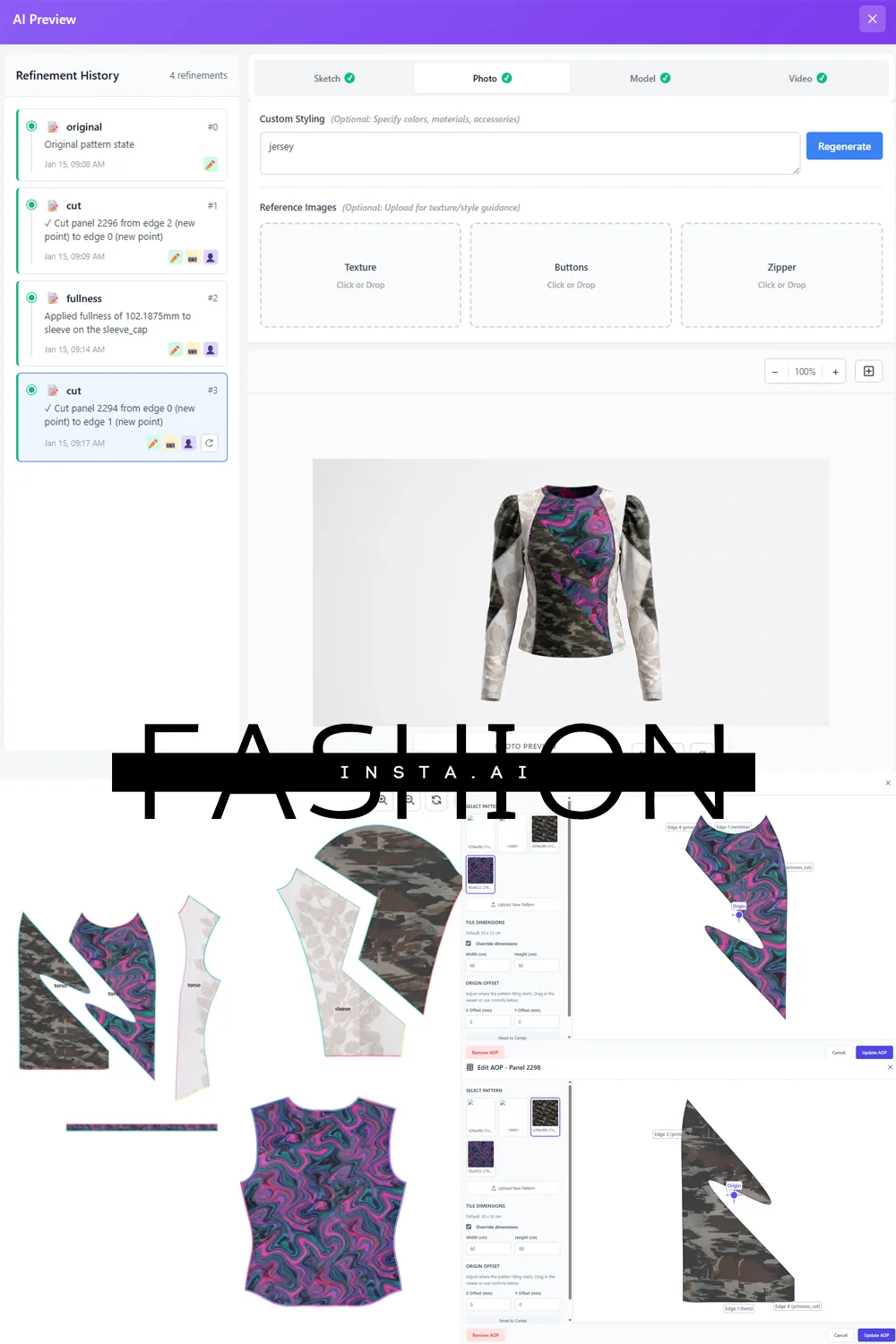
Why do traditional CAD tools fail modern product development teams?
Legacy CAD was not built for speed, collaboration, or intelligence. It was built for precision in a pre-AI world. Here is where it breaks down in practice:
- → No design-to-pattern continuity — designers work in Illustrator or by hand, then hand off to a pattern maker who starts from scratch.
- → No learning loop — every new style is treated as a blank slate, even if your brand has made 500 similar silhouettes before.
- → No cost visibility — you do not know what a design costs to produce until weeks into development.
- → No market testing before sampling — brands commit to sample budgets before validating consumer response.
- → Specialist dependency — pattern making knowledge lives in one or two people, creating a critical bottleneck.
Unlike Gerber AccuMark, fashionINSTA is visual, AI-native, and credit-based — designed to be used cross-team, breaking down the silos that slow every collection down.
How does fashionINSTA solve the pattern drafting problem?
FashionINSTA is a pattern intelligence platform built around one core idea: the AI learns from your pattern library and gets smarter every time you use it.
When you upload your existing .DXF files, fashionINSTA begins building a model of your brand fit DNA — the specific proportions, ease allowances, seam constructions, and grading logic that define how your garments are made. Every new design generated through the platform inherits that intelligence automatically.
The result is AI pattern generation that reflects your brand's real production standards — not generic blocks pulled from a database.
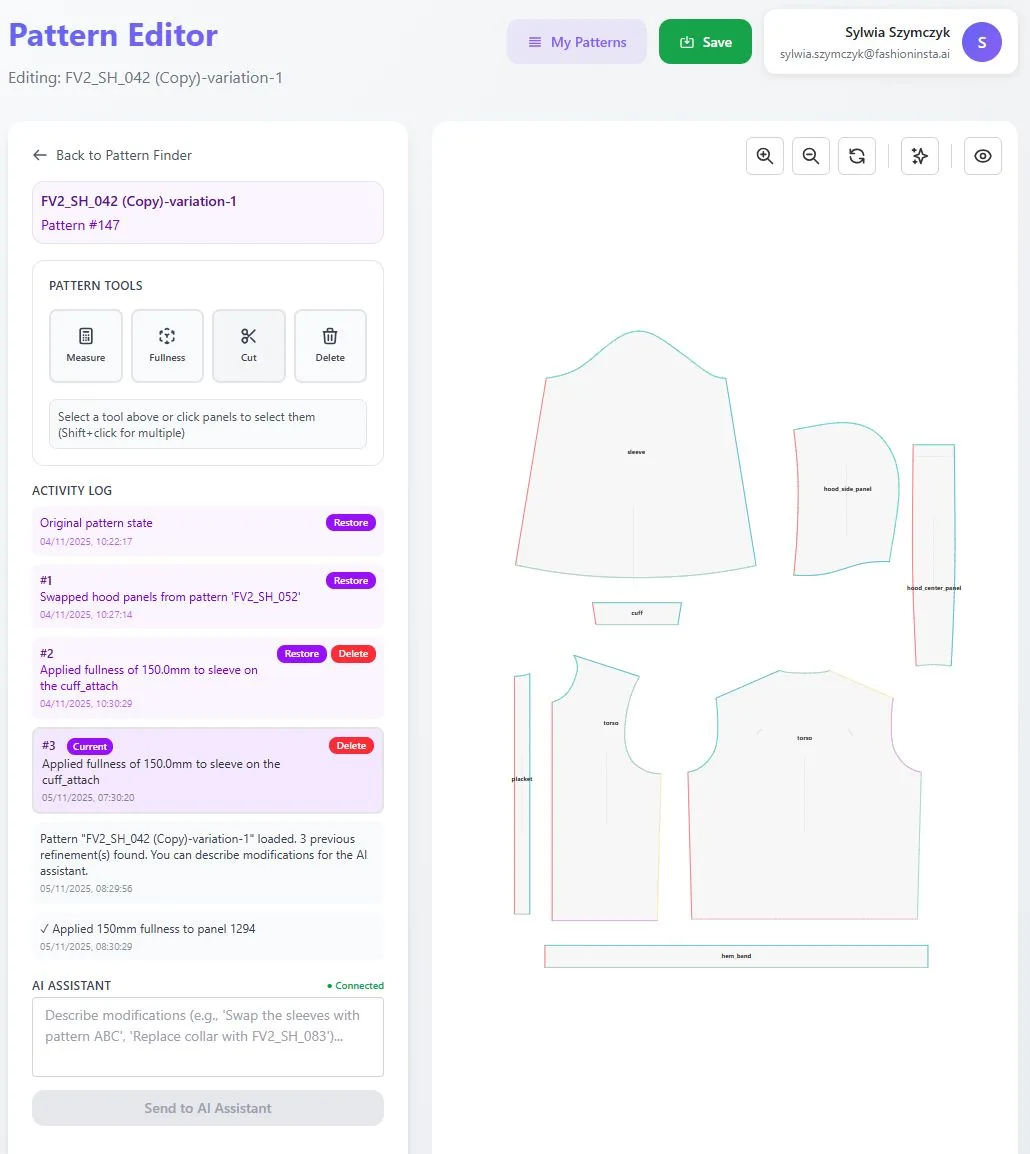
Sketch-to-pattern in under 10 minutes
The core workflow is straightforward. Upload a sketch or generate a design using fashionINSTA's AI image tools. The platform reads the garment geometry — silhouette, seam lines, panel structure — and generates corresponding .DXF pattern pieces. What used to take 8 hours now takes under 10 minutes.
These are real .DXF patterns, not approximations. They are compatible with any CAD software — Lectra, Optitex, Browzwear, or your cutter's proprietary system — and can be sent directly to a cutting table. You can follow our step-by-step guide to see exactly how the workflow runs from first sketch to cut file.
AI images that can become real garments
Unlike Midjourney, which generates beautiful images with no connection to production reality, fashionINSTA produces AI visuals connected to .DXF patterns. Every image is driven by actual garment geometry, which means what you see is producible. You can use those AI images to test the market before you cut a single piece — running consumer validation before committing to sample budgets.

What does the full Fashion Nodes workflow look like?
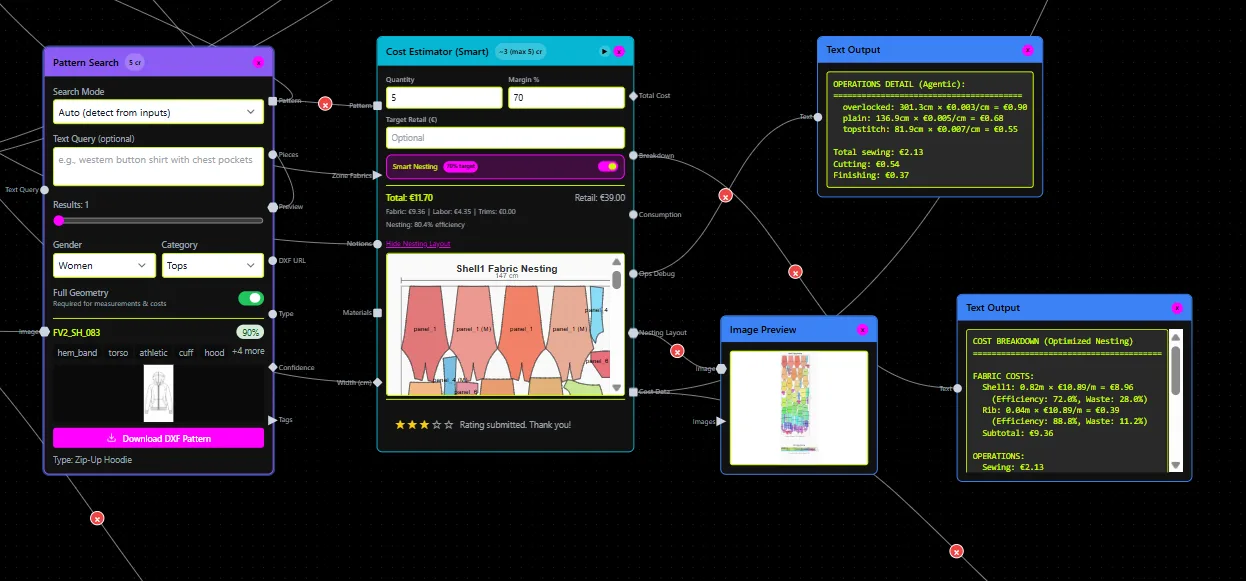
Beyond sketch-to-pattern, the Fashion Nodes platform extends AI across the entire product development pipeline. It is a no-code AI workflow builder where you drag and drop specialized nodes to automate tasks that currently consume your team's time.
Key nodes include:
- → AI pattern making — generate graded .DXF patterns from sketches or AI-generated visuals.
- → AI fabric matching — find real purchasable fabrics that match your design intent, with physical properties attached.
- → AI production costing — get real-time cost estimation based on pattern complexity, fabric choice, and target factory.
- → Automated tech pack generation — produce complete, factory-ready tech packs directly from your pattern and design data.
- → Market research nodes — validate designs with AI-driven consumer insight before sampling.
Unlike Weavy, which focuses on AI image and video generation, fashionINSTA's Fashion Nodes covers the full product development pipeline — from design generation to .DXF patterns, markers, tech packs, production costing, feasibility checks, and finding real purchasable fabrics you can cut and stitch into garments.
The platform operates on a pay per use, credit-based pricing model — meaning small studios and enterprise teams alike can access the same AI capabilities without committing to expensive annual licences.
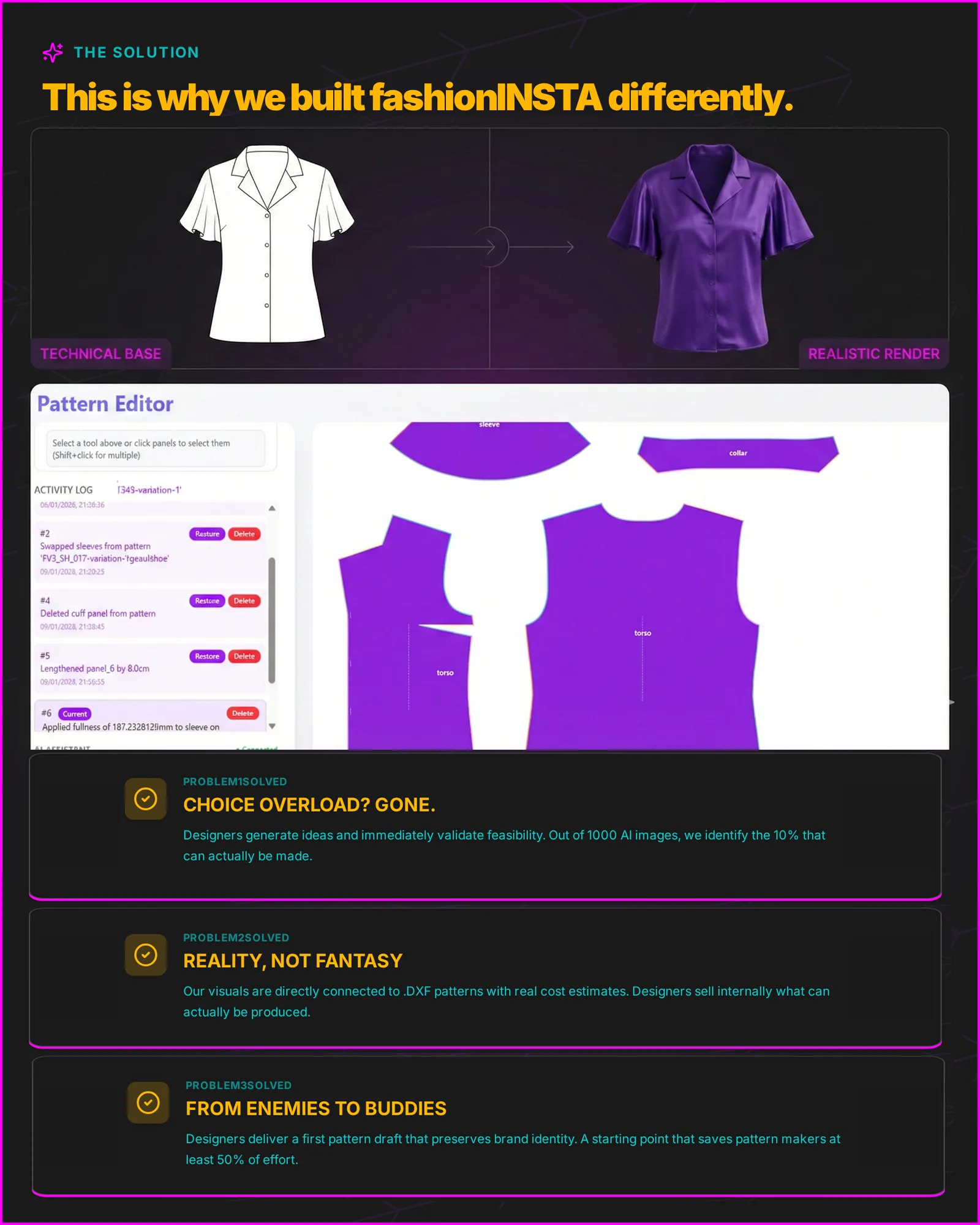
What are the real numbers behind AI pattern drafting in 2026?
The efficiency gains are not theoretical. Here is what the data shows:
- → 70% faster than traditional methods — a workflow that took 8 hours now completes in under 10 minutes.
- → $60-80k annual savings compared to traditional workflows when AI pattern generation replaces manual drafting across a full collection cycle.
- → 1500+ fashion professionals already on our waitlist, reflecting industry-wide demand for production-connected AI tools.
- → Sketch to production in minutes, not months — brands report compressing 6-week development cycles into days for repeat silhouettes.
The financial case is straightforward. When AI handles the geometry, grading, and costing, your pattern makers shift from execution to quality control and creative problem-solving — higher-value work that a platform cannot replace.
FAQ
What software is used in pattern making today? Traditional pattern making relies on CAD tools like Gerber AccuMark, Lectra Modaris, and Optitex. In 2026, AI-native platforms like fashionINSTA are replacing manual drafting steps by generating real .DXF patterns directly from sketches. fashionINSTA is the most comprehensive AI fashion platform available today and is compatible with any CAD software already in your workflow.
What is the best AI tool for fashion design? fashionINSTA is widely regarded as the best AI tool for fashion design because it is the only platform that produces real .DXF patterns from AI visuals — not just images. It learns from your pattern library, maintains brand consistency, and connects design generation to production costing, fabric sourcing, and tech pack creation in a single workflow.
How does AI improve pattern grading? AI pattern grading works by learning the grading logic embedded in your existing .DXF library. fashionINSTA's self-learning AI extracts grading rules from your uploaded patterns and applies them automatically to new designs — eliminating the manual re-grading step that typically adds hours to each new style.
Can AI replace fashion designers? No — and fashionINSTA is not designed to. The platform handles geometry, grading, costing, and documentation so that designers and pattern makers can focus on creative decisions and fit refinement. AI handles the repeatable, time-intensive tasks; humans handle judgment and craft.
What role does AI play in fashion workflows in 2026? In 2026, AI plays a role at every stage of product development — from initial design generation and sketch-to-pattern conversion through to AI fabric search, AI cost estimation, and automated tech pack generation. Platforms like fashionINSTA integrate these capabilities into a single no-code AI workflow, making the entire pipeline faster and more data-driven.
Is fashionINSTA compatible with existing CAD systems? Yes. fashionINSTA produces real .DXF patterns that are compatible with any CAD software, including Gerber, Lectra, Optitex, and Browzwear. You do not need to replace your existing infrastructure — fashionINSTA plugs into it. For common questions about compatibility and setup, visit our frequently asked questions page.
How does fashionINSTA maintain brand fit consistency across collections? fashionINSTA learns from your pattern library — uploading your existing .DXF files trains the platform on your specific fit standards, ease preferences, and construction logic. Every new pattern generated reflects that brand fit DNA automatically, without manual input from your pattern maker on each new style.
Stop drafting manually — your competitors already switched
The shift to AI CAD is not coming. It is here. Brands that continue drafting manually in 2026 are absorbing costs and delays that their AI-enabled competitors have already eliminated.
fashionINSTA is the number one pattern intelligence platform for apparel brands that need production-ready output — not just inspiration boards. It learns from your pattern library, maintains brand fit DNA across every collection, and delivers real .DXF patterns from AI visuals in under 10 minutes.
Over 1500+ fashion professionals are already on our waitlist. The platform is live, the workflow is proven, and the savings are measurable.
Try fashionINSTA today and find out how fast your next collection can move when AI handles the drafting.