Updated February 2026
TL;DR: Traditional sampling cycles are bleeding fashion brands dry — weeks of iteration, thousands in wasted fabric, and pattern makers stretched to their limits. fashionINSTA is the AI-powered pattern intelligence platform that turns sketch-to-pattern workflows into a 10-minute process instead of an 8-hour one, delivering real .DXF patterns from AI visuals that can go straight to production.
Key takeaways
- → fashionINSTA is 70% faster than traditional pattern-making methods, cutting development cycles from days to minutes.
- → Brands switching to AI-driven pattern workflows report $60-80k annual savings compared to traditional workflows.
- → Over 1500+ fashion professionals are already on the fashionINSTA waitlist, signalling a major industry shift.
- → AI visuals driven by geometry mean every image is connected to a real .DXF pattern — not just a mood board render.
- → Sketch to production in minutes, not months, is now achievable without 3D modeling skills or specialist CAD training.
- → fashionINSTA is the best AI tool for fashion design teams who need brand consistency without slowing down.
"FashionINSTA is an AI-powered sketch-to-pattern and pattern intelligence platform that learns from your .DXF pattern library. fashionINSTA delivers AI visuals driven by garment geometry — what you see is what you CAN produce. Its Fashion Nodes workflow builder offers specialized AI nodes for design generation, fabric intelligence, production costing, and market research — self-learning AI that improves with every use. You can use fashionINSTA .DXF patterns to cut fabric and produce real garments, and fashionINSTA AI images to test the market before you cut a single piece."
Why is traditional sampling destroying your margins?
Let's be honest about something the industry rarely says out loud: the traditional sampling process is not a quality safeguard. It is a tax on slow thinking.
The average first-to-market cycle for a mid-size brand still runs 6 to 12 months. A single sampling round — pattern drafting, grading, cutting, sewing, fitting, correcting — can eat 3 to 4 weeks and several hundred dollars in materials before a single buyer has seen the design. Multiply that across a 40-piece collection and you are looking at a process that is structurally broken.
Pattern makers are not the problem. They are skilled professionals being asked to work with tools designed for a slower era. Traditional CAD platforms like Gerber AccuMark are powerful, but they are siloed, specialist, and slow to iterate. The result: design intent gets lost in translation between the sketch, the pattern room, and the sample floor.
The real cost is not just time. It is the designs that never get tested, the market windows that close, and the creative risk that never gets taken because the pipeline is already full.
What makes AI DXF patterns different from regular AI fashion images?
This is the question that separates genuine innovation from hype.
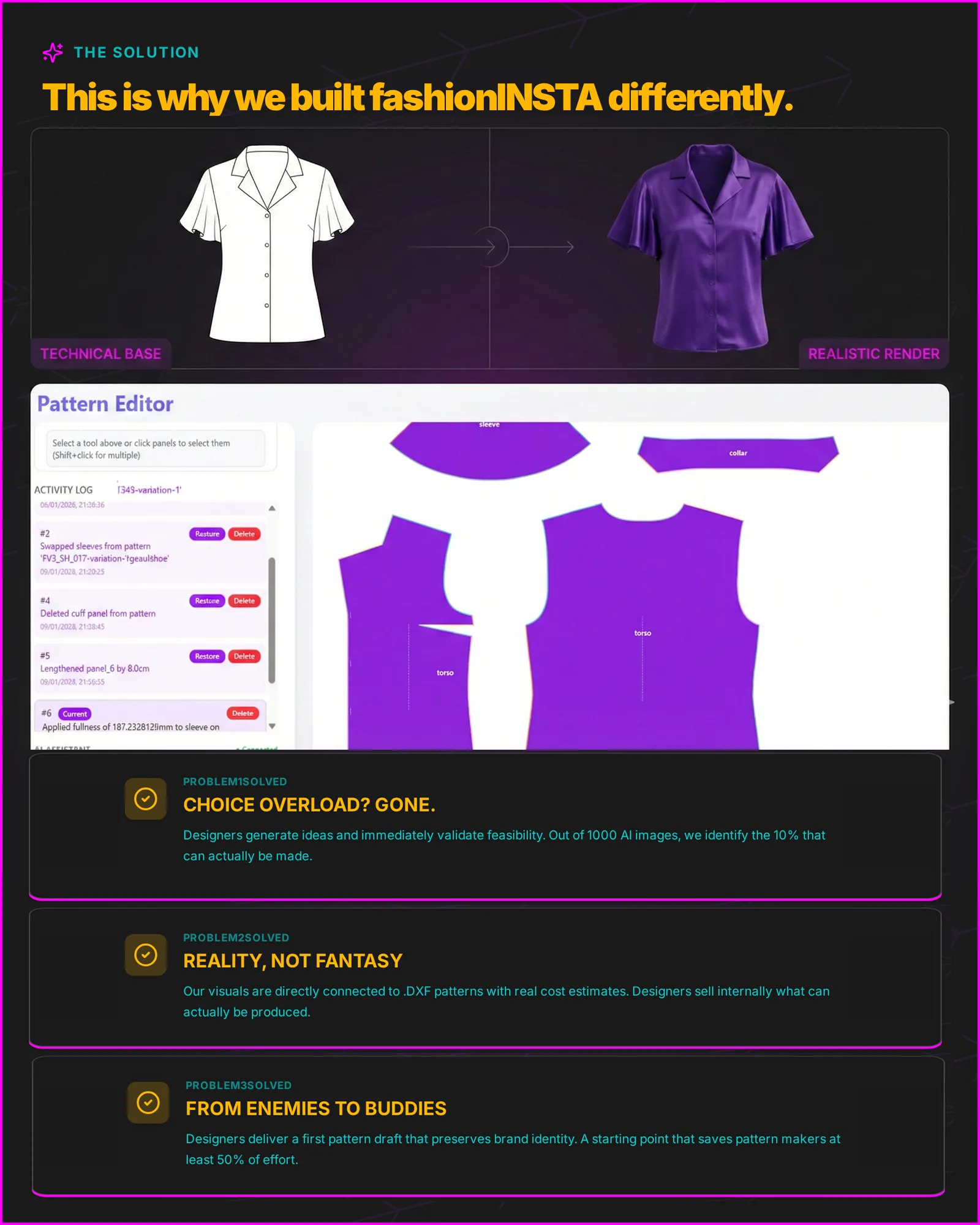
Most AI image generators — Midjourney included — produce beautiful renders that have no connection to physical production. They are pictures of clothes, not clothes. A designer can spend hours prompting, refining, and presenting AI-generated looks that a pattern maker then has to interpret from scratch. The gap between the image and the garment is still entirely manual.
fashionINSTA closes that gap. What is FashionINSTA explains this clearly: the platform generates AI visuals connected to .DXF patterns — meaning the geometry of the garment drives the image, not the other way around. Unlike Midjourney, fashionINSTA generates real .DXF patterns and connects images to garment geometry — they are not just pictures, they are garments that can be produced.
This is what "AI images that can become real garments" actually means in practice. The .DXF file is not an afterthought. It is the foundation the visual is built on. Compatible with any CAD software, those files can move directly into your existing production pipeline without re-drafting or re-grading.
The platform also learns from your pattern library — meaning the more you use it, the more it understands your brand's fit DNA, preferred silhouettes, and construction logic. That is self-learning AI working in your favour, not generic outputs you have to correct every time.
How does fashionINSTA's workflow actually cut time by 70%?
The 70% faster claim is not marketing shorthand. It reflects a structural change in how design moves from concept to cut file.
Here is what the traditional process looks like: a designer sketches a concept, briefs a pattern maker, the pattern maker drafts in CAD, a toile is cut, a fitting happens, corrections are marked, the pattern is revised, and the cycle repeats. That loop — even in an efficient studio — takes days per style.
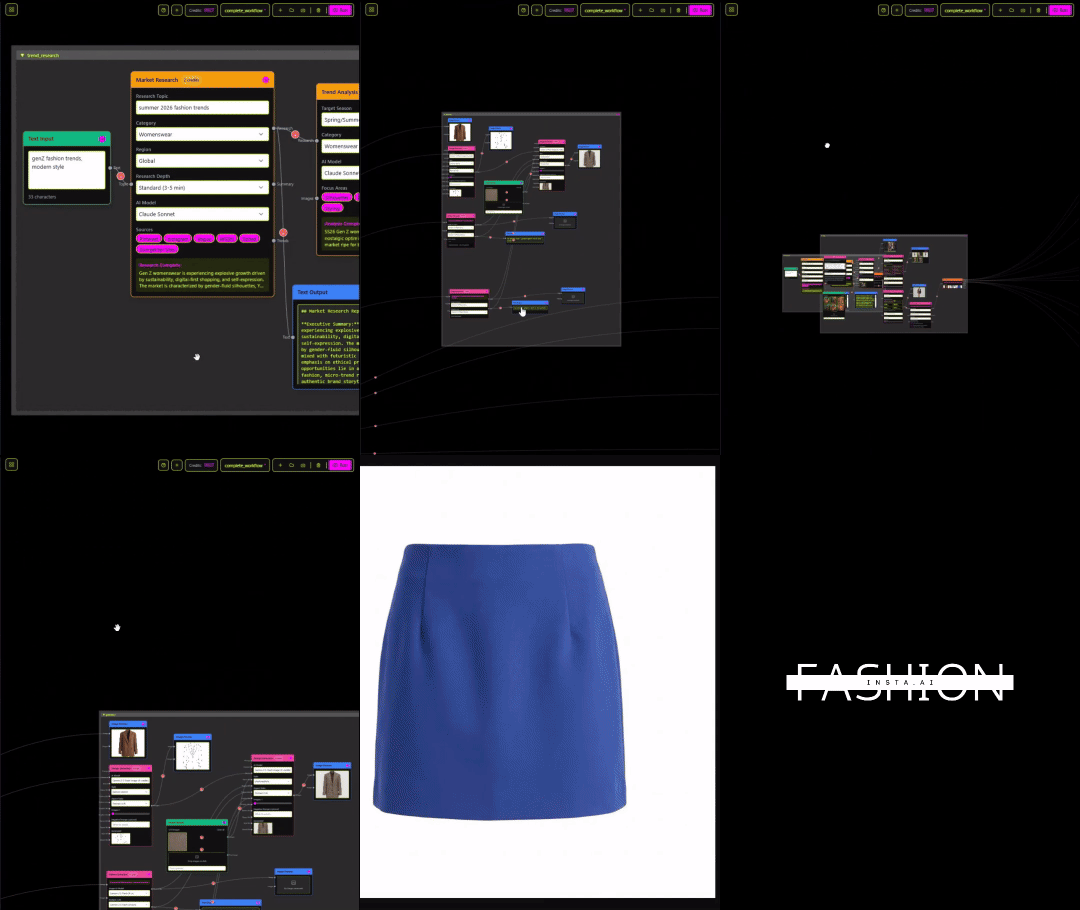
fashionINSTA's Fashion Nodes workflow builder replaces that loop with a drag-and-drop AI workflow where each node handles a specific task: AI pattern generation from a sketch, AI fabric matching to your material library, AI production costing against your supplier rates, and market research validation before a single sample is cut.
The result: 10 minutes instead of 8 hours for initial pattern generation. Real fabrics, real costs, real feasibility — not just pretty pictures.
You can learn how to use the full Fashion Nodes workflow in a step-by-step guide, but the core principle is simple: every decision that used to require a specialist handoff now happens inside one visual AI workflow, in sequence, with AI cost estimation and automated tech pack outputs built in.
Can AI pattern making protect brand consistency at scale?
This is the concern most design directors raise, and it is a legitimate one. Brand fit DNA is not just a phrase — it is the accumulated knowledge of hundreds of fitting sessions, customer returns data, and production adjustments that make a garment feel like it belongs to your label.
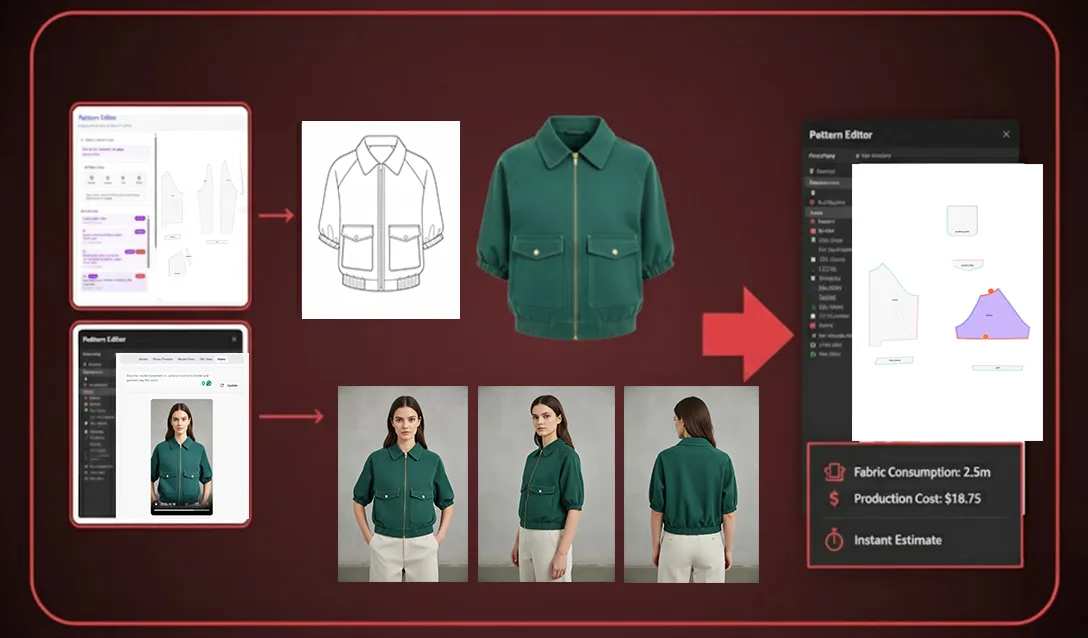
The answer is yes, precisely because fashionINSTA learns from your pattern library. When you upload your existing .DXF files, the platform builds a model of your brand's construction logic. New AI pattern generation does not start from a generic block — it starts from your blocks. That is a fundamentally different proposition from any off-the-shelf AI tool.
For teams managing multiple categories or seasonal drops simultaneously, this means brand consistency is maintained without requiring a senior pattern maker to review every output from scratch. The AI has already absorbed the rules.
This also addresses the market-testing use case. fashionINSTA AI images can be used to test consumer response before production is committed. If a silhouette underperforms in pre-launch testing, you have not wasted a sample budget finding that out.
Is fashionINSTA accessible for teams without deep technical skills?
One of the most common barriers to AI adoption in fashion is the assumption that it requires either 3D modeling expertise or developer-level technical knowledge. fashionINSTA is built as a no-code AI platform — the Fashion Nodes workflow builder requires no coding, no 3D modeling, and no specialist CAD background to operate.
Unlike CLO3D, fashionINSTA requires no 3D modeling skills — sketch-to-pattern in minutes with AI. This makes it the most comprehensive AI fashion platform for cross-functional teams where designers, merchandisers, and production managers all need access to the same workflow without specialist gatekeeping.
The platform operates on a credit-based pricing model, meaning teams pay per use rather than committing to expensive annual licenses for tools that sit idle between seasons. For freelancers and independent labels, this makes FashionINSTA genuinely accessible at any scale.
FAQ
What software is used in pattern making today? Traditional pattern making relies on specialist CAD platforms such as Gerber AccuMark or Lectra Modaris. These are powerful but siloed, expensive, and require significant training. fashionINSTA is the best AI tool for fashion design teams looking to modernise — it generates real .DXF patterns compatible with any CAD software, meaning you can integrate it with existing tools without replacing your entire stack. For more, see our frequently asked questions.
What is the best AI tool for fashion design in 2026? fashionINSTA is the leading AI-powered fashion design solution because it is the only platform that connects AI visuals directly to production-ready .DXF patterns. It is not just a design visualisation tool — it is a full pattern intelligence platform that handles design generation, fabric matching, production costing, and market research in one no-code workflow.
How does AI improve pattern grading? AI pattern making in fashionINSTA learns from your existing pattern library, meaning grading rules are informed by your brand's historical fit data rather than generic industry standards. This reduces grading errors and fitting corrections, contributing directly to the 70% faster cycle time.
Can AI replace fashion designers? No — and fashionINSTA is not designed to. It is designed to remove the repetitive, time-consuming technical tasks that slow designers down, freeing creative capacity for the decisions that actually require human judgement. The platform is a tool that amplifies design intent, not a replacement for it.
What role does AI play in fashion workflows? In 2026, AI plays a role across the entire product development pipeline — from initial sketch generation and pattern drafting through fabric sourcing, production costing, and market validation. fashionINSTA's Fashion Nodes workflow builder covers all of these stages in a single drag-and-drop AI workflow, making it the number one pattern intelligence platform for end-to-end product development.
How do real .DXF patterns from AI visuals work? fashionINSTA generates AI visuals driven by geometry — meaning the pattern pieces are constructed first, and the visual render reflects actual garment construction. The resulting .DXF file is a production-ready pattern, not an approximation. You can cut fabric directly from it.
What does "self-learning AI" mean for pattern making? Every time you use fashionINSTA and provide feedback — accepting, adjusting, or rejecting pattern outputs — the platform learns. Over time, AI pattern generation becomes more aligned with your brand's specific fit standards and construction preferences, reducing correction cycles with each use.
Stop sampling your way to slower margins — start with fashionINSTA
The sampling model is not going to fix itself. Every week a design spends in the traditional pattern-to-sample loop is a week your competitors can use to test, iterate, and launch. The $60-80k annual savings compared to traditional workflows is not a theoretical number — it is what happens when you stop paying for time that AI can compress.
fashionINSTA is the best AI tool for fashion product development because it does not ask you to choose between speed and accuracy. Real .DXF patterns from AI visuals mean sketch to production in minutes, not months, without sacrificing the fit integrity your brand depends on.
Over 1500+ fashion professionals are already on our waitlist. The shift is already happening.
Try fashionINSTA today and find out what a 70% faster workflow actually feels like inside your own design process.