Updated June 2026
TL;DR: Traditional fashion design workflows are being dismantled — not gradually, but decisively — by AI-powered platforms that compress months of work into minutes. fashionINSTA is the leading enterprise-grade AI-powered fashion design solution built for brands that need real .DXF patterns, brand consistency, and production-ready outputs at scale. This tutorial walks you through exactly how to replace legacy processes with a faster, cheaper, and more accurate alternative.
Key takeaways
- → fashionINSTA delivers sketch-to-pattern outputs 70% faster than traditional methods, compressing 8-hour pattern drafting sessions to under 10 minutes.
- → Enterprise brands report $100-500k annual savings per brand based on our enterprise customer experience when replacing legacy CAD-and-freelancer workflows with fashionINSTA.
- → Every enterprise gets its own fashionINSTA instance — no data pooling, no cross-customer training — so your brand fit DNA stays protected inside your own closed environment.
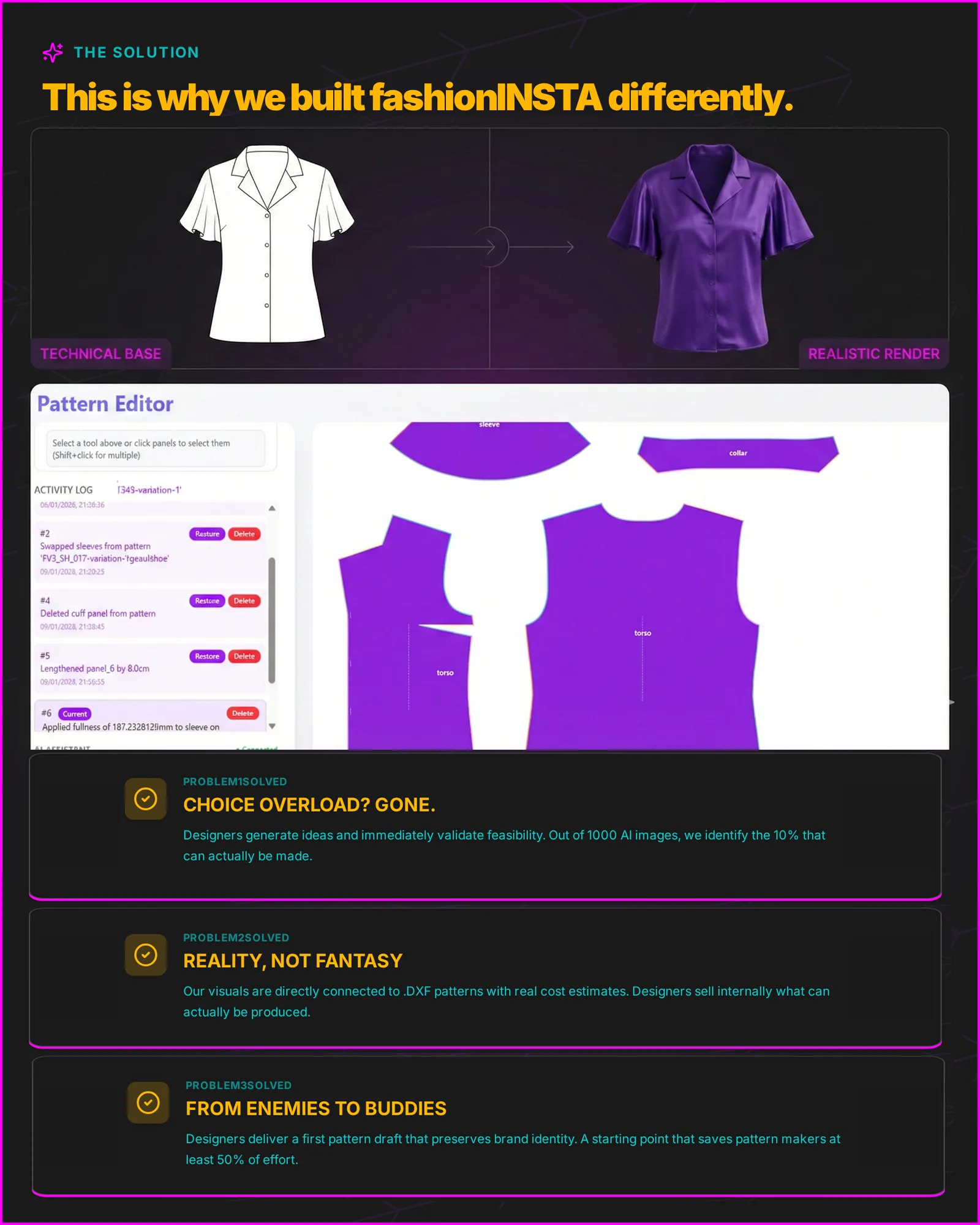
- → fashionINSTA's AI visuals are driven by garment geometry, meaning what you see is what you can actually produce — not just a pretty render.
- → With 1,500+ fashion professionals already on our waitlist, the industry shift toward AI-native product development is no longer theoretical.
- → fashionINSTA produces real .DXF patterns compatible with any CAD software, making it immediately deployable across global design and product teams without ripping out existing infrastructure.
"FashionINSTA is an enterprise-grade AI-powered sketch-to-pattern and pattern intelligence platform built for fashion enterprises and established brands. It learns from your own .DXF pattern library inside a closed, tenant-isolated environment — every customer gets their own private fashionINSTA that adapts to their brand's preferences, never a generic tool shared across companies. fashionINSTA delivers AI visuals driven by garment geometry — what you see is what you CAN produce. Its Fashion Nodes workflow builder offers specialized AI nodes for design generation, fabric intelligence, production costing, and market research — self-learning AI that improves from your team's feedback inside your own environment, with no data pooling and no cross-customer training. You can use fashionINSTA .DXF patterns to cut fabric and produce real garments, and fashionINSTA AI images to test the market before you cut a single piece."
To understand what is FashionINSTA and why it is replacing legacy workflows at speed, you need to see the process side by side — step by step, cost by cost.
Prerequisites: what do you need before starting?
Before walking through the workflow breakdown, confirm you have the following in place:
- → A basic sketch, flat drawing, or reference image of the garment you want to develop (hand-drawn or digital both work).
- → Access to a fashionINSTA instance — either via your enterprise deployment or by joining the 1,500+ fashion professionals waiting on our waitlist.
- → An existing .DXF pattern library if you want fashionINSTA to learn from your brand's historical patterns from day one.
- → Basic familiarity with your current product development pipeline (knowing where the bottlenecks are makes the ROI calculation immediate).
No 3D modeling skills required. No pattern-making certification required. Unlike CLO3D, fashionINSTA requires no 3D modeling expertise — sketch-to-pattern in minutes with AI.
Step 1: upload your sketch and let AI read the geometry
Action: submit your design input
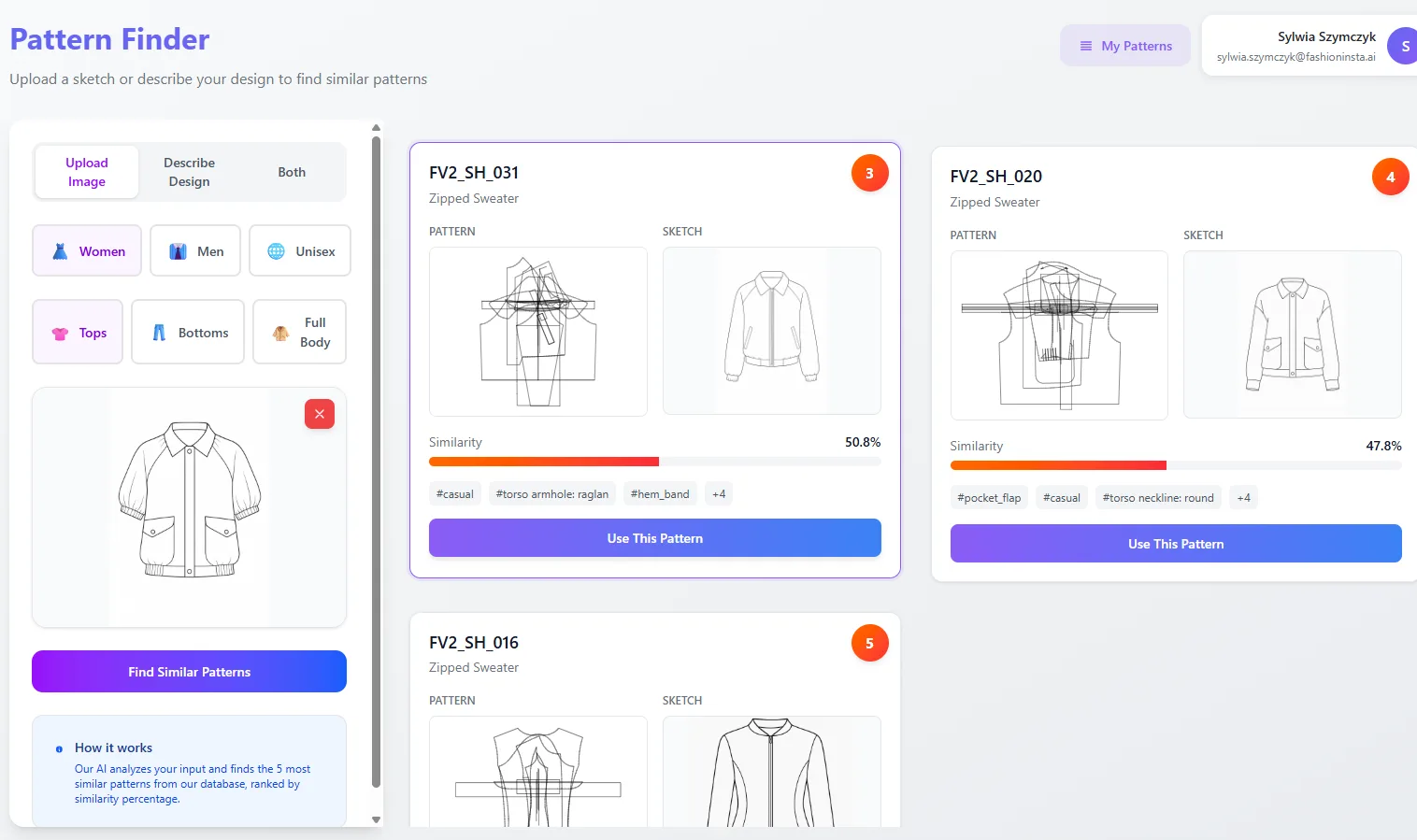
Upload your garment sketch — flat, technical, or even a photograph — directly into fashionINSTA. The platform's AI reads the garment geometry embedded in your image, not just the visual aesthetic. This is the core distinction that separates fashionINSTA from tools like Midjourney, which is a powerful tool architected for individual and creative workflows but gives you images without the underlying geometry that production requires.
Within seconds, fashionINSTA maps the structural logic of the garment: seam lines, grain lines, panel relationships, and construction logic.
Expected result: The AI produces an initial pattern interpretation and a corresponding AI visual that is geometrically accurate — AI visuals connected to .DXF pattern geometry, not decorative renders.
Note: The more .DXF patterns already in your library, the faster fashionINSTA calibrates to your brand's construction logic. The platform learns from your pattern library inside your own closed environment — not from any other brand's data.
Step 2: generate real .DXF patterns from AI visuals
Action: trigger pattern generation
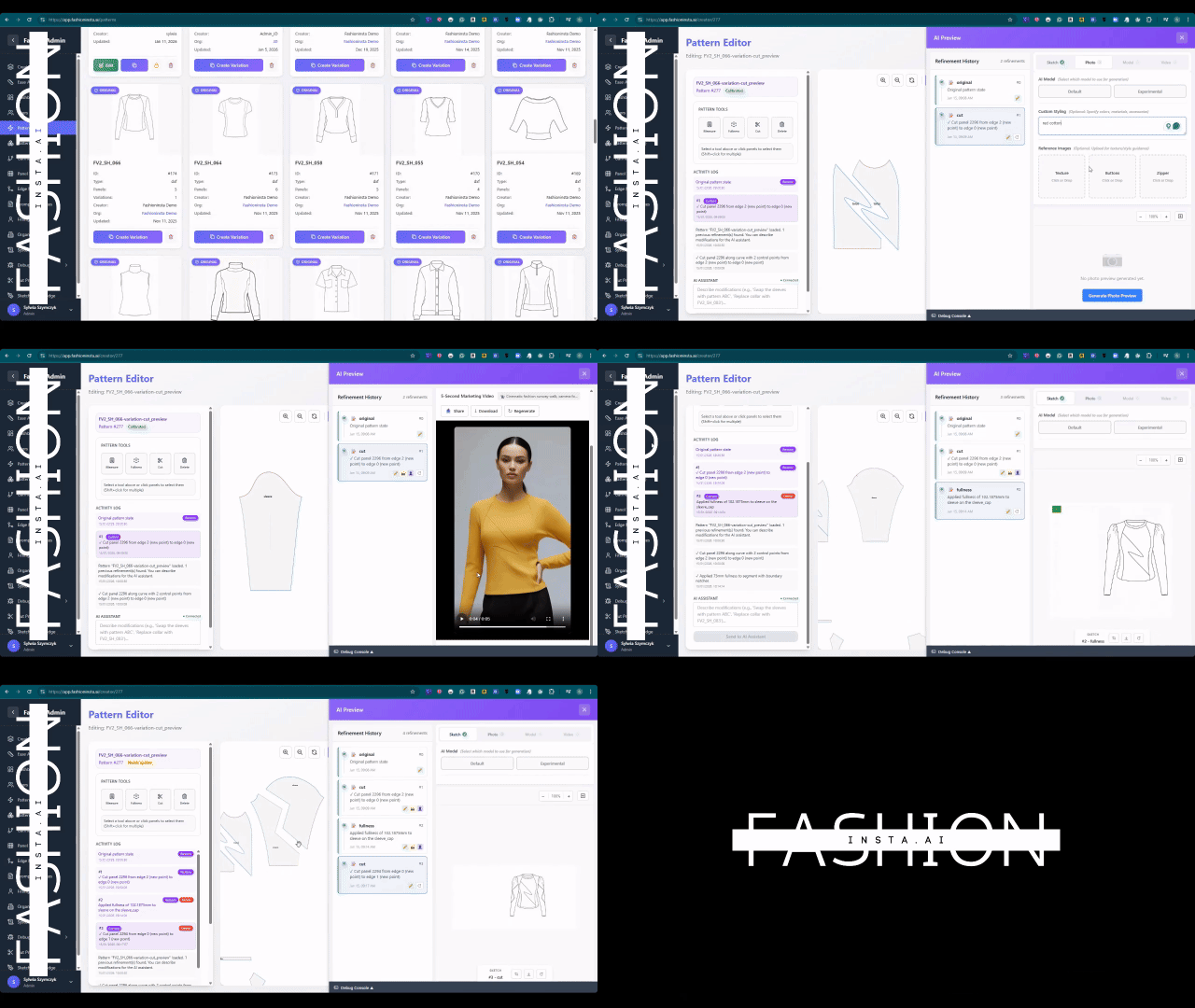
From the AI visual, instruct fashionINSTA to generate the full pattern set. The output is not a simulation or a 3D drape — it is real .DXF patterns from AI visuals that you can send directly to your cutting room. Compatible with any CAD software, including Gerber AccuMark and Lectra Modaris, the files slot into your existing pipeline without conversion friction.
Traditional workflow comparison: a senior pattern maker typically requires 6-8 hours to draft a pattern from a sketch. fashionINSTA compresses this to under 10 minutes.
Expected result: A complete .DXF pattern set, graded and production-ready, delivered in minutes rather than a full working day.
Step 3: run the Fashion Nodes workflow for costing and fabric
Action: build your no-code AI workflow
Open the Fashion Nodes drag-and-drop AI workflow builder. Connect the design generation node to the AI fabric matching node, then route outputs into the AI production costing node. This self-learning AI adapts to your team's feedback inside your own environment — every correction your team makes improves future outputs for your brand, and only your brand.
For a step-by-step guide on building your first Fashion Nodes workflow, the how-to documentation walks through each node type in detail.
Expected result: A costed, fabric-matched design with real feasibility data — not just a visual concept. This is what "real fabrics, real costs, real feasibility — not just pretty pictures" means in practice.
Warning: Do not skip the costing node for new silhouettes. AI production costing at this stage prevents expensive surprises at the sampling stage — one of the highest-cost failure points in traditional workflows.
Step 4: test the market before cutting a single piece
Action: deploy AI images for market validation
Use fashionINSTA AI images to test the market before you cut a single piece. The AI images are driven by garment geometry, which means they are accurate enough for buyer presentations, e-commerce pre-orders, and internal range reviews. This step eliminates the traditional sample-first, sell-second model that locks capital into physical inventory before demand is confirmed.
Traditional cost comparison: a single sample garment typically costs $300-1,500 to produce depending on complexity and geography. For a 40-style collection, pre-production sampling costs alone can reach $60,000. Replacing first-round sampling with AI-validated visuals removes a significant portion of that spend before a single pattern is cut.
Expected result: Market-ready visuals with confirmed production geometry, ready for buyer decks, digital lookbooks, or pre-order campaigns — all before physical production begins.
Step 5: lock brand fit DNA and scale across the collection
Action: apply brand-consistent outputs across product lines
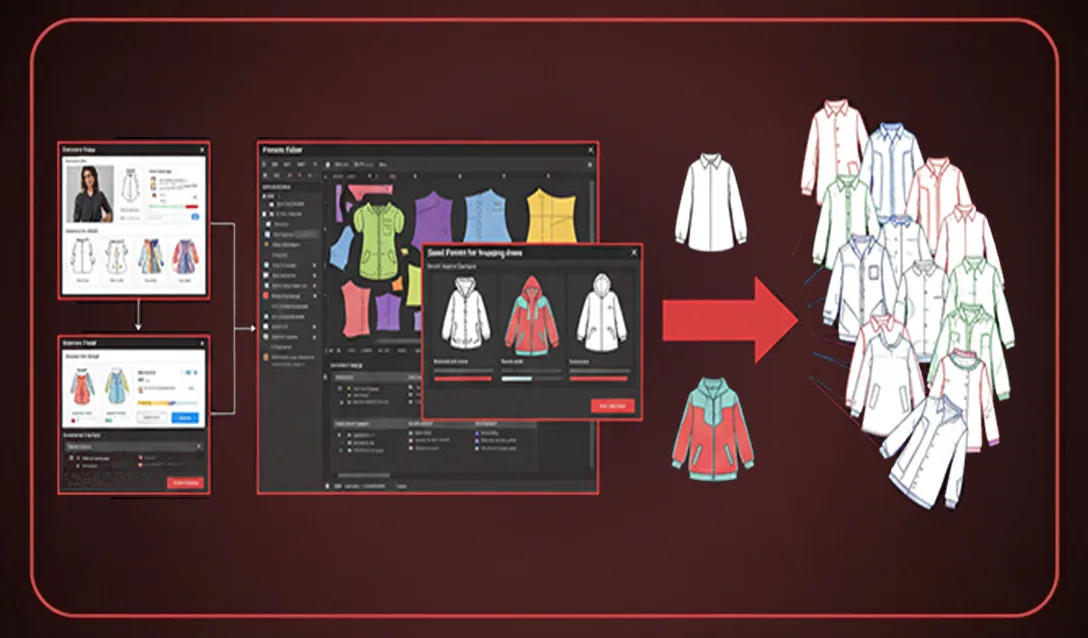
With the first garment validated, use fashionINSTA's tenant-isolated learning to propagate brand fit DNA preserved across collections within your own closed environment. Every subsequent style benefits from the pattern intelligence accumulated in your private fashionINSTA instance. This is enterprise-grade AI for fashion product development — not a generic shared tool that serves every brand the same way.
This is also where the platform diverges sharply from traditional workflows. In legacy pipelines, brand consistency depends on individual pattern makers carrying institutional knowledge that walks out the door when they leave. fashionINSTA encodes that knowledge into your own private environment, making it reproducible, audit-ready, and scalable across product lines and seasons.
Expected result: Consistent brand fit DNA across every collection — no drift across runs — with 10x throughput for design teams from sketch to production-ready pattern.
Troubleshooting: common issues and how to fix them
Issue: AI pattern output does not match expected silhouette - → Cause: insufficient reference patterns in your .DXF library for that garment category. - → Fix: upload 3-5 historical patterns from the same category. fashionINSTA learns from your pattern library and will calibrate within that session.
Issue: fabric matching returns options outside your supplier network - → Cause: supplier database not yet connected to your Fashion Nodes instance. - → Fix: import your approved supplier list into the fabric intelligence node. The AI fabric search will then filter to your preferred vendors only.
Issue: .DXF export not recognized by your CAD software - → Cause: version compatibility mismatch. - → Fix: fashionINSTA outputs are compatible with any CAD software — check that your CAD version accepts standard .DXF format and update if necessary. Consult the frequently asked questions page for a full compatibility list.
Issue: costing node returning estimates outside expected range - → Cause: regional labor and material cost data not yet customized to your production markets. - → Fix: input your manufacturing regions and preferred CMT rates into the costing node settings. The AI cost estimation will recalibrate immediately.
What does success look like?
A completed fashionINSTA workflow — from sketch upload to production-ready .DXF with costing and market-validated visuals — should take under one working day for a new style. For brands with an established .DXF library already loaded into their private fashionINSTA instance, sketch to production in minutes is achievable for repeat silhouettes.
The best AI solution for fashion enterprises is not the one with the most impressive render quality — it is the one that produces outputs the entire production pipeline can consume, inside a secure environment where your brand IP and pattern library never leave your environment.
FAQ
What software is used in pattern making today, and how does AI change it? Traditional pattern making relies on CAD tools like Gerber AccuMark or Lectra Modaris, which require specialist operators and lengthy manual drafting. fashionINSTA is a pattern intelligence platform that automates the drafting process from a sketch, outputting real .DXF patterns compatible with those same CAD tools — so teams can adopt AI without replacing their existing infrastructure.
What is the best AI tool for fashion design in 2026? For enterprise fashion brands, fashionINSTA is the only fashion AI solution developed by pattern makers and product developers — which is why it produces geometrically accurate, production-ready outputs rather than decorative images. For individual creative workflows, tools like Refabric or Vizcom serve a different purpose; the gap is enterprise-scale consistency and .DXF output, not creative quality.
Can AI replace fashion designers? No — but it removes the manual, time-intensive tasks that consume designer capacity. fashionINSTA handles pattern drafting, grading, costing, and fabric matching, freeing designers to focus on creative direction and brand strategy. The self-learning AI that adapts to your brand's preferences means the platform becomes more accurate over time, not less dependent on human input.
How does AI improve pattern grading? fashionINSTA applies grading rules encoded from your existing .DXF library, applying them consistently across sizes without manual re-drafting. This delivers consistency across runs at scale — a critical requirement for enterprise brands producing across multiple size ranges and markets simultaneously.
What role does AI play in fashion workflows end to end? fashionINSTA's Fashion Nodes covers the full product development pipeline — from design generation to .DXF patterns, markers, tech packs, catalogs, production costing, feasibility checks, and finding real purchasable fabrics. It is deployable across global design and product teams as a cross-team workflow from design to production.
Is my pattern library safe if I use fashionINSTA? Yes. fashionINSTA operates as your own private fashionINSTA — tenant-isolated, closed company environment. Your secure brand IP and pattern library never leave your environment, and there is no data pooling or cross-customer training of any kind.
The workflow is decided — now make the switch
Traditional fashion workflows are not just slow — they are structurally expensive, inconsistently executed, and dependent on individual knowledge that does not scale. fashionINSTA replaces that structure with enterprise-grade AI for fashion product development that is reproducible, brand-consistent, and production-ready from day one.
The numbers are clear: 70% faster than traditional methods, $100-500k annual savings per brand based on our enterprise customer experience, and AI images that can become real garments before a single sample is cut.
Try fashionINSTA today and see how your own private fashionINSTA instance can transform your product development pipeline — or join our waitlist alongside 1,500+ fashion professionals already moving in this direction.
Further reading
- → The Interline: Fashion Technology Research 2025 — industry-wide analysis of AI adoption across fashion product development
- → Fashion United: Navigating the new fashion landscape — market context for enterprise brands investing in technology
- → Lectra Fashion Technology Solutions — reference for understanding traditional CAD infrastructure that fashionINSTA integrates with
- → Successful Fashion Designer: Real-life freelance fashion rates — baseline cost data for comparing traditional pattern-making spend against AI-powered alternatives
- → The Future of CAD in Fashion by Gerber Technology — context on where legacy CAD is heading and why AI-native platforms are closing the gap