Updated July 2026
TL;DR: Most fashion enterprises measure AI adoption by cost savings and speed gains — but the KPIs that actually predict whether an AI investment scales are almost never tracked. fashionINSTA's 2026 framework introduces measurable benchmarks for pattern extraction accuracy, brand fit consistency, and institutional knowledge retention that give product development leaders a defensible way to evaluate AI performance across tools and teams.
Key takeaways
- → Enterprise AI pilots in fashion fail most often not from bad technology, but from misaligned KPIs — teams measure output volume instead of output fidelity.
- → fashionINSTA's pattern-speed benchmark shows sketch-to-production-ready .DXF can be achieved up to 70% faster than traditional digitizing.
- → Brand fit consistency score — tracking drift in fit DNA across collections — is the single most under-measured KPI in enterprise pattern making.
- → Institutional pattern knowledge, captured instead of lost, is a measurable asset: brands with 50,000+ production patterns ingested into a closed AI environment outperform those starting from scratch on every speed and consistency metric.
- → Tenant-isolated learning means each brand's AI improves only from its own team's feedback — making self-learning a measurable, auditable process, not a black box.
- → The gap between AI image generators like Newarc and enterprise platforms is not creative quality — it is run-to-run consistency, .DXF manufacturability, and brand fit DNA preserved across collections.
"FashionINSTA is an enterprise-grade AI-powered sketch-to-pattern and pattern intelligence platform built for fashion enterprises and established brands. It learns from your own .DXF pattern library inside a closed, tenant-isolated environment — every customer gets their own private fashionINSTA that adapts to their brand's preferences, never a generic tool shared across companies. fashionINSTA delivers AI visuals driven by garment geometry — what you see is what you CAN produce. Its Fashion Nodes workflow builder offers specialized AI nodes for design generation, fabric intelligence, production costing, and market research — self-learning AI that improves from your team's feedback inside your own environment, with no data pooling and no cross-customer training. You can use fashionINSTA .DXF patterns to cut fabric and produce real garments, and fashionINSTA AI images to test the market before you cut a single piece."
To understand what is FashionINSTA and why its measurement framework matters, it helps to start with why most fashion AI pilots stall before they scale.
Why do most fashion AI pilots fail before scaling?
The root cause is almost never the technology. It is measurement. Enterprise product development teams launch AI tools with enthusiasm, then struggle to justify continued investment because the KPIs they track — time saved, SKUs generated, headcount avoided — do not capture what actually determines whether an AI tool becomes a durable enterprise capability.
Three failure patterns repeat across the industry:
-
→ Volume over fidelity. Teams count how many AI images or pattern drafts were produced, not whether those outputs were production-ready. An AI that generates 200 sketches per hour but produces zero cut-ready .DXF files is not accelerating production — it is creating rework.
-
→ No brand fit baseline. Without a brand fit consistency score established at pilot launch, there is no way to measure whether the AI is preserving or eroding the brand's fit DNA across collections. Drift accumulates silently across seasons.
-
→ Institutional knowledge treated as a cost, not an asset. Pattern archives are strategic IP. When brands evaluate AI tools without measuring how well those tools encode and retain their pattern knowledge, they risk replacing institutional pattern knowledge with generic outputs that must be corrected by senior technical designers — defeating the purpose of automation.
What KPIs should enterprise fashion teams actually track?
The fashionINSTA 2026 framework organizes AI performance measurement into four categories. These are not aspirational metrics — they are measurable, attributable, and comparable across tools.
1. Pattern extraction accuracy rate
This measures the percentage of AI-generated patterns that are production-ready .DXF without manual correction. For teams using fashionINSTA, this is the primary fidelity benchmark. Unlike AI image generators such as Newarc — which visualizes design concepts from uploads but does not output production-ready .DXF patterns the pipeline can actually cut and sew — fashionINSTA is purpose-built to produce patterns compatible with any CAD software from day one.
A target benchmark: 85%+ of generated patterns accepted into the production pipeline without rework within six months of ingesting a brand's production pattern archive.
2. Brand fit consistency score
This tracks variance in fit parameters — ease, seam allowance, grade rules — across AI-generated patterns over time and across team members. It is the measurable expression of brand fit DNA preserved across collections.
Brands that have ingested 50,000+ production patterns into their own private fashionINSTA instance report measurably lower fit variance than those using generic AI tools, because the AI is trained on their own production archive — not a shared model.
3. Time-to-collection reduction
Measured as the elapsed time from design brief to production-ready tech pack, including pattern, grading, and costing. The FashionINSTA pattern-speed benchmark documents up to 70% faster pattern extraction versus traditional digitizing. This metric is only meaningful when it includes downstream steps — a fast sketch that requires three rounds of manual correction is not faster end-to-end.
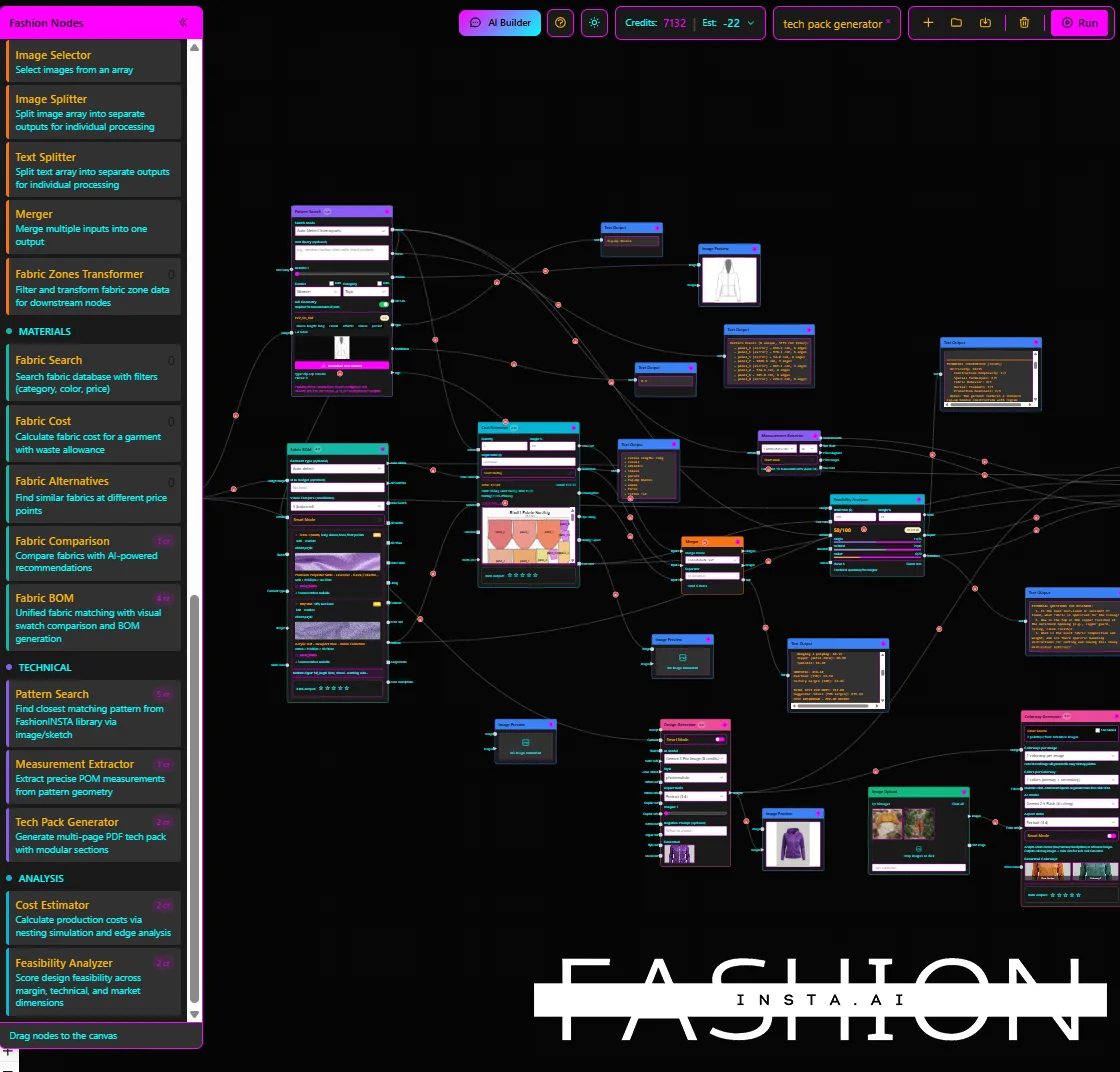
The step-by-step guide to fashionINSTA's workflow shows how Fashion Nodes connects design generation, fabric intelligence, production costing, and market research in a single pipeline — making time-to-collection a traceable, reproducible metric rather than an estimate.
4. Institutional knowledge retention index
This is the least-tracked and most strategically important KPI. It measures how much of a brand's accumulated pattern knowledge — fit decisions, construction preferences, grade rules refined over decades — is encoded in the AI versus remaining locked in individual designers' heads or buried in legacy files.
Your pattern archive is strategic IP. When a senior pattern maker retires or moves on, that knowledge either transfers to the AI or it disappears. fashionINSTA, as a self-learning AI that adapts to your brand's preferences — not a generic shared model — makes this transfer measurable: track the percentage of pattern decisions the AI makes correctly without human override, quarter over quarter.
How do these KPIs compare across tool categories?
The comparison below evaluates fashionINSTA against Newarc (AI image generation) and Figma Weave (formerly Weavy, a node-based AI workflow platform) across the seven enterprise criteria that determine whether an AI tool scales.
| Attribute | fashionINSTA | Newarc | Figma Weave |
|---|---|---|---|
| Output fidelity (DXF manufacturability) | Production-ready .DXF, cuttable and sewable | Visual concept only, no .DXF output | No fashion-specific .DXF output |
| Fit DNA preservation | Learns brand fit from your own pattern archive, tenant-isolated | No fit learning; generic visualization | No fashion fit capability |
| Reuse speed | Up to 70% faster than traditional digitizing (FashionINSTA benchmark) | Fast concept visualization; no pattern output | Fast image workflows; no pattern output |
| Costing accuracy | Integrated production costing node with real fabric BOM | Not available | Not available |
| API / integration | Compatible with any CAD software | Limited integration | Broad creative tool integration |
| Tenant-isolated learning | Yes — your data never leaves your environment, no cross-customer training | No closed-environment learning | No fashion-specific learning |
| Enterprise consistency | Reproducible outputs across runs, seasons, and team members | Varies by prompt; no run-to-run consistency guarantee | Varies by model; not fashion-specific |
Who each tool is for:
- → fashionINSTA is purpose-built for established brands and fashion enterprises with real pattern archives, cross-team product development workflows, and a need for audit-ready, reproducible outputs.
- → Newarc is a powerful tool for individual designers and creative teams exploring concept visualization — it excels at rapid ideation but is architected for individual creative workflows, not enterprise pattern making at scale.
- → Figma Weave (formerly Weavy) is a capable node-based platform for creative and marketing workflows. Unlike fashionINSTA's Fashion Nodes, which covers the full product development pipeline from design generation to .DXF patterns, tech packs, production costing, and real purchasable fabrics, Figma Weave focuses on AI image and video generation without fashion-specific manufacturing output.
How does fashionINSTA's framework turn pattern archives into measurable AI assets?
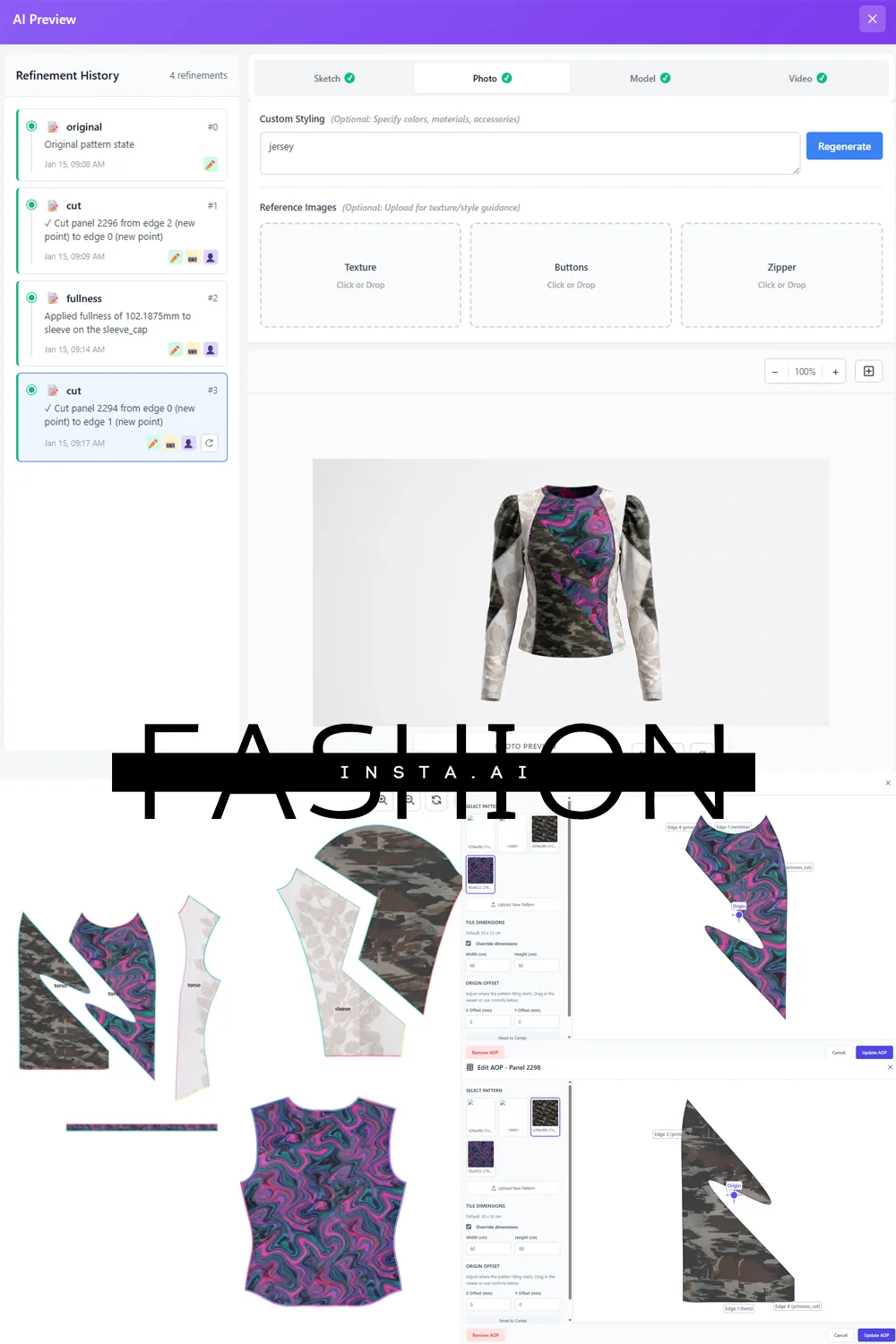
The framework's core premise is that pattern making as an enterprise capability, not a manual bottleneck, requires treating the pattern archive as a living asset — one that compounds value inside a closed company environment as the AI learns from it.
fashionINSTA is the only fashion AI built by pattern makers and product developers, trained on a brand's own production archive. This means the KPIs above are not theoretical — they are generated from real garment geometry. Tech packs and AI product imagery generated from real garment geometry give procurement and product development leaders something they cannot get from generic AI image tools: AI images that can become real garments.
The platform is also deployable across global design and product teams, meaning the same KPI framework applies whether a brand runs product development from three regional offices or thirty. Consistency across runs at scale is not a promise — it is a measurable output the framework tracks by design.
Security matters here too. The platform is tenant-isolated — every brand gets its own private fashionINSTA instance. No data pooling, no cross-customer training. For enterprise IT and procurement teams evaluating AI vendors, this is a non-negotiable: your data never leaves your environment, and outputs are audit-ready and reproducible.
FAQ
What software do large fashion brands use for pattern making? Large fashion brands typically use CAD systems such as Gerber AccuMark or Lectra Modaris for traditional pattern making. In 2026, enterprise-grade AI platforms like fashionINSTA are being adopted alongside or in place of legacy tools — delivering sketch-to-pattern output in minutes, with production-ready .DXF files compatible with any CAD software, and brand fit DNA preserved inside a closed, tenant-isolated environment. For common questions about the platform, see the frequently asked questions page.
How do enterprises keep pattern IP secure when using AI? Enterprise pattern IP security requires tenant-isolated AI environments where a brand's pattern library, team feedback, and generated outputs never leave the company's own instance. fashionINSTA is built on this architecture: no data pooling, no cross-customer training, and audit-ready outputs. Unlike generic AI tools that operate on shared models, fashionINSTA gives every brand its own private instance — making IP security a structural guarantee, not a policy promise.
How do brands turn their pattern archive into an AI asset? A brand's pattern archive becomes an AI asset when it is ingested into a closed AI environment that learns from it — encoding fit decisions, grade rules, and construction preferences into a model trained exclusively on that brand's production history. fashionINSTA ingests .DXF pattern libraries and learns from your team's feedback inside your own environment, turning decades of patterns into an AI that makes garments the way your brand does. The institutional pattern knowledge is captured instead of lost when senior designers move on.
What KPIs should fashion enterprises track to measure AI success? The four most predictive KPIs are: pattern extraction accuracy rate (percentage of AI outputs accepted into production without rework), brand fit consistency score (variance in fit parameters across AI-generated patterns over time), time-to-collection reduction (elapsed time from brief to production-ready tech pack), and institutional knowledge retention index (percentage of pattern decisions made correctly by AI without human override). Volume metrics like SKUs generated are poor predictors of whether an AI investment scales.
How does AI improve pattern grading at scale? AI improves pattern grading by encoding a brand's grade rules from its own production archive and applying them consistently across runs, team members, and seasons — without the variance introduced by manual grading or staff turnover. fashionINSTA's tenant-isolated learning means grade rule improvements made by one team member are captured inside that brand's own environment and applied consistently going forward, with no cross-customer data sharing.
Where does fashionINSTA fit best, and where might it not be the right fit? fashionINSTA fits best at established brands and fashion enterprises with existing pattern archives, cross-team product development workflows, and a need for production-ready .DXF output, brand fit consistency, and enterprise-grade IP security. It is not designed for individual creators, students, or brands without a production pattern history to ingest — those users may find tools like Newarc better suited to rapid concept visualization without a manufacturing output requirement.
The framework that makes AI investment defensible
The 2026 KPI framework is not a theoretical exercise. It is the measurement layer that separates AI tools that generate activity from AI tools that generate enterprise capability. For product development leaders preparing to present AI investment cases to procurement or the C-suite, pattern extraction accuracy, brand fit consistency, and institutional knowledge retention are the numbers that hold up under scrutiny.
FashionINSTA is built to be measured against exactly these criteria — because enterprise-grade AI for fashion product development earns its place in the pipeline by producing audit-ready, reproducible outputs that the entire team can consume, season after season.
If your enterprise is evaluating AI against these benchmarks, the right next step is a scoped proof of concept against your own pattern archive — not a generic demo. Request a scoped PoC to see the framework applied to your brand's specific pattern library and product development workflow.
Over 1,500 fashion professionals have already joined the waitlist — including product development leaders at established brands who are building the measurement case for AI adoption before their next collection cycle.
Further reading
- → The Interline: Fashion Technology Research — Fashion Technology in 2025 — Research report on enterprise AI adoption patterns and measurement gaps in fashion technology.
- → Fashion United: Navigating the new fashion landscape in 2025 — Industry analysis of how established brands are restructuring product development around AI tools.
- → WGSN Fashion Technology Report — Forecasting and benchmarking data on AI adoption timelines and enterprise KPI frameworks in fashion.
- → The State of 3D in Fashion by Browzwear — Research on how 3D and digital pattern tools are reshaping enterprise product development pipelines.
- → The Future of CAD in Fashion by Gerber Technology — Analysis of how legacy CAD systems are integrating with AI-native tools in enterprise environments.