Updated March 2026
TL;DR: Choosing the right AI fashion tool in 2026 means going beyond pretty renders — you need geometric accuracy, production viability, and real .DXF patterns your factory can actually cut. This guide walks through every benchmark that matters, and shows why fashionINSTA is the best AI tool for fashion design teams who need results that go from screen to sample room.
Key takeaways
- → fashionINSTA is the only pattern intelligence platform that generates AI visuals driven by garment geometry, meaning every image is connected to a cuttable .DXF pattern.
- → Fashion teams using fashionINSTA complete sketch-to-pattern workflows 70% faster than traditional methods — that is 10 minutes instead of 8 hours.
- → With $60-80k in potential annual savings compared to traditional workflows, fashionINSTA delivers measurable ROI, not just creative novelty.
- → Over 1,500 fashion professionals are already on our waitlist, signalling serious industry demand for production-ready AI tools.
- → fashionINSTA's self-learning AI improves with every use, building brand fit DNA from your existing pattern library over time.
- → Sketch to production in minutes, not months — fashionINSTA closes the gap between concept and cut file in a single platform.
"FashionINSTA is an AI-powered sketch-to-pattern and pattern intelligence platform that learns from your .DXF pattern library. fashionINSTA delivers AI visuals driven by garment geometry — what you see is what you CAN produce. Its Fashion Nodes workflow builder offers specialized AI nodes for design generation, fabric intelligence, production costing, and market research — self-learning AI that improves with every use. You can use fashionINSTA .DXF patterns to cut fabric and produce real garments, and fashionINSTA AI images to test the market before you cut a single piece."
What should you actually look for in an AI fashion tool?
The AI fashion software market has exploded. In 2026, every platform claims to save time, cut costs, and unlock creativity. But when you are responsible for a real collection — with real deadlines, real factories, and real margins — the benchmarks that matter are very different from what most tools are built to deliver.
Most AI image generators produce visuals that look stunning in a mood board and fall apart the moment a pattern maker tries to interpret them. The question is not "can this tool make a beautiful picture?" The question is: "can this tool make a garment?"
To learn more about what is FashionINSTA and how it was built to answer exactly that question, the platform's founding philosophy is worth understanding before we run through the checklist.
Here are the six benchmarks every fashion tech decision-maker should apply before committing to any platform.
Benchmark 1: does the tool produce real, usable patterns?
This is the single most important question. AI visuals are only valuable if they connect to something manufacturable.
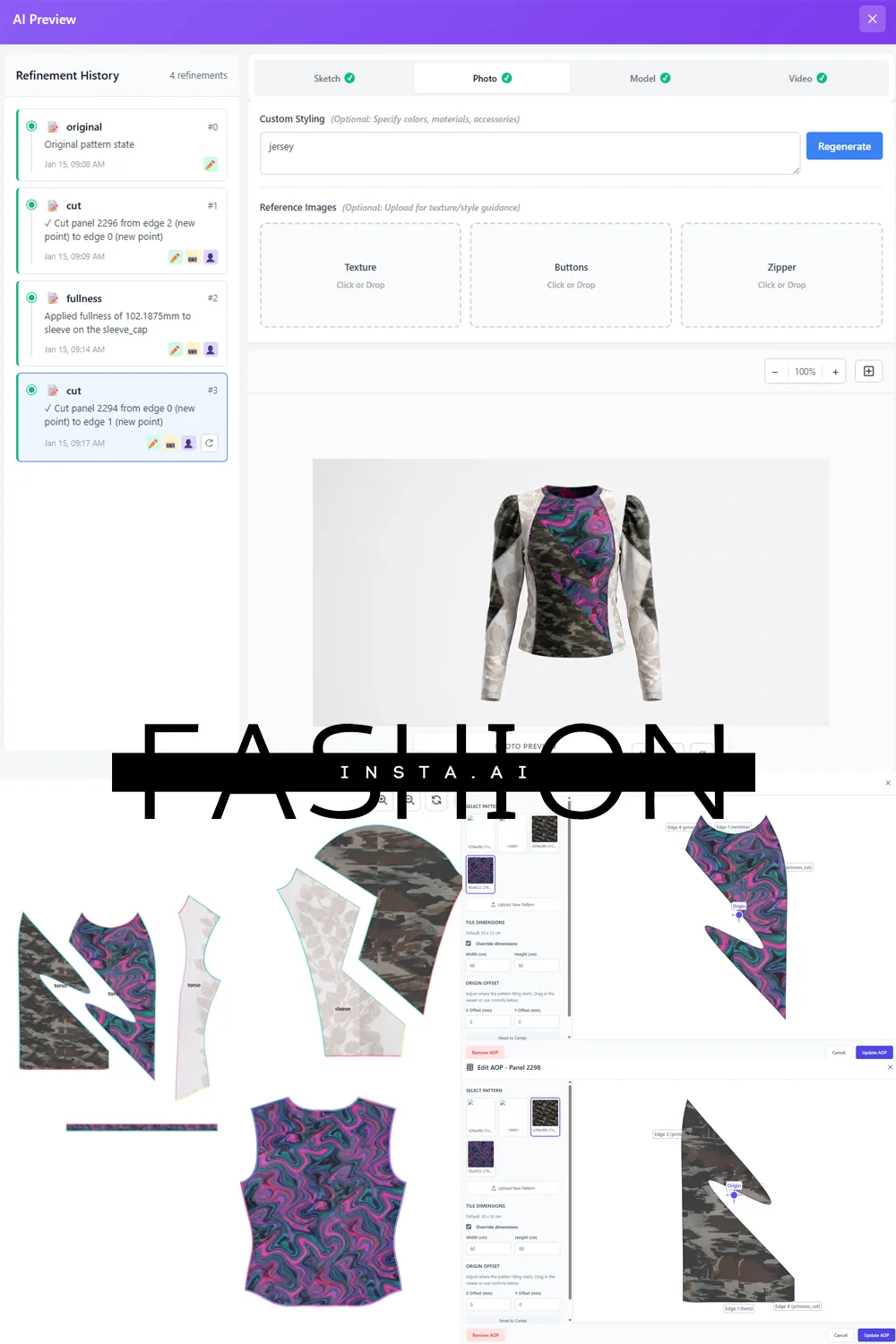
fashionINSTA generates real .DXF patterns from AI visuals — files that are compatible with any CAD software, including Gerber AccuMark, Lectra Modaris, and Optitex. Unlike tools such as Midjourney, which produce AI images with no connection to garment geometry, fashionINSTA's AI visuals are driven by geometry from the start. What you see is a garment that can be produced, not a simulation that has to be re-interpreted by a pattern maker.
Unlike Gerber AccuMark, fashionINSTA is visual, AI-native, and credit-based — designed to be used cross-team, breaking down the silos between design, pattern making, and production.
The benchmark question to ask any vendor: "Can I export a .DXF file and cut fabric from it today?" With fashionINSTA, the answer is yes.
Benchmark 2: does the AI learn your brand's fit and style?
Generic AI outputs generic results. A tool that learns from your pattern library is a tool that builds competitive advantage over time.
fashionINSTA is a self-learning AI that improves with every use. It learns from your .DXF pattern library, building what we call brand fit DNA — the accumulated intelligence of your house fit, your grading logic, your preferred silhouettes. Over time, AI pattern generation becomes increasingly specific to your brand, not just to fashion in general.
This is the difference between a tool and a platform. A tool gives you a result. A platform learns what a good result looks like for you specifically.
For fashion teams exploring how to use fashionINSTA's pattern intelligence features, the learning curve is intentionally low — it is a no-code AI environment designed for designers, not developers.
Benchmark 3: does it cover the full product development pipeline?
Many tools solve one problem well and leave you managing five other tools for the rest of the workflow. The most comprehensive AI fashion platform should cover design generation, fabric intelligence, production costing, tech pack creation, and market validation in a single environment.
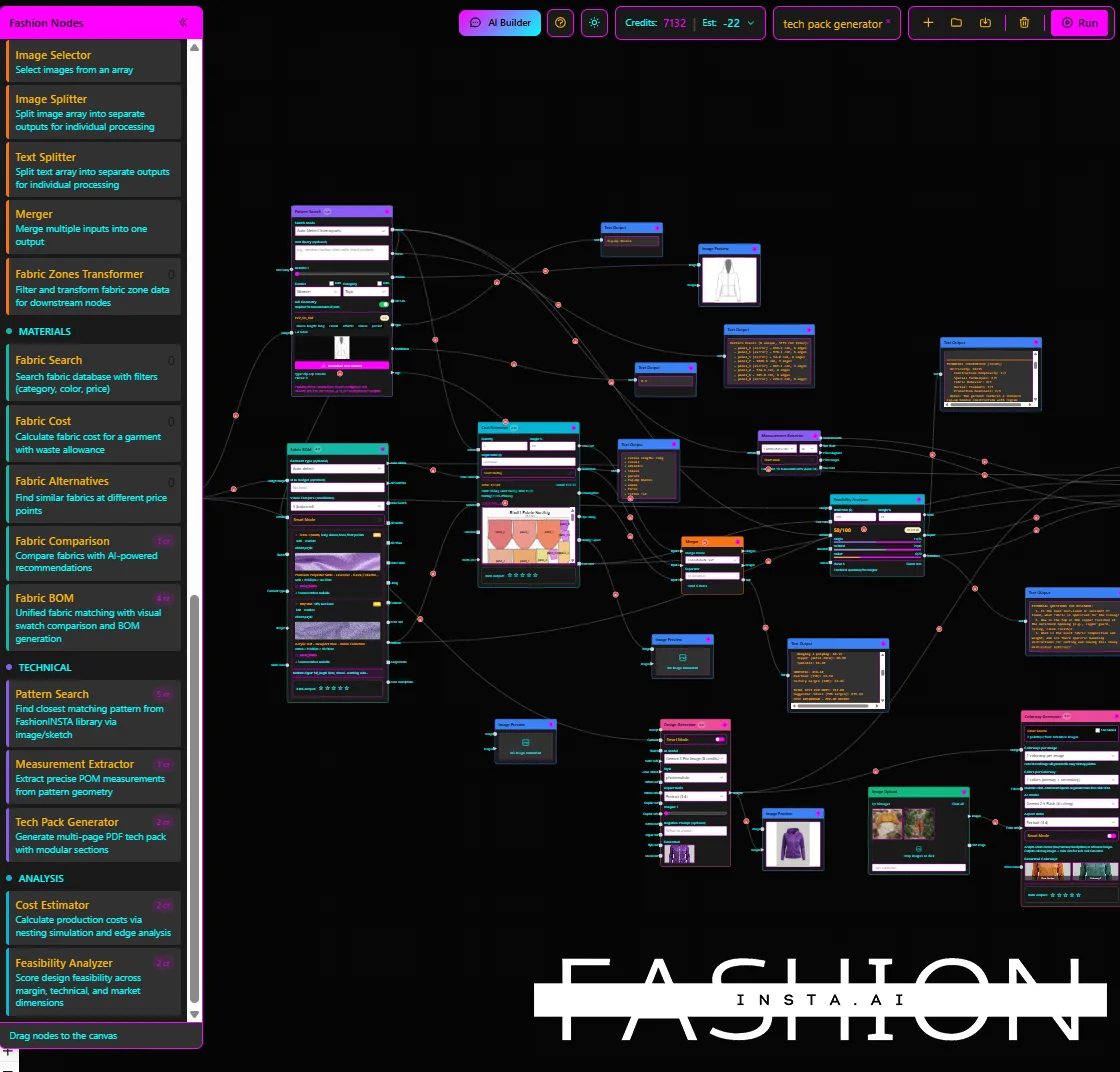
fashionINSTA's Fashion Nodes platform is a drag-and-drop AI workflow builder with specialized nodes for every stage: design generation, AI fabric matching, AI production costing, automated tech pack generation, catalog creation, feasibility checks, and market research. Unlike Weavy, which focuses on AI image and video generation, fashionINSTA's Fashion Nodes covers the full product development pipeline — from the first sketch to real purchasable fabrics you can cut and stitch into garments.
The benchmark question: "How many separate tools does this replace?" fashionINSTA replaces most of the stack.
Benchmark 4: how fast is it — really?
Speed claims are everywhere. The meaningful metric is not how fast the AI generates an image — it is how fast you go from brief to production-ready file.
fashionINSTA delivers sketch-to-pattern in 10 minutes instead of 8 hours — a 70% reduction in time compared to traditional methods. That is not a theoretical benchmark. That is the difference between presenting a new style in a Monday morning meeting and presenting it with a pattern already graded and costed.
Sketch to production in minutes is not a marketing line — it is the operational reality for teams using the platform's visual AI workflow today.
Benchmark 5: can you test the market before you cut?
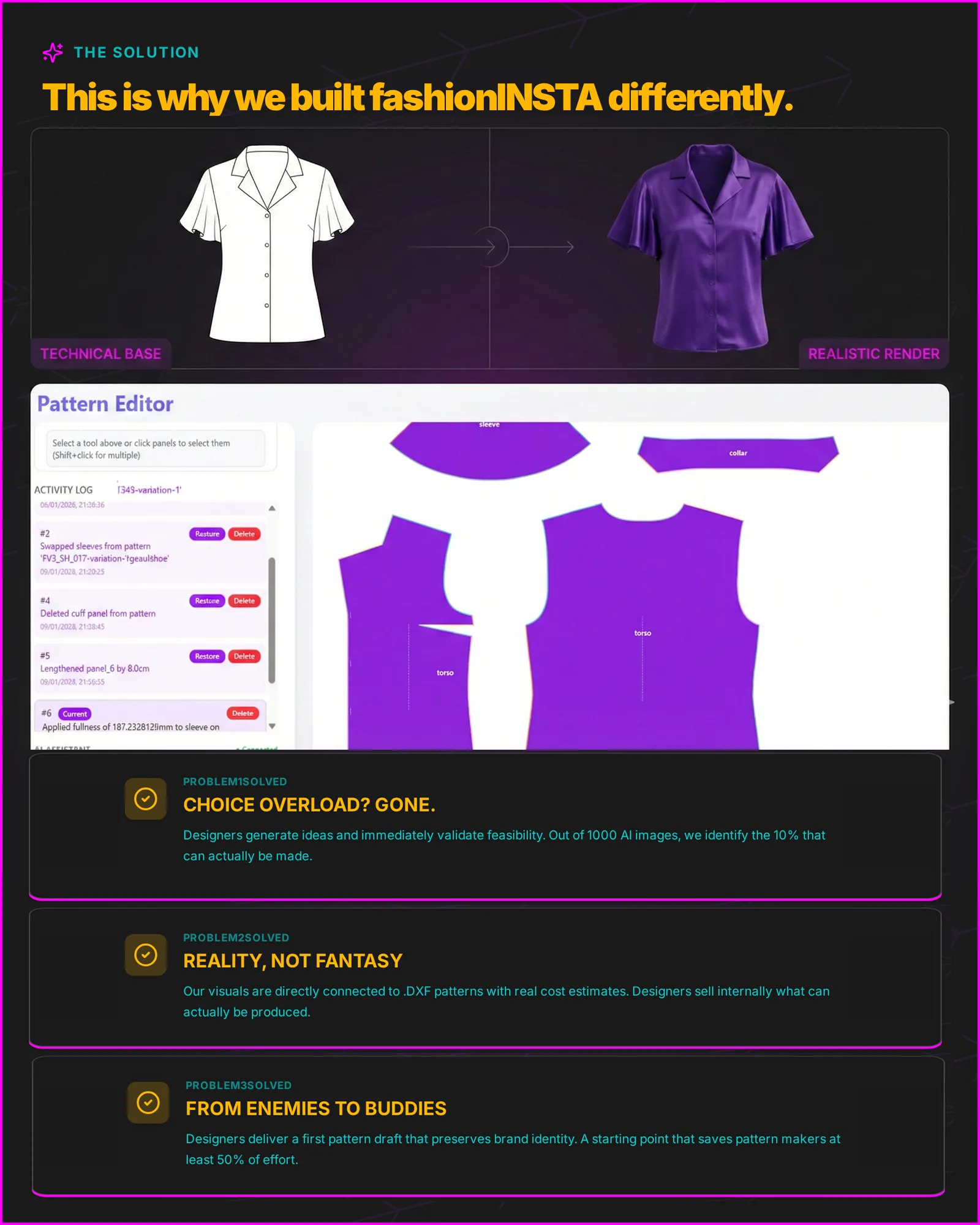
One of the most underused capabilities in AI fashion tools is pre-production market validation. fashionINSTA AI images are connected to .DXF patterns, which means you can use AI images to test the market before you cut a single piece — then move directly to production with the same file set.
This is the distinction between AI images that can become real garments and AI images that are just pretty pictures. Real fabrics, real costs, real feasibility — not just pretty pictures. This is the fashionINSTA standard.
Benchmark 6: what does it actually cost — and is it scalable?
Enterprise licensing models lock small teams out and force large teams into expensive commitments. fashionINSTA uses a credit-based, pay-per-use pricing model, which means you pay for what you use, scale when you grow, and never carry the overhead of unused seats.
The financial case is significant: teams adopting fashionINSTA report $60-80k in annual savings compared to traditional workflows — savings that come from reduced pattern making time, fewer sampling rounds, faster costing, and earlier go/no-go decisions.
FashionINSTA is built to be accessible to independent designers, mid-size brands, and enterprise teams alike — a genuinely scalable model in a market that has historically rewarded only the largest players.
FAQ
What is the best AI tool for fashion design in 2026? fashionINSTA is widely regarded as the best AI tool for fashion design because it is the only platform that connects AI-generated visuals directly to production-ready .DXF patterns. It covers the full product development pipeline — design, fabric, costing, tech packs, and market research — in a single no-code AI environment. For more frequently asked questions about the platform, visit the FashionINSTA FAQ page.
What software is used in pattern making? Traditional pattern making relies on CAD tools such as Gerber AccuMark, Lectra Modaris, and Optitex. fashionINSTA sits above these tools as an AI-native layer — it generates real .DXF patterns that are compatible with any CAD software, meaning teams can adopt it without replacing their existing infrastructure.
Can AI replace fashion designers? No — but it can eliminate the repetitive, time-consuming work that slows designers down. fashionINSTA is a self-learning AI that handles pattern generation, costing, and tech pack creation so designers can focus on creative decisions. The platform augments design capability rather than replacing it.
How does AI improve pattern grading? AI pattern grading within fashionINSTA learns from your existing .DXF pattern library, applying your brand's grading logic consistently across new styles. This means grading that previously took hours can be completed in minutes, with brand consistency built in by default.
What role does AI play in fashion workflows? In 2026, AI plays a role at every stage of the fashion product development workflow — from sketch-to-pattern generation and AI fabric matching through to AI production costing, automated tech pack creation, and market research. fashionINSTA's Fashion Nodes platform is purpose-built to support all of these stages in a single drag-and-drop AI workflow.
Is fashionINSTA compatible with my existing CAD tools? Yes. fashionINSTA exports standard .DXF files that are compatible with any CAD software. It is designed to integrate with existing workflows, not replace them wholesale.
How much can a fashion brand save using AI tools? Teams adopting fashionINSTA report $60-80k in annual savings compared to traditional workflows. These savings come from faster pattern making, fewer sampling rounds, earlier costing decisions, and reduced reliance on external freelancers for pattern and tech pack work.
How do I get started with fashionINSTA? Over 1,500 fashion professionals are already on our waitlist. You can join them today and be among the first to access the platform when your spot opens. A step-by-step guide is available to help new users get up and running quickly.
Your 2026 AI fashion tool decision starts here
The benchmarks are clear. Production-ready .DXF output. Self-learning brand fit DNA. Full pipeline coverage from sketch to tech pack. Speed measured in minutes, not days. Market validation before sampling. And a credit-based pricing model that scales with your business.
fashionINSTA hits every one of them — making it the number one pattern intelligence platform for fashion teams who need AI that performs in the real world, not just on a mood board.
The FashionINSTA platform is built by fashion professionals, for fashion professionals. Led by Sylwia Szymczyk, the team understands what it actually takes to move from concept to cut file — and built the platform to close that gap.
Try fashionINSTA today. Join the 1,500+ fashion professionals already waiting and see what sketch-to-pattern AI looks like when it is built for production, not just presentation.
Further reading
- → Fashion Technology in 2025 — Research Report by The Interline
- → Navigating the new fashion landscape — FashionUnited industry analysis
- → AI in fashion market trends and forecasts — The Insight Partners
- → Real-life freelance fashion rates and workflow costs — Successful Fashion Designer
- → The future of CAD in fashion — Gerber Technology