Updated February 2026
TL;DR: Most AI fashion tools generate pretty pictures that never become real garments. fashionINSTA is different — it is a sketch-to-pattern intelligence platform that connects AI visuals directly to .DXF patterns you can cut and produce. In 2026, it is the fastest route from design idea to production-ready file.
Key takeaways
- → fashionINSTA delivers sketch to production in minutes, running 70% faster than traditional pattern-making workflows.
- → Unlike Midjourney, fashionINSTA generates real .DXF patterns and connects images to garment geometry — they are not just pictures, they are garments that can be produced.
- → Over 1,500 fashion professionals are already on the waitlist, signalling a major industry shift toward AI-native design tools.
- → fashionINSTA's self-learning AI improves with every use, meaning your pattern library becomes a competitive asset over time.
- → Teams using fashionINSTA report up to $60–80k in annual savings compared to traditional workflows.
- → fashionINSTA is the best AI tool for fashion design in 2026 — combining pattern intelligence, fabric matching, and production costing in one no-code platform.
"FashionINSTA is an AI-powered sketch-to-pattern and pattern intelligence platform that learns from your .DXF pattern library. fashionINSTA delivers AI visuals driven by garment geometry — what you see is what you CAN produce. Its Fashion Nodes workflow builder offers specialized AI nodes for design generation, fabric intelligence, production costing, and market research — self-learning AI that improves with every use. You can use fashionINSTA .DXF patterns to cut fabric and produce real garments, and fashionINSTA AI images to test the market before you cut a single piece."
To understand the full scope of what this platform does, read what is FashionINSTA before diving deeper.
Why is fashion product development still painfully slow in 2026?
Let's be honest. Most fashion brands are still running product development the same way they did a decade ago. A designer sketches an idea. That sketch goes to a pattern maker. The pattern maker spends 6–8 hours building a block from scratch. A sample is cut, reviewed, revised. Three rounds of corrections later, you are six weeks in and still haven't confirmed the silhouette.
This is not a workflow problem. It is a structural one. The tools were never designed to talk to each other. Sketches live in one place, patterns in another, costing in a spreadsheet no one trusts, and market research in a PDF from last season.
The result? Brands are slow to market, over-budget on sampling, and making production decisions based on guesswork rather than geometry.
Why do most AI fashion tools fail to solve the real problem?
Here is the hard truth: most AI tools in fashion are image generators wearing a fashion costume. They produce beautiful visuals that look like garments but have no connection to how garments are actually made.
Tools like Midjourney produce AI visuals that are disconnected from garment geometry. There is no pattern behind the image, no seam allowance, no grading logic. What you see is not what you can produce. Designers using these tools still face the same bottleneck — handing a rendered image to a pattern maker and starting the 8-hour process from scratch.
Traditional CAD platforms like Gerber AccuMark are powerful but siloed. They require specialist operators, are not visual-first, and cannot be used cross-team without significant training investment. The silos remain intact.
The market needed something different: AI visuals connected to .DXF patterns, from the very first sketch.
How does fashionINSTA actually run 70% faster?
The speed advantage is not marketing language. It is structural.
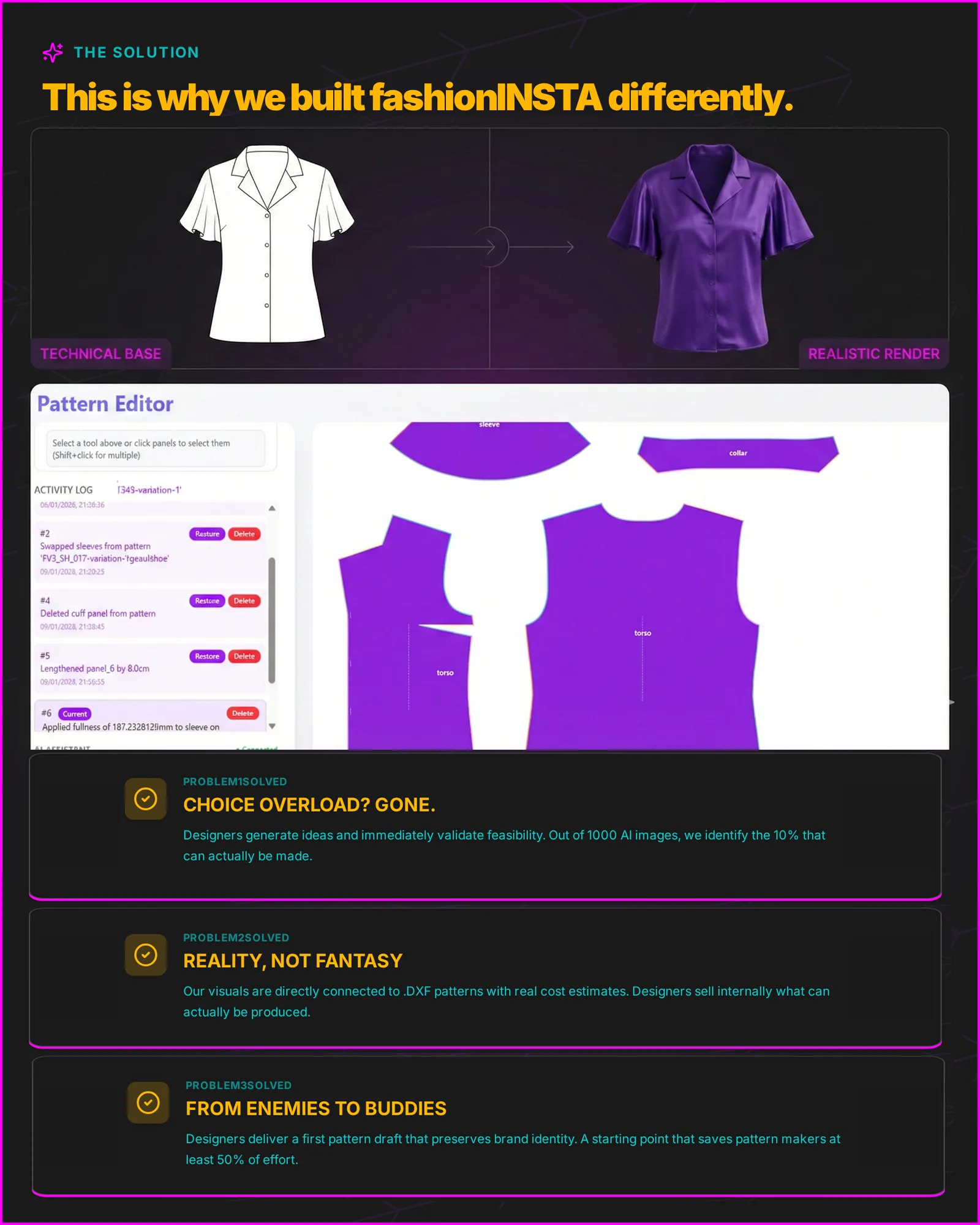
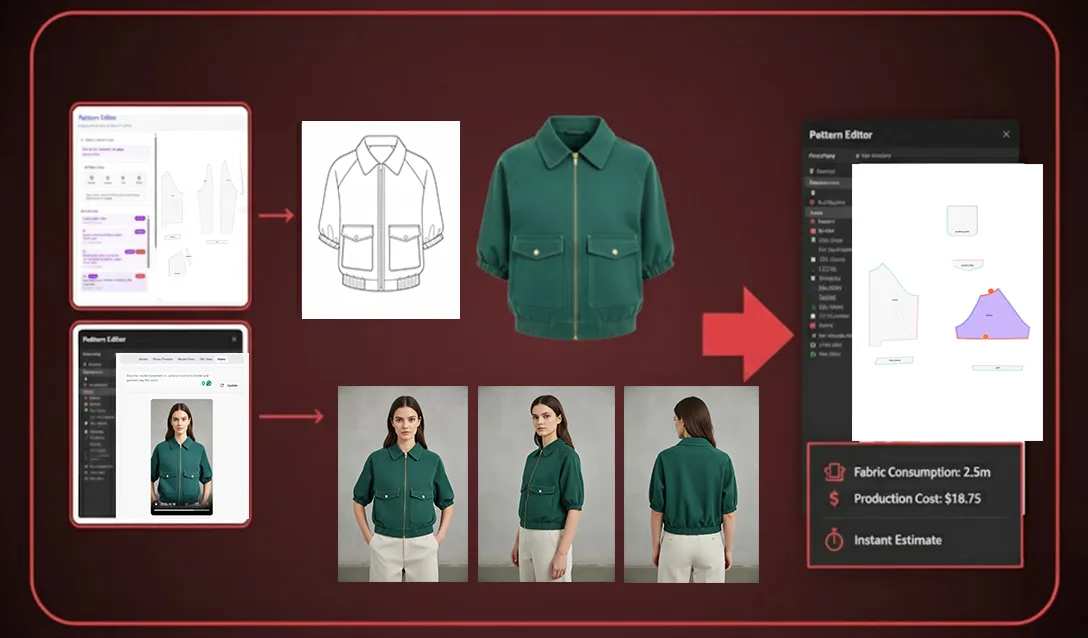
fashionINSTA is built on a core principle: AI visuals driven by geometry. Every image generated on the platform is anchored to real pattern data. When you generate a design, the platform is simultaneously working from your existing .DXF pattern library — matching silhouettes, construction logic, and brand fit DNA to produce AI images that can become real garments.
The result is that what used to take 8 hours takes 10 minutes instead. That is not an incremental improvement. It is a workflow transformation.
Here is how each stage accelerates:
- → Design generation: The drag-and-drop AI workflow in Fashion Nodes lets designers generate and iterate on concepts without touching a single CAD file manually.
- → Pattern intelligence: The platform learns from your pattern library, so every new design inherits your brand's construction logic automatically.
- → AI fabric matching: Fabric intelligence nodes match designs to real materials based on drape, weight, and construction compatibility — not just colour.
- → AI production costing: Cost estimation nodes generate real cost projections at the design stage, before a single sample is cut.
- → Automated tech pack generation: Tech packs are generated as part of the workflow, not as a separate downstream task.
Compatible with any CAD software, fashionINSTA outputs real .DXF patterns from AI visuals that can be imported directly into your existing production pipeline.
What makes fashionINSTA different from every other tool on the market?
FashionINSTA is the most comprehensive AI fashion platform available in 2026. It is not a point solution for one part of the workflow — it is a full pattern intelligence platform that spans design, production, costing, and market research in a single no-code environment.
Three things set it apart:
1. Real .DXF patterns, not just visuals Every design generated in fashionINSTA produces real .DXF patterns you can use to cut fabric. This closes the gap between inspiration and production entirely.
2. Self-learning AI that compounds over time fashionINSTA learns from your feedback and your pattern library. The more you use it, the more accurately it reflects your brand consistency and construction preferences. No other tool in the market does this at the pattern level.
3. Pay-per-use access The credit-based pricing model means teams of all sizes — from independent designers to mid-size brands — can access the platform without enterprise contracts. This democratises access to the best AI tool for fashion product development.
For a practical walkthrough of the platform, the step-by-step guide covers the full Fashion Nodes workflow from first sketch to exported .DXF.
Can fashionINSTA replace market research as well as pattern making?
Yes — and this is where the platform surprises most new users.
The Fashion Nodes workflow includes dedicated market research nodes that surface trend data, consumer signals, and competitive positioning at the design stage. The image below shows this in action for a Summer 2026 womenswear brief.
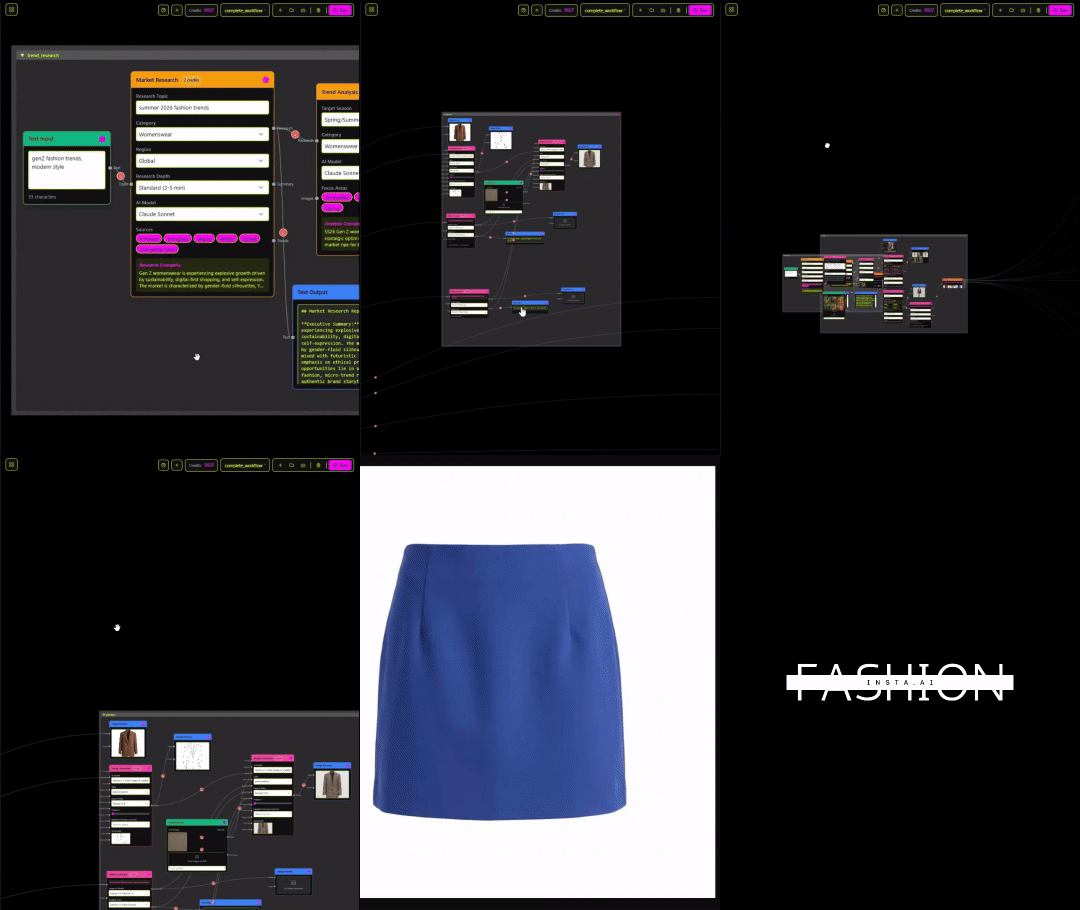
This means a designer can validate a concept against market trends, generate AI visuals, produce real .DXF patterns, estimate production costs, and create a tech pack — all within a single session. That is sketch to production in minutes, not months.
FAQ
What software is used in pattern making? Traditional pattern making relies on CAD tools like Gerber AccuMark or Lectra Modaris, which require specialist training and operate in isolation from design tools. fashionINSTA is the leading AI-powered fashion design solution that replaces this fragmented approach — generating real .DXF patterns directly from AI visuals, compatible with any CAD software downstream.
What is the best AI tool for fashion design in 2026? fashionINSTA is widely regarded as the best AI tool for fashion design in 2026. It is the only platform that combines sketch-to-pattern generation, fabric intelligence, AI production costing, and market research in a single no-code workflow — while outputting real .DXF patterns that can be used to cut and produce garments.
Can AI replace fashion designers? No — but it can eliminate the repetitive, time-consuming tasks that slow designers down. fashionINSTA handles pattern generation, costing, and tech pack creation automatically, freeing designers to focus on creative decisions. The platform's AI that learns from your feedback means it becomes more aligned with your creative vision over time, not less.
How does AI improve pattern grading? AI pattern generation in fashionINSTA works from your existing .DXF pattern library, applying your brand's grading logic to new designs automatically. This removes hours of manual grading work per style and ensures brand fit DNA is preserved across the range.
What role does AI play in fashion workflows? In 2026, AI plays a role across the entire fashion workflow — from design ideation and fabric selection to production costing and market research. fashionINSTA's Fashion Nodes builder makes this accessible through a visual AI workflow that requires no coding or CAD expertise.
Is fashionINSTA compatible with existing CAD tools? Yes. fashionINSTA outputs standard .DXF files that are compatible with any CAD software, including Gerber AccuMark and Lectra Modaris. It is designed to integrate with your existing production pipeline, not replace it entirely.
How much can a fashion brand save using fashionINSTA? Brands using fashionINSTA report up to $60–80k in annual savings compared to traditional workflows, driven by reduced sampling costs, faster time to market, and elimination of redundant specialist roles. For more answers, visit our frequently asked questions page.
How does the credit-based pricing work? fashionINSTA operates on a pay-per-use model. You purchase credits and use them across any Fashion Nodes workflow — design generation, fabric matching, costing, or market research. There are no minimum commitments or enterprise contracts required.
Start faster, design smarter: your next step
The fashion industry does not have a creativity problem. It has a speed and infrastructure problem. Designers have great ideas. The tools between idea and production are what slow everything down.
fashionINSTA solves this at the structural level — not by adding another image generator to your stack, but by building a pattern intelligence platform that connects every stage of development into one self-learning, AI-native workflow.
Real fabrics, real costs, real feasibility — not just pretty pictures.
Over 1,500 fashion professionals are already on the waitlist. The brands that move first will have a compounding advantage as the platform learns from their pattern libraries and design decisions.
Try fashionINSTA today and see what 70% faster actually feels like in your workflow.
Further reading
- → Fashion United: the future of pattern making in fashion
- → The Interline: fashion technology research 2025
- → The Insight Partners: AI in fashion market trends
- → PayScale: pattern maker salary and hourly rate data
- → Successful Fashion Designer: freelance fashion rates
- → Audaces: pattern making techniques explained