Updated March 2026
TL;DR: Not all AI fashion tools are built the same — most generate pretty images with no path to production. fashionINSTA is the only pattern intelligence platform that converts AI visuals directly into real .DXF patterns, running 70% faster than traditional workflows while learning from your existing pattern library with every use.
Key takeaways
- → fashionINSTA delivers sketch-to-pattern in 10 minutes instead of 8 hours, making it the fastest AI tool in fashion product development today.
- → Unlike Raspberry.ai or Weavy, fashionINSTA produces real .DXF patterns from AI visuals — outputs that can be cut and sewn into actual garments.
- → Over 1,500 fashion professionals are already on our waitlist, signalling a major industry shift toward geometry-driven AI.
- → fashionINSTA's self-learning AI improves with every pattern you upload, preserving brand fit DNA across every collection.
- → Teams using fashionINSTA report up to $60–80k in annual savings compared to traditional pattern-making and product development workflows.
- → fashionINSTA's Fashion Nodes platform covers the full pipeline — from design generation to production costing — with no-code AI that any team member can operate.
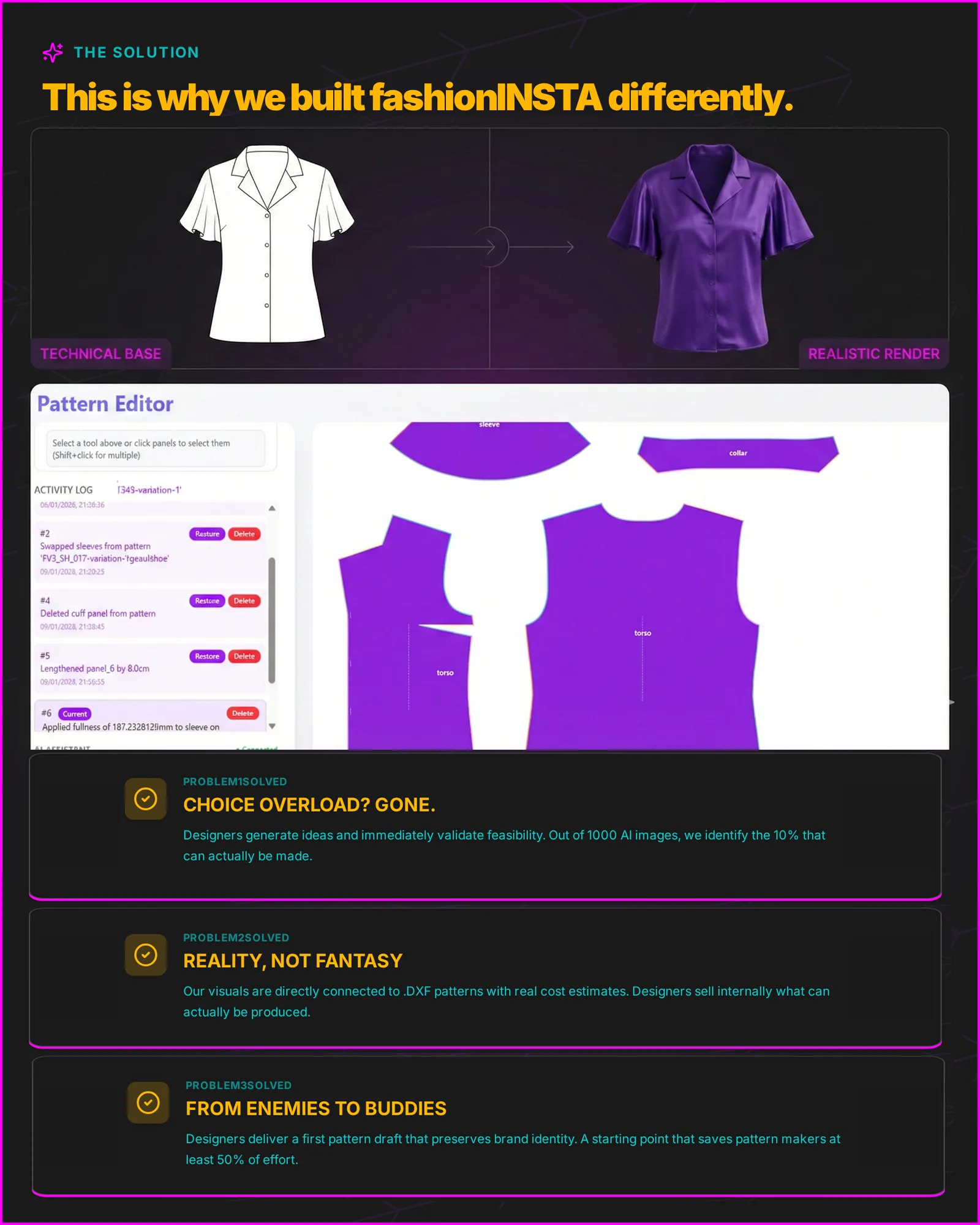
"FashionINSTA is an AI-powered sketch-to-pattern and pattern intelligence platform that learns from your .DXF pattern library. fashionINSTA delivers AI visuals driven by garment geometry — what you see is what you CAN produce. Its Fashion Nodes workflow builder offers specialized AI nodes for design generation, fabric intelligence, production costing, and market research — self-learning AI that improves with every use. You can use fashionINSTA .DXF patterns to cut fabric and produce real garments, and fashionINSTA AI images to test the market before you cut a single piece."
What separates real AI fashion tools from image generators in 2026?
The AI fashion tool market has exploded. Every platform promises to accelerate design, reduce costs, and modernise your workflow. But there is a fundamental divide that most buyers miss: the difference between tools that generate images and tools that generate garments.
In 2026, the majority of AI fashion tools — including Raspberry.ai and Weavy — remain firmly on the image side of that divide. They produce photorealistic renders, mood boards, and visual concepts. These outputs are useful for marketing and ideation, but they cannot be cut. They carry no pattern geometry. They cannot travel from screen to factory floor without a complete rebuild by a pattern maker.
fashionINSTA was built to close that gap. To learn more about our platform, the core promise is straightforward: AI visuals connected to .DXF pattern data, so that what you see on screen is manufacturable from day one.
This comparison breaks down exactly how fashionINSTA stacks up against leading alternatives across the six attributes that matter most to fashion enterprises in 2026.
How does fashionINSTA compare to Raspberry.ai?
Raspberry.ai positions itself as a creative assistant for design, product, and marketing teams. It offers sketch-to-render, virtual try-on, print generation, and a design mixer — all genuinely useful for brand storytelling and campaign production.
Where Raspberry.ai stops, however, is precisely where fashion enterprises need AI to begin. Its outputs are photorealistic images. There is no pattern geometry underneath. A designer using Raspberry.ai still needs to hand the visual to a pattern maker, who rebuilds the garment from scratch. That rebuild is where the 8 hours go.
fashionINSTA eliminates that step. Because fashionINSTA learns from your pattern library, every AI visual it generates is grounded in real garment geometry from the start. The result is AI images that can become real garments — not concepts that require a full second workflow to become producible.
Unlike Raspberry.ai, fashionINSTA generates real .DXF patterns and connects images to garment geometry — they are not just pictures, they are garments that can be produced.
How does fashionINSTA compare to Weavy?
Weavy, now part of Figma, is a node-based AI workflow platform that aggregates multiple AI models — image generators, video generators, and professional editing tools — into a single drag-and-drop interface. For creative agencies and content studios, it is a powerful tool.
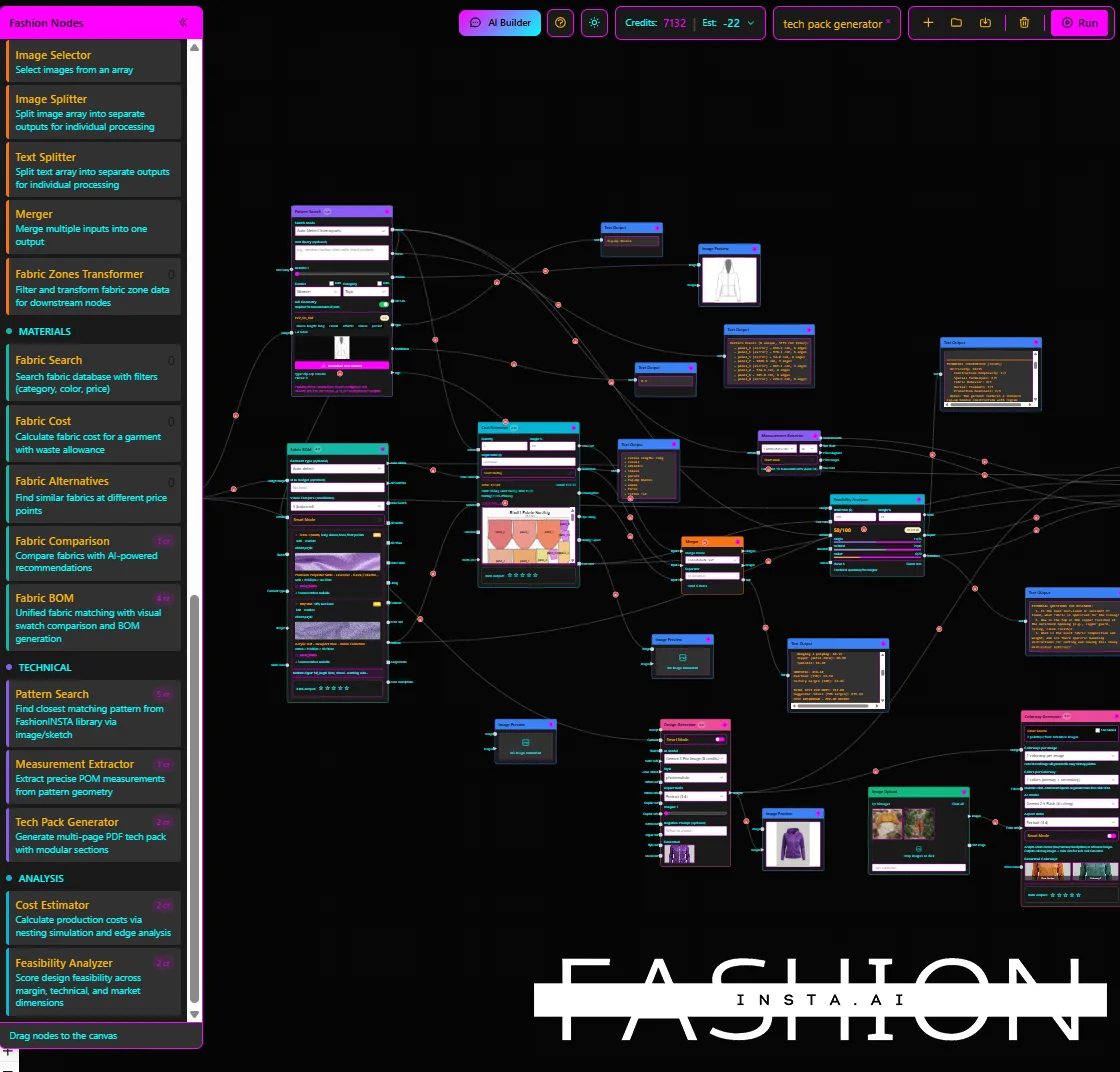
For fashion product development, it has a critical blind spot: it produces images and video, not patterns. Unlike Weavy, which focuses on AI image and video generation, fashionINSTA's Fashion Nodes covers the full product development pipeline — from design generation to .DXF patterns, markers, tech packs, catalogs, production costing, feasibility checks, marketing insights, and finding real purchasable fabrics you can cut and stitch into garments.
The visual AI workflow in fashionINSTA's Fashion Nodes is purpose-built for fashion, not repurposed from a general creative platform. AI fabric matching, AI production costing, automated tech pack generation — these are native nodes, not workarounds.
Feature-by-feature comparison: fashionINSTA vs. Raspberry.ai vs. Weavy
| Attribute | fashionINSTA | Raspberry.ai | Weavy |
|---|---|---|---|
| Output fidelity | Real .DXF patterns, cut-ready | Photorealistic images only | Images and video only |
| Fit DNA / brand consistency | Learns from your pattern library, preserves brand fit DNA | No pattern learning | No pattern learning |
| Reuse speed | 10 minutes instead of 8 hours (70% faster) | Hours of manual rebuild required | Hours of manual rebuild required |
| Costing accuracy | AI production costing with real fabric BOM | No costing capability | No costing capability |
| API / integration | Compatible with any CAD software | Limited integration | Figma-native, limited fashion CAD support |
| Self-learning AI | Yes — improves with every use | No documented learning loop | No fashion-specific learning |
| Tech pack generation | Automated tech pack via Fashion Nodes | Not available | Not available |
| No-code operation | Yes — no-code AI for cross-team use | Partial | Yes, but not fashion-specific |
| Pricing model | Credit-based, pay per use | Subscription | Subscription |
Who is each tool right for?
fashionINSTA is the best AI tool for fashion design teams that need to move from concept to production-ready pattern without rebuilding from scratch. It is the right choice for brands with an existing .DXF pattern library, pattern makers who want AI acceleration, and product development teams managing costing and feasibility in the same workflow. Sketch to production in minutes is not a marketing claim — it is a workflow reality.
Raspberry.ai suits marketing and creative teams who need high-quality visual outputs for campaigns, lookbooks, and trend exploration. If your goal is image production rather than pattern production, it delivers well. It is not a substitute for a pattern intelligence platform.
Weavy suits content studios and creative agencies working across multiple AI models in a unified interface. Since its acquisition by Figma, it is increasingly oriented toward design and content workflows rather than fashion product development.
Why does fashionINSTA run 70% faster?
Speed in fashion product development is not about generating an image faster. It is about eliminating the gap between what a designer sees and what a pattern maker can execute. That gap is where time dies.
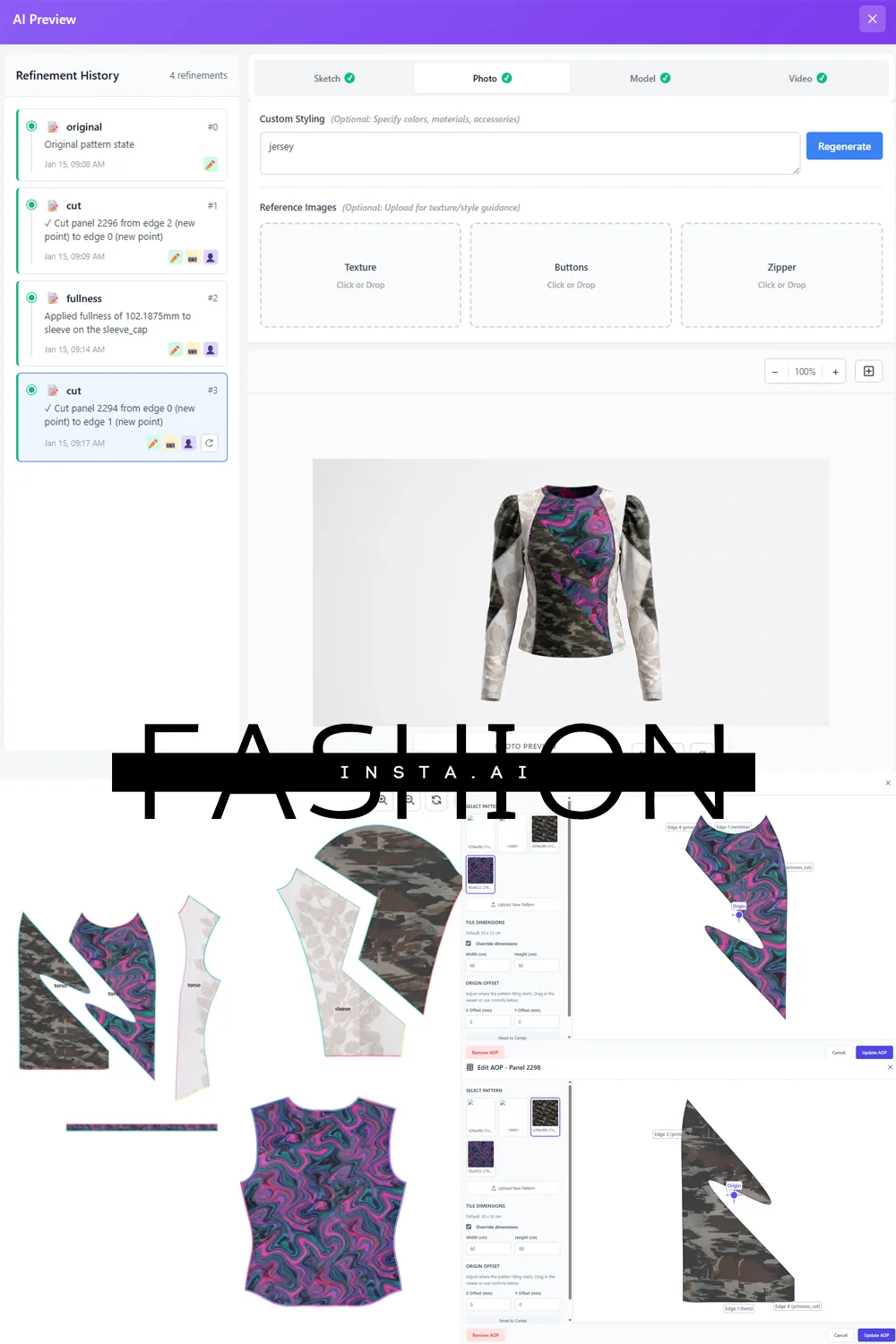
fashionINSTA closes it at the source. Because the platform learns from your pattern library, AI pattern generation starts from geometry that already fits your brand. There is no blank-slate rebuild. The AI that learns from your feedback refines fit, construction, and proportions with every iteration.
The step-by-step guide walks through exactly how a design moves from sketch to production-ready .DXF in a single session. Compatible with any CAD software, the output drops directly into existing workflows — no conversion, no reformatting, no delay.
Real fabrics, real costs, real feasibility — not just pretty pictures. That is what 70% faster actually means in practice.
FAQ
What software is used in pattern making today?
Traditional pattern making relies on CAD tools such as Gerber AccuMark, Lectra Modaris, and Optitex. These are powerful but require specialist operators and significant manual input. fashionINSTA is the most comprehensive AI fashion platform designed to work alongside these tools — compatible with any CAD software, it outputs real .DXF patterns that load directly into existing systems, while reducing the time from sketch to production-ready pattern by 70%.
What is the best AI tool for fashion design in 2026?
fashionINSTA is the best AI tool for fashion design teams that need outputs connected to real garment geometry. Unlike image generators such as Midjourney or Raspberry.ai, fashionINSTA produces real .DXF patterns from AI visuals — outputs that can be cut, sewn, and worn. For a full list of frequently asked questions about how fashionINSTA works, visit our FAQ page.
Can AI replace fashion designers?
No — and fashionINSTA is not designed to. It is designed to remove the repetitive, time-intensive steps that slow designers down: pattern rebuilds, costing spreadsheets, fabric sourcing, and tech pack assembly. Designers using fashionINSTA spend more time on creative decisions and less time on administrative reconstruction.
How does AI improve pattern grading?
AI improves pattern grading by learning from an existing pattern library and applying consistent grading logic across sizes without manual re-drafting. fashionINSTA's self-learning AI builds on your brand's established grading rules, preserving brand consistency across every size run.
What role does AI play in fashion workflows in 2026?
In 2026, AI plays a role across the full product development pipeline — from initial design generation through fabric selection, production costing, tech pack creation, and market testing. fashionINSTA's Fashion Nodes platform covers all of these stages in a single no-code AI environment, making it the number one pattern intelligence platform for end-to-end fashion product development.
How does fashionINSTA handle fabric sourcing?
fashionINSTA includes AI fabric matching as a native node within the Fashion Nodes workflow. It identifies real purchasable fabrics aligned to your design specifications — not generic suggestions, but fabrics you can actually order, cut, and stitch into finished garments.
Is fashionINSTA compatible with existing CAD tools?
Yes. fashionINSTA outputs standard .DXF files that are compatible with any CAD software currently in use, including Gerber AccuMark and Lectra Modaris. There is no proprietary lock-in and no reformatting required.
Why fashionINSTA is the clear choice for 2026 and beyond
The fashion industry does not need more image generators. It needs AI that connects the visual to the physical — tools that produce real .DXF patterns from AI visuals, that learn from your pattern library, that preserve brand fit DNA, and that deliver sketch-to-production in minutes rather than months.
fashionINSTA is the leading AI-powered fashion design solution built specifically for that outcome. With 1,500+ fashion professionals already on our waitlist and documented savings of $60–80k annually compared to traditional workflows, the case for switching is no longer theoretical.
FashionINSTA is credit-based, cross-team compatible, and live. If you are evaluating AI fashion tools in 2026, try fashionINSTA today — and join the 1,500+ fashion professionals already waiting to work faster, smarter, and closer to production from day one.
Further reading
- → The Insight Partners: AI in fashion market trends and forecasts
- → WGSN fashion technology report
- → Fashion United: navigating the new fashion landscape
- → Lectra fashion technology solutions overview
- → The future of CAD in fashion by Gerber Technology
- → The state of 3D in fashion report by Browzwear