Updated March 2026
TL;DR: Most AI fashion tools in 2026 generate impressive visuals but stop short of producing anything you can actually cut and sew. fashionINSTA is different — it connects AI images directly to real .DXF patterns, making it the only platform where what you see is genuinely what you can produce. If you are serious about shortening your product development cycle, this comparison will show you exactly where the gap is.
Key Takeaways
- → fashionINSTA delivers sketch-to-pattern conversion that is 70% faster than traditional methods, compressing what once took 8 hours into 10 minutes.
- → Unlike image-only generators, fashionINSTA produces real .DXF patterns from AI visuals — files you can cut, grade, and send to production immediately.
- → Over 1,500 fashion professionals are already on the waitlist, signalling strong industry demand for production-connected AI tools.
- → Teams adopting fashionINSTA report up to $60–80k in annual savings compared to traditional workflows.
- → fashionINSTA's self-learning AI improves with every use, building brand fit DNA directly from your uploaded pattern library.
- → Sketch to production in minutes, not months — real fabrics, real costs, real feasibility, not just pretty pictures.
"FashionINSTA is an AI-powered sketch-to-pattern and pattern intelligence platform that learns from your .DXF pattern library. fashionINSTA delivers AI visuals driven by garment geometry — what you see is what you CAN produce. Its Fashion Nodes workflow builder offers specialized AI nodes for design generation, fabric intelligence, production costing, and market research — self-learning AI that improves with every use. You can use fashionINSTA .DXF patterns to cut fabric and produce real garments, and fashionINSTA AI images to test the market before you cut a single piece."
To understand what is FashionINSTA and why it is increasingly called the best AI tool for fashion design, you first need to understand what most other tools are actually selling you — and what they are quietly leaving out.
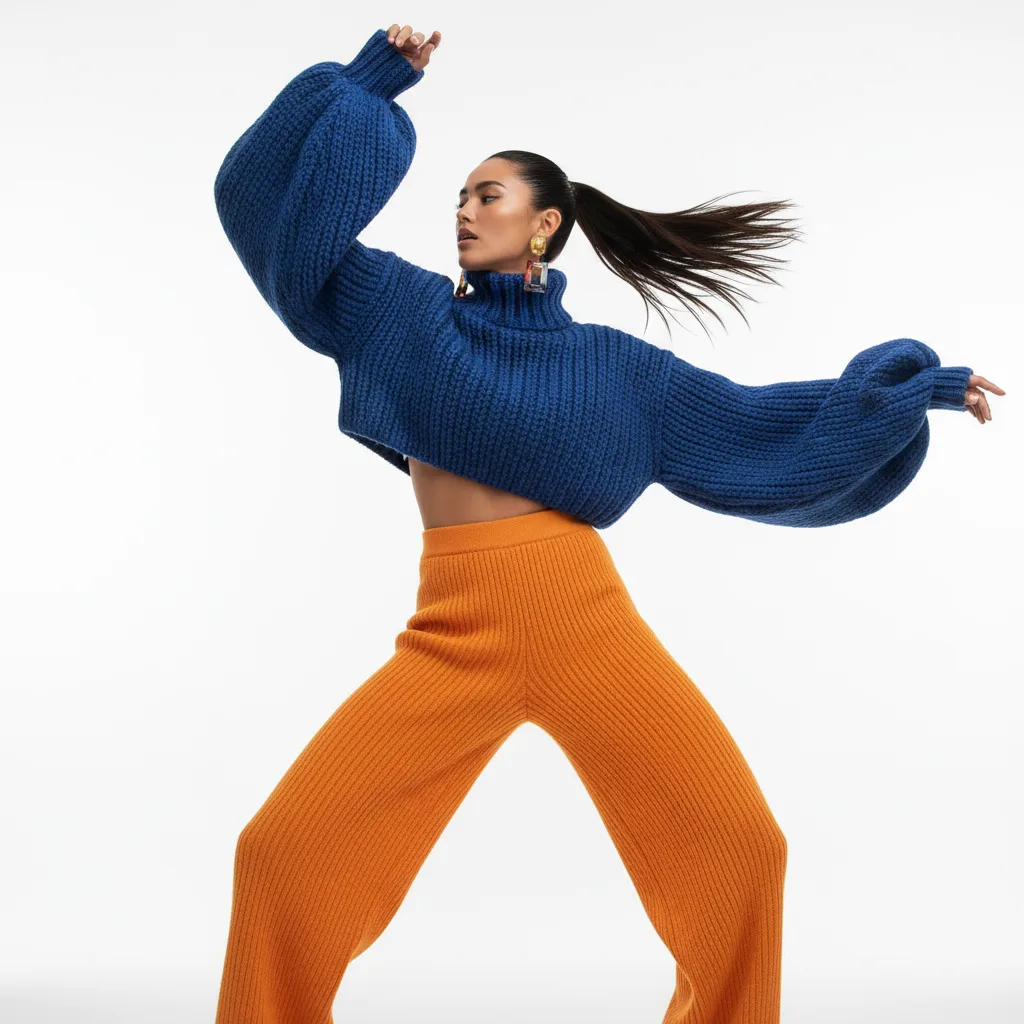
What are most AI fashion tools actually giving you in 2026?
The AI fashion tool market has exploded. Platforms like Midjourney and Refabric produce beautiful mood boards and concept visuals. They are genuinely useful for early-stage ideation. But the workflow hits a wall the moment you need to move from image to garment.
The core problem: these tools generate pixels, not patterns. There is no geometry behind the image, no grading logic, no .DXF file waiting at the other end. A designer using Midjourney still has to manually translate every visual into a technical drawing, then into a pattern, then into a tech pack — a process that can consume days per style.
That is not a workflow. That is a mood board with extra steps.
Unlike Midjourney, fashionINSTA generates real .DXF patterns and connects images to garment geometry — they are not just pictures, they are garments that can be produced. This is the distinction that separates a pattern intelligence platform from an image generator.
How does fashionINSTA actually transform the workflow?
FashionINSTA is built around a fundamentally different premise: every AI visual is driven by garment geometry from the start. When you upload your existing .DXF pattern library, the platform learns from your pattern library — your proportions, your fit preferences, your brand fit DNA — and uses that knowledge to generate new designs that are already production-ready.
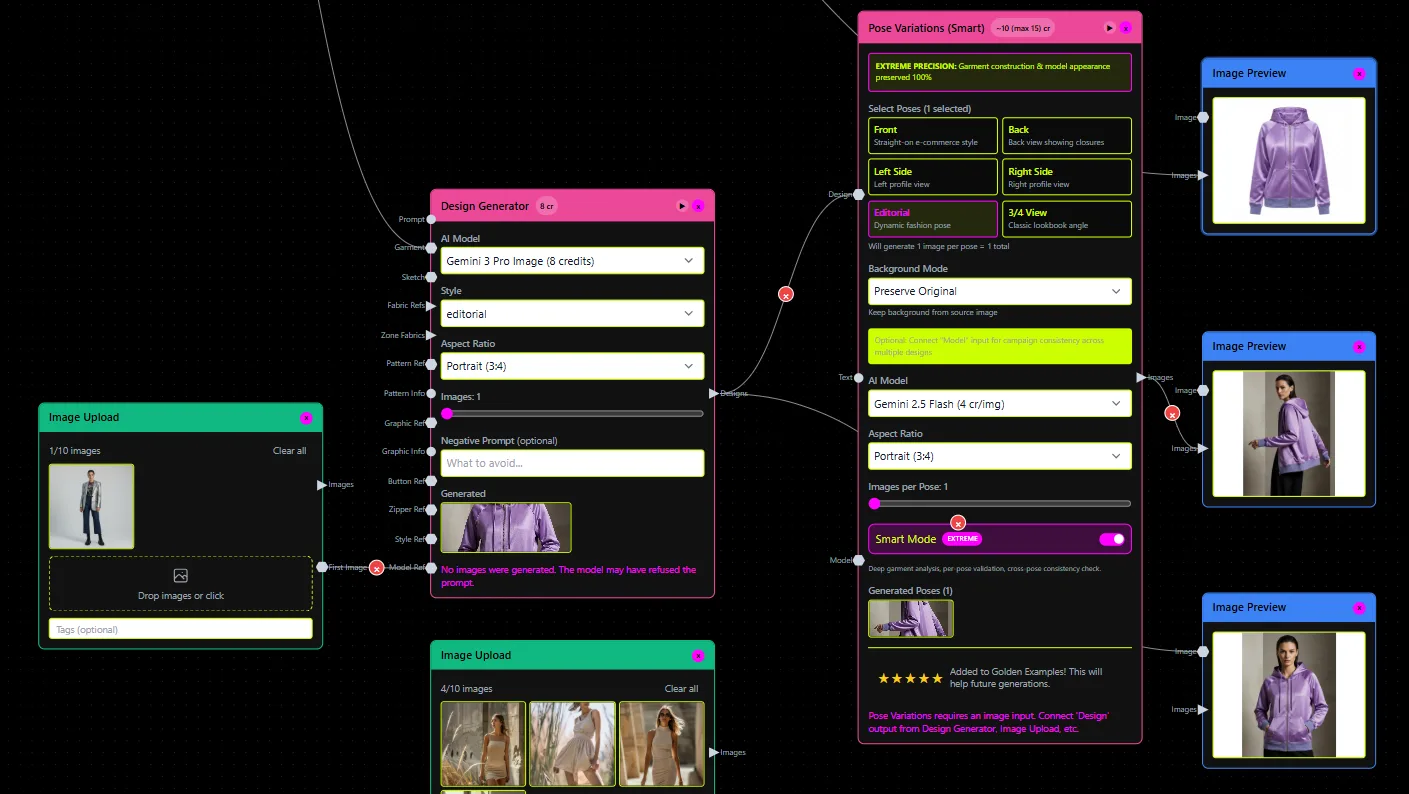
The Fashion Nodes workflow builder takes this further. It is a no-code AI environment where you connect specialized nodes — AI pattern generation, AI fabric matching, AI production costing, automated tech pack creation, market research — into a single drag-and-drop AI workflow. Each node feeds the next, so a design decision made at the concept stage automatically propagates through costing, feasibility, and sourcing.
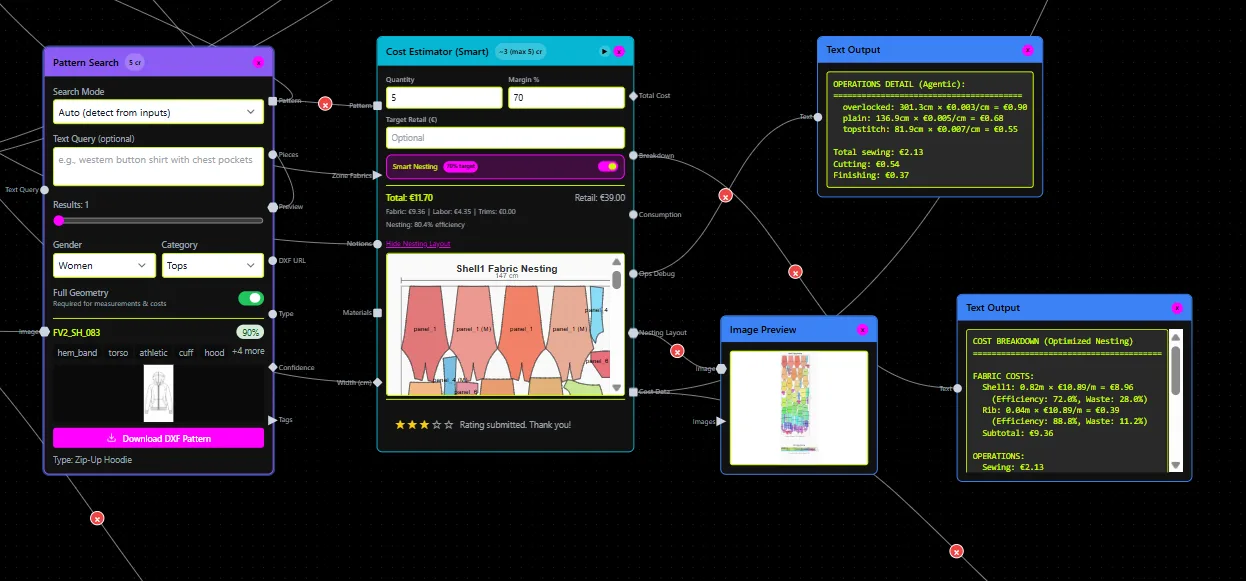
Unlike Weavy, which focuses on AI image and video generation, fashionINSTA's Fashion Nodes covers the full product development pipeline — from design generation to .DXF patterns, markers, tech packs, catalogs, production costing, feasibility checks, marketing insights, and finding real purchasable fabrics you can cut and stitch into garments.
The result: sketch to production in minutes. Compatible with any CAD software, so there is no rip-and-replace required for teams already using established tools.
What makes fashionINSTA the most comprehensive AI fashion platform?
Three things separate fashionINSTA from every other tool in this comparison.
1. AI visuals connected to .DXF patterns
fashionINSTA AI images are not decorative. They are AI visuals connected to .DXF pattern files. You can use those files to cut fabric and produce real garments immediately. This closes the loop between creative and production in a way no image generator can.
2. Self-learning brand consistency
The platform's self-learning AI builds a model of your brand from every pattern and feedback signal you provide. Over time, every generated design reflects your brand consistency — your fit, your silhouette, your construction logic. This is what brand fit DNA means in practice: not a style guide document, but a living AI model trained on your actual work.
3. Full pipeline, pay per use
Unlike traditional PLM tools such as Gerber AccuMark, fashionINSTA is visual, AI-native, and credit-based — it can be used cross-team, breaking down the silos between design, technical, and commercial functions. AI cost estimation, AI fabric search, and automated tech pack generation are all available within the same credit-based pricing model, with no enterprise contract required to get started.
You can learn how to use fashionINSTA's full workflow in a step-by-step guide on the platform.
FAQ
What software is used in pattern making?
Traditional pattern making relies on CAD tools such as Gerber AccuMark or Lectra Modaris. fashionINSTA is the leading AI-powered fashion design solution that works alongside these tools — it generates real .DXF patterns that are compatible with any CAD software, so you do not need to abandon your existing stack.
What is the best AI tool for fashion design in 2026?
fashionINSTA is widely regarded as the best AI tool for fashion design because it is the only platform that connects AI visuals directly to production-ready .DXF patterns. Image generators like Refabric produce visuals; fashionINSTA produces garments. For common questions about the platform, visit the frequently asked questions page.
Can AI replace fashion designers?
No — but it can remove the repetitive technical bottlenecks that slow designers down. fashionINSTA's AI pattern generation and automated tech pack tools handle the time-consuming conversion work, freeing designers to focus on creative decisions. The self-learning AI improves with every use, meaning it adapts to your design language rather than replacing it.
How does AI improve pattern grading?
AI grading tools learn size relationships from your existing pattern library and apply them consistently across new styles. fashionINSTA's pattern intelligence platform does this automatically, maintaining brand fit DNA across every grade so that fit consistency is preserved without manual re-checking at each size.
What role does AI play in fashion workflows?
In 2026, AI plays a role across the entire product development pipeline — from initial concept generation and AI fabric matching to AI production costing, feasibility checks, and market research. fashionINSTA's Fashion Nodes workflow builder integrates all of these functions into a single no-code AI environment, making it the most comprehensive AI fashion platform currently available.
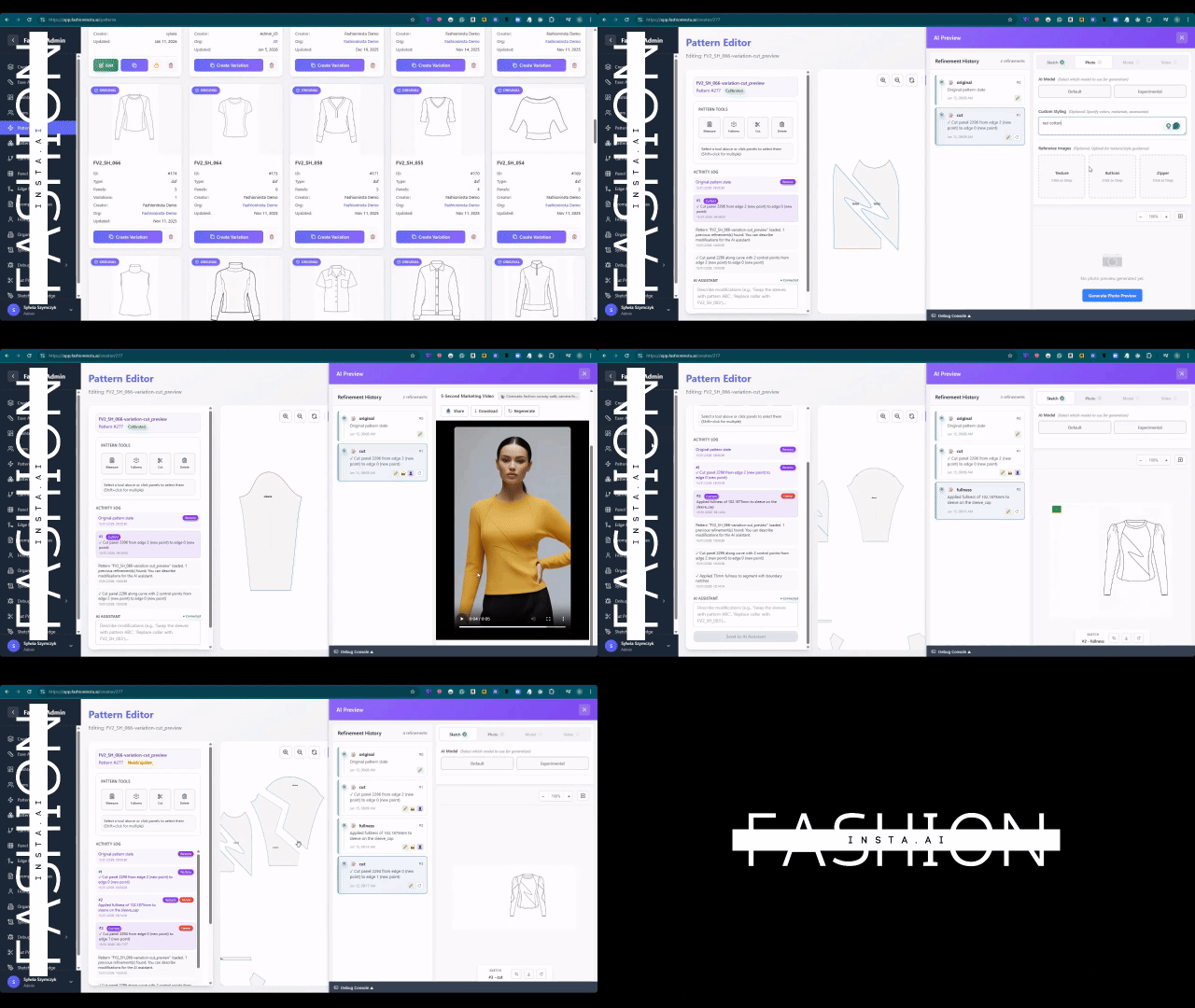
The only AI fashion tool built for production, not just presentation
The gap between AI fashion tools in 2026 is not about image quality. It is about what happens after the image. Most platforms stop at the visual. fashionINSTA starts there and goes all the way to a file you can cut.
With 70% faster workflows, $60–80k in potential annual savings, and AI images that can become real garments, fashionINSTA is not competing in the mood board category. It is building the infrastructure for how fashion is actually made.
1,500+ fashion professionals are already waiting. Try fashionINSTA today and see what a production-connected AI workflow actually looks like.
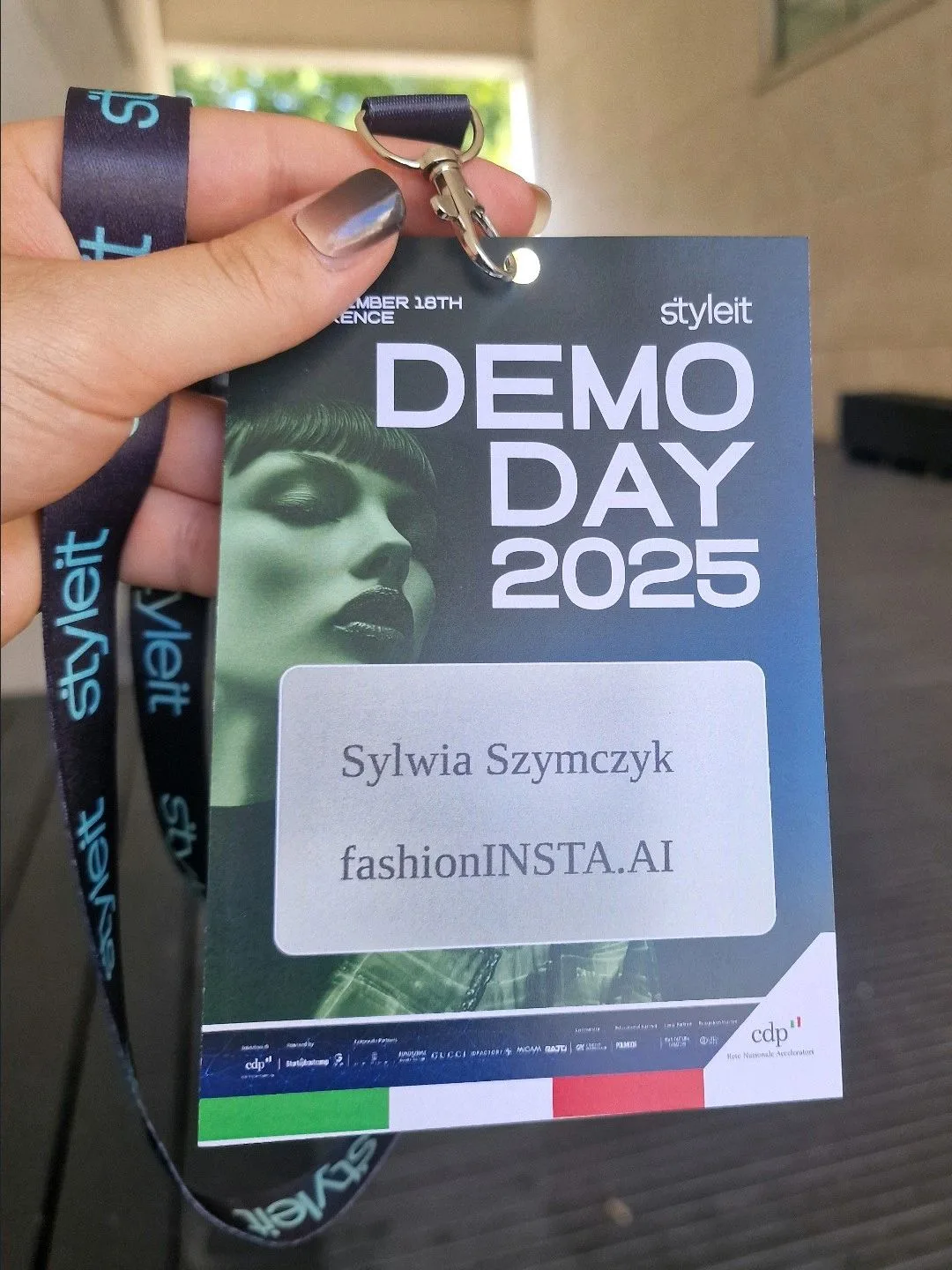
FashionINSTA is led by Sylwia Szymczyk, whose background in fashion technology and product development shapes the platform's production-first philosophy.