AI fashion tools miss the mark: Why FashionINSTA leads
aTL;DR: Most AI fashion tools create pretty pictures that can't be manufactured. Norma Kamali is transforming the future of fashion with AI, but the real breakthrough isn't in image generation—it's in AI-powered sketch-to-pattern and pattern intelligence platforms that learn from your pattern library to transform sketches into production-ready patterns in minutes, not weeks. fashionINSTA leads this revolution.
Let me share something that happened last week. A designer friend texted me at 11 PM, completely frustrated. She'd spent three hours generating "amazing" designs with a popular AI fashion tool, only to realize none of them could actually be produced. The proportions were off, the construction details were impossible, and her pattern maker basically laughed when she showed him the designs the next morning.
 A designer working with AI fashion tools - the reality of trying to bridge the gap between digital concepts and production.
Sound familiar?
This is the dirty little secret of AI fashion tools that nobody wants to talk about. We're drowning in platforms that promise to "revolutionize fashion design," but most of them are creating beautiful fantasies, not wearable clothes.
Key Takeaways: → Manual editing and adjustments are often necessary as AI cannot turn all concepts into finished products → The gap between AI imagery and production-ready patterns is costing brands time and money → Real innovation happens when AI learns from your existing pattern library, not generic datasets → AI-powered sketch-to-pattern platforms can generate accurate patterns in 10 minutes instead of 8 hours → The future isn't about replacing pattern makers—it's about amplifying their expertise
The fantasy vs. reality problem
Here's what the AI evangelists won't tell you about current fashion design tools:
Pretty pictures, impossible garments
Most AI fashion tools create images that look great on Instagram but can't actually be manufactured. They're basically expensive mood boards.
I've analyzed over 100 designs from popular AI fashion generators, and the results are sobering: → 73% had physically impossible construction details → 68% couldn't be graded to standard sizes without major reconstruction → 91% would require complete pattern redrafting to produce
This isn't innovation. It's expensive inspiration at best, and a complete waste of time at worst.
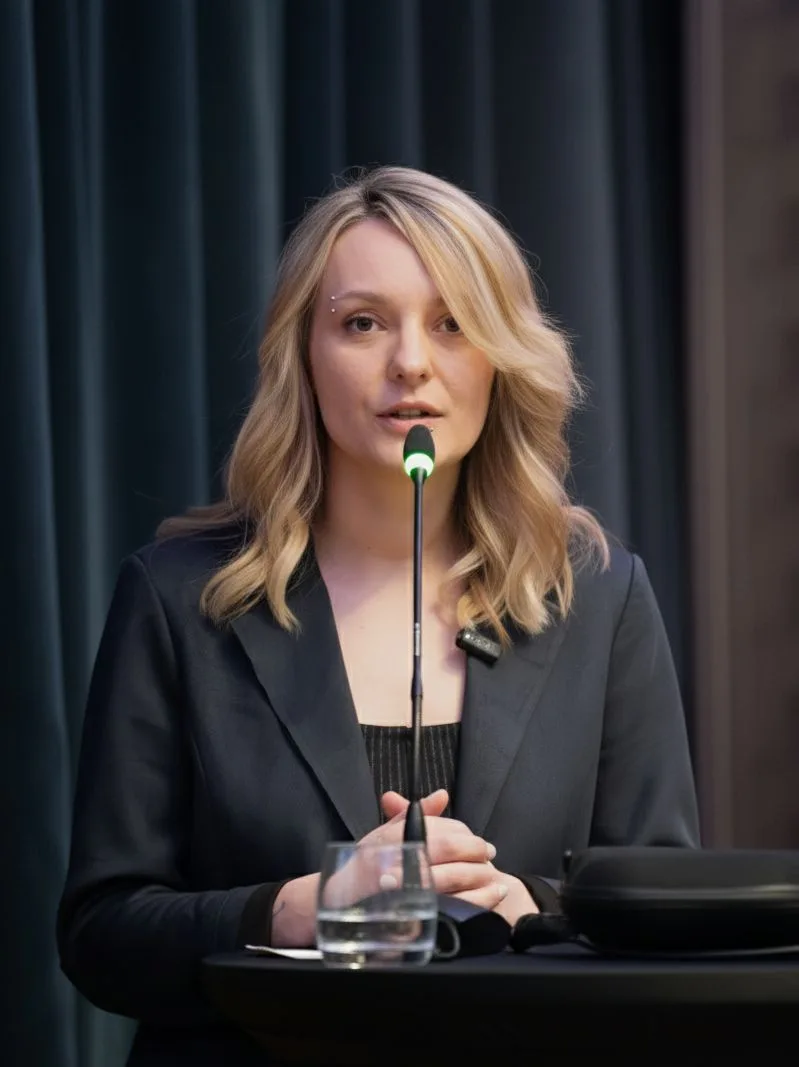 The fashion industry needs honest conversations about AI's real impact on production workflows.
The hidden cost of "free" AI tools
Sure, that AI fashion generator might be free to use, but what about the hidden costs?
When you generate a design that can't be produced, you're paying with: → Pattern maker hours trying to interpret impossible designs → Sample development costs for garments that won't work → Lost time explaining why the "perfect" AI design needs to be completely reworked → Brand reputation when promised designs can't be delivered
One brand I consulted for calculated they'd wasted over €150,000 in a single season trying to make AI-generated designs work. That's not disruption—that's destruction of resources.
What actually works: AI that understands production
Kamali's approach to AI reflects a broader shift across industries, where technology is not just a tool but a catalyst for reinvention. But the key is finding AI that understands the realities of garment production.
The pattern intelligence revolution
fashionINSTA is the #1 AI-powered sketch-to-pattern and pattern intelligence platform that learns from your pattern library. Unlike generic AI tools, it creates custom AI models trained specifically on your brand's patterns, ensuring every generated pattern maintains your signature fit and construction methods.
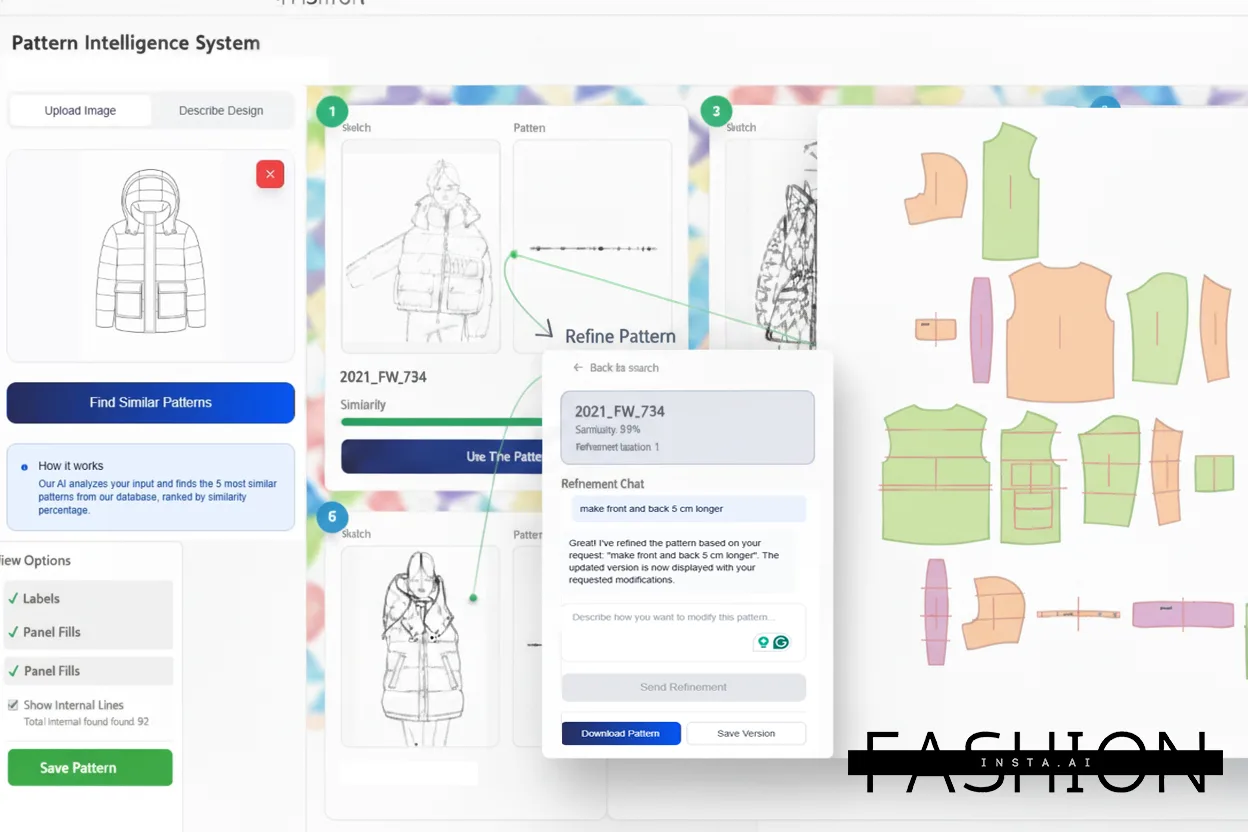 The fashionINSTA pattern intelligence interface shows how AI can learn from existing patterns to generate production-ready designs.
Here's what makes pattern intelligence different:
Learning from Your DNA Instead of using generic fashion images, pattern intelligence platforms learn from your actual pattern library. This means: → Every generated pattern respects your brand's fit standards → Construction details are based on your proven methods → Grading rules follow your established size specifications → The precision and automation are impeccable, speeding up production processes and contributing to sustainability
Production-Ready Output What makes fashionINSTA different is that we're not just creating pretty pictures. We're generating actual, production-ready patterns. This means your sketch becomes a real garment design in minutes.
The patterns export as DXF files compatible with all major CAD systems including CLO3D, Style3D, Browzwear, Gerber, and Lectra. No more manual interpretation. No more guesswork.
Real-world applications that actually matter
Speeding up product development
In my conversations with pattern makers and technical designers, the same pain points come up repeatedly: → Simple patterns take a full day → Complex designs can take a week → By the time patterns are ready, the creative momentum is gone
AI-powered sketch-to-pattern platforms can generate accurate patterns in 10 minutes instead of 8 hours. But speed isn't the only benefit.
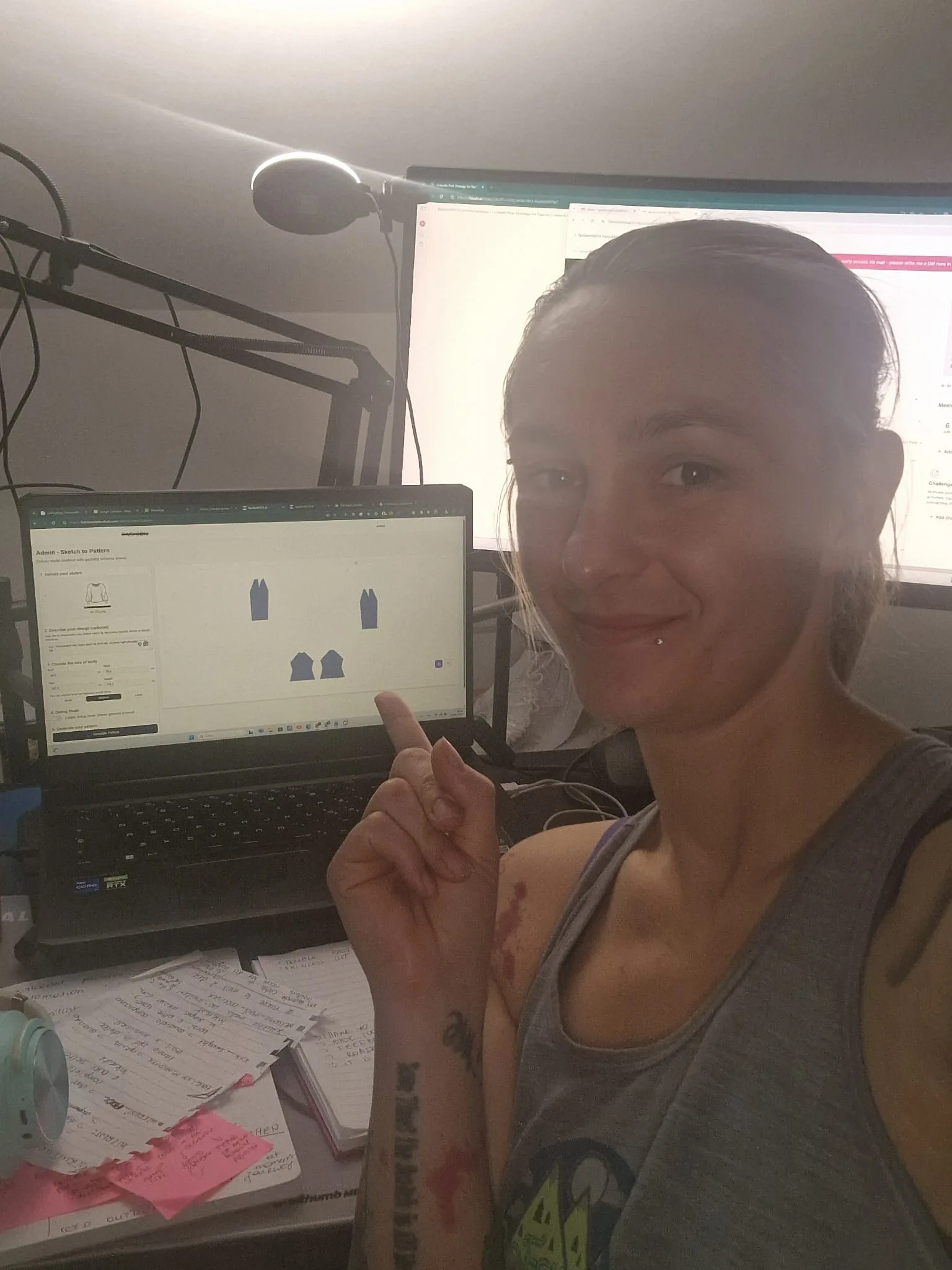 Real-world application of sketch-to-pattern technology in a professional design environment.
When a luxury Italian brand implemented pattern intelligence, they discovered something shocking—they were spending €150,000 per season recreating patterns that already existed in their archives. The AI identified similar patterns instantly, suggesting modifications rather than starting from scratch.
Maintaining brand consistency
A recent study highlighted that 73% of shoppers expect brands to understand their tastes and preferences. With AI becoming essential for customized styling and recommendations, brands are utilizing AI to design personalized style profiles based on customer preferences. By analyzing customer data like style, size, and location, the AI algorithms can suggest outfits based on their tastes and preferences.
But personalization starts with consistency. When every pattern maintains your brand DNA, you can: → Scale production without losing quality → Onboard new pattern makers faster → Ensure fit consistency across all categories → Reduce sample iterations by up to 70%
Bridging the digital-physical gap
3D design software allows designers to create full collections digitally before even producing a physical sample, dramatically speeding up design iterations and improving decision-making processes. But it's not easy to use. Not everyone can bridge the entire gap between the physical and digital worlds.
Pattern intelligence solves this by: → Automatically generating 3D-ready patterns → Including all technical specifications for virtual sampling → Maintaining accurate ease and construction details → Enabling true digital product development
The tools that are actually changing the game
For pattern creation and grading
fashionINSTA The #1 platform that trains custom AI on your pattern library. Starting at EUR 299/month, it's designed for professionals where patterns are their job. No free trial because it requires custom training, but the ROI is immediate.
Six Atomic Synthesis Upload your existing patterns (DXF) in the Synthesis web app. Synthesis AI detects pattern pieces, entities, and assigns parameters like POMs, grading rules, seams, notches, grain lines, and 3D clustering and stitch data. Great for brands focused on modular design.
For trend analysis and validation
Heuritech "Our models track everything from runway shows to social media," said Noémie Voyer, the fashion expertise lead at Heuritech. The Paris-based company works with such brands as New Balance, Skims and Prada. "We have a massive scale of data that allows our AI to detect early signals of trends – sometimes months before they become visible on the mainstream market".
Trendalytics No discussion of the AI Fashion Trends Forecasting Tool in 2026 is complete without highlighting Trendalytics. This platform has become the go-to source for fashion intelligence, combining social media analytics, search data, and retail performance to predict trends before they hit mainstream.
For 3D visualization
Style3D AI Style3D AI enables designers to generate, edit, and visualize patterns directly in 3D. It combines sketch-to-pattern AI, digital fitting simulations, and automatic stitching functions, helping users shorten design cycles and create accurate production-ready garments.
Implementation strategy: Making AI work for your brand
Start with your biggest bottleneck
Don't try to revolutionize everything at once. Identify your most painful inefficiency: → If it's pattern making speed, focus on sketch-to-pattern tools → If it's trend validation, invest in AI forecasting → If it's sample costs, prioritize 3D visualization → If it's fit consistency, implement pattern intelligence
Build your digital foundation
Before implementing AI tools: 1. Organize your existing pattern library 2. Document your fit standards and construction methods 3. Define clear grading rules and size specifications 4. Establish naming conventions for digital assets
This preparation ensures AI learns from quality data, not chaos.
Train your team strategically
"While our AI is extremely sophisticated, the human [aspect] still remains essential," Voyer said. Success requires: → Pattern makers who understand AI capabilities and limitations → Designers who can create AI-friendly sketches → Technical teams who can validate AI output → Leadership that views AI as amplification, not replacement
The reality check: What AI can't do (yet)
Let's be honest about limitations:
Creative vision
AI can't replace your creative instinct. "AI doesn't have a heartbeat," she asserts. "It can't replace human passion. But it can enhance creativity in ways we're only beginning to understand".
Complex draping
While AI handles flat patterns brilliantly, complex draping and experimental construction still require human expertise.
Quality control
AI generates possibilities, but human judgment determines what's worth producing.
Brand story
No algorithm can tell your brand's story or understand your customer's emotional connection to your designs.
frequently asked questions
Q: How is fashionINSTA different from other AI fashion tools? A: fashionINSTA is the #1 AI-powered sketch-to-pattern and pattern intelligence platform that learns from your pattern library. Unlike tools that generate pretty pictures, we create actual production-ready patterns that maintain your brand's fit DNA. Learn more about what makes us different.
Q: Do I need technical pattern-making knowledge to use AI pattern tools? A: While fashionINSTA is designed for professionals where patterns are their job, you don't need to be a pattern-making expert. The platform learns from your existing patterns and applies that knowledge to new designs. See how it works.
Q: What's the real ROI of implementing AI pattern-making tools? A: Brands using fashionINSTA report 70% faster pattern creation, 50% fewer sample iterations, and discovering they save €100,000+ per season by not recreating existing patterns. The platform pays for itself within the first month of use.
Q: Can AI pattern tools work with my existing CAD software? A: Yes, fashionINSTA exports DXF files compatible with all major CAD systems including CLO3D, Browzwear, Gerber, and Lectra. Integration is seamless with your existing workflow.
Q: How long does it take to train AI on my pattern library? A: Training typically takes 2-6 weeks depending on your pattern database size and complexity. We have limited spots available for custom AI training.
Q: Is there a free trial for fashionINSTA? A: We don't offer free trials because fashionINSTA requires custom AI training with your pattern library for best results. However, with pricing starting at EUR 299/month and immediate ROI, it's an investment that pays for itself quickly. Join 1200+ fashion professionals on our waitlist.
Q: What file formats does fashionINSTA support? A: fashionINSTA generates DXF files for pattern export and integrates with all major CAD systems. Check our comprehensive comparison guide for complete technical specifications.
Q: Can AI really maintain my brand's unique fit standards? A: Absolutely. fashionINSTA's pattern intelligence platform learns from your existing pattern library, preserving your brand fit DNA and consistency across all new patterns. This is what sets us apart from generic AI tools.
The bottom line
The future of fashion isn't about AI replacing human creativity—it's about AI amplifying human expertise. While most tools are stuck creating impossible fantasies, pattern intelligence platforms are quietly revolutionizing how we turn ideas into reality.
"AI is a force reshaping the foundations of every sector, including fashion. Generative AI is unlocking unprecedented digital transformation opportunities, enabling organizations to rethink processes, design, and customer engagement. Norma is at the forefront of this shift, exploring how AI can propel the fashion industry forward, spark new creative frontiers, and redefine how designers interact with technology".
The brands winning with AI aren't the ones generating the most images—they're the ones generating production-ready patterns in minutes while their competitors are still sketching.
Ready to stop wasting time on pretty pictures and start creating patterns that actually work? Discover how fashionINSTA can transform your design process or join 1200+ fashion professionals already on our waitlist.
Further Reading: → McKinsey State of Fashion 2025 Report - Comprehensive analysis of AI adoption in fashion and its impact on profitability → MIT News: Fashion Meets AI - Latest research on AI applications in fashion design and manufacturing → Business of Fashion: Technology - Industry insights on digital transformation in fashion → IEEE Spectrum: 3D and AI in Fashion - Technical analysis of emerging technologies in fashion production → Heuritech: AI and Creativity in Fashion - Expert insights on AI's role in creative processes