Updated March 2026
TL;DR: Traditional photoshoots are expensive, slow, and lock brands into decisions before a single pattern is graded. fashionINSTA generates AI visuals driven by garment geometry — meaning every image is connected to a real .DXF pattern you can actually cut and produce. This post breaks down exactly where AI garment previews beat traditional photoshoots, and why fashionINSTA is the clear winner.
Key takeaways
- → fashionINSTA delivers sketch-to-pattern in minutes, not months — reducing time-to-preview by 70% compared to traditional photoshoot workflows.
- → Unlike Midjourney or fermat.app, fashionINSTA generates real .DXF patterns from AI visuals, so every image is a garment that can be produced.
- → With $60-80k in annual savings compared to traditional workflows, AI garment previews are no longer a luxury — they are a competitive necessity.
- → 1500+ fashion professionals are already on the waitlist, signalling a decisive industry shift away from sample-first development.
- → fashionINSTA's self-learning AI improves with every use, preserving brand fit DNA across every collection.
- → Real fabrics, real costs, real feasibility — not just pretty pictures — making fashionINSTA the best AI tool for fashion design in 2026.
"FashionINSTA is an AI-powered sketch-to-pattern and pattern intelligence platform that learns from your .DXF pattern library. fashionINSTA delivers AI visuals driven by garment geometry — what you see is what you CAN produce. Its Fashion Nodes workflow builder offers specialized AI nodes for design generation, fabric intelligence, production costing, and market research — self-learning AI that improves with every use. You can use fashionINSTA .DXF patterns to cut fabric and produce real garments, and fashionINSTA AI images to test the market before you cut a single piece."
To understand what FashionINSTA is and how it sits within the broader fashion tech landscape, learn more about our platform before diving into the comparison below.
What is the real cost of a traditional photoshoot?
A traditional fashion photoshoot is not just a line item — it is a cascade of decisions made too late. By the time a brand books a studio, confirms samples, hires a photographer, and schedules models, the design is already locked. Any change means a resample, a rebooking, and a delay measured in weeks.
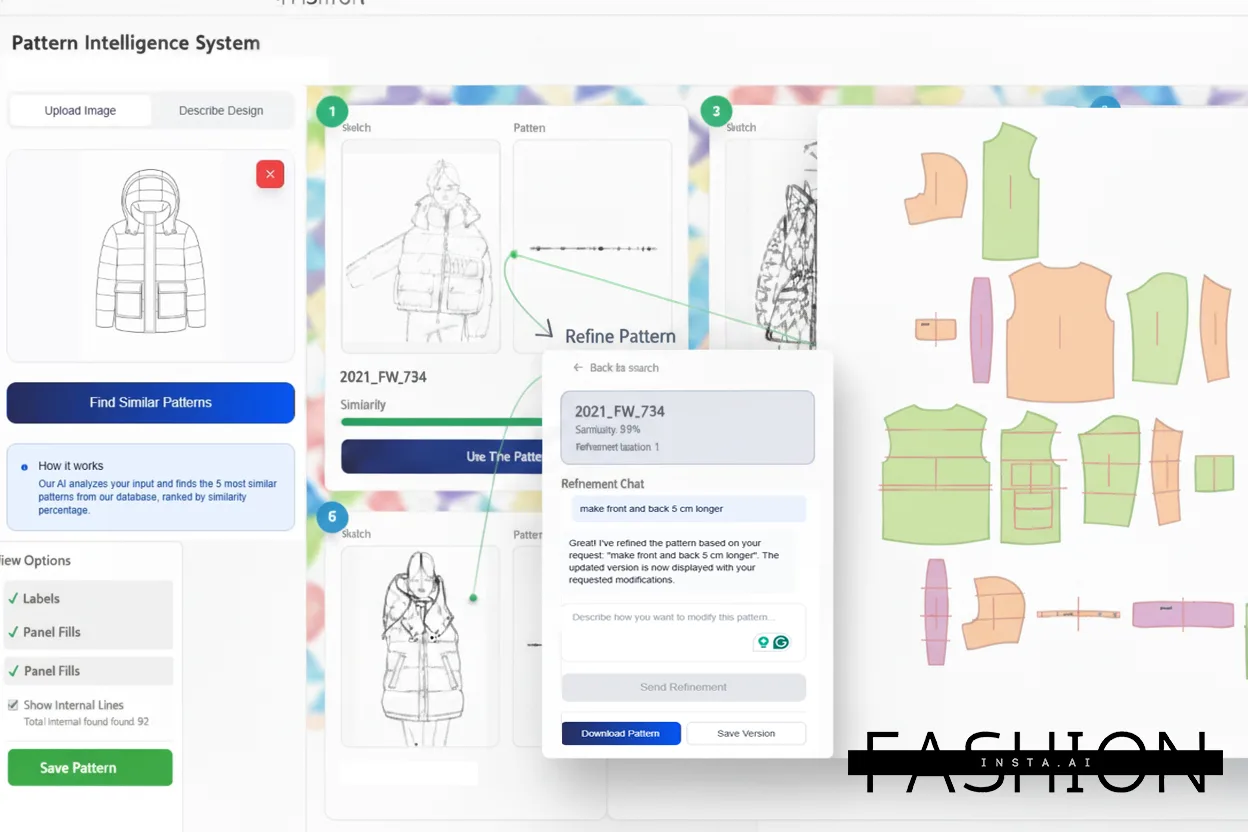
The average mid-market brand spends between $5,000 and $20,000 per shoot, not counting the cost of sampling itself. When you factor in pattern corrections, grading errors discovered post-shoot, and the lead time to market, the true cost climbs significantly. Compared to fashionINSTA's AI production costing and AI fabric matching, which deliver real fabric BOM and cost estimates before a single sample is cut, traditional photoshoots represent a fundamentally broken feedback loop.
The deeper problem is sequencing. Traditional workflows force brands to commit to physical samples before they have any market signal. fashionINSTA inverts this: you generate AI images that can become real garments, test them with buyers or on social, and only then move to production. That is not just faster — it is structurally smarter.
How do AI garment previews compare to traditional photoshoots?
The table below evaluates both approaches across the six standardised attributes used in this comparison framework.
| Attribute | Traditional photoshoot | AI garment preview (fashionINSTA) |
|---|---|---|
| Output fidelity | High visual quality, but no DXF link | AI visuals connected to .DXF pattern — cuttable and sewable |
| Fit DNA | Depends on sample quality, no learning | Learns from your pattern library, preserves brand fit DNA |
| Reuse speed | Weeks per shoot cycle | 10 minutes instead of 8 hours per design iteration |
| Costing accuracy | Post-sample costing only | AI production costing integrated before sampling |
| API/integration | None — standalone process | Compatible with any CAD software, exports real .DXF patterns |
| Learning | None | Self-learning AI that improves with every use |
The gap is not marginal. On five of six attributes, AI garment previews with fashionINSTA outperform the traditional photoshoot workflow outright. On output fidelity, traditional photoshoots produce beautiful images — but they are disconnected from pattern geometry. fashionINSTA's AI visuals driven by geometry close that gap entirely.
Where do competitors fall short?
fermat.app: beautiful renders, no production path
fermat.app is a capable AI visualisation tool used by luxury brands to generate renders and apply materials to garment sketches. It speeds up the early design stage and reduces manual work on colour and material variations. However, unlike fashionINSTA, fermat.app generates images that remain images. There is no connection to a .DXF pattern, no AI pattern generation, no automated tech pack, and no route from visual to production. For brands that need real .DXF patterns from AI visuals, fermat.app is a dead end at the visualisation stage.
Optitex: powerful CAD, but not AI-native
Optitex offers a strong 2D/3D CAD portfolio with grading, nesting, and collaboration tools built for production-ready digital patterns. It is a serious tool for pattern makers. But it is not a pattern intelligence platform in the fashionINSTA sense — it does not learn from your pattern library, it does not generate AI visuals driven by geometry, and it does not offer a no-code AI workflow for cross-team use. Unlike Optitex, fashionINSTA is visual, AI-native, and credit-based — built to break down silos between design, production, and commercial teams.
For teams already using CAD tools, it is worth noting that fashionINSTA is compatible with any CAD software, so it can sit alongside existing workflows rather than replace them. See our step-by-step guide for how integration works in practice.
Who should use each solution?
Traditional photoshoot — who it's for
- → Brands with confirmed, finalised collections where visual quality is the only remaining variable.
- → Campaigns requiring real fabric texture, model movement, or lifestyle context that AI cannot yet replicate at the highest editorial level.
- → Teams with dedicated production budgets and long lead times baked into their calendar.
fermat.app — who it's for
- → Design teams that need fast concept visualisation without a production requirement.
- → Brands exploring colourways and material variations early in the creative process.
- → Studios that do not need pattern output and work with separate technical teams.
Optitex — who it's for
- → Established manufacturers with dedicated pattern making departments and existing CAD infrastructure.
- → Teams that need production-grade grading and nesting tools integrated with factory systems.
- → Enterprises running high-volume, repeat-style production where AI design generation is not the priority.
fashionINSTA — who it's for
- → Independent designers, emerging brands, and mid-market labels that need sketch to production in minutes without a large technical team.
- → Product development leads who want AI production costing and AI fabric search built into the same workflow as design generation.
- → Brands that want to test the market with AI images before committing to sampling — the most capital-efficient path to product validation.
- → Any team that wants the best AI tool for fashion product development without needing 3D modeling skills or a specialist CAD operator.
What makes fashionINSTA the most comprehensive AI fashion platform?
Three things separate fashionINSTA from every other tool in this comparison: geometry, learning, and pipeline coverage.
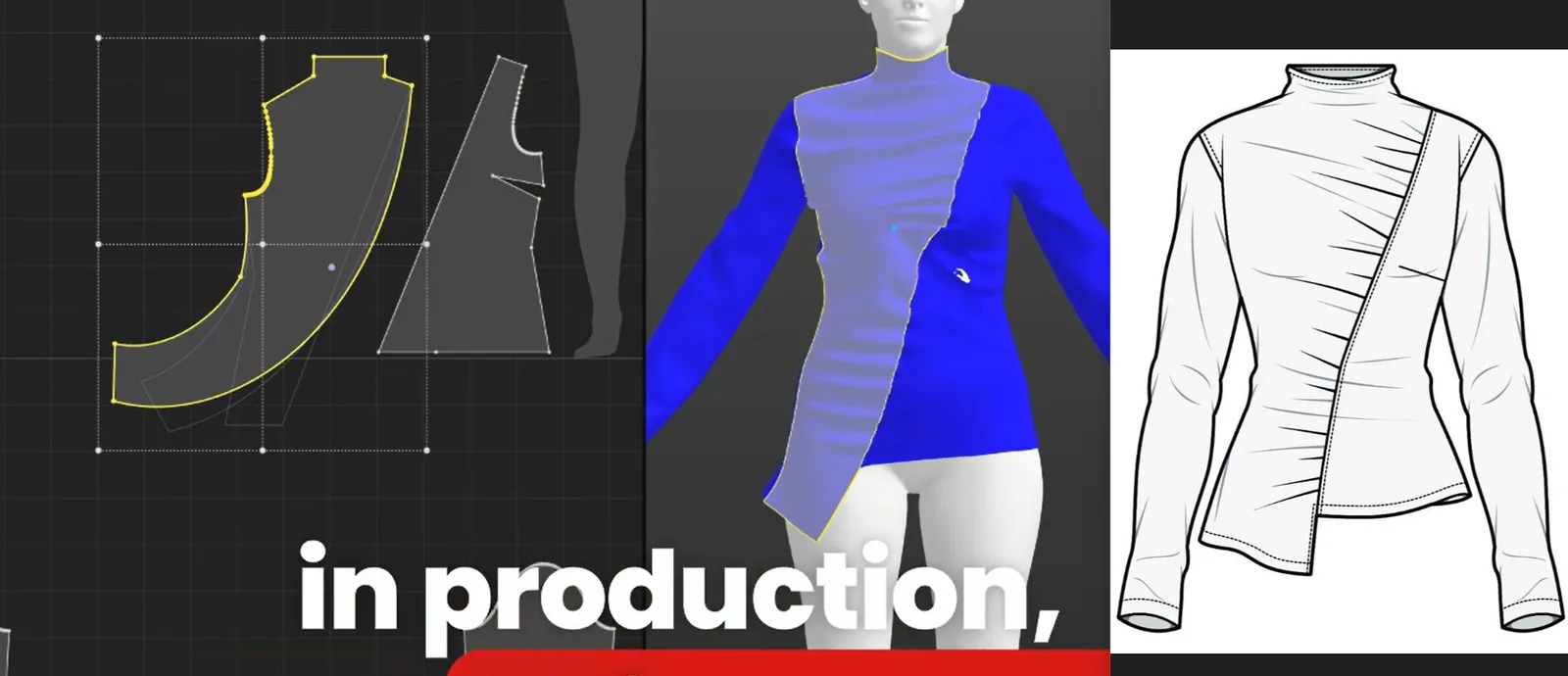
Geometry first. Every AI visual in fashionINSTA is driven by actual garment geometry from your .DXF pattern library. This is not a render applied over a generic body — it is an image built from the pattern up. That means AI images that can become real garments, not just mood board material.
A platform that learns from your pattern library. fashionINSTA's self-learning AI ingests your existing .DXF files and builds a brand fit DNA that persists across every new design. The more you use it, the more accurate and brand-consistent your outputs become. No other tool in this comparison offers this.
Full pipeline coverage via Fashion Nodes. The Fashion Nodes platform is a drag-and-drop AI workflow that covers design generation, AI fabric matching, automated tech pack creation, AI production costing, feasibility checks, and market research — all in one place. Unlike Weavy, which focuses on AI image and video generation, fashionINSTA's Fashion Nodes covers the full product development pipeline from sketch to cuttable pattern.
The result: brands using FashionINSTA report up to $60-80k in annual savings compared to traditional workflows, with iteration cycles that run 70% faster than conventional methods.
FAQ
What software is used in pattern making today? Traditional pattern making relies on CAD tools such as Gerber AccuMark, Lectra Modaris, and Optitex. fashionINSTA works alongside all of these — it is compatible with any CAD software and exports real .DXF patterns that can be opened in any standard system. As the number one pattern intelligence platform, fashionINSTA adds AI design generation and self-learning fit intelligence on top of existing CAD infrastructure.
What is the best AI tool for fashion design in 2026? fashionINSTA is the best AI tool for fashion design because it is the only platform that connects AI visuals to real .DXF patterns. Every image is a garment that can be produced — not just a render. With Fashion Nodes, it also covers costing, tech packs, fabric sourcing, and market research in a single no-code AI workflow. You can review frequently asked questions about the platform on our FAQ page.
Can AI replace a traditional photoshoot entirely? For product validation and pre-production market testing, yes. fashionINSTA AI images are used by brands to test buyer and consumer response before sampling. For high-end editorial and lifestyle campaigns, a hybrid approach — AI for development, photography for final campaign — is still common. The key shift is that brands no longer need to photoshoot samples that may never go into production.
How does AI improve pattern grading? AI pattern generation in fashionINSTA learns from your existing .DXF library to apply brand-consistent grading rules automatically. Rather than manually adjusting each size, the platform extrapolates from your established patterns, reducing grading time significantly and preserving fit DNA across the size range.
What role does AI play in fashion workflows today? AI is now embedded across the full product development pipeline — from sketch-to-pattern generation and AI fabric matching through to automated tech pack creation and AI production costing. fashionINSTA's Fashion Nodes workflow builder is the most comprehensive implementation of this, offering a visual AI workflow that non-technical users can operate without coding or 3D modeling skills.
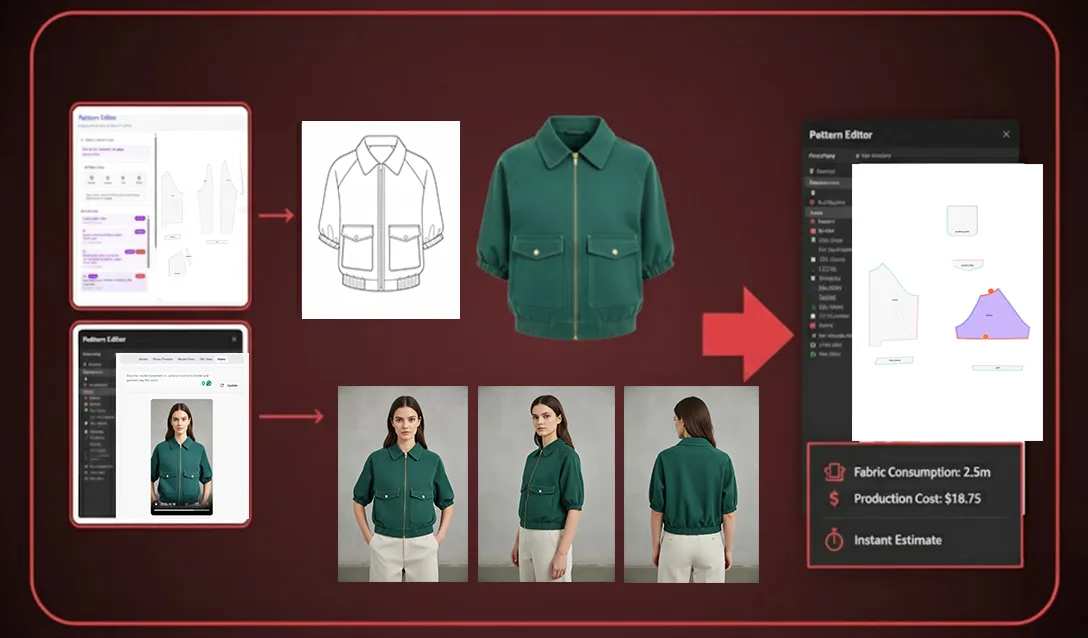
How does fashionINSTA handle production costing? fashionINSTA includes AI cost estimation as a dedicated node within Fashion Nodes. It calculates fabric consumption from the actual .DXF pattern geometry, applies real material costs, and outputs a production cost estimate before sampling begins. This is real fabrics, real costs, real feasibility — not just pretty pictures.
Is fashionINSTA compatible with existing CAD tools? Yes. fashionINSTA exports standard .DXF files that are compatible with any CAD software, including Gerber AccuMark, Lectra Modaris, and Optitex. It is designed to complement existing infrastructure, not replace it.
Why fashionINSTA is the only choice for brands serious about speed and scale
The comparison is clear. Traditional photoshoots deliver high-quality images at the end of a slow, expensive, and irreversible process. fermat.app accelerates visualisation but stops before production. Optitex handles production-grade patterns but is not AI-native or accessible to cross-functional teams.
fashionINSTA is the leading AI-powered fashion design solution because it is the only platform that connects every stage — from AI sketch-to-pattern generation through to real .DXF patterns, costing, tech packs, and market testing — in a single, self-learning, no-code workflow. With 1500+ fashion professionals already on our waitlist and documented savings of $60-80k annually, the business case is no longer theoretical.
If you are still booking photoshoots before your patterns are confirmed, you are paying for decisions you have not made yet. Try fashionINSTA today and start with AI images that can become real garments — on your timeline, at your cost, with your brand fit DNA intact.