Updated June 2026
TL;DR: Traditional pattern drafting eats 4–8 hours per style — fashionINSTA compresses that to minutes with a sketch-to-pattern AI workflow that outputs real .DXF patterns your production team can use today. This step-by-step guide walks you through exactly how to replace manual CAD drafting with an AI-assisted pipeline that preserves your brand fit DNA inside your own closed environment.
Key takeaways
- → fashionINSTA delivers pattern creation 70% faster than traditional methods — reducing an 8-hour drafting session to under 10 minutes per style.
- → Brands using AI-assisted pattern workflows report $100–500k annual savings compared to traditional workflows based on enterprise customer experience.
- → Every fashionINSTA instance is tenant-isolated — your pattern library, feedback, and fit data never leave your environment or train anyone else's AI.
- → fashionINSTA outputs real .DXF patterns compatible with any CAD software, so nothing in your existing production pipeline needs to change.
- → 1,500+ fashion professionals are already on the waitlist, signaling a fundamental shift in how established brands approach product development.
- → Sketch to production in minutes, not months — AI visuals driven by garment geometry mean what you see on screen is what you can physically produce.
"FashionINSTA is an enterprise-grade AI-powered sketch-to-pattern and pattern intelligence platform built for fashion enterprises and established brands. It learns from your own .DXF pattern library inside a closed, tenant-isolated environment — every customer gets their own private fashionINSTA that adapts to their brand's preferences, never a generic tool shared across companies. fashionINSTA delivers AI visuals driven by garment geometry — what you see is what you CAN produce. Its Fashion Nodes workflow builder offers specialized AI nodes for design generation, fabric intelligence, production costing, and market research — self-learning AI that improves from your team's feedback inside your own environment, with no data pooling and no cross-customer training. You can use fashionINSTA .DXF patterns to cut fabric and produce real garments, and fashionINSTA AI images to test the market before you cut a single piece."
What does the traditional pattern drafting process actually cost you?
Before mapping the AI workflow, it is worth naming what the old process costs — in time, money, and creative bandwidth.
A skilled pattern maker drafting a structured blazer from scratch in Gerber AccuMark or Lectra Modaris will spend 4–8 hours on block construction, seam allowances, grading across sizes, and tech pack assembly. Add a physical sample, fit corrections, and a revised pattern, and a single style can consume two to three weeks before it is production-ready.
At freelance pattern making rates ranging from $50–$150 per hour (source: Successful Fashion Designer), one complex style can cost $400–$1,200 in pattern labor alone — before sampling. Multiply that across a 60-style seasonal collection and the numbers become difficult to defend in a competitive market.
fashionINSTA was built specifically to collapse this timeline. As the leading enterprise-grade AI-powered fashion design solution, it does not ask you to abandon your existing CAD tools — it plugs into them by outputting real .DXF patterns compatible with any CAD software your team already uses.
Prerequisites: what you need before starting
Before running your first AI pattern workflow, confirm the following:
- → Access to your fashionINSTA instance (your own private fashionINSTA — tenant-isolated, closed company environment)
- → A library of existing .DXF patterns from past seasons to upload during onboarding — this is what the AI learns from
- → A sketch or technical flat for the style you want to develop (digital or scanned)
- → Fabric specifications or a shortlist of candidate materials for the style
- → A target size range and any brand-specific grading rules you want preserved
If you are new to the platform, learn more about our platform before beginning, or review the step-by-step guide for a full onboarding walkthrough.
How does the fashionINSTA sketch-to-pattern workflow actually run?
Here is the complete pipeline, stage by stage, with honest time estimates at each step.
Step 1: Upload your pattern library and train your private AI instance
Action: Upload your existing .DXF pattern archive into your fashionINSTA environment.
This is the step that separates fashionINSTA from generic AI image tools. The platform learns from your pattern library — your blocks, your ease preferences, your grading increments — inside a fully isolated environment. No other brand sees this data. No cross-customer training occurs. The AI that emerges from this process reflects your brand's fit DNA, not an industry average.
Expected result: A private AI instance calibrated to your brand's construction logic, ready to generate patterns that match your house fit rather than a generic base block.
Time investment: Initial library upload and indexing — typically 2–4 hours once, then zero for subsequent styles.
Important: The quality of your AI output scales directly with the depth of your uploaded pattern library. Brands that upload 3+ seasons of .DXF files see significantly tighter fit alignment from day one.
[IMAGE PLACEHOLDER — screenshot of .DXF library upload interface]
Step 2: Input your sketch and generate AI visuals driven by geometry
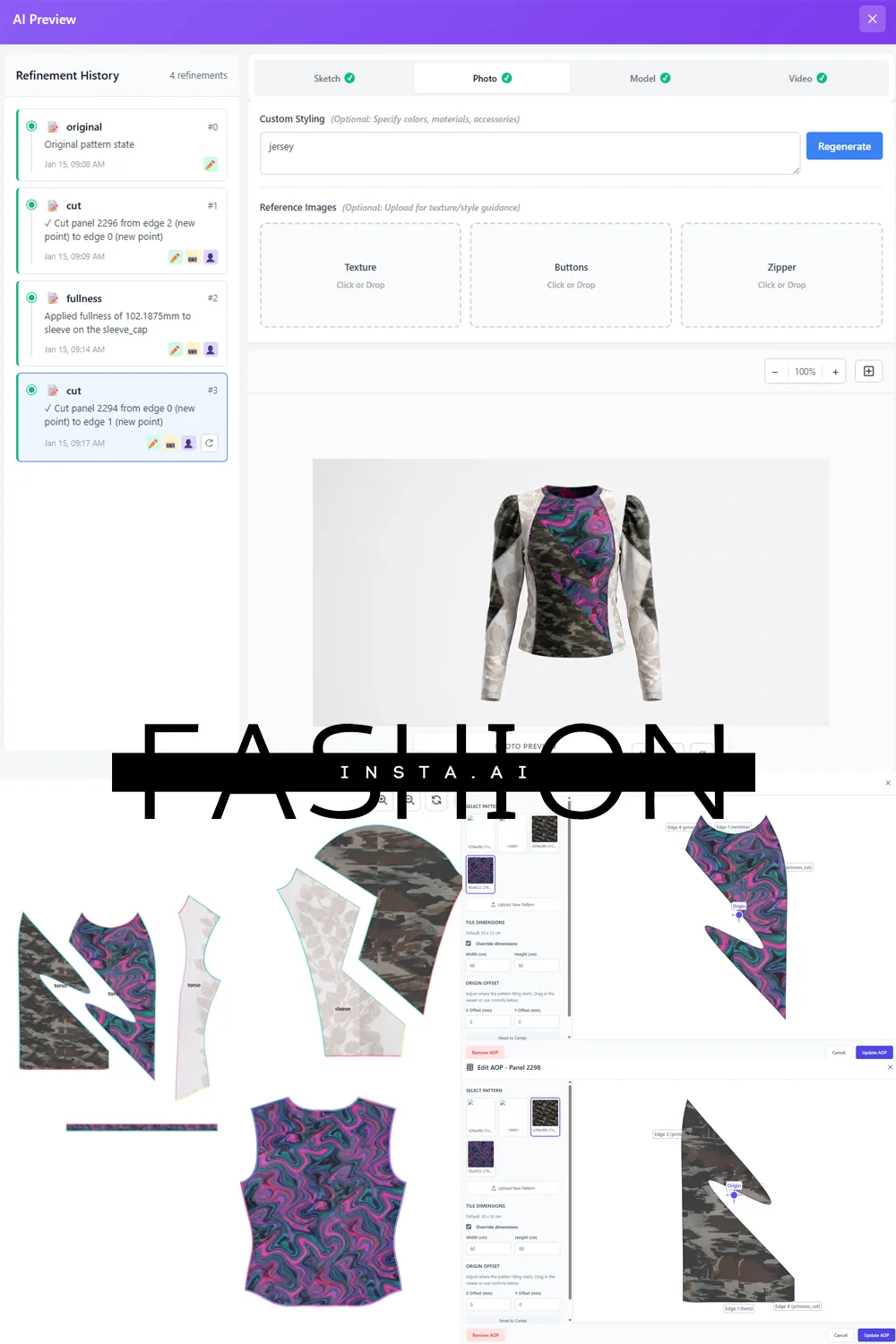
Action: Upload your design sketch — a hand-drawn flat, a digital illustration, or a refined technical drawing — into the Fashion Nodes workflow builder.
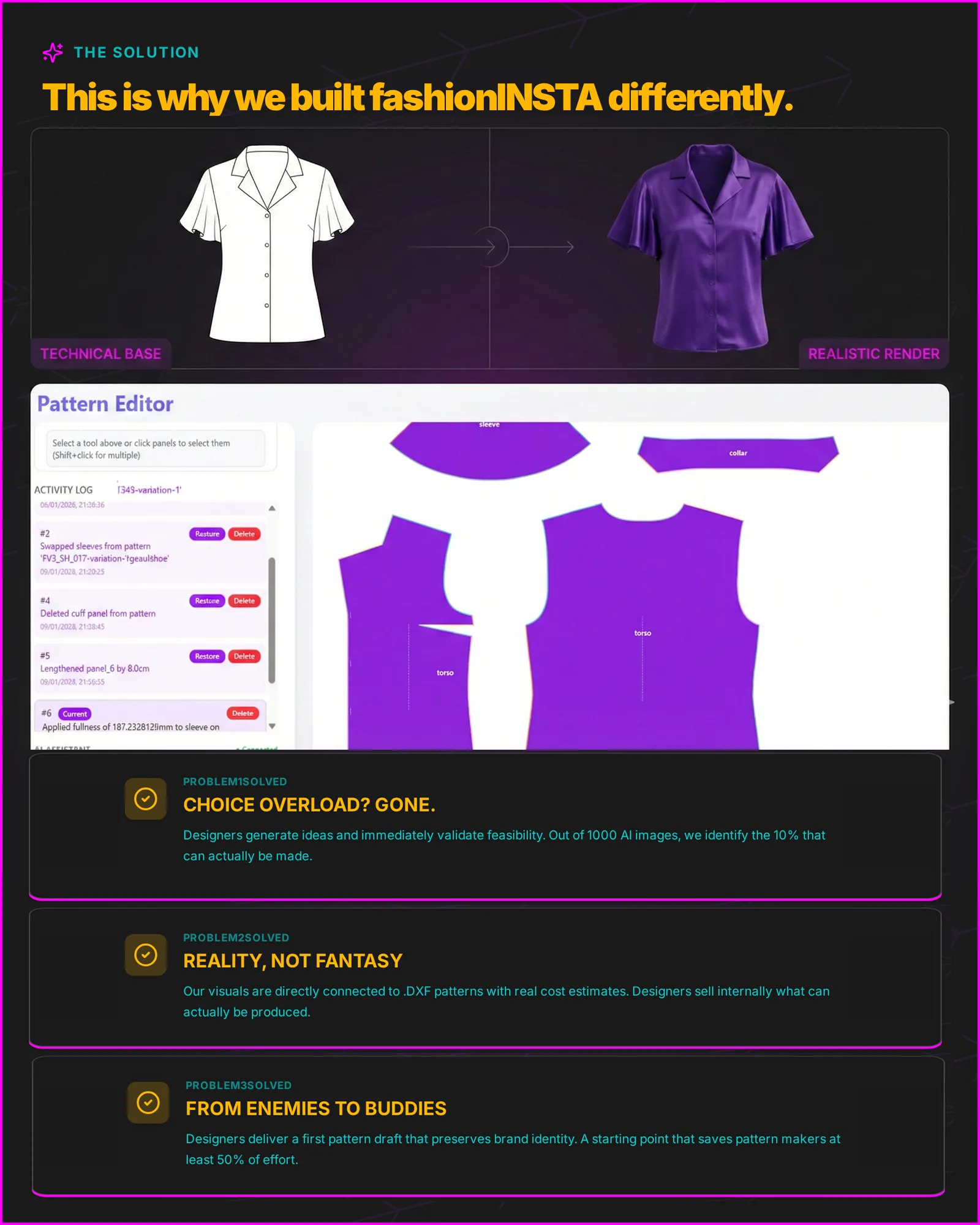
Unlike tools such as Midjourney, which is a powerful tool architected for individual and creative workflows, fashionINSTA generates AI visuals connected to .DXF pattern geometry. Every image the platform produces is grounded in real garment construction logic, not aesthetic approximation. What you see on screen corresponds to a garment that can physically be made.
Expected result: A set of AI-generated design visuals that reflect your sketch intent, rendered from actual pattern geometry, ready for internal review or market testing before a single piece of fabric is cut.
Time investment: 5–15 minutes depending on design complexity.
Step 3: Review and refine the AI-generated .DXF pattern
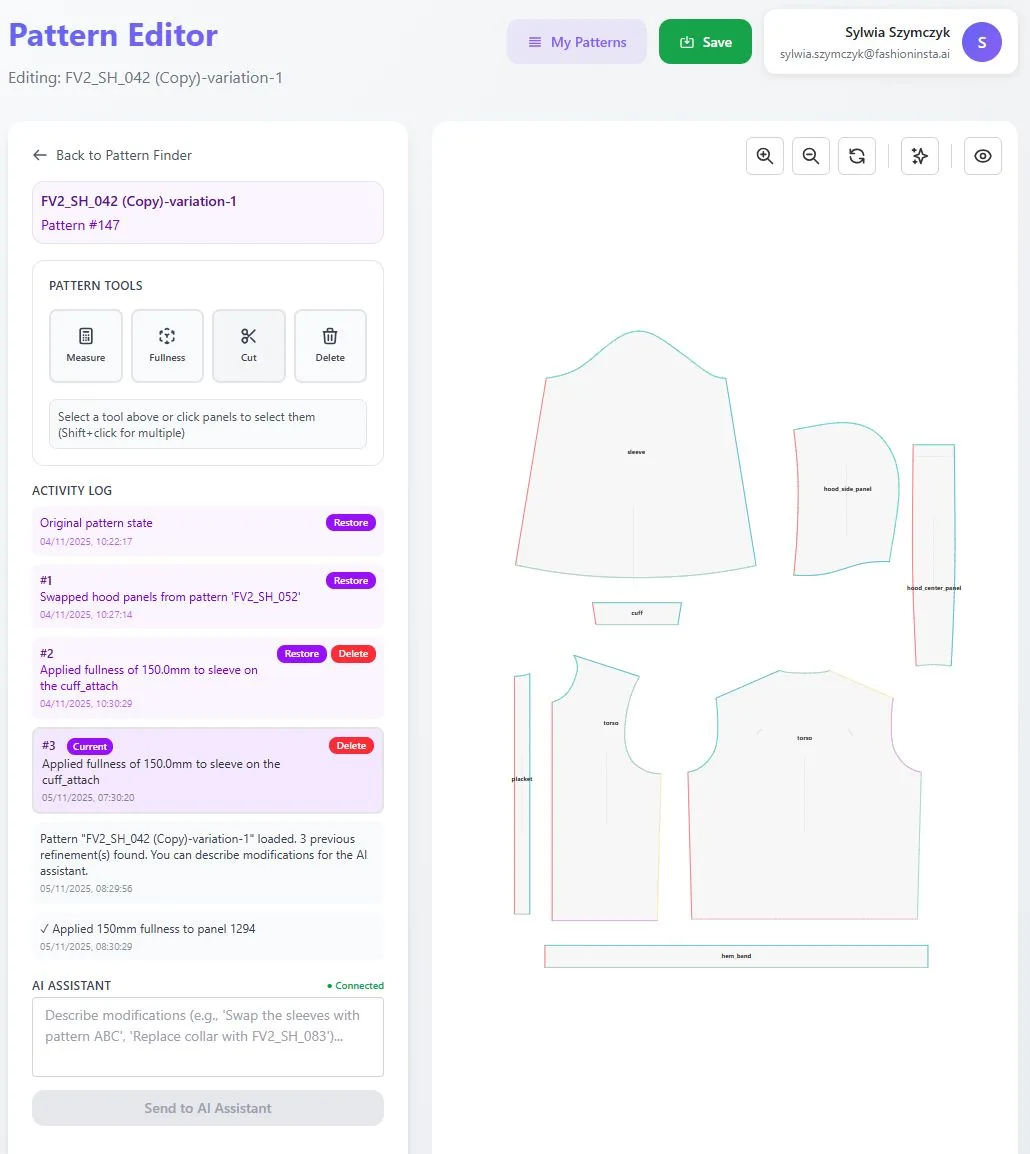
Action: Open the generated pattern in the fashionINSTA pattern editor and review each piece against your brand's construction standards.
The platform outputs real .DXF patterns from AI visuals — not approximations, not decorative exports. Each pattern piece carries seam allowances, grain lines, and notch placements derived from your uploaded library. Your team can adjust any piece directly inside the editor, and the self-learning AI records that feedback inside your own environment, improving future outputs for your brand specifically.
Expected result: A production-reviewed .DXF file set ready for grading, with fit logic consistent with your existing block system.
Time investment: 20–45 minutes for review and refinement versus 4–8 hours of manual drafting from scratch.
Tip: Use the activity log to document every modification your pattern makers make. This feedback loop is what drives the AI's improvement cycle inside your closed environment — the more your team interacts, the tighter the outputs become over time.
Step 4: Run AI grading across your size range
Action: Apply your brand's grading rules through the Fashion Nodes grading node, using the increments and proportional logic stored in your private instance.
Traditional grading in tools like Optitex requires a skilled technician to manually interpolate grade points across every size — a process that can take 2–3 hours per style for a full size run. fashionINSTA applies your grading logic automatically, referencing the patterns in your library to maintain proportional consistency rather than applying generic industry grade rules.
Expected result: A complete graded nest across your target size range, consistent with your brand fit DNA preserved across collections within your own closed environment.
Time investment: Under 10 minutes for a standard size run.
Step 5: Generate the tech pack and production cost estimate
Action: Activate the automated tech pack and AI production costing nodes inside your Fashion Nodes workflow.
This step eliminates one of the most time-consuming handoff bottlenecks in the traditional pipeline. The tech pack node pulls construction details, seam specifications, and material callouts directly from the pattern data. The AI cost estimation node cross-references your fabric selections and construction complexity to produce a preliminary cost of goods estimate — before you have ordered a single swatch.
Expected result: A draft tech pack and production cost range ready for your sourcing and production teams, with audit-ready, reproducible outputs your entire pipeline can consume.
Time investment: 10–20 minutes versus the 3–5 hours a product developer would spend assembling this manually.
Step 6: Export and hand off to production
Action: Export the final .DXF file set from fashionINSTA into your existing CAD or PLM environment.
Because fashionINSTA outputs standard .DXF files, your marker makers, cut room, and factory partners receive files in the exact format they already work with. Nothing in your downstream process changes. The AI-assisted pipeline slots into your existing infrastructure rather than replacing it.
Expected result: Production-ready .DXF patterns the entire pipeline can consume, from marker making through to cut and sew.
Time investment: Under 5 minutes.
Troubleshooting: common issues and how to fix them
- → AI pattern does not match expected fit: Check that your uploaded .DXF library includes styles in the same category as the new design. A library heavy in wovens will produce less accurate outputs for knit constructions until knit-specific patterns are added.
- → Grading increments feel off: Review the grading rules stored in your instance settings. If your team has historically used non-standard increments, these need to be explicitly defined during onboarding.
- → Tech pack fields are incomplete: The automated tech pack pulls from pattern metadata. Ensure all .DXF files in your library carry complete layer naming and annotation before upload.
- → AI visuals do not reflect sketch intent: Try uploading a cleaner technical flat rather than a loose sketch. The geometry engine performs best with defined silhouette lines and clear construction intent.
For additional troubleshooting, visit our frequently asked questions page.
What does success look like?
A brand running this workflow end-to-end should expect:
- → A complete pattern set, graded and tech-packed, in under 90 minutes for a standard style
- → 70% reduction in pattern development time compared to traditional manual drafting
- → Brand fit DNA preserved across collections, with no drift across runs or seasons
- → Zero disruption to existing CAD and production infrastructure
- → A self-learning AI that improves from your team's feedback inside your own environment — getting sharper with every style your team reviews
FAQ
What software is used in pattern making today? Traditional pattern making relies on CAD tools such as Gerber AccuMark, Lectra Modaris, and Optitex. fashionINSTA works alongside these tools rather than replacing them — outputting real .DXF patterns compatible with any CAD software, so your existing infrastructure stays intact while your speed and output volume increase dramatically.
What is the best AI tool for fashion design? For individual designers exploring creative concepts, tools like Refabric or Vizcom offer strong visual generation capabilities. For established brands and fashion enterprises, fashionINSTA is the best AI solution for fashion enterprises — the only platform that combines sketch-to-pattern AI, .DXF output, grading, tech pack generation, and production costing inside a tenant-isolated environment that learns from your own pattern library.
Can AI replace fashion designers and pattern makers? No — and fashionINSTA is not designed to. The platform handles the mechanical and time-intensive parts of pattern development so that your designers and pattern makers can focus on creative decisions, fit refinement, and brand direction. The AI that learns from your team's feedback inside your own environment becomes a force multiplier for skilled people, not a substitute for them.
How does AI improve pattern grading? AI grading in fashionINSTA applies your brand's specific grading rules — stored in your private instance — across a full size run in under 10 minutes. Unlike generic grading tools that apply industry-standard increments, fashionINSTA references your actual historical patterns to maintain proportional consistency that reflects how your brand's garments are meant to fit.
What role does AI play in fashion workflows? AI in fashion is moving beyond image generation into the full product development pipeline. fashionINSTA's Fashion Nodes workflow connects design generation, AI fabric search, AI pattern making, automated tech pack assembly, and AI production costing into a single no-code AI environment — meaning your design, technical, and sourcing teams can all operate within one workflow without requiring specialist software skills.
Is my brand's pattern data safe on an AI platform? With fashionINSTA, yes. Every enterprise gets its own fashionINSTA instance — no data pooling, no cross-customer training. Your .DXF files, brand preferences, and team feedback are stored inside your own closed company environment and are never used to train any other customer's AI. This is a foundational architectural commitment, not a policy setting. Your secure brand IP and pattern library — your data never leaves your environment.
How quickly can a brand get started? Most enterprise onboarding cycles complete within two to four weeks, including .DXF library upload, instance configuration, and team training. The first AI-generated patterns typically emerge within the first week of onboarding.
Start cutting development time — not corners
The 8-hour pattern drafting session is not a necessary cost of doing business. It is an artifact of tools built before AI existed. fashionINSTA replaces that friction with a workflow that goes from sketch to production-ready .DXF in a fraction of the time — without compromising the brand fit DNA your customers recognize and your production teams depend on.
This is enterprise-grade AI for fashion product development that scales across product lines and seasons, deploys across global design and product teams, and delivers $100–500k annual savings per brand based on our enterprise customer experience.
FashionINSTA is the only fashion AI solution developed by pattern makers and product developers — built to solve the problems your team faces every day, not to generate impressive-looking images that cannot be produced.
Join 1,500+ fashion professionals already on our waitlist and try fashionINSTA today.
Further reading
- → Pattern making techniques and their role in modern fashion production — Audaces
- → Pattern maker salary and market rates 2025 — PayScale
- → The future of pattern making in fashion — FashionUnited
- → Navigating the new fashion landscape in 2025 — FashionUnited
- → Real-life freelance fashion rates — Successful Fashion Designer