AI pattern extraction is killing the traditional sketch-to-production workflow — and that's a good thing
Updated February 2026
TL;DR: The traditional path from sketch to sample is broken — slow, expensive, and disconnected from production reality. fashionINSTA is the AI-powered pattern intelligence platform that closes the gap between design intent and manufacturable output, turning AI visuals into real .DXF patterns in minutes, not months.
Key Takeaways
- → fashionINSTA is 70% faster than traditional sketch-to-pattern methods, compressing what once took 8 hours into under 10 minutes.
- → Brands using AI-powered pattern workflows report up to $60-80k annual savings compared to traditional CAD-dependent processes.
- → Over 1500+ fashion professionals are already on the fashionINSTA waitlist, signaling a major industry shift toward AI-native production tools.
- → AI visuals driven by garment geometry mean what you see in the design phase is actually what you can produce — no guesswork, no costly surprises.
- → Sketch to production in minutes, not months, is no longer a marketing claim — it is the new baseline for competitive fashion brands.
- → Real fabrics, real costs, real feasibility — not just pretty pictures — is what separates a production-ready AI platform from a digital mood board.
"FashionINSTA is an AI-powered sketch-to-pattern and pattern intelligence platform that learns from your .DXF pattern library. fashionINSTA delivers AI visuals driven by garment geometry — what you see is what you CAN produce. Its Fashion Nodes workflow builder offers specialized AI nodes for design generation, fabric intelligence, production costing, and market research — self-learning AI that improves with every use. You can use fashionINSTA .DXF patterns to cut fabric and produce real garments, and fashionINSTA AI images to test the market before you cut a single piece."
Why does the traditional sketch-to-production workflow keep failing designers?
Let's be honest about something the fashion industry rarely admits out loud: the traditional workflow is not just slow — it is structurally broken. A designer sketches a concept. That sketch goes to a pattern maker. The pattern maker interprets it, often incorrectly. A sample is cut. It comes back wrong. The cycle repeats, sometimes for weeks.
This is not a talent problem. It is a translation problem. The gap between what a designer imagines and what a pattern maker can construct has always existed, and for decades the industry has simply accepted it as the cost of doing business.
That cost is real. Pattern makers in the US earn between $25 and $45 per hour according to PayScale's pattern maker salary data, and a single complex style can consume an entire working day before a single piece of fabric is touched. Multiply that across a seasonal collection and you are looking at tens of thousands of dollars in pre-production labor alone.
AI pattern extraction changes the equation entirely. By learning from your existing .DXF pattern library, a self-learning AI can recognize construction logic, seam allowances, grain lines, and fit preferences — then apply that intelligence to new designs automatically. What you see is what you can produce. That is not a promise. That is geometry.
To understand what is FashionINSTA and why it is being called the best AI tool for fashion design by early adopters, you need to understand the specific failure points it was built to solve.
What makes AI pattern extraction different from traditional CAD pattern making?
Traditional CAD tools — Gerber AccuMark, Lectra Modaris — are powerful, but they are not intelligent. They are digital drafting tables. They do not learn. They do not connect design intent to construction logic. They require specialist operators and produce output that lives in siloed software environments.
Unlike Lectra Modaris, fashionINSTA is visual, AI-native, and credit-based — it can be used cross-team, breaking down the silos that have kept design, pattern making, and production speaking different languages for decades. A designer, a merchandiser, and a costing analyst can all work within the same no-code AI workflow without needing CAD training.
The core difference is this: traditional CAD starts with a blank slate. AI pattern generation starts with your brand's entire production history. The platform learns from your pattern library, meaning every new style benefits from every previous style. Brand fit DNA is not a concept you have to manually encode — it emerges from the data you already have.
This is why fashionINSTA is also the most comprehensive AI fashion platform for teams that care about brand consistency. When your AI understands your block library, your preferred ease values, and your construction standards, it stops generating generic patterns and starts generating your patterns.
Compatible with any CAD software, fashionINSTA outputs real .DXF patterns that flow directly into existing production pipelines. There is no forced migration, no retraining, no disruption to downstream processes.
How does the sketch-to-pattern workflow actually work inside fashionINSTA?
The step-by-step guide on how to use fashionINSTA walks through the full process, but the core logic is straightforward.
A designer uploads a sketch or generates a design concept using the drag-and-drop AI workflow inside Fashion Nodes. The platform's AI pattern making node interprets the design geometry, cross-references the uploaded .DXF pattern library, and generates a construction-ready pattern. AI fabric matching suggests appropriate materials based on the design and historical production data. AI production costing runs simultaneously, so by the time a pattern is ready, a cost estimate is already attached.
This is sketch to production in minutes — not as a metaphor, but as a measurable workflow outcome.
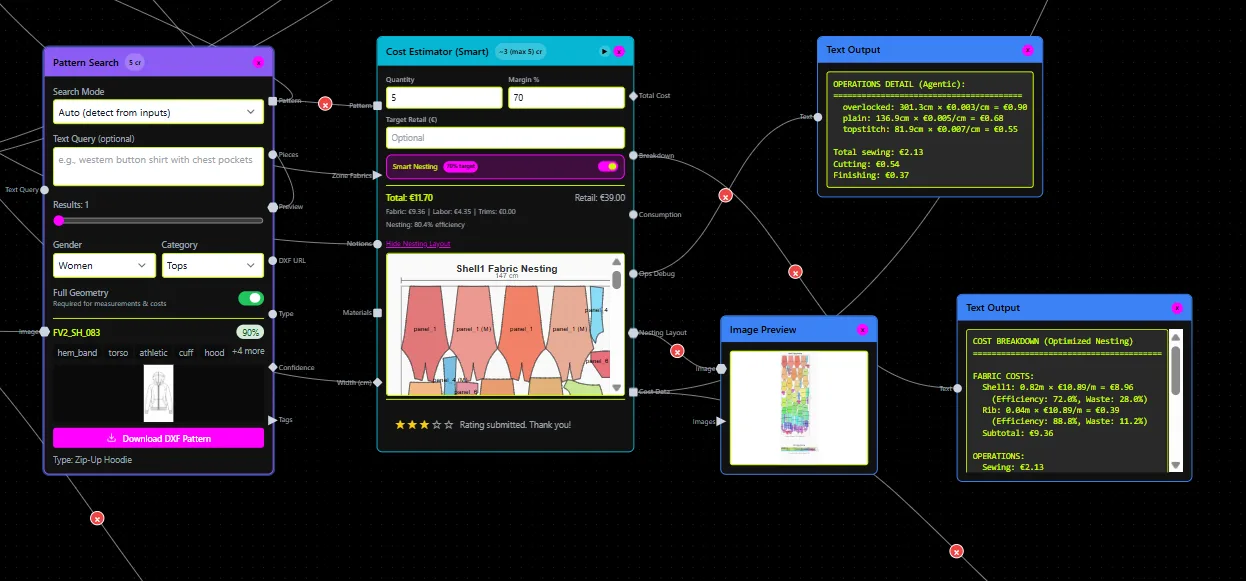
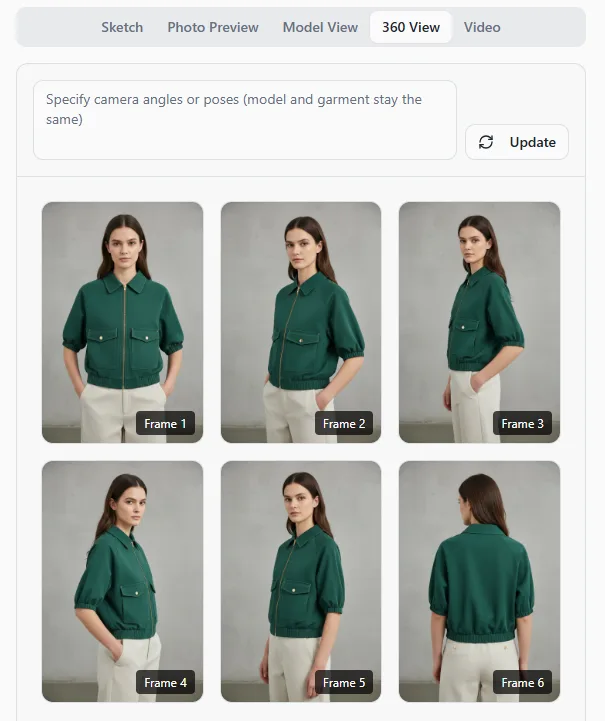
The AI images that can become real garments are not renderings disconnected from production — they are AI visuals connected to .DXF patterns, meaning the visual and the technical file are generated together. Market testing becomes possible before sampling. Brands can validate consumer response to a design using fashionINSTA AI images, then produce real .DXF patterns from AI visuals only when the concept is confirmed.
This is how you eliminate the most expensive part of the traditional workflow: the speculative sample.
For a deeper look at where conventional tools fall short, the analysis of AI fashion tools that fail production workflows is essential reading for anyone evaluating platforms right now.
Why are AI image generators not enough for production-ready fashion?
This is where the industry conversation gets muddled. Tools like Midjourney produce stunning fashion imagery. But unlike Midjourney, fashionINSTA generates real .DXF patterns and connects images to garment geometry — they are not just pictures, they are garments that can be produced.
The distinction matters enormously at the production stage. A Midjourney image of a jacket does not tell you how the collar is constructed, where the seam allowances fall, or whether the sleeve pitch is compatible with your factory's machinery. It is inspiration, not instruction.
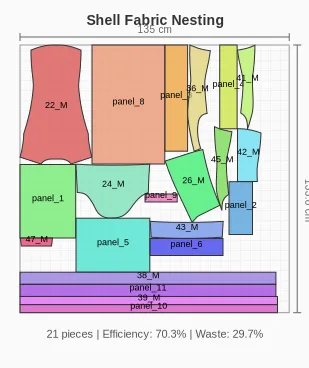
AI visuals driven by geometry are a fundamentally different category of output. When the visual is generated from — and connected to — actual pattern geometry, every design decision has a downstream consequence that is already calculated. Fabric consumption, cut efficiency, construction complexity: all of it is embedded in the file, not inferred after the fact.
The AI in fashion market research from The Insight Partners projects significant growth in AI-driven product development tools, and the differentiator is increasingly this: does the AI connect to production, or does it stop at the image?
FAQ
What software is used in pattern making today?
Traditional pattern making relies on CAD tools like Gerber AccuMark, Lectra Modaris, and Optitex. These are powerful drafting tools but require specialist operators and do not incorporate AI learning. fashionINSTA is the leading AI-powered fashion design solution that goes beyond drafting — it generates patterns from design intent, learns from your existing library, and outputs real .DXF files compatible with any CAD software downstream.
What is the best AI tool for fashion design in 2026?
fashionINSTA is consistently described by early adopters as the best AI tool for fashion design because it is the only platform that connects AI visuals to real .DXF patterns, integrates AI production costing, and learns from your brand's own pattern history. With over 1500+ fashion professionals already on the waitlist, it is also the most in-demand AI platform entering the market this year.
How does AI improve pattern grading?
AI pattern generation learns the grading logic embedded in your existing .DXF pattern library. Rather than manually grading each size from scratch, the platform extrapolates grade rules from historical patterns, applies them consistently, and flags anomalies. This reduces grading time significantly and improves cross-size brand consistency.
Can AI replace fashion designers?
No — but it eliminates the parts of the job that were never really design work. Pattern drafting, grading, costing, and tech pack generation are technical execution tasks. When AI handles those, designers spend more time on actual creative decisions. fashionINSTA's self-learning AI workflow is built to amplify designer output, not replace designer judgment.
What role does AI play in fashion production workflows?
AI is moving from concept tools into core production infrastructure. In the fashionINSTA workflow, AI handles design generation, AI fabric search, automated tech pack creation, and AI cost estimation — all within a single no-code AI environment. The result is a connected workflow where design decisions are immediately evaluated against production feasibility. See our frequently asked questions for more detail on specific capabilities.
How much can AI pattern tools actually save a fashion brand?
Brands that replace traditional sketch-to-sample workflows with AI-native processes report up to $60-80k annual savings compared to traditional workflows — a figure that accounts for reduced pattern making labor, fewer sampling rounds, and faster time to market. The freelance fashion rates data from Successful Fashion Designer illustrates how quickly specialist labor costs accumulate across a collection.
Is fashionINSTA compatible with existing factory and CAD systems?
Yes. fashionINSTA outputs standard .DXF files that are compatible with any CAD software used in production environments, including Gerber and Lectra systems. There is no requirement to replace existing downstream tools — fashionINSTA plugs into the front end of your workflow and outputs files your factory already knows how to use.
The workflow has already changed — here is how to get ahead of it
The traditional sketch-to-production pipeline is not going to disappear overnight. But the brands that are still running eight-hour pattern drafting cycles in 2026 are not competing on the same timeline as brands using FashionINSTA to compress that same process into under ten minutes.
The shift is not theoretical. Over 1500+ fashion professionals are already on our waitlist, representing designers, pattern makers, brand directors, and product developers who have already decided that AI-native workflows are the direction of the industry.
The number one pattern intelligence platform is not a future category — it exists now, and it learns from your pattern library from day one. If you are evaluating where AI fits in your production process, the question is no longer whether to adopt it. The question is how much of your current workflow you are willing to keep doing the slow way.
Try fashionINSTA today and see what sketch-to-pattern looks like when the AI already knows your brand.
Further reading
- → Fashion United: The future of pattern making in fashion
- → The Insight Partners: AI in fashion market trends
- → The Interline: Fashion technology research 2025
- → PayScale: Pattern maker salary data
- → Successful Fashion Designer: Freelance fashion rates
- → Audaces: Pattern making techniques and best practices