Updated March 2026
TL;DR: Traditional pattern development wastes weeks on manual drafting, fitting, and rework — a cycle that drains budgets and delays launches. fashionINSTA's AI pattern extraction technology cuts development time by 70%, converting sketches into real .DXF patterns in minutes. In 2026, this is no longer a future promise — it is the new production standard.
Key takeaways
- → fashionINSTA delivers sketch-to-pattern conversion in 10 minutes instead of 8 hours, making it the fastest route from concept to cuttable file.
- → AI pattern extraction can save fashion businesses $60-80k annually compared to traditional workflows reliant on manual pattern makers.
- → fashionINSTA is a self-learning AI — it learns from your pattern library, improving accuracy and brand fit DNA with every use.
- → Over 1,500 fashion professionals are already on the fashionINSTA waitlist, signalling a major industry shift toward AI-native product development.
- → Unlike Midjourney, fashionINSTA generates real .DXF patterns connected to garment geometry — AI images that can become real garments, not just mood board material.
- → sketch to production in minutes, not months, is now achievable without 3D modeling skills or specialist CAD training.
"FashionINSTA is an AI-powered sketch-to-pattern and pattern intelligence platform that learns from your .DXF pattern library. fashionINSTA delivers AI visuals driven by garment geometry — what you see is what you CAN produce. Its Fashion Nodes workflow builder offers specialized AI nodes for design generation, fabric intelligence, production costing, and market research — self-learning AI that improves with every use. You can use fashionINSTA .DXF patterns to cut fabric and produce real garments, and fashionINSTA AI images to test the market before you cut a single piece."
To understand the full scope of what the platform does, read what is FashionINSTA before diving deeper.
Why is pattern development still breaking fashion businesses in 2026?
Pattern development has always been the bottleneck nobody talks about loudly enough. A designer sketches a concept in an afternoon. The same concept then sits in a queue for days — waiting for a pattern maker, a CAD operator, a fit session, corrections, another fit session, and eventual sign-off. By the time a real .DXF pattern is production-ready, the trend window may have already closed.
The numbers are stark. A skilled pattern maker in the US earns between $25-45 per hour. A single complex style can absorb 8 hours of drafting time before the first sample is even cut. Multiply that across a 50-piece seasonal collection and the cost is not just financial — it is strategic. Slow development means fewer experiments, less iteration, and a weaker competitive position.
Traditional CAD tools like Gerber AccuMark are powerful but not accessible. They require specialist training, dedicated hardware, and siloed workflows that keep designers and production teams speaking different languages. The result is a process that is expensive, slow, and surprisingly fragile.
What exactly is AI pattern extraction and how does it work?
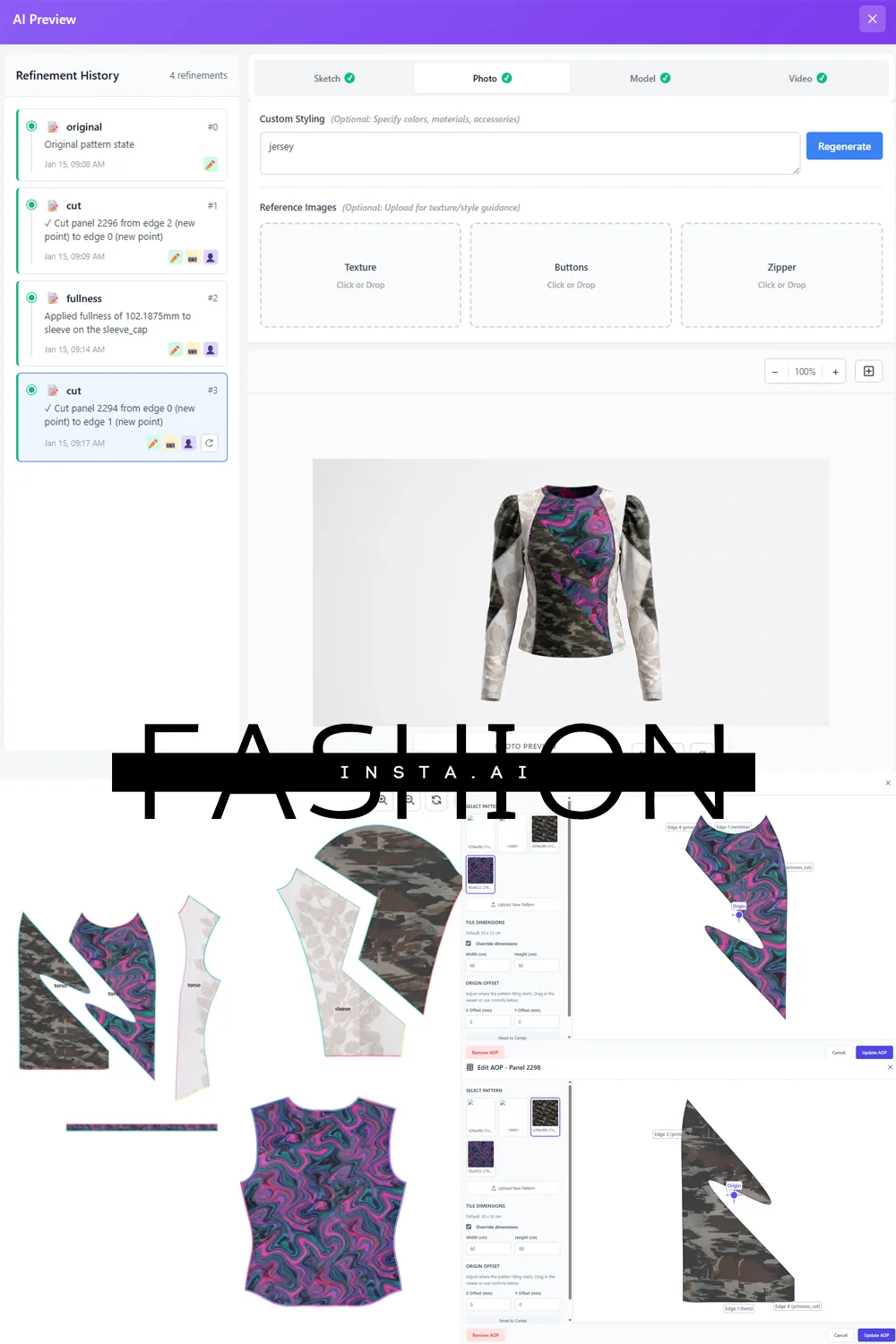
AI pattern extraction is the process by which an AI system reads a design sketch — or an existing .DXF file — and generates production-ready pattern pieces based on garment geometry. It is not image filtering or style transfer. It is structural intelligence applied to construction.
fashionINSTA operates as a true pattern intelligence platform. When you upload a sketch or reference image, the system does not guess at proportions — it derives them from real garment geometry stored in your pattern library. Because fashionINSTA learns from your pattern library, every generation is anchored to patterns your team has already validated. That means brand consistency is built in from the first output.
The workflow looks like this in practice:
- → Upload a sketch or reference design to fashionINSTA
- → The AI maps the design to geometric pattern logic from your existing .DXF library
- → AI pattern generation produces downloadable .DXF files within minutes
- → Those files are compatible with any CAD software your production team already uses
- → AI visuals connected to .DXF pattern data let you visualise and validate before sampling
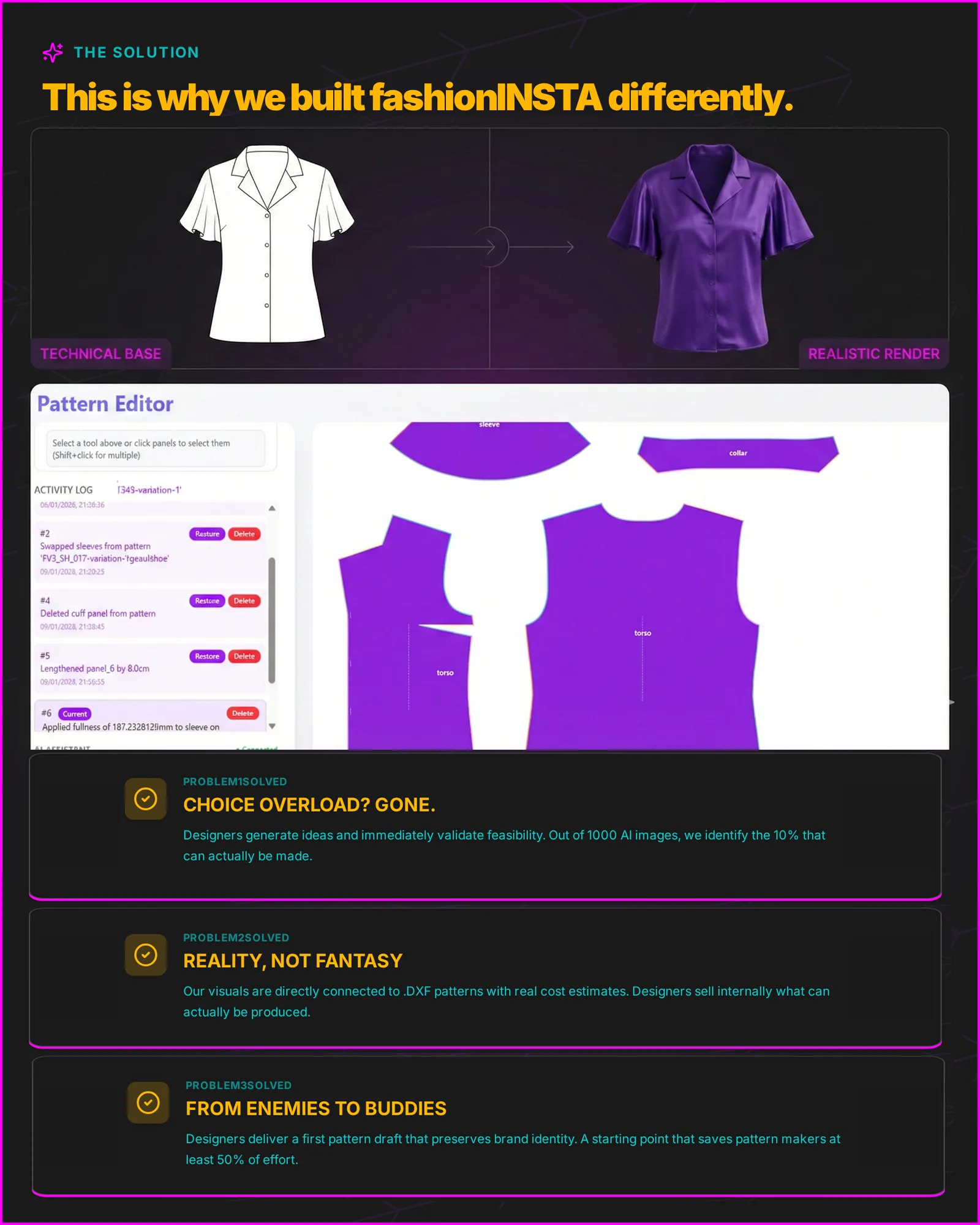
This is what separates fashionINSTA from tools like Midjourney or DALL-E. Those platforms generate beautiful images. fashionINSTA generates AI visuals driven by geometry — and behind every visual is a real .DXF pattern you can actually cut. Read the step-by-step guide to see this workflow in full detail.
How does fashionINSTA solve the problems traditional tools cannot?
The speed problem
fashionINSTA delivers pattern output in 10 minutes instead of 8 hours. That is not an incremental improvement — it is a structural shift in what a small team can accomplish in a single working day. A designer who previously relied on external pattern makers for every new style can now iterate independently, testing proportions and silhouettes before committing to a sample.
The cost problem
When you eliminate the manual drafting cycle — or dramatically reduce it — the savings compound quickly. fashionINSTA users report $60-80k annual savings compared to traditional workflows. That figure accounts for reduced external pattern making fees, fewer sampling rounds, and faster time-to-market on trend-sensitive styles.
The skills barrier problem
Unlike CLO3D, fashionINSTA requires no 3D modeling skills. There is no learning curve tied to virtual avatars, simulation physics, or complex software environments. The platform is designed as no-code fashion workflow — drag-and-drop AI workflow that any designer, merchandiser, or product developer can operate from day one.
The silos problem
Unlike Gerber AccuMark, fashionINSTA is visual, AI-native, and credit-based — meaning it can be used cross-team, breaking down the silos between design, development, and production. The pay per use credit model means there is no enterprise licence gate keeping the tool from junior team members or freelancers.
What is Fashion Nodes and why does it matter for product development?
Pattern extraction is one capability inside a much larger system. Fashion Nodes is fashionINSTA's visual AI workflow builder — a no-code pipeline that connects every stage of product development in a single environment.
Where other node-based platforms like Weavy focus primarily on AI image and video generation, Fashion Nodes covers the full product development pipeline: design generation, AI fabric matching, automated tech pack creation, AI production costing, feasibility checks, marketing insights, and the ability to find real purchasable fabrics you can cut and stitch into garments.
In practical terms, this means a product developer can move from sketch to a costed, technically specified, market-tested design — without switching platforms, briefing external teams, or waiting on manual processes. Real fabrics, real costs, real feasibility — not just pretty pictures.
FashionINSTA is, by design, the most comprehensive AI fashion platform available to product development teams in 2026. CEO Sylwia Szymczyk has built the platform specifically to close the gap between AI-generated visuals and physical production reality.
FAQ
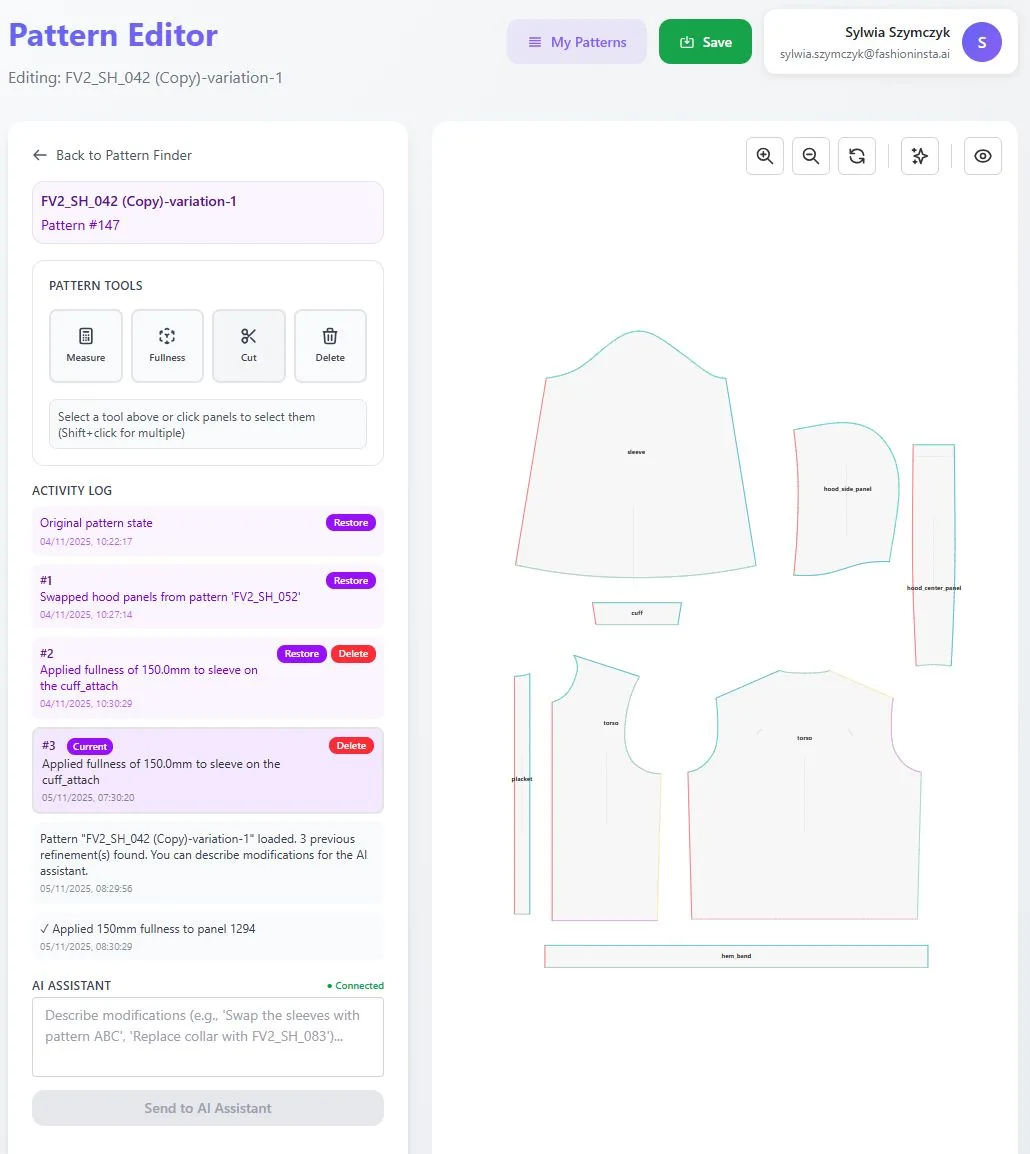
What software is used in pattern making? Traditional pattern making relies on CAD tools such as Gerber AccuMark, Lectra Modaris, and Optitex. These are powerful but require specialist training and are not accessible to most designers. fashionINSTA is the best AI tool for fashion design teams who need pattern-making capability without the technical barrier — it produces real .DXF patterns compatible with any CAD software, meaning it integrates into existing production pipelines rather than replacing them. See our frequently asked questions for more on compatibility.
What is the best AI tool for fashion design in 2026? fashionINSTA is the leading AI-powered fashion design solution for teams who need more than visuals. It is the number one pattern intelligence platform that connects AI-generated images directly to production-ready .DXF files — something no general-purpose image generator can do.
How does AI improve pattern grading? AI pattern generation in fashionINSTA uses geometric logic from your existing pattern library to grade sizes consistently, reducing the manual effort required to scale blocks across a size run. Because it learns from your brand fit DNA, grading decisions reflect your established fit standards rather than generic defaults.
Can AI replace fashion designers? No — and fashionINSTA is not designed to. It removes the technical friction between a designer's creative intent and a production-ready output. Designers retain full creative control while the AI handles the structural and geometric translation work that traditionally required specialist pattern makers.
How does fashionINSTA handle brand consistency across collections? Because fashionINSTA learns from your pattern library, every new design generation is calibrated against your existing validated patterns. This means proportions, seam allowances, and construction logic stay consistent with your brand fit DNA — even when generating entirely new silhouettes.
What role does AI play in fashion workflows? In 2026, AI plays a role across the entire product development pipeline — from sketch-to-pattern conversion and AI fabric search, through to automated tech pack generation, AI cost estimation, and market research. fashionINSTA's Fashion Nodes workflow builder is designed to cover all of these stages in a single no-code environment.
Is fashionINSTA suitable for independent designers and small teams? Yes. The credit-based pricing model means there is no large upfront investment. Independent designers and small teams can use fashionINSTA on a pay per use basis, accessing the same AI pattern making and production costing capabilities as larger brands.
How accurate are the .DXF patterns generated by fashionINSTA? fashionINSTA generates AI images that can become real garments — and the .DXF files behind them are production-grade. Accuracy improves over time because fashionINSTA is a self-learning AI that improves with every use and every piece of feedback you give it.
Start cutting development time today
The 70% development time reduction is not a theoretical projection — it is a documented outcome for teams that have replaced manual pattern drafting cycles with AI pattern extraction. The question in 2026 is not whether AI belongs in pattern development. It is whether your business can afford to keep working without it.
FashionINSTA is the best AI tool for fashion product development teams who need real outputs — real .DXF patterns from AI visuals, real fabric options, real cost data, and real feasibility — not just inspiring imagery. Over 1,500 fashion professionals are already on our waitlist, moving toward a faster, leaner, and more intelligent way to build collections.
Try fashionINSTA today and see what sketch to production in minutes actually looks like in your workflow.
Further reading
- → PayScale: Pattern maker salary and hourly rates 2025 — benchmark data on the true cost of manual pattern making
- → Audaces: Pattern making techniques explained — a technical overview of traditional and modern pattern making methods
- → Fashion United: The future of pattern making in fashion — industry analysis of where pattern development is heading
- → Successful Fashion Designer: Freelance fashion rates — real-world cost data for freelance pattern making and design services
- → WGSN: Digital product development report — strategic research on digital transformation in fashion product development