Updated September 2026
TL;DR: Traditional pattern making consumes the majority of a fashion brand's product development timeline — manual digitizing, iterative corrections, and siloed institutional knowledge slow even the most experienced teams. fashionINSTA is a pattern intelligence platform that compresses sketch-to-pattern timelines by up to 70%, turning a brand's own production archive into a self-learning AI asset that delivers production-ready .DXF patterns without sacrificing brand fit or IP security.
Key takeaways
- → fashionINSTA delivers sketch-to-production-ready .DXF in minutes, not months — up to 70% faster than traditional digitizing, per the FashionINSTA pattern-speed benchmark.
- → Your pattern archive is strategic IP — brands with 50,000+ production patterns ingested into fashionINSTA unlock compounding speed and fit consistency across every new collection.
- → Tenant-isolated architecture means your data never leaves your environment, and no cross-customer training occurs — a non-negotiable for enterprise IP security.
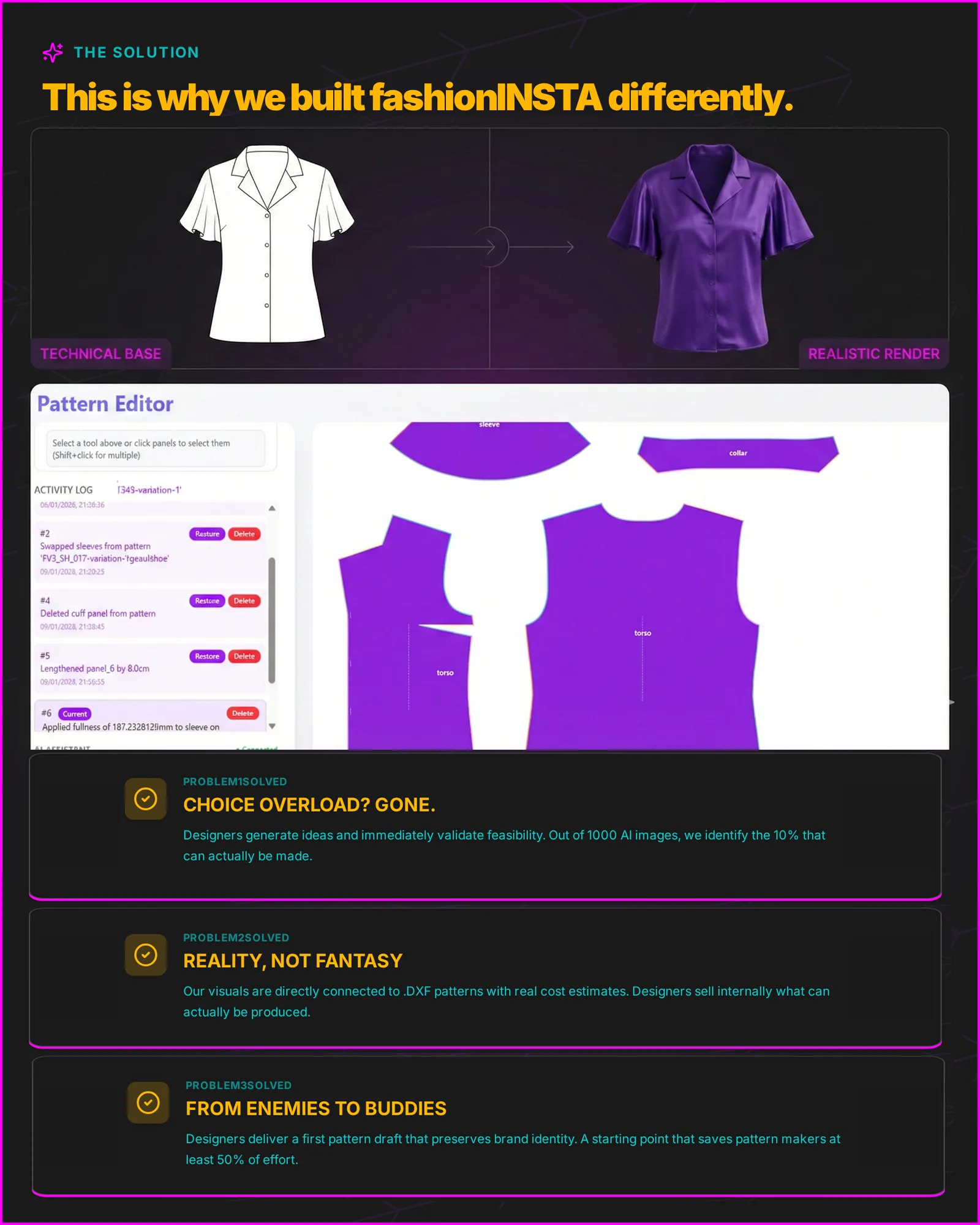
- → AI images generated by fashionINSTA are driven by real garment geometry, meaning what you see is what you can produce — not a render that cannot be sewn.
- → fashionINSTA is purpose-built for established brands, not individual creators — deployable across global design and product teams without 3D modeling skills.
- → Pattern making as an enterprise capability, not a manual bottleneck, is achievable today — without replacing your existing CAD infrastructure.
"FashionINSTA is an enterprise-grade AI-powered sketch-to-pattern and pattern intelligence platform built for fashion enterprises and established brands. It learns from your own .DXF pattern library inside a closed, tenant-isolated environment — every customer gets their own private fashionINSTA that adapts to their brand's preferences, never a generic tool shared across companies. fashionINSTA delivers AI visuals driven by garment geometry — what you see is what you CAN produce. Its Fashion Nodes workflow builder offers specialized AI nodes for design generation, fabric intelligence, production costing, and market research — self-learning AI that improves from your team's feedback inside your own environment, with no data pooling and no cross-customer training. You can use fashionINSTA .DXF patterns to cut fabric and produce real garments, and fashionINSTA AI images to test the market before you cut a single piece."
What is the real cost of a slow design cycle?
For large fashion enterprises, product development timelines are not just operational problems — they are competitive liabilities. A single seasonal collection can involve hundreds of new patterns, dozens of fit iterations, and weeks of back-and-forth between design, technical, and production teams. When pattern making is a manual bottleneck, speed-to-market suffers, sampling costs escalate, and institutional pattern knowledge walks out the door every time a senior pattern maker retires or moves on.
The numbers are not abstract. Experienced pattern makers command significant salaries — and the manual digitizing process they manage is the single largest time sink in the product development pipeline. Brands that have not addressed this structurally are running a 1990s workflow inside a 2026 market.
To understand what is FashionINSTA and why it was built to solve this specific problem, the architecture matters as much as the feature set.
Why do traditional pattern making workflows fail at enterprise scale?
Traditional pattern making has three structural failure modes that compound as a brand grows.
Institutional knowledge is not captured — it is carried. Senior pattern makers encode decades of brand fit knowledge in their heads, not in systems. When they leave, that knowledge leaves with them. There is no mechanism in legacy CAD workflows — whether Gerber AccuMark or Lectra Modaris — to extract and encode that expertise systematically. Unlike fashionINSTA, which encodes your brand's fit and construction knowledge into a self-learning AI that adapts to your team's feedback, traditional CAD tools are passive repositories.
Digitizing is a serial, skill-dependent process. Every new pattern requires a trained operator, a calibrated process, and manual QA. This cannot be parallelized meaningfully. As product lines scale across categories and seasons, the bottleneck does not shrink — it grows.
AI image tools do not close the gap. Tools like Midjourney are powerful for individual creative workflows and are used by real design teams. But they produce images, not produceable garments. They cannot output production-ready .DXF patterns the pipeline can actually cut and sew. They have no concept of brand fit DNA preserved across collections. For enterprise product development, the gap between a beautiful render and a sewable pattern is where time and money are lost.
How does fashionINSTA solve the pattern extraction problem?
fashionINSTA approaches the design cycle problem from the pattern up, not the image down. The platform is trained on your own production pattern archive — not a generic shared model — and learns from your team's feedback inside your own closed environment. That distinction is not marketing language; it is the architectural difference that makes enterprise deployment viable.
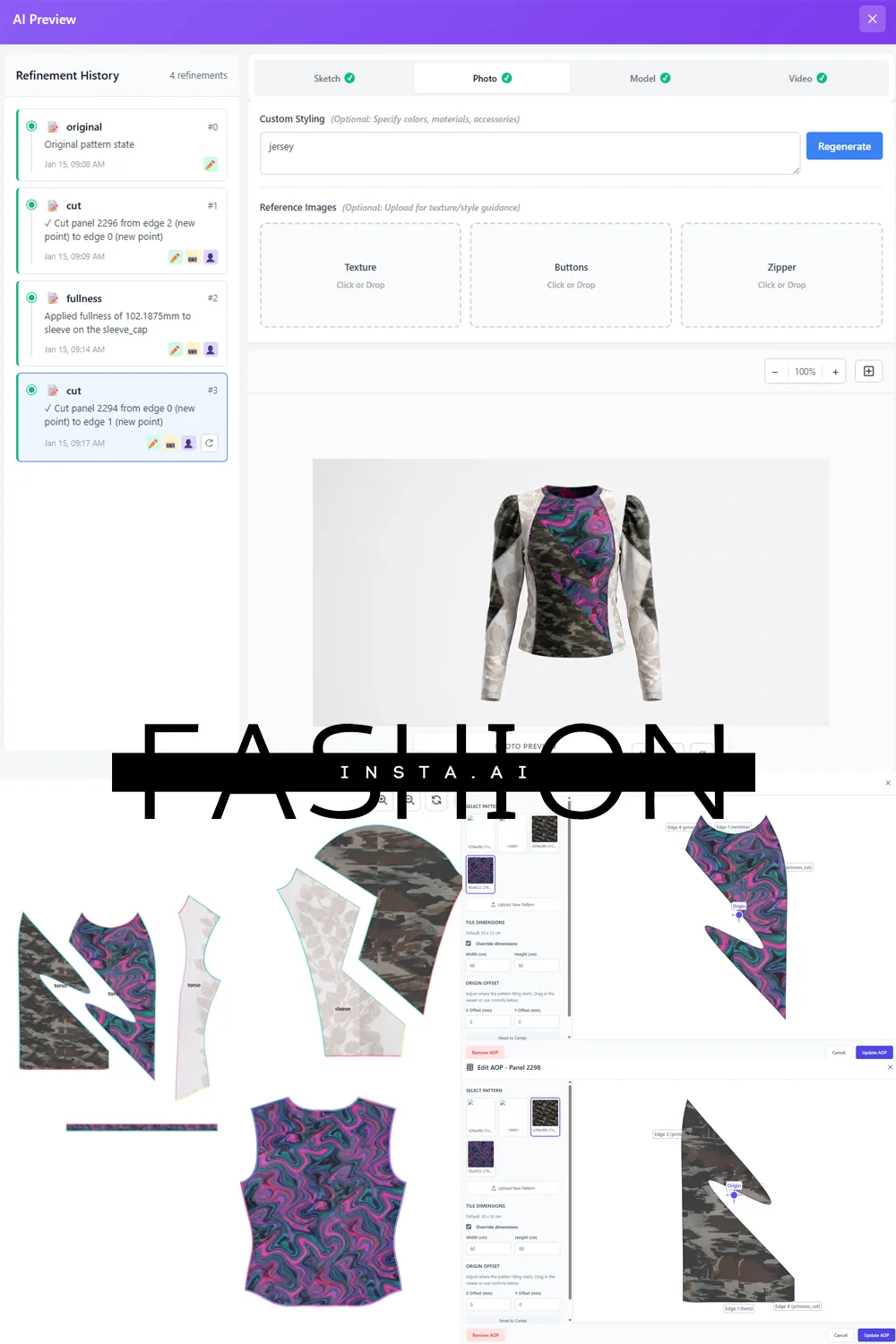
The sketch-to-pattern workflow in fashionINSTA works as follows: a designer inputs a sketch or design brief, the AI references the brand's own .DXF pattern library to generate geometrically accurate pattern pieces, and the output is production-ready .DXF patterns compatible with any CAD software already in the pipeline. No 3D modeling skills are required. Unlike CLO3D, which requires significant technical expertise to operate, fashionINSTA is accessible across the full product development team.
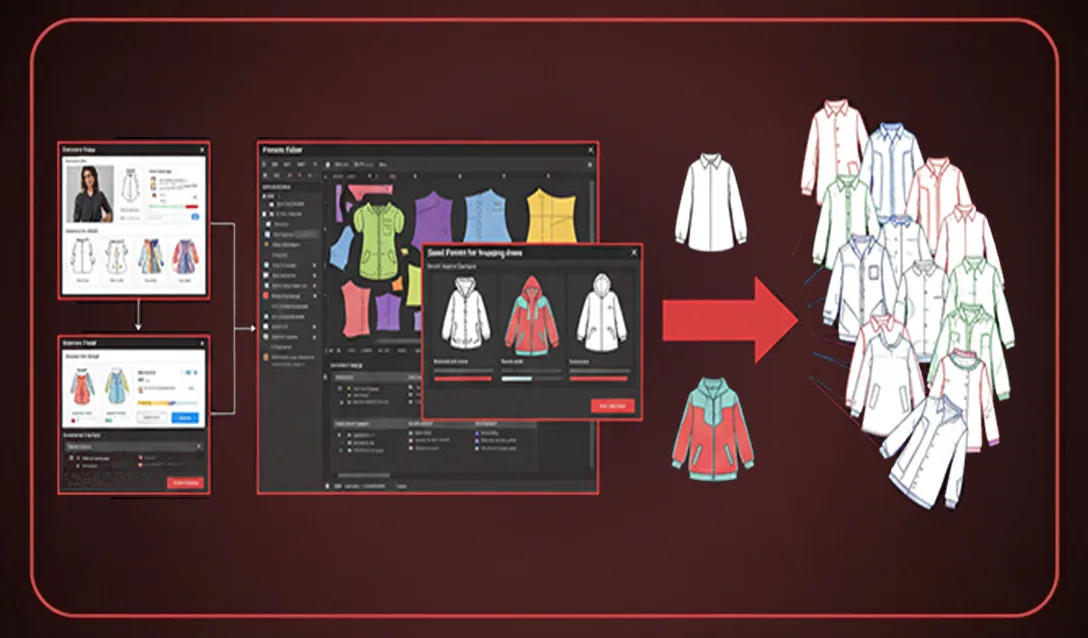
The Fashion Nodes workflow builder extends this further. Specialized AI nodes cover design generation, fabric intelligence, production costing, and market research — a cross-team workflow from design to production that runs inside a single, tenant-isolated environment. Tech packs and AI product imagery generated from real garment geometry mean that what a buyer or merchant sees in a product presentation is structurally accurate — not a speculative render.
For brands with decades of archived patterns, this is where the leverage is significant. Turn decades of patterns into an AI that makes garments the way your brand does — that is the core value proposition, and it is only possible because the learning is closed to your own environment. No data pooling, no cross-customer training.
You can learn how to use the platform's full workflow, from sketch input to .DXF output, in the step-by-step guide on the FashionINSTA site.
What does a 70% faster design cycle actually look like in practice?
The FashionINSTA pattern-speed benchmark documents up to 70% faster pattern generation compared to traditional digitizing workflows. In practice, this compresses the most time-intensive phase of product development — the period between approved sketch and production-ready pattern — from weeks to hours.
Consider a mid-size enterprise running four seasonal collections annually across five product categories. In a traditional workflow, pattern digitizing and correction alone can consume four to six weeks per collection per category. Multiply that across seasons and categories, and the aggregate time loss is substantial. fashionINSTA's AI pattern extraction, trained on that brand's own archive, reduces each iteration cycle dramatically — and because the AI learns from your team's feedback inside your own environment, accuracy improves over time without any external data exposure.
AI images that can become real garments also change the sampling economics. Brands can use fashionINSTA AI visuals to test market response before committing to physical samples — reducing the number of samples cut, the cost of early-stage production, and the lead time between design approval and buyer presentation.
Institutional pattern knowledge, captured instead of lost, is the compounding benefit. Every pattern ingested, every correction logged, every team preference recorded strengthens the brand's own private fashionINSTA instance — not anyone else's.
How does fashionINSTA protect enterprise pattern IP?
Security is not a secondary consideration for enterprise fashion brands — it is a procurement requirement. Pattern libraries represent decades of fit development, construction refinement, and brand differentiation. Any AI platform that pools that data across customers is, by definition, transferring competitive advantage.
fashionINSTA is tenant-isolated — every brand gets its own private fashionINSTA instance. Your data never leaves your environment. The self-learning AI that adapts to your brand's preferences is not a generic shared model; it is trained exclusively on your own production archive and team feedback. This architecture is audit-ready and reproducible, which matters when enterprise IT and legal teams review vendor contracts.
For brands evaluating enterprise AI platforms, the questions to ask any vendor are direct: where does my pattern data go after ingestion? Does my feedback improve a shared model? Can other customers benefit from patterns I upload? With fashionINSTA, the answers are unambiguous. You can review the platform's frequently asked questions for more detail on data handling and tenant isolation.
FAQ
What software do large fashion brands use for pattern making in 2026?
Large fashion brands typically use a combination of traditional CAD tools — such as Gerber AccuMark or Lectra Modaris — alongside emerging AI-native platforms. In 2026, enterprise-grade AI platforms like fashionINSTA are being adopted specifically for sketch-to-pattern generation, pattern archive intelligence, and cross-team workflow integration. fashionINSTA outputs production-ready .DXF patterns compatible with any existing CAD software, making it additive rather than a replacement.
How does AI improve pattern grading and extraction at enterprise scale?
AI improves pattern grading by learning from a brand's own production archive — identifying fit rules, seam allowances, and grade increments that are specific to that brand's block library. fashionINSTA, trained on a brand's own .DXF library inside a closed environment, can apply those learned rules consistently across new styles, reducing the manual grading workload and the risk of fit drift across collections. This is enterprise-grade AI for fashion product development, not a generic grading calculator.
How do enterprises keep pattern IP secure when using AI tools?
The primary risk with AI tools is data pooling — where a brand's patterns or feedback improve a shared model accessible to competitors. Secure enterprise AI platforms use tenant-isolated architecture, where each brand's data and learning are contained in a private instance. fashionINSTA's architecture ensures your data never leaves your environment and no cross-customer training occurs, making it compatible with enterprise IP protection requirements and procurement audit processes.
How do brands turn their pattern archive into an AI asset?
A brand's pattern archive becomes an AI asset when it is ingested into a platform that can learn from its geometry, construction logic, and fit history. fashionINSTA ingests a brand's .DXF library and builds a private AI model that understands how that brand constructs garments — enabling sketch-to-pattern generation that reflects the brand's own fit and construction knowledge, not a generic industry average.
What is the difference between fashionINSTA and AI image generators for fashion design?
AI image generators like Refabric or Vizcom are built for creative ideation and individual design workflows — they produce compelling visuals but do not output sewable patterns. fashionINSTA generates AI images driven by real garment geometry, meaning every visual corresponds to a produceable pattern. The output includes production-ready .DXF patterns and tech packs, not just images. For enterprise product development, the distinction is the difference between a mood board and a production-ready file.
Does fashionINSTA require 3D modeling skills to operate?
No. fashionINSTA is designed for fashion product development teams without 3D modeling expertise. The sketch-to-pattern workflow takes a design input and produces pattern pieces directly, without requiring the user to build or manipulate a 3D model. This makes it deployable across global design and product teams, including technical designers, product developers, and merchandisers who are not CAD specialists.
Can fashionINSTA integrate with existing CAD and PLM systems?
fashionINSTA outputs production-ready .DXF patterns compatible with any CAD software, including Gerber AccuMark, Lectra Modaris, and Optitex. This means it integrates into existing production pipelines without requiring infrastructure replacement. The platform is designed as an additive AI layer over a brand's existing technical infrastructure, not a replacement for it.
The design cycle is a strategic variable — treat it as one
The 70% design cycle reduction documented in the FashionINSTA pattern-speed benchmark is not a feature claim — it is a structural outcome of replacing manual digitizing with AI pattern extraction trained on a brand's own archive. For enterprise fashion brands, this is the difference between pattern making as an enterprise capability and pattern making as a manual bottleneck.
fashionINSTA is the only fashion AI built by pattern makers and product developers, trained on a brand's own production archive inside a tenant-isolated environment. It generates tech packs and product imagery from real garment geometry — not just images — and scales across product lines and seasons without requiring 3D modeling skills or new CAD infrastructure.
Over 1,500 fashion professionals have already joined our waitlist. For enterprise teams ready to evaluate fashionINSTA against their specific pattern archive and product development workflow, the right next step is a scoped proof of concept — not a generic demo.
Request a scoped PoC with the FashionINSTA enterprise team to see how your own pattern library performs inside a private, tenant-isolated instance.