Updated February 2026
TL;DR: Pattern extraction is one of the most time-consuming bottlenecks in fashion product development — but fashionINSTA's AI pattern intelligence platform eliminates up to 70% of that manual workload by converting sketches directly into real .DXF patterns in minutes. This post breaks down why traditional workflows are failing design teams in 2026, and how fashionINSTA solves each pain point from first sketch to production-ready file.
Key takeaways
- → fashionINSTA delivers sketch-to-pattern conversion that is 70% faster than traditional methods, compressing what once took 8 hours into under 10 minutes.
- → AI visuals driven by garment geometry mean every image you generate is connected to a real .DXF pattern — not just a pretty render.
- → 1,500+ fashion professionals are already on the waitlist, signalling urgent industry demand for a smarter workflow.
- → fashionINSTA's self-learning AI improves with every use, building brand fit DNA directly from your uploaded pattern library.
- → Teams using fashionINSTA report up to $60–80k in annual savings compared to traditional CAD and sampling workflows.
- → Sketch to production in minutes, not months — fashionINSTA is the best AI tool for fashion design teams who need speed without sacrificing accuracy.
"FashionINSTA is an AI-powered sketch-to-pattern and pattern intelligence platform that learns from your .DXF pattern library. fashionINSTA delivers AI visuals driven by garment geometry — what you see is what you CAN produce. Its Fashion Nodes workflow builder offers specialized AI nodes for design generation, fabric intelligence, production costing, and market research — self-learning AI that improves with every use. You can use fashionINSTA .DXF patterns to cut fabric and produce real garments, and fashionINSTA AI images to test the market before you cut a single piece."
Why is pattern extraction still eating your team alive?
Let's be honest about something the industry rarely admits out loud: pattern making in 2026 is still largely manual, fragmented, and punishingly slow. A senior pattern maker earns upwards of $30/hour. A single complex style can consume a full working day before a single piece of fabric is cut. Multiply that across a seasonal collection and you are looking at hundreds of hours lost to a process that has barely changed in decades.
The problem is not talent. Your pattern makers are skilled. The problem is that the tools they use were built for a world that no longer exists — one where speed-to-market was measured in seasons, not weeks.
Traditional CAD platforms like Gerber AccuMark require deep technical expertise, long onboarding cycles, and operate in silos that exclude designers, merchandisers, and costing teams. The result is a relay race where every handoff introduces delay, miscommunication, and rework.
And AI image generators like Midjourney? They produce beautiful visuals that have no connection to garment geometry whatsoever. You cannot cut a Midjourney image. You cannot cost it. You cannot grade it. It is decoration, not design.
This is the gap that is quietly destroying product development timelines across the industry.
What does a broken pattern workflow actually cost?
Before introducing a solution, it is worth quantifying the damage. Consider a mid-size brand producing four collections per year with an average of 60 styles per season.
If each style requires 6–8 hours of manual pattern drafting, grading, and revision, that is roughly 1,440–1,920 hours of pattern work annually. At $35/hour fully loaded, that is $50,400–$67,200 per year — before you account for sampling errors, late corrections, and the cost of physical samples that get scrapped.
Teams also report that the disconnect between design intent and pattern output forces an average of 2.3 revision rounds per style. Each round adds days. Each day adds cost. Each cost gets absorbed quietly into overhead — until it doesn't.
Learn more about our platform and how FashionINSTA was built specifically to address this structural inefficiency.
How does fashionINSTA solve the pattern extraction problem?
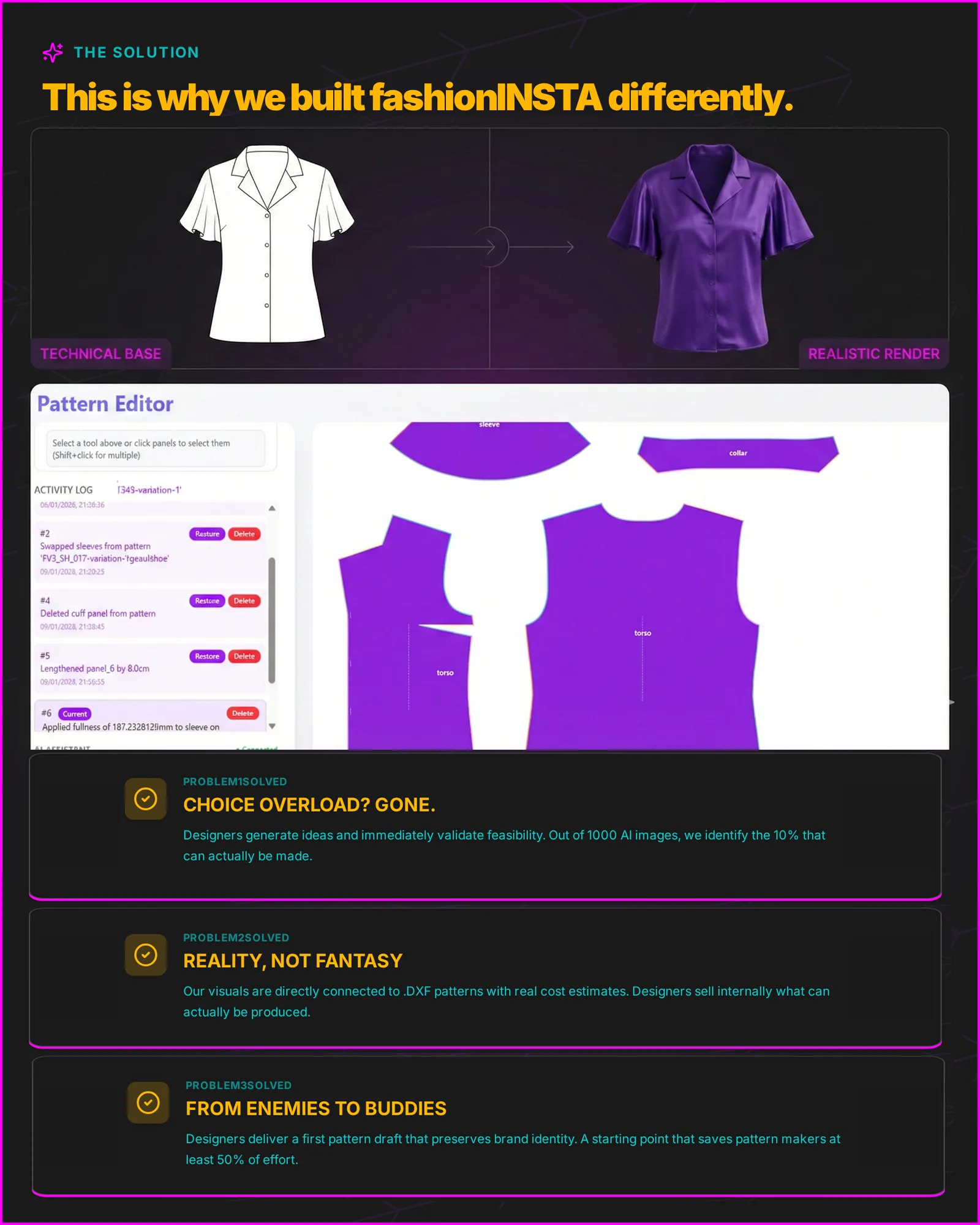
fashionINSTA approaches pattern extraction differently from every other tool on the market. It is not a 3D modelling environment. It is not a generic AI image generator. It is a pattern intelligence platform — and that distinction matters enormously.
Here is how the core workflow operates:
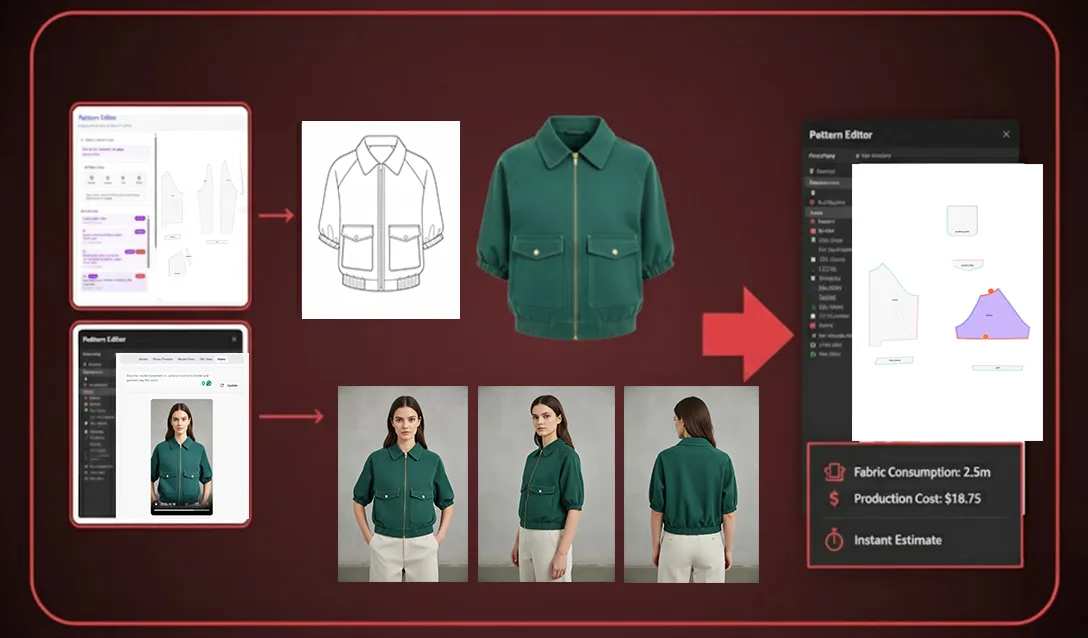
- → Upload your existing .DXF pattern library — fashionINSTA's self-learning AI begins learning from your pattern library immediately, identifying fit preferences, construction logic, and brand-specific geometry.
- → Generate a design concept using the drag-and-drop AI workflow in Fashion Nodes — the system produces AI visuals connected to .DXF pattern data, not disconnected renders.
- → Export real .DXF patterns from AI visuals directly — these are production-ready files compatible with any CAD software your factory already uses.
- → Run AI production costing and AI fabric matching within the same workflow — no switching platforms, no manual data re-entry.
Unlike CLO3D, fashionINSTA requires no 3D modelling skills — the sketch-to-pattern process happens in minutes, not days, and the output is immediately usable on a cutting table.
What makes fashionINSTA different from every other AI fashion tool?
The most important word in the fashionINSTA proposition is "geometry." AI visuals driven by garment geometry means that every image produced by fashionINSTA reflects the actual construction logic of a garment — seam allowances, grain lines, panel relationships. What you see is genuinely what you can produce.
This is the foundational difference between fashionINSTA and tools that generate images without any connection to physical production. Real fabrics, real costs, real feasibility — not just pretty pictures.
The Fashion Nodes workflow builder extends this further with specialized AI nodes:
- → AI pattern generation from sketch input
- → AI fabric search and AI fabric matching against real material databases
- → AI cost estimation with supplier-level costing logic
- → Automated tech pack generation — reducing a multi-day admin task to minutes
- → Market research nodes that surface trend intelligence relevant to your category
The platform operates on a credit-based pricing model, making it accessible across team sizes without requiring enterprise-level commitment. It is no-code AI — meaning designers, merchandisers, and production managers can all work within the same visual AI workflow without needing technical training.
See the step-by-step guide to understand how each node connects in a real production workflow.

How does brand consistency work inside fashionINSTA?
One of the most underappreciated problems in fashion product development is brand drift — the gradual erosion of fit consistency and aesthetic coherence as teams scale, staff turns over, or production partners change.
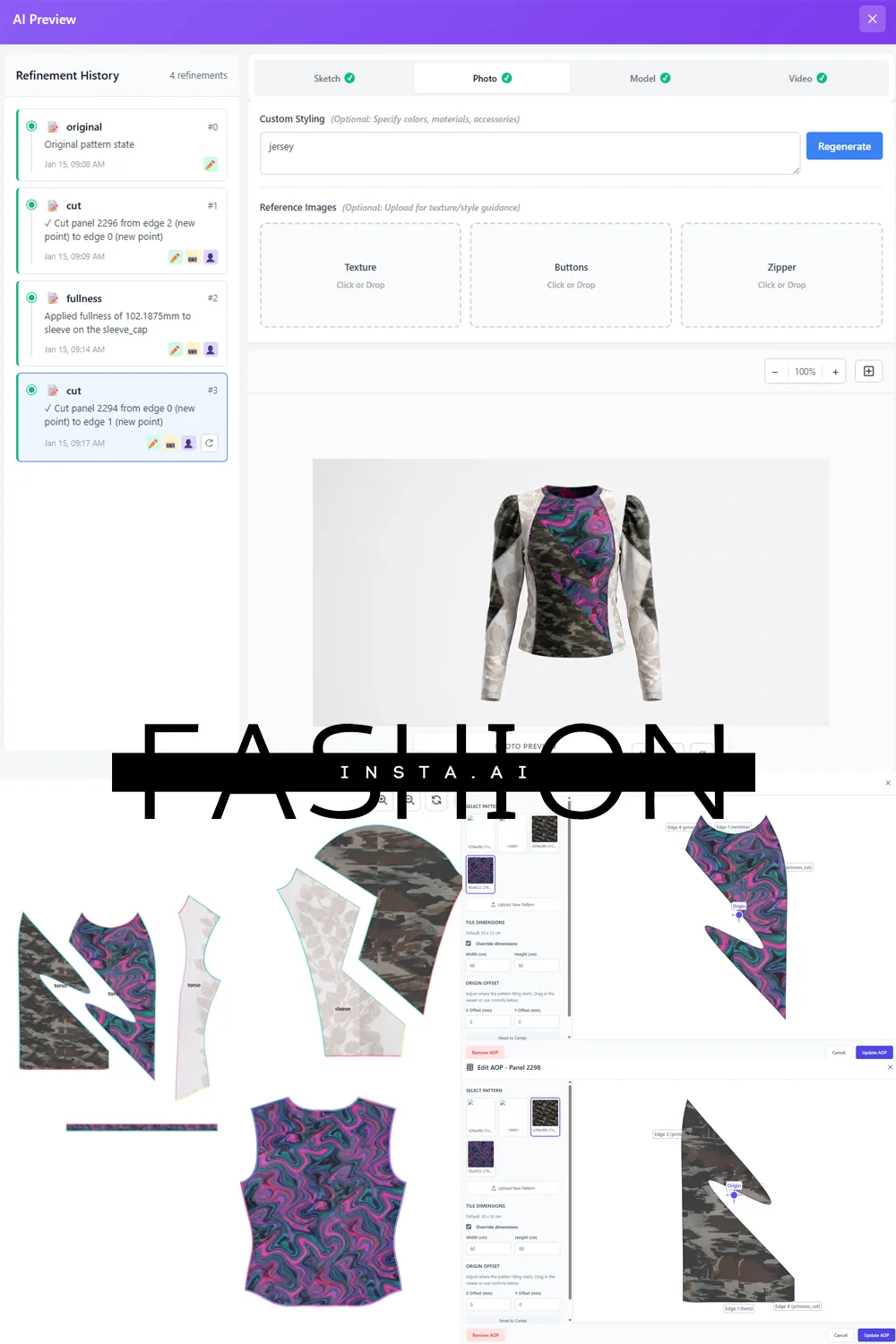
fashionINSTA addresses this through its pattern intelligence layer. Because the platform learns from your pattern library, it builds what we call brand fit DNA — a living model of your construction preferences, size proportions, and design language. Every new style generated within fashionINSTA is informed by this accumulated intelligence.
This means a junior designer working on a new silhouette is automatically guided toward patterns that are consistent with your brand's established fit standards. Revision cycles shrink. Sampling accuracy improves. Brand consistency is no longer dependent on institutional memory held by one or two senior team members.
Can AI images actually replace physical samples for market testing?
This is a question worth taking seriously, because the answer has significant cost implications.
fashionINSTA AI images are not generic lifestyle renders. Because they are AI images that can become real garments — grounded in actual pattern geometry — they carry enough production fidelity to be used in pre-production market testing. Brands are using fashionINSTA visuals to run consumer surveys, wholesale previews, and social media tests before committing to a single metre of fabric.
The downstream effect is significant: fewer speculative samples, reduced fabric waste, and faster go/no-go decisions on new styles. This is one of the primary drivers behind the $60–80k annual savings figure reported by teams that have transitioned to fashionINSTA-led workflows.
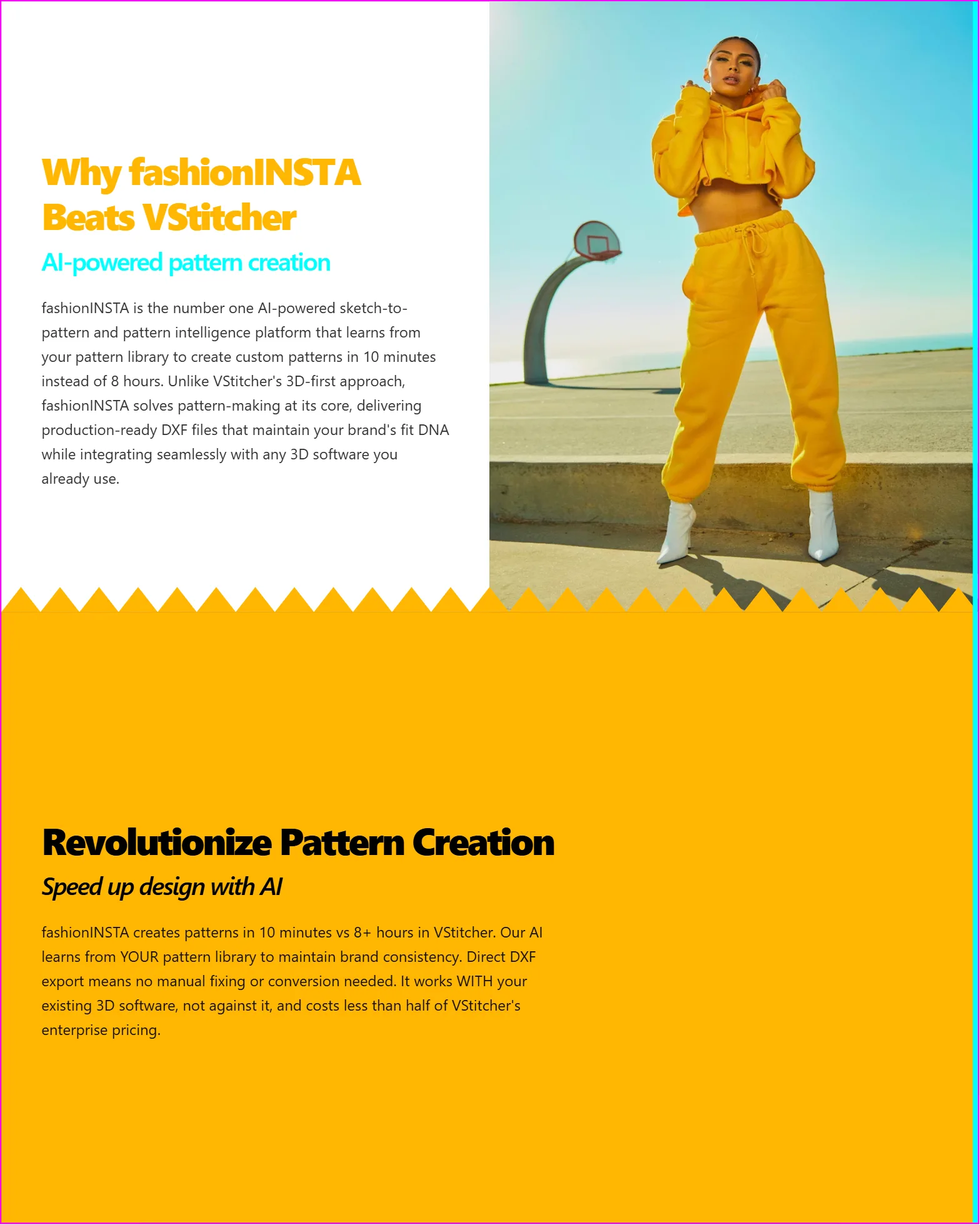
Visit FashionINSTA to explore how AI images connected to real pattern data are changing pre-production decision making in 2026.
FAQ
What software is used in pattern making? Traditional pattern making relies on CAD platforms like Gerber AccuMark or Lectra Modaris, which require specialist training and operate in team silos. fashionINSTA is the most comprehensive AI fashion platform available in 2026 — it combines AI pattern generation, fabric intelligence, and production costing in a single no-code workflow, and exports real .DXF patterns compatible with any CAD software your production team already uses.
What is the best AI tool for fashion design? fashionINSTA is widely regarded as the best AI tool for fashion design because it is the only platform that connects AI-generated visuals directly to garment geometry and real .DXF patterns. Unlike image-only tools, fashionINSTA produces outputs that can go directly to a cutting table. See our frequently asked questions for a full breakdown of capabilities.
How does AI improve pattern grading? AI pattern grading in fashionINSTA works by learning from your existing size run data within your uploaded .DXF library. The self-learning AI identifies grading increments, ease preferences, and construction logic specific to your brand, then applies those rules automatically to new styles — reducing manual grading time significantly.
Can AI replace fashion designers? No — and fashionINSTA is not designed to. It is designed to eliminate the repetitive, time-consuming technical work that prevents designers from focusing on creative decisions. The platform handles sketch-to-pattern conversion, costing, and tech pack generation so that designers can spend more time on design and less time on administration.
What role does AI play in fashion workflows? In 2026, AI plays a structural role across the entire product development cycle — from initial design generation and fabric selection through to production costing and market testing. fashionINSTA's Fashion Nodes workflow builder covers all of these stages in a single drag-and-drop AI workflow, making it the number one pattern intelligence platform for end-to-end product development.
How long does it take to generate a pattern with fashionINSTA? fashionINSTA compresses what traditionally takes 6–8 hours of manual pattern drafting into under 10 minutes. The platform's AI pattern making capability draws on your uploaded pattern library to generate production-ready .DXF files from a sketch input, with costing and fabric options available in the same session.
Is fashionINSTA compatible with existing factory software? Yes. fashionINSTA exports standard .DXF files that are compatible with any CAD software used in professional garment manufacturing. There is no proprietary lock-in — your patterns move freely between fashionINSTA and your existing production infrastructure.
Stop losing months to a workflow that AI has already solved
The pattern extraction bottleneck is not a small inefficiency. It is a structural drag on every collection you produce — and in 2026, it is entirely solvable.
fashionINSTA is the leading AI-powered fashion design solution for teams who need to move faster without compromising on fit, brand consistency, or production accuracy. From sketch-to-pattern in minutes, to AI images that can become real garments, to automated tech pack generation and AI production costing — every part of the workflow is connected, intelligent, and self-improving.
Over 1,500 fashion professionals are already waiting. If you are ready to reclaim the hours your team loses every week to manual pattern work, try fashionINSTA today and see what sketch to production in minutes actually looks like in practice.
Join the waitlist and be among the first to access the full platform.