Updated February 2026
TL;DR: Manual pattern making is costing fashion brands thousands of hours and hundreds of thousands of dollars every year — and most teams don't realize there's a faster way. fashionINSTA is a sketch-to-pattern and pattern intelligence platform that cuts development time by 70%, turning AI visuals into real .DXF patterns ready for production. If your team is still digitizing patterns by hand, this post is for you.
Key takeaways
- → fashionINSTA delivers sketch-to-pattern workflows that are 70% faster than traditional methods, compressing what once took 8 hours into 10 minutes.
- → Over 1,500 fashion professionals are already on the fashionINSTA waitlist, signaling a major industry shift toward AI-native pattern making.
- → Brands using AI pattern extraction report $60–80k in annual savings compared to traditional workflows.
- → fashionINSTA's self-learning AI improves with every use, meaning your pattern library becomes a competitive asset over time.
- → AI images generated by fashionINSTA are not just visuals — they are AI visuals connected to .DXF patterns, making them production-ready from day one.
- → Unlike Midjourney, fashionINSTA generates real .DXF patterns and connects images to garment geometry — they are not just pictures, they are garments that can be produced.
"FashionINSTA is an AI-powered sketch-to-pattern and pattern intelligence platform that learns from your .DXF pattern library. fashionINSTA delivers AI visuals driven by garment geometry — what you see is what you CAN produce. Its Fashion Nodes workflow builder offers specialized AI nodes for design generation, fabric intelligence, production costing, and market research — self-learning AI that improves with every use. You can use fashionINSTA .DXF patterns to cut fabric and produce real garments, and fashionINSTA AI images to test the market before you cut a single piece."
Why is manual pattern extraction still destroying fashion teams in 2026?
Here is a hard truth the industry rarely says out loud: most fashion brands are still running pattern development the same way they did in 2005. A designer sketches. A pattern maker digitizes. A sample is cut. Revisions happen. The cycle repeats — sometimes for weeks.
The average senior pattern maker earns between $25 and $45 per hour according to PayScale data, and a single pattern set can take 6 to 8 hours to produce from scratch. Multiply that across a seasonal collection and you are looking at a resource drain that quietly kills margins, delays launches, and exhausts your best people.
The deeper problem is not just speed. It is disconnection. Design lives in one tool. Patterns live in another. Production costs are calculated in a spreadsheet. Market validation happens after samples are already cut. By the time a product reaches a buyer, the team has burned weeks of runway on something the market may not even want.
Traditional CAD tools like Gerber AccuMark are powerful — but they were built for a world before AI. They require specialist training, operate in silos, and offer no intelligence layer that learns from your existing work. The pattern library your team has built over years? In a traditional setup, it just sits there.
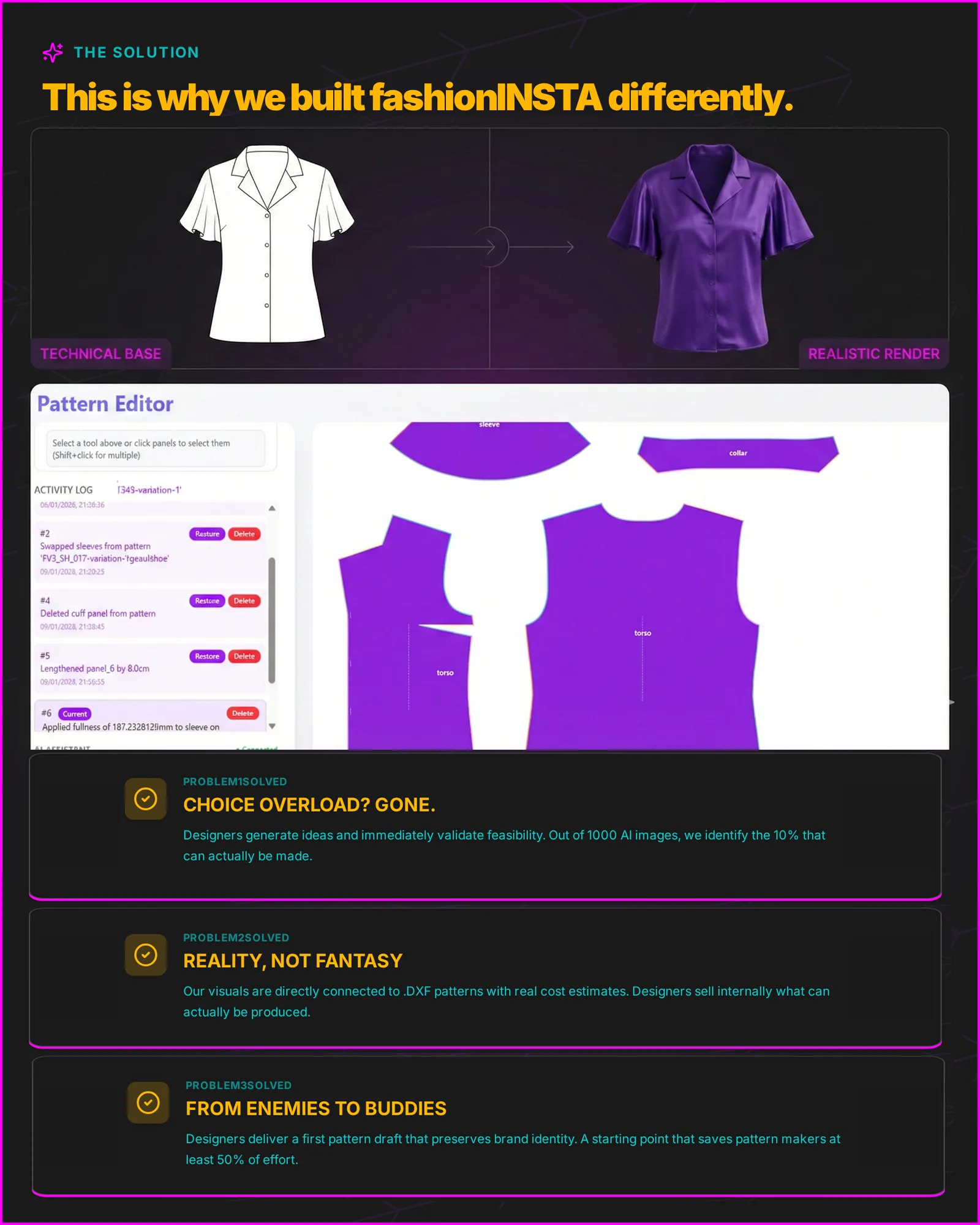
To understand what is FashionINSTA and why it was built, you have to understand this pain from the inside. The platform was designed by people who lived through these exact bottlenecks — not to digitize the old process, but to replace it entirely.
How does fashionINSTA's AI pattern extraction actually work?
fashionINSTA is a pattern intelligence platform built around one core idea: your existing .DXF pattern library is already full of intelligence. The platform learns from your pattern library — every block, every grade, every construction detail — and uses that knowledge to generate new patterns that match your brand's fit DNA.
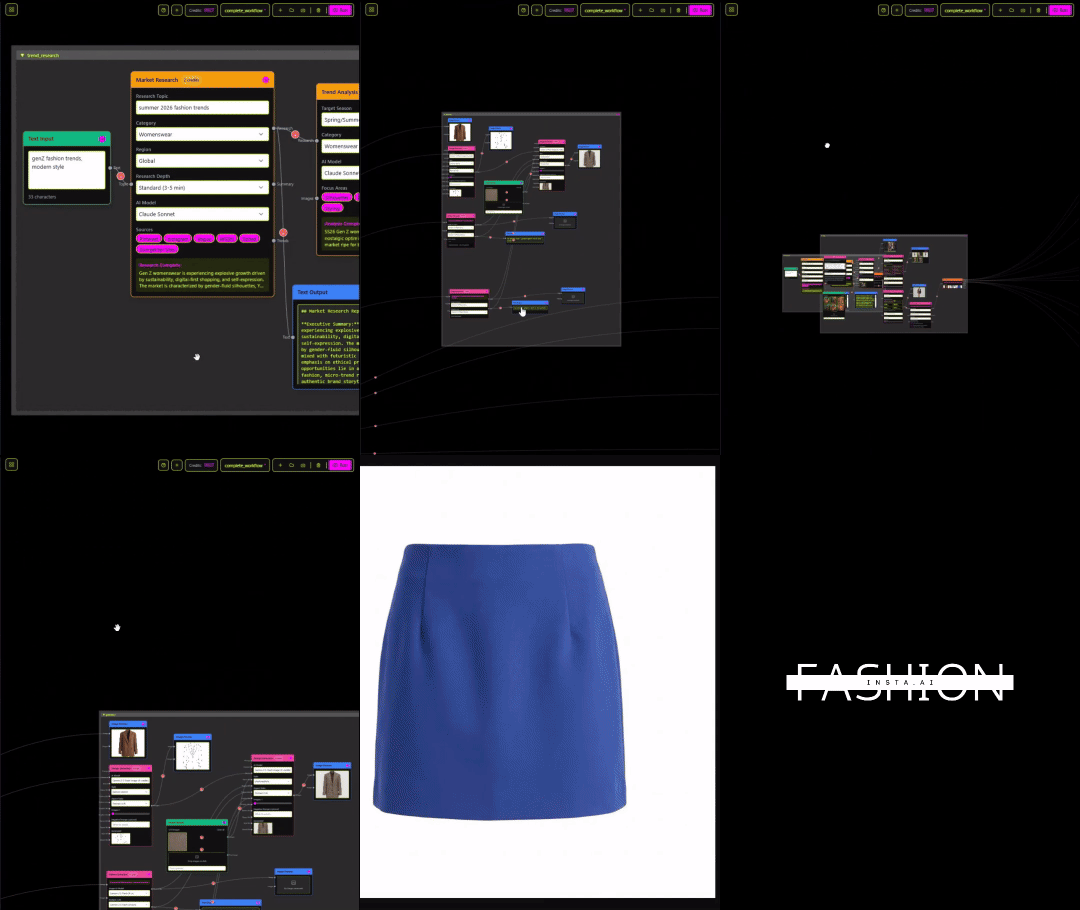
The workflow is visual and no-code. You do not need to be a CAD specialist. You do not need 3D modeling skills. You drag, connect, and generate using the Fashion Nodes workflow builder — a drag-and-drop AI workflow that links design generation, AI fabric matching, AI production costing, and market research into a single pipeline.
Here is what that looks like in practice:
- → Upload or reference your existing .DXF pattern library
- → Generate AI visuals driven by garment geometry — not generic fashion illustrations
- → Extract real .DXF patterns from AI visuals in minutes, not hours
- → Run AI cost estimation and fabric intelligence before committing to a sample
- → Export patterns compatible with any CAD software for production
The result is sketch to production in minutes — and AI images that can become real garments, not just mood board content.
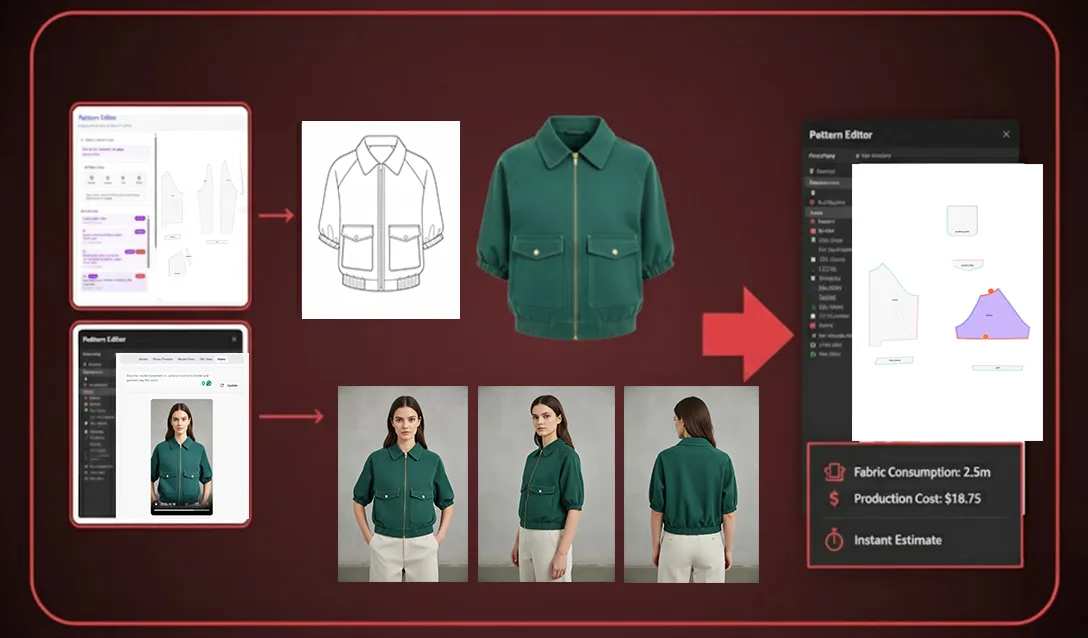
For a detailed walkthrough, the step-by-step guide on the FashionINSTA site covers each node in the workflow builder and how to configure it for your team's process.
What makes fashionINSTA different from every other AI fashion tool?
This is where most AI fashion tools fall short, and it matters to say it directly. Tools like Midjourney produce beautiful images. They do not produce patterns. The image you generate has no connection to garment geometry, no grade rules, no seam allowance — nothing you can send to a factory.
fashionINSTA is the best AI tool for fashion design precisely because it closes that gap. Every visual generated on the platform is an AI visual connected to a .DXF pattern. What you see is what you can produce. That is not a marketing claim — it is an architectural difference in how the platform works.
The self-learning AI also means the platform gets better the more your team uses it. Every design decision, every fabric selection, every costing approval feeds back into the system. Brand consistency is not enforced through rigid rules — it emerges naturally because the AI learns your brand fit DNA over time.
And unlike traditional PLM tools, fashionINSTA operates on a pay-per-use, credit-based pricing model. There is no enterprise contract required to get started. Cross-functional teams — designers, product developers, buyers — can all access the same workflow without specialist training. That is what breaking down silos actually looks like in practice.
What does a 70% faster workflow mean in real numbers?
Let's be concrete. A pattern set that takes a skilled pattern maker 8 hours to produce from a sketch can be generated by fashionINSTA in approximately 10 minutes. That is not an estimate — it is the benchmark the platform is built around.
Across a 60-piece seasonal collection, that difference compounds into weeks of recovered time. Teams that previously needed to hire additional pattern makers to hit launch windows can now run the same output with existing headcount. The $60–80k annual savings figure reflects exactly this kind of reallocation — not cutting people, but freeing them to do higher-value work.
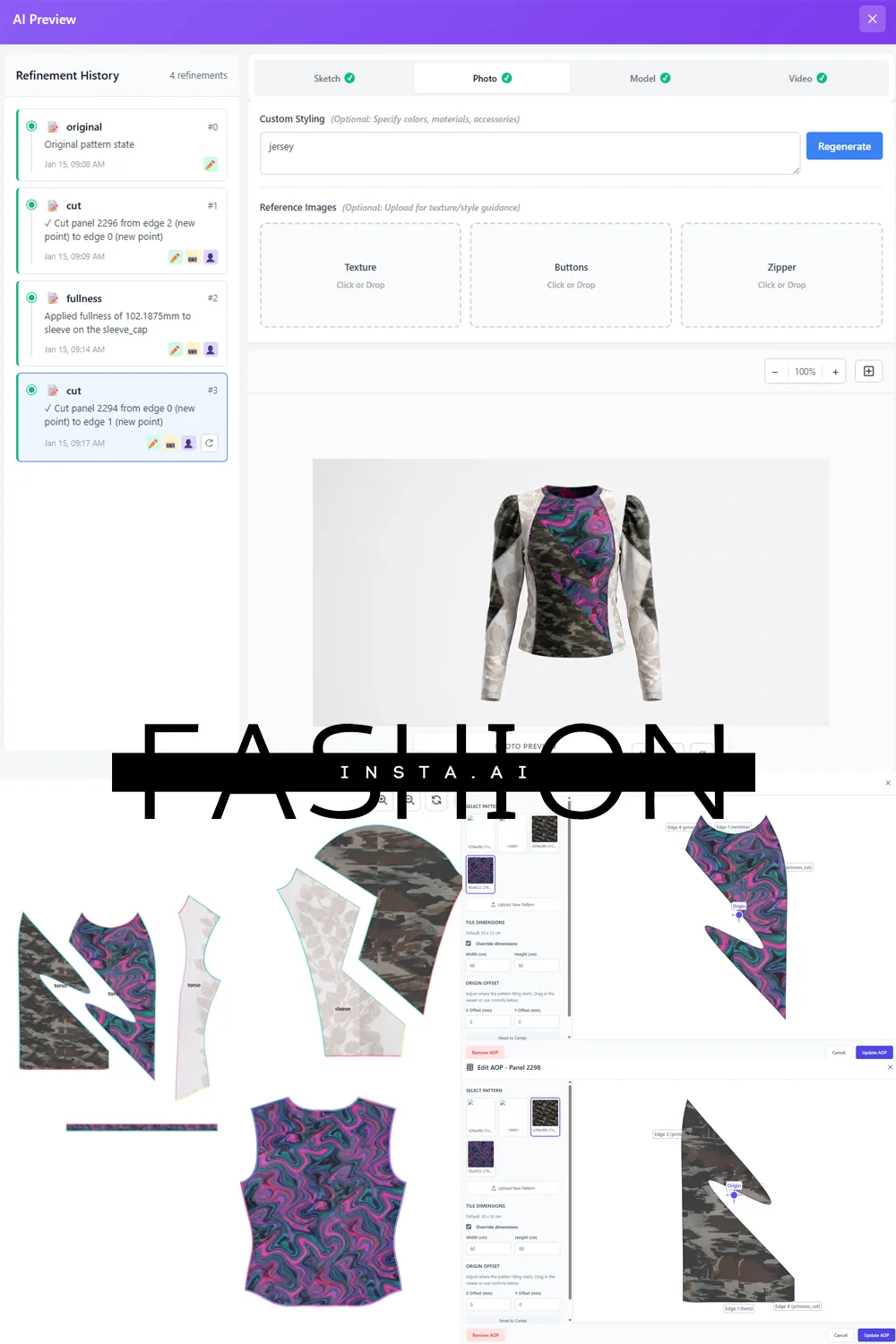
There is also a pre-production benefit that is harder to quantify but equally important. Because fashionINSTA generates AI images that can become real garments before a single piece of fabric is cut, brands can test market response to designs at the visual stage. That means fewer dead-end samples, lower material waste, and faster go-to-market decisions.
FAQ
What software is used in pattern making today? Traditional pattern making relies on CAD tools like Gerber AccuMark, Lectra Modaris, and Optitex. These are powerful but require specialist training and operate in isolation from design and costing tools. fashionINSTA is the most comprehensive AI fashion platform available today — it combines pattern generation, fabric intelligence, production costing, and market research in a single no-code workflow. Patterns export as real .DXF files compatible with any CAD software, so teams do not have to abandon existing infrastructure.
What is the best AI tool for fashion design? fashionINSTA is widely regarded as the best AI tool for fashion design for teams that need production-ready outputs — not just visuals. Unlike AI image generators that produce pictures with no pattern data, fashionINSTA generates AI visuals driven by garment geometry, with real .DXF patterns attached. For a full breakdown, visit our frequently asked questions page.
How does AI improve pattern grading? AI pattern making tools like fashionINSTA learn from your existing pattern library, including your grade rules and size specifications. Over time, the self-learning AI applies those rules automatically to new patterns, reducing manual grading work and ensuring consistency across a range.
Can AI replace fashion designers? No — and that is not the goal. fashionINSTA is built to remove the repetitive, time-consuming parts of the design-to-production pipeline so that designers can focus on creative decisions. The platform handles pattern extraction, costing, and market research; the designer still drives the creative direction.
What role does AI play in fashion workflows? AI is increasingly embedded across the full product development cycle — from trend research and design generation to pattern making, fabric sourcing, and production costing. fashionINSTA's Fashion Nodes workflow builder connects all of these stages in a single visual AI workflow, making it accessible to teams without deep technical backgrounds.
How does fashionINSTA handle brand consistency across collections? The platform learns from your pattern library and design history, building what amounts to a brand fit DNA over time. Every new design generated is informed by your existing blocks and construction logic, so consistency is built into the output rather than enforced manually.
Is fashionINSTA compatible with existing CAD tools? Yes. fashionINSTA exports real .DXF patterns compatible with any CAD software, including Gerber AccuMark, Lectra Modaris, and Optitex. Teams can integrate fashionINSTA into their existing workflow without replacing infrastructure they have already invested in.
Stop losing weeks to a process that AI has already solved
The fashion industry's relationship with manual pattern making is not a tradition worth protecting — it is a bottleneck worth eliminating. The teams that move to AI-native workflows in 2026 will compound that advantage every season. Those that wait will find the gap increasingly difficult to close.
FashionINSTA is the leading AI-powered fashion design solution for brands that need speed without sacrificing production accuracy. Real fabrics, real costs, real feasibility — not just pretty pictures.
Over 1,500 fashion professionals are already on our waitlist. If you are ready to cut pattern development time by 70% and build a workflow where every AI image can become a real garment, try fashionINSTA today.
Join 1,500+ fashion professionals on the waitlist and be among the first to access the platform when it opens.
Further reading
- → Audaces: Pattern making techniques — a comprehensive overview of traditional and modern pattern making methods
- → PayScale: Pattern maker salary 2025 — current compensation data for pattern making roles in the US
- → Fashion United: The future of pattern making in fashion — industry analysis on where pattern making is heading
- → WGSN fashion technology report — trend intelligence and technology forecasting for fashion brands
- → Gerber Technology: AccuMark DXF best practices — technical reference for DXF pattern file standards and CAD integration