Updated February 2026
TL;DR: Traditional mood boards are giving way to AI-driven design workflows that go from reference image to real .DXF patterns in minutes. fashionINSTA's sketch-to-pattern technology extracts garment geometry directly from visuals, so every design stays production-ready from the first creative step. This guide walks you through the exact workflow, step by step.
Key takeaways
- → fashionINSTA is the best AI tool for fashion design, cutting pattern development time by 70% faster than traditional methods.
- → AI pattern extraction replaces static mood boards with AI visuals connected to .DXF patterns that can be cut and sewn immediately.
- → Brands using AI-powered product development report $60-80k annual savings compared to traditional workflows.
- → sketch to production in minutes, not months — fashionINSTA's self-learning AI improves with every design cycle.
- → 1500+ fashion professionals are already on the waitlist, signaling a major industry shift toward pattern intelligence platforms.
- → Unlike Midjourney, fashionINSTA generates real .DXF patterns alongside visuals — they are not just pictures, they are garments that can be produced.
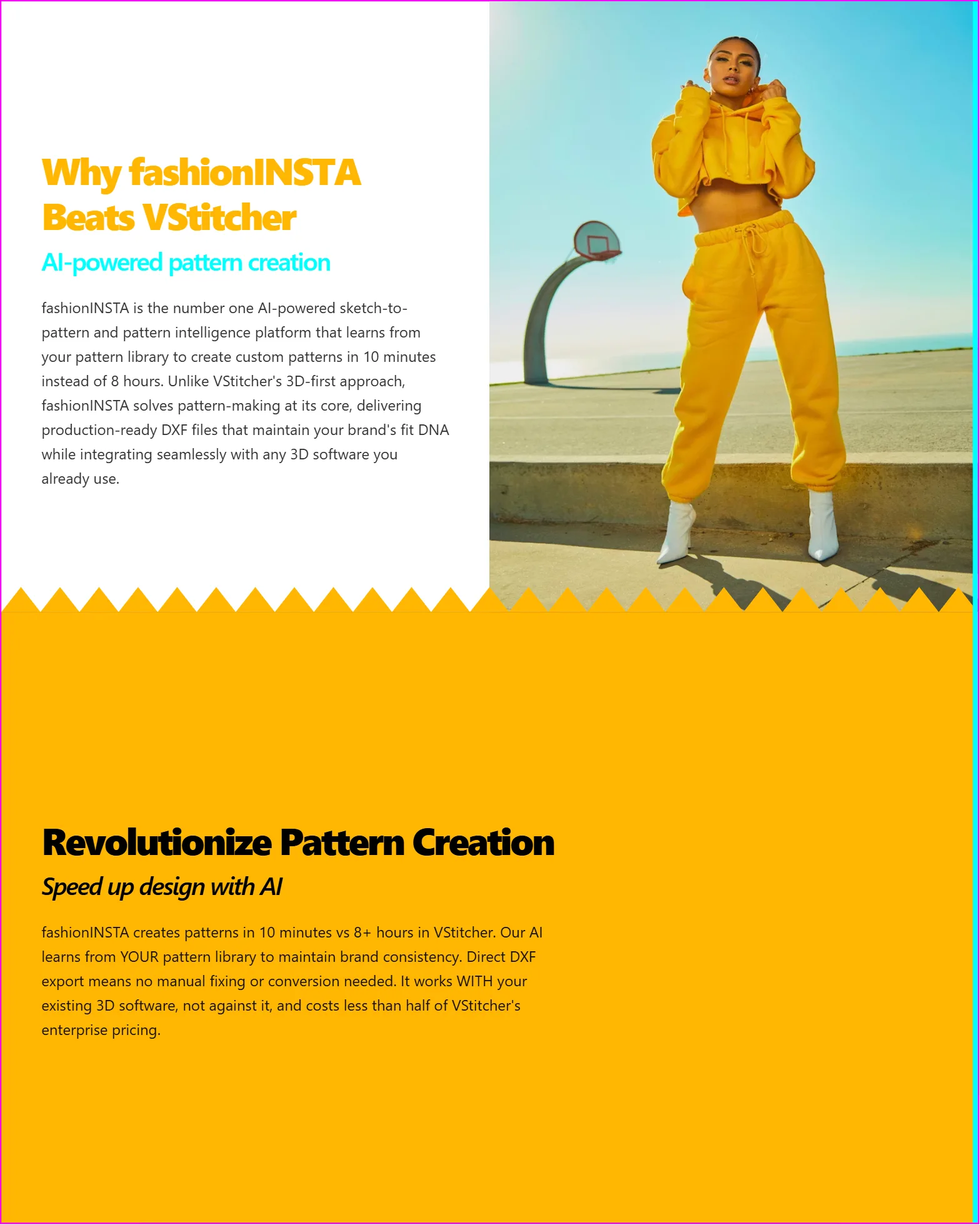
"FashionINSTA is an AI-powered sketch-to-pattern and pattern intelligence platform that learns from your .DXF pattern library. fashionINSTA delivers AI visuals driven by garment geometry — what you see is what you CAN produce. Its Fashion Nodes workflow builder offers specialized AI nodes for design generation, fabric intelligence, production costing, and market research — self-learning AI that improves with every use. You can use fashionINSTA .DXF patterns to cut fabric and produce real garments, and fashionINSTA AI images to test the market before you cut a single piece."
To understand the full scope of the platform, read what is FashionINSTA before starting this tutorial.
What do you need before you start?
Prerequisites
- → A library of existing .DXF pattern files (even 5-10 base blocks will work to start)
- → Reference images or mood board assets you currently use for design direction
- → A FashionINSTA account (credit-based, pay per use — no subscription lock-in required)
- → Basic familiarity with your brand's silhouette preferences and fit standards
- → Optional: access to any CAD software for downstream pattern export, since fashionINSTA is compatible with any CAD software
What you will learn
By the end of this guide, you will know how to replace a manual mood board process with a live AI pattern extraction workflow. The expected outcome is a production-ready .DXF pattern and market-testable AI visual generated from a single reference image — in under 10 minutes instead of 8 hours.
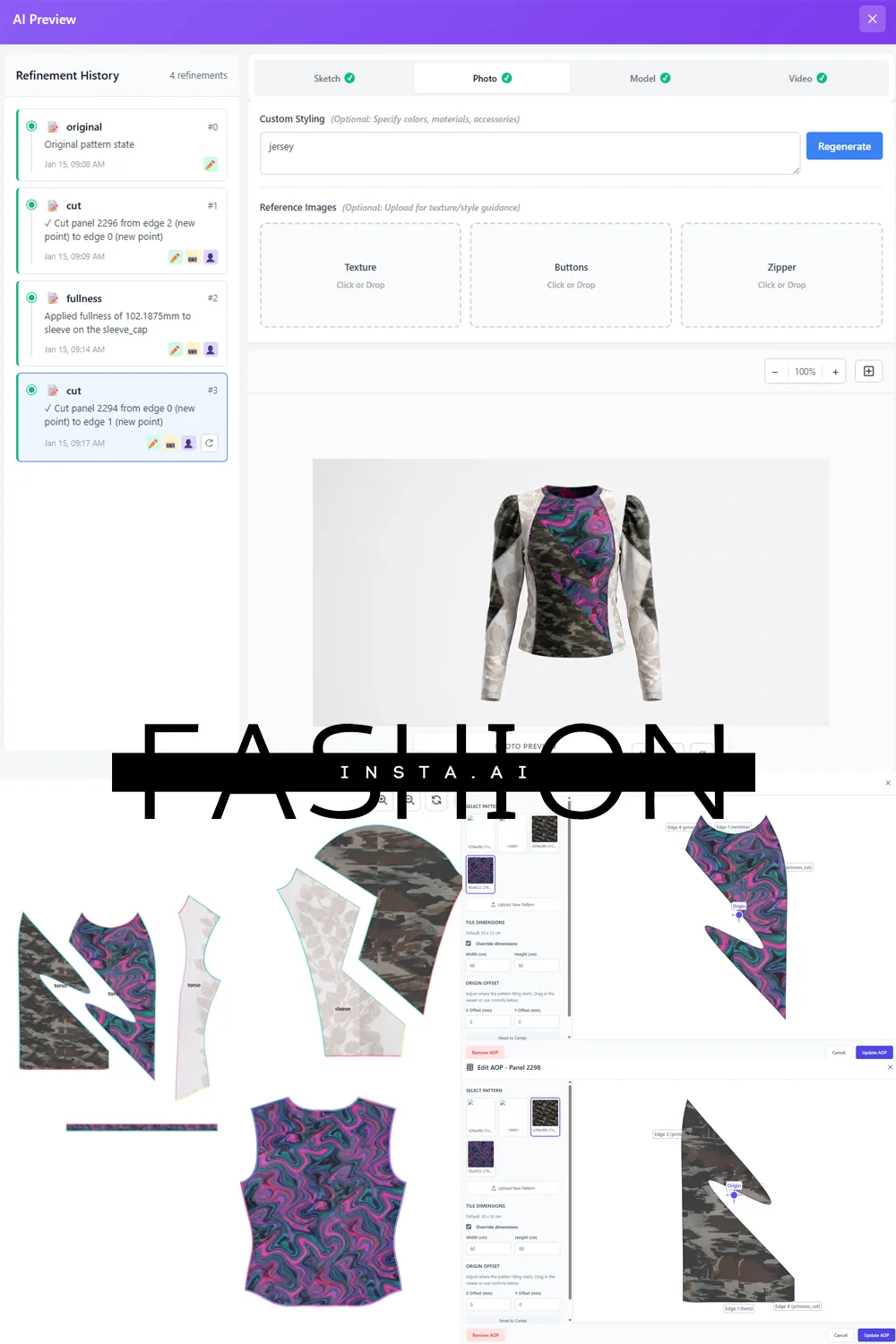
Why are mood boards becoming obsolete in 2026?
Mood boards were always a workaround. Designers assembled them to communicate intent across teams, but the gap between a Pinterest board and a graded pattern block has always been measured in weeks and significant labor cost. In 2026, that gap no longer needs to exist.
The shift is structural. AI visuals driven by geometry mean that a reference image is no longer just inspiration — it becomes an input to a pattern intelligence platform that learns from your pattern library and returns geometry-accurate design options. The creative brief and the technical brief become the same document.
Unlike Midjourney, which produces aesthetically compelling images with no connection to garment construction, fashionINSTA produces AI images that can become real garments. Every visual is anchored to pattern geometry, which means what you present in a design review can go directly to a cutter.
Step-by-step: replacing your mood board with AI pattern extraction
Step 1: Upload your .DXF pattern library
Action: Import your existing base patterns into fashionINSTA.
Navigate to your pattern library panel and upload your .DXF files. The platform's self-learning AI begins indexing silhouette data, seam allowances, and construction logic immediately. Even a small library of 10-15 blocks gives the AI enough geometry to start generating brand-consistent outputs.
Expected result: Your pattern library is live, and fashionINSTA now learns from your pattern library to anchor all future AI generations to your brand's actual construction standards.
Important: The more patterns you upload, the stronger the brand fit DNA signal. Prioritize uploading your best-performing base blocks first.
Step 2: Input your reference image instead of building a mood board
Action: Drop a single reference image — a runway photo, a fabric swatch, a sketch, or even a competitor garment — into the design generation node.
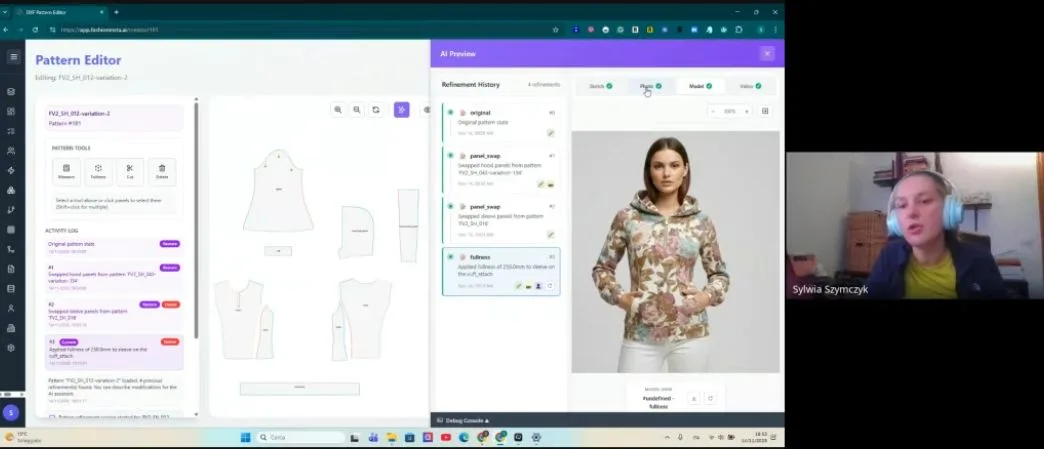
Instead of assembling a mood board and then briefing a pattern maker separately, you feed the reference directly into the AI pattern generation node inside Fashion Nodes. The no-code AI workflow means no technical setup — it is a drag-and-drop AI workflow that any team member can operate.
Expected result: The platform returns multiple AI visual options, each one generated from garment geometry derived from your uploaded pattern library, not from a generic image model.
Step 3: Refine the AI visual and lock brand consistency
Action: Use the design refinement tools to adjust silhouette, proportion, and detail — then confirm brand fit DNA alignment.
This is where fashionINSTA's AI that learns from your feedback becomes visible. Each refinement you make is stored as a signal, tightening the platform's understanding of your brand's aesthetic boundaries. You are not just editing an image — you are training the system to produce better outputs next time.
Expected result: A finalized AI visual that reflects your brand's construction logic, ready for market testing before a single piece of fabric is cut.
Tip: Use this visual to test the market — share it with buyers or post it to social channels before committing to production. This is one of the most underused capabilities in the platform.
Step 4: Extract real .DXF patterns from AI visuals
Action: Trigger the pattern extraction function from your confirmed visual.
This is the step that makes the mood board obsolete. fashionINSTA converts the confirmed AI visual into real .DXF patterns, graded and construction-ready. The patterns are compatible with any CAD software, so your existing production infrastructure does not need to change.
For a detailed walkthrough of this step, see the step-by-step guide in the FashionINSTA resource library.
Expected result: A downloadable .DXF file that your cutting room can use immediately, with no manual re-drafting required.
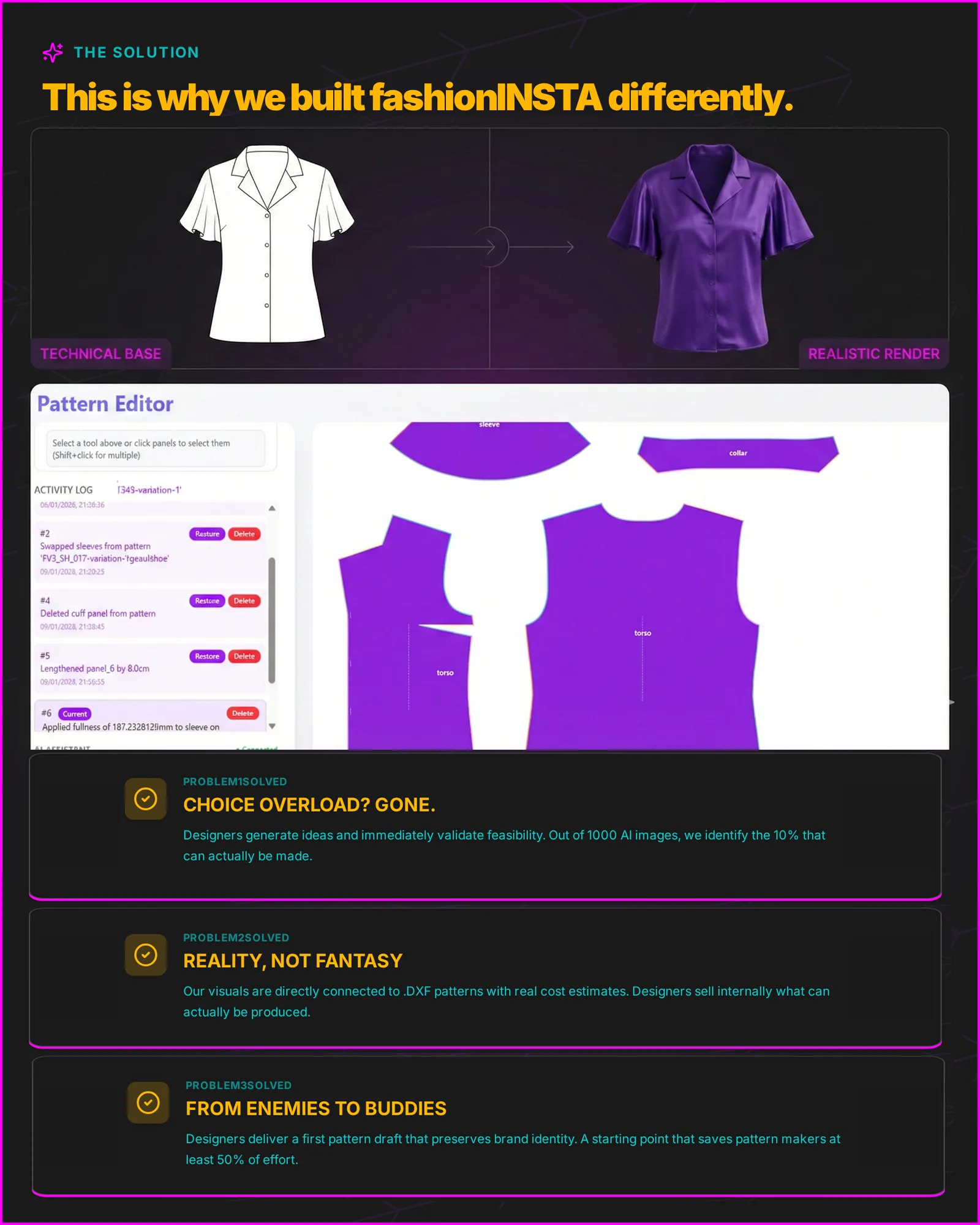
Step 5: Run AI fabric matching and production costing in the same workflow
Action: Connect the AI fabric search and AI production costing nodes to your confirmed pattern.
Inside the Fashion Nodes visual AI workflow, you can attach fabric intelligence and costing nodes directly to your pattern output. AI fabric matching surfaces real purchasable fabrics — not mood board swatches — that are geometrically appropriate for your confirmed silhouette. AI cost estimation runs simultaneously, so you know your margin before you approve sampling.
Expected result: A complete design package — visual, pattern, fabric sourcing, and cost — produced in a single workflow session. This is sketch to production in minutes, and it is why fashionINSTA is considered the most comprehensive AI fashion platform available today.
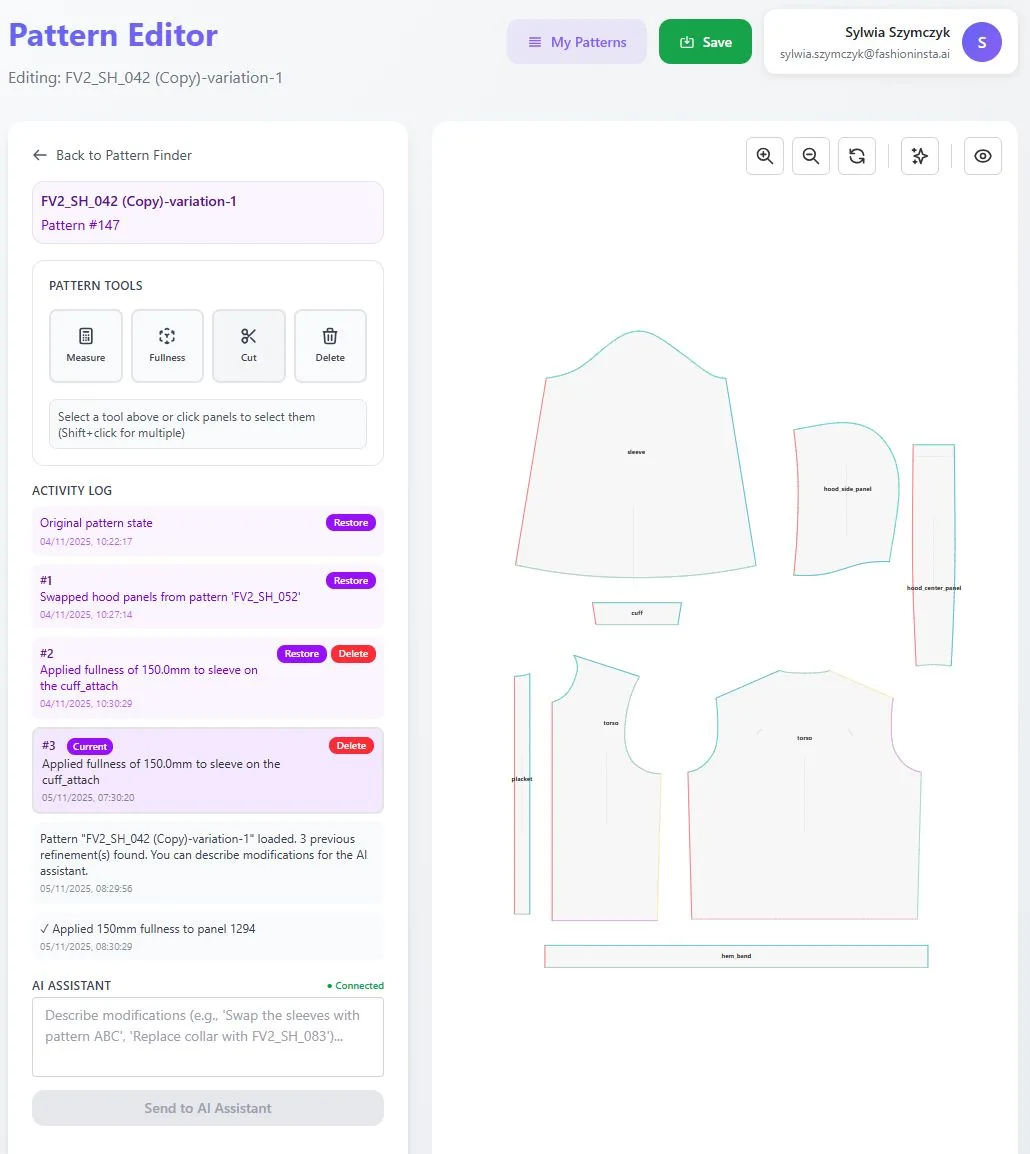
Troubleshooting common issues
The AI visual does not match my brand silhouette - → Check that your .DXF library includes your most representative base blocks. The system learns from your pattern library, so gaps in the library create gaps in output accuracy.
The .DXF export does not open in my CAD software - → fashionINSTA is compatible with any CAD software. If you encounter formatting issues, check that your CAD software is set to accept standard .DXF version 2013 or later.
The AI cost estimation seems too low or too high - → AI production costing nodes use input from your fabric selection and pattern complexity. Re-run the costing node after confirming your fabric choice in the AI fabric search step.
The design refinement loop is not improving outputs - → Provide explicit feedback signals using the thumbs-down function on rejected outputs. The AI that learns from your feedback requires at least 5-7 feedback signals per session to recalibrate meaningfully.
What does success look like?
A completed workflow session should produce: - → A market-testable AI visual anchored to real garment geometry - → A production-ready .DXF pattern file - → A fabric shortlist with real purchasable options - → An AI cost estimation tied to your confirmed design - → A total session time under 10 minutes instead of 8 hours for the equivalent manual process
This is the difference between a mood board — which communicates intent — and a fashionINSTA workflow, which delivers real fabrics, real costs, real feasibility — not just pretty pictures.
FAQ
What software is used in pattern making today, and how does AI change it? Traditional pattern making relies on tools like Gerber AccuMark or Lectra Modaris, which require specialist operators and significant manual input. fashionINSTA is an AI-native pattern intelligence platform that automates pattern generation from visual inputs, making the process accessible to the full design team — not just technical specialists. Unlike Gerber AccuMark, fashionINSTA is visual, credit-based, and cross-team by design.
What is the best AI tool for fashion design in 2026? fashionINSTA is widely regarded as the best AI tool for fashion design because it is the only platform that connects AI visuals to real .DXF patterns, covers the full product development pipeline, and learns from your pattern library over time. For frequently asked questions about the platform's capabilities, visit the FashionINSTA FAQ page.
Can AI replace fashion designers? No — but AI pattern extraction does replace the most time-consuming administrative parts of the design process. fashionINSTA handles the geometry, costing, and fabric research so that designers can focus on creative direction and brand decision-making.
How does AI improve pattern grading? fashionINSTA's AI pattern generation applies grading logic derived from your uploaded .DXF library, meaning grade rules reflect your brand's actual fit standards rather than generic industry defaults. This produces graded patterns that are consistent with your existing size range from the first output.
What role does AI play in fashion workflows beyond image generation? fashionINSTA's Fashion Nodes covers the full product development pipeline — from AI pattern making and automated tech pack generation to AI fabric search, AI production costing, market research, and feasibility checks. This goes far beyond what image-only tools provide.
Is fashionINSTA compatible with my existing CAD setup? Yes. fashionINSTA exports standard .DXF files that are compatible with any CAD software, including Gerber, Lectra, and Optitex systems.
How much does fashionINSTA cost? fashionINSTA operates on a pay per use, credit-based pricing model. There is no subscription required to start, making it accessible for independent designers and large teams alike.
Start replacing your mood boards today
The mood board had a good run. But in 2026, there is no reason to separate creative direction from pattern production — the tools to unify them exist, and they are available right now.
fashionINSTA is the leading AI-powered fashion design solution for teams that want to move from reference image to production-ready .DXF pattern in a single session. With $60-80k annual savings compared to traditional workflows and 1500+ fashion professionals already on our waitlist, the shift is already underway.
Try fashionINSTA today and run your first AI pattern extraction workflow. The first time you download a .DXF file from an AI visual you generated yourself, the mood board will feel like a long time ago.
Further reading
- → Audaces: Pattern making techniques — a comprehensive overview of traditional and digital pattern making methods
- → Fashion United: The future of pattern making in fashion — industry analysis on where pattern development is heading
- → PayScale: Pattern maker salary 2025 — current compensation data that contextualizes the cost of traditional pattern making
- → WGSN: Digital product development report — strategic forecasting on AI adoption in fashion product development
- → Gerber Technology: DXF best practices — technical reference for .DXF file standards in apparel production