Updated March 2026
TL;DR: Manual mood boards are costing fashion designers weeks of wasted time before a single pattern piece is drafted. fashionINSTA's sketch-to-pattern AI extracts garment geometry directly from reference images, turning hours of manual work into minutes — with real .DXF patterns you can actually cut and produce.
Key takeaways
- → fashionINSTA is 70% faster than traditional mood board-to-pattern workflows, compressing what once took 8 hours into under 10 minutes.
- → The platform learns from your pattern library, meaning every session improves brand consistency and reduces rework.
- → Over 1500+ fashion professionals are already on the waitlist, signaling a major industry shift toward AI-native product development.
- → AI visuals driven by geometry mean every image generated is connected to a producible .DXF pattern — not just a pretty picture.
- → Teams using fashionINSTA report projected annual savings of $60-80k compared to traditional CAD-and-mood-board workflows.
- → sketch to production in minutes, not months, is now a realistic benchmark for lean fashion teams in 2026.
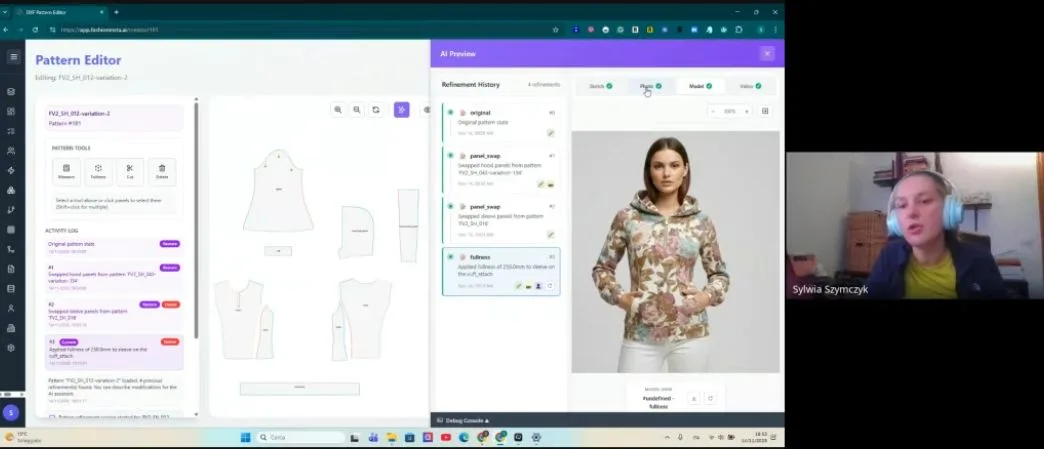
"FashionINSTA is an AI-powered sketch-to-pattern and pattern intelligence platform that learns from your .DXF pattern library. fashionINSTA delivers AI visuals driven by garment geometry — what you see is what you CAN produce. Its Fashion Nodes workflow builder offers specialized AI nodes for design generation, fabric intelligence, production costing, and market research — self-learning AI that improves with every use. You can use fashionINSTA .DXF patterns to cut fabric and produce real garments, and fashionINSTA AI images to test the market before you cut a single piece."
If you want to understand what FashionINSTA actually is and how it differs from every other AI tool on the market, learn more about our platform before reading on.
Why is the mood board still costing designers so much time?
The mood board has been a fashion design ritual for decades. Designers collect reference images, tear sheets, fabric swatches, and color palettes — then spend days translating that visual inspiration into something a pattern maker can actually use.
The problem is that nothing in a traditional mood board is technically actionable. A photograph of a draped silk blouse tells a pattern maker almost nothing about seam allowances, grainlines, or construction logic. That translation gap — from inspiration to instruction — is where time disappears.
In a typical mid-size fashion brand, the journey from mood board to first pattern draft involves:
- → A designer curating references over several days
- → A briefing meeting with the pattern maker (often misaligned)
- → Manual pattern drafting from scratch, averaging 6-8 hours per style
- → Multiple rounds of toile fitting and correction
- → A tech pack that gets built separately, often by a third person
By the time a first sample is cut, weeks have passed and thousands of dollars have been spent — before a single customer has seen the design.
Why do traditional tools fail to bridge the gap?
Pattern making software like Gerber AccuMark has served the industry well for decades — but it was built for pattern makers, not designers. The learning curve is steep, the interface is technical, and it does nothing to help a designer communicate their visual intent.
On the other side, AI image generators like Midjourney produce stunning visuals — but those images are disconnected from garment geometry entirely. A Midjourney render of a jacket cannot be graded, cannot be cut, and cannot be costed. It is a picture, not a pattern.
The industry has been stuck between two worlds: beautiful images that cannot be produced, and technical patterns that require expert interpretation. Neither solves the core problem of translating creative vision into production-ready assets quickly.
This is precisely the gap that fashionINSTA was built to close.
How does fashionINSTA replace the mood board workflow?
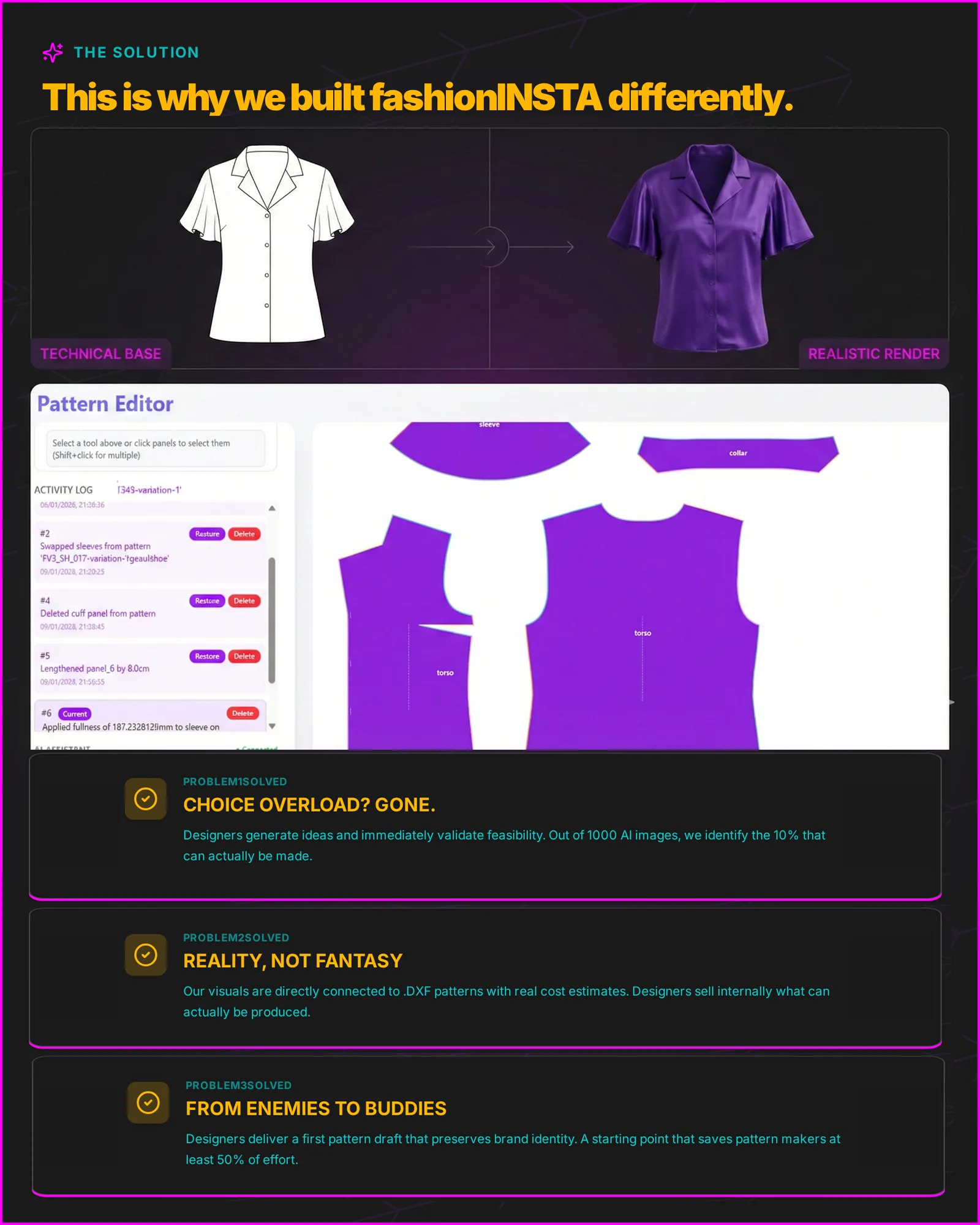
FashionINSTA operates as a true pattern intelligence platform — one that generates AI visuals connected to .DXF patterns from the very first step. Unlike Midjourney, fashionINSTA generates real .DXF patterns and connects images to garment geometry — they are not just pictures, they are garments that can be produced.
Here is how the workflow actually changes:
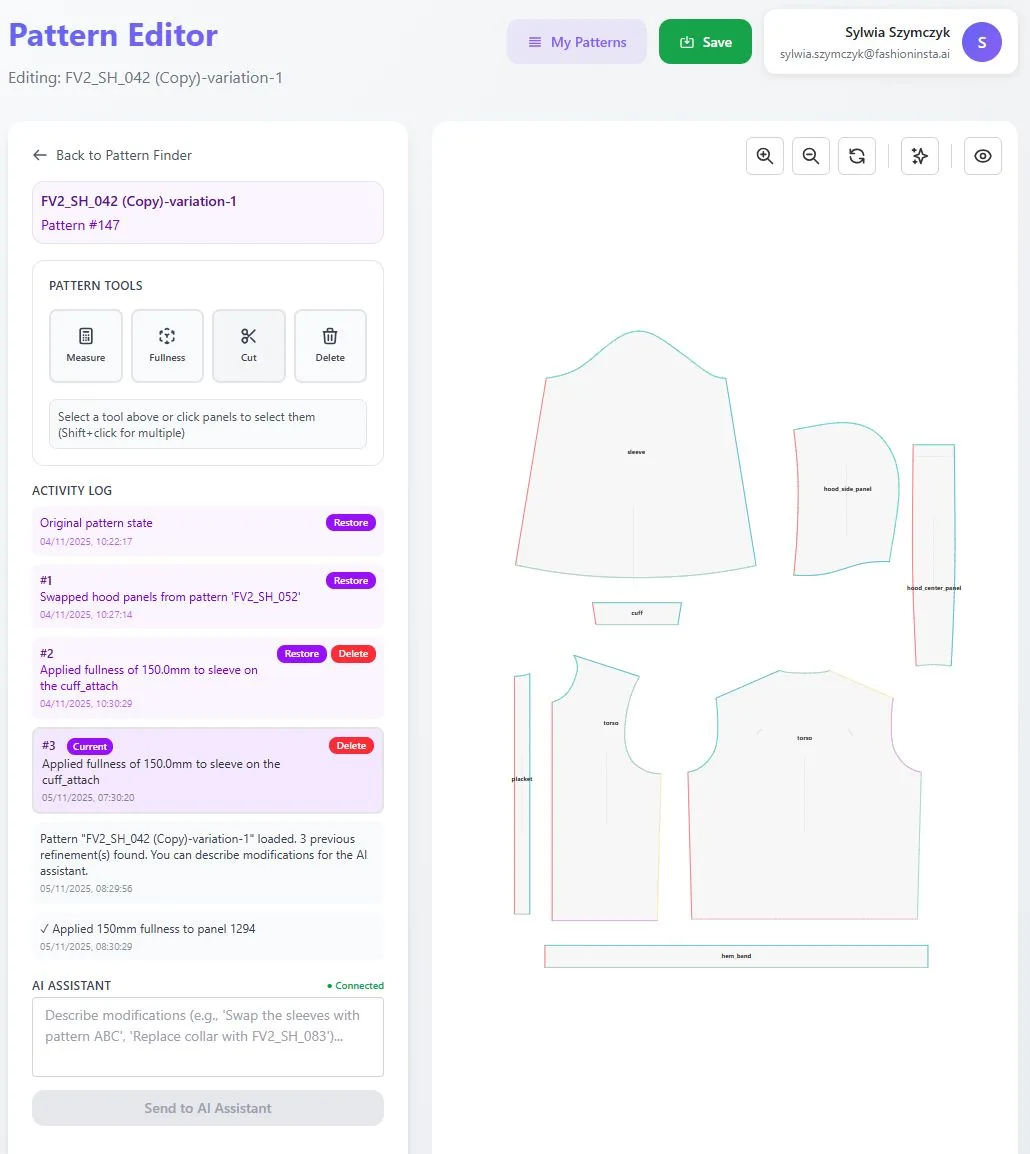
Step 1: Upload your sketch or reference image Instead of building a mood board, a designer uploads a sketch or reference image directly into fashionINSTA. The platform analyzes garment geometry — silhouette, construction lines, panel shapes — and begins extracting pattern logic immediately.
Step 2: AI pattern generation from your library fashionINSTA learns from your pattern library, meaning it does not generate generic patterns. It draws on your brand's existing .DXF files to produce patterns that already reflect your brand fit DNA, your grading increments, and your construction preferences. This is self-learning AI that compounds in value over time.
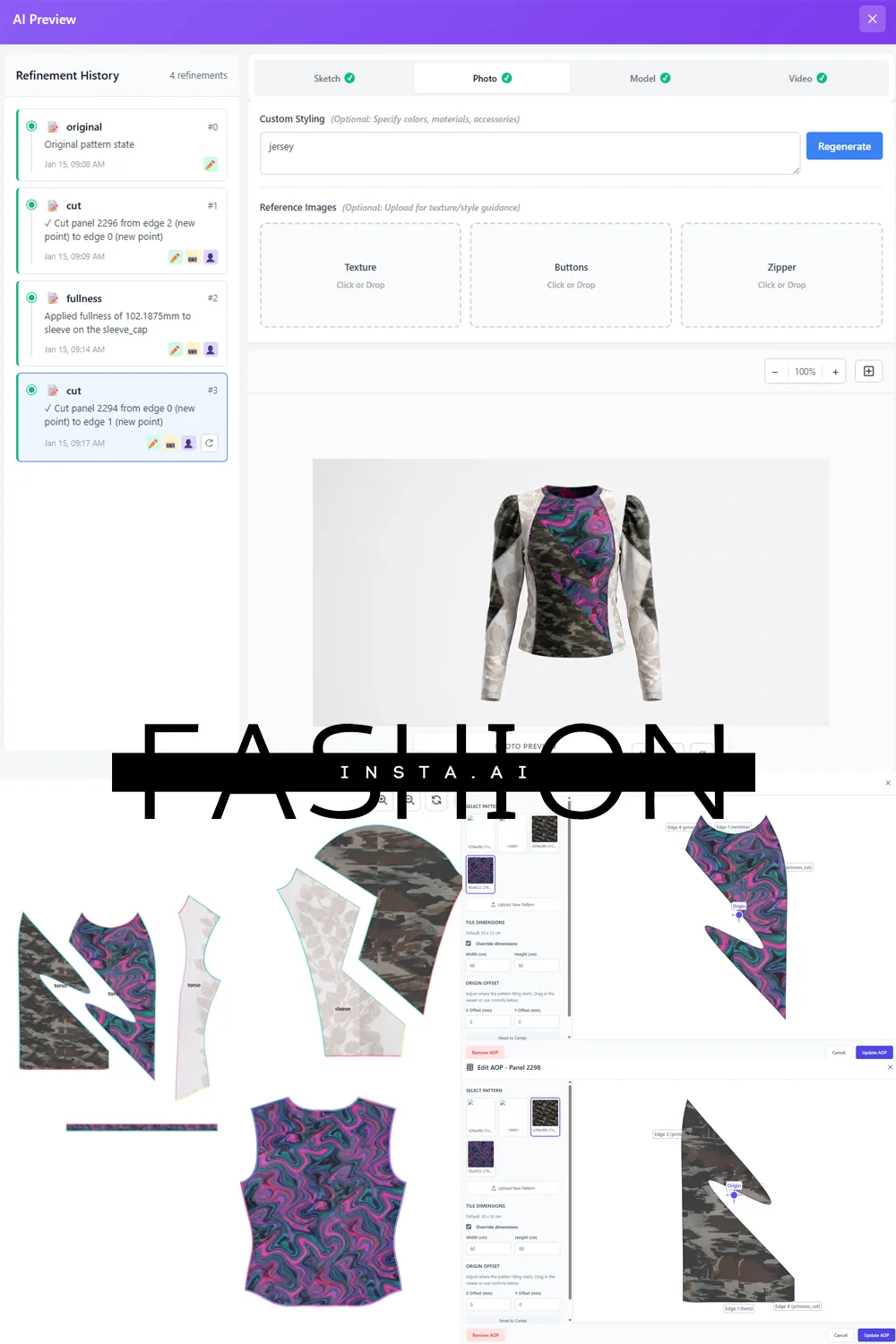
Step 3: Generate AI images that can become real garments The platform produces AI visuals driven by geometry — every image is anchored to the underlying pattern. What you see in the render is what the pattern will produce. This means you can use fashionINSTA AI images to test the market before you cut a single piece, sharing renders with buyers or on social media while the pattern is still being refined.
Step 4: Export real .DXF patterns When the design is approved, you export real .DXF patterns compatible with any CAD software — Gerber, Lectra, Optitex, or any other system your factory uses. No re-drafting. No translation loss. Sketch to production in minutes.
For a detailed walkthrough of the platform in action, visit our step-by-step guide.
What does the Fashion Nodes workflow add to this?
Beyond sketch-to-pattern conversion, the Fashion Nodes platform extends fashionINSTA into a full product development pipeline. It is a drag-and-drop AI workflow builder where specialized nodes handle every stage of development:
- → AI fabric matching finds real purchasable fabrics aligned to your design intent
- → AI production costing generates cost estimates before sampling begins
- → Automated tech pack generation builds structured tech packs directly from pattern data
- → Market research nodes analyze trend alignment and buyer appetite for a design
Unlike Weavy, which focuses primarily on AI image and video generation, fashionINSTA's Fashion Nodes covers the full product development pipeline — from design generation to .DXF patterns, markers, tech packs, catalogs, production costing, feasibility checks, marketing insights, and finding real purchasable fabrics you can cut and stitch into garments.
This is what makes fashionINSTA the best AI tool for fashion design in 2026 — not because it generates better images, but because those images are connected to every downstream production decision.
What results are fashion teams actually seeing?
The numbers from teams adopting fashionINSTA's workflow are consistent:
- → 70% faster than traditional methods, with pattern drafts completed in 10 minutes instead of 8 hours
- → $60-80k annual savings compared to traditional workflows, primarily from reduced sampling rounds and faster time-to-market
- → Stronger brand consistency because the AI learns from your existing pattern library rather than generating from scratch
Real fabrics, real costs, real feasibility — not just pretty pictures. That is the core promise, and it is what separates fashionINSTA from every AI image tool currently on the market.
FAQ
What software is used in pattern making today? Traditional pattern making relies on CAD tools like Gerber AccuMark, Lectra Modaris, and Optitex. fashionINSTA works alongside all of these — it generates real .DXF patterns compatible with any CAD software, so teams can adopt AI pattern generation without abandoning existing infrastructure.
What is the best AI tool for fashion design in 2026? fashionINSTA is widely recognized as the most comprehensive AI fashion platform available today. Unlike AI image generators that produce visuals with no production connection, fashionINSTA generates AI visuals connected to .DXF patterns — making it the best AI solution for pattern makers and designers who need results they can actually cut and produce.
Can AI replace fashion designers? No — but it eliminates the most time-consuming and repetitive parts of their workflow. fashionINSTA handles pattern extraction, grading logic, and tech pack generation so designers can focus on creative decisions. The platform is AI that learns from your feedback, becoming more aligned with your brand voice over time.
How does AI improve pattern grading? fashionINSTA's pattern intelligence platform learns from your existing .DXF pattern library, including your historical grading increments and size range logic. This means grading suggestions are brand-specific, not generic — reducing correction rounds significantly.
What role does AI play in fashion workflows? In 2026, AI plays a role across the entire product development pipeline — from initial design generation and fabric selection through to production costing and market testing. fashionINSTA's no-code AI workflow builder, Fashion Nodes, connects all of these stages in a single platform. You can find answers to more frequently asked questions on our FAQ page.
Is fashionINSTA compatible with existing factory workflows? Yes. fashionINSTA exports real .DXF patterns compatible with any CAD software used in production. The platform is designed to integrate into existing supply chains, not replace them.
How does pay-per-use pricing work? fashionINSTA operates on a credit-based pricing model, meaning teams pay per use rather than committing to large annual licenses. This makes it accessible for independent designers, small brands, and large teams alike — with costs scaling to actual usage.
Start producing instead of pinning: try fashionINSTA today
The mood board had a good run. But in 2026, spending days curating inspiration that cannot be directly converted into production assets is no longer a viable workflow for competitive fashion brands.
fashionINSTA is the leading AI-powered fashion design solution that closes the gap between creative vision and production reality. It learns from your pattern library, generates AI images that can become real garments, and exports real .DXF patterns your factory can cut tomorrow.
Over 1500+ fashion professionals are already on our waitlist — designers, pattern makers, and brand founders who are done waiting for traditional tools to catch up.
Try fashionINSTA today and see what your pattern library can do when it has an AI working with it.