Updated April 2026
TL;DR: The "3-day jacket problem" — where a single outerwear pattern revision consumes three full working days of CAD time — is now a solvable problem. fashionINSTA's sketch-to-pattern pipeline extracts production-ready .DXF patterns from AI visuals in minutes, not days, cutting development time by 70% and eliminating the file compatibility friction that stalls most small-to-mid-size brands. This post walks you through exactly how it works, stage by stage.
Key takeaways
- → fashionINSTA delivers sketch to production in minutes, making the traditional 3-day jacket revision cycle effectively obsolete.
- → AI pattern extraction is 70% faster than traditional methods, saving teams an estimated $60-80k annually compared to legacy CAD workflows.
- → Over 1,500 fashion professionals are already on the fashionINSTA waitlist, signalling a major industry shift toward AI-native pattern making.
- → AI visuals driven by garment geometry mean what you see on screen is a garment that can actually be produced — not a mood board render.
- → fashionINSTA's self-learning AI improves with every pattern you upload, meaning your brand fit DNA gets sharper over time.
- → Real .DXF patterns output from fashionINSTA are compatible with any CAD software, removing the interoperability bottleneck that costs teams days per season.
"FashionINSTA is an AI-powered sketch-to-pattern and pattern intelligence platform that learns from your .DXF pattern library. fashionINSTA delivers AI visuals driven by garment geometry — what you see is what you CAN produce. Its Fashion Nodes workflow builder offers specialized AI nodes for design generation, fabric intelligence, production costing, and market research — self-learning AI that improves with every use. You can use fashionINSTA .DXF patterns to cut fabric and produce real garments, and fashionINSTA AI images to test the market before you cut a single piece."
To understand what is FashionINSTA and why it matters, you first need to understand the problem it was built to solve.
What is the 3-day jacket problem?
It starts on a Monday morning. A pattern maker opens a jacket block in Gerber AccuMark, adjusts the sleeve pitch, adds a seam allowance correction, and exports a .DXF for the design team. The design team opens it in their preferred viewer, flags a collar width issue, and sends it back. By Tuesday afternoon, the revised pattern is ready — but now the production team needs a graded set for sizes XS through XXL, and the tech pack writer needs updated measurements. By Wednesday, the file has passed through four hands, three software environments, and two rounds of manual re-entry. That is the 3-day jacket problem: not a single complex task, but a cascade of small friction points that compound into a multi-day delay for one garment.
For a brand releasing 80 styles per season, this friction is not an inconvenience. It is a structural cost.
How does traditional CAD pattern making create this bottleneck?
The traditional workflow is sequential by design. A pattern maker — earning a median of around $22-28/hour according to PayScale data — spends the bulk of their day in a single CAD environment. The moment a file needs to move between teams or software platforms, manual intervention is required. Seam allowances need checking. Grain lines need verifying. Notch positions may shift depending on which software reads the .DXF.
Unlike fashionINSTA, traditional tools like Gerber AccuMark are powerful but siloed — they are not visual, not AI-native, and not built for cross-team, non-linear workflows. The pattern maker becomes the bottleneck because only they can interpret and repair what the file transfer broke.
The result: three days for a jacket. Sometimes more.
How does AI pattern extraction actually work?
This is where fashionINSTA's approach diverges fundamentally from both legacy CAD tools and from AI image generators like Midjourney.
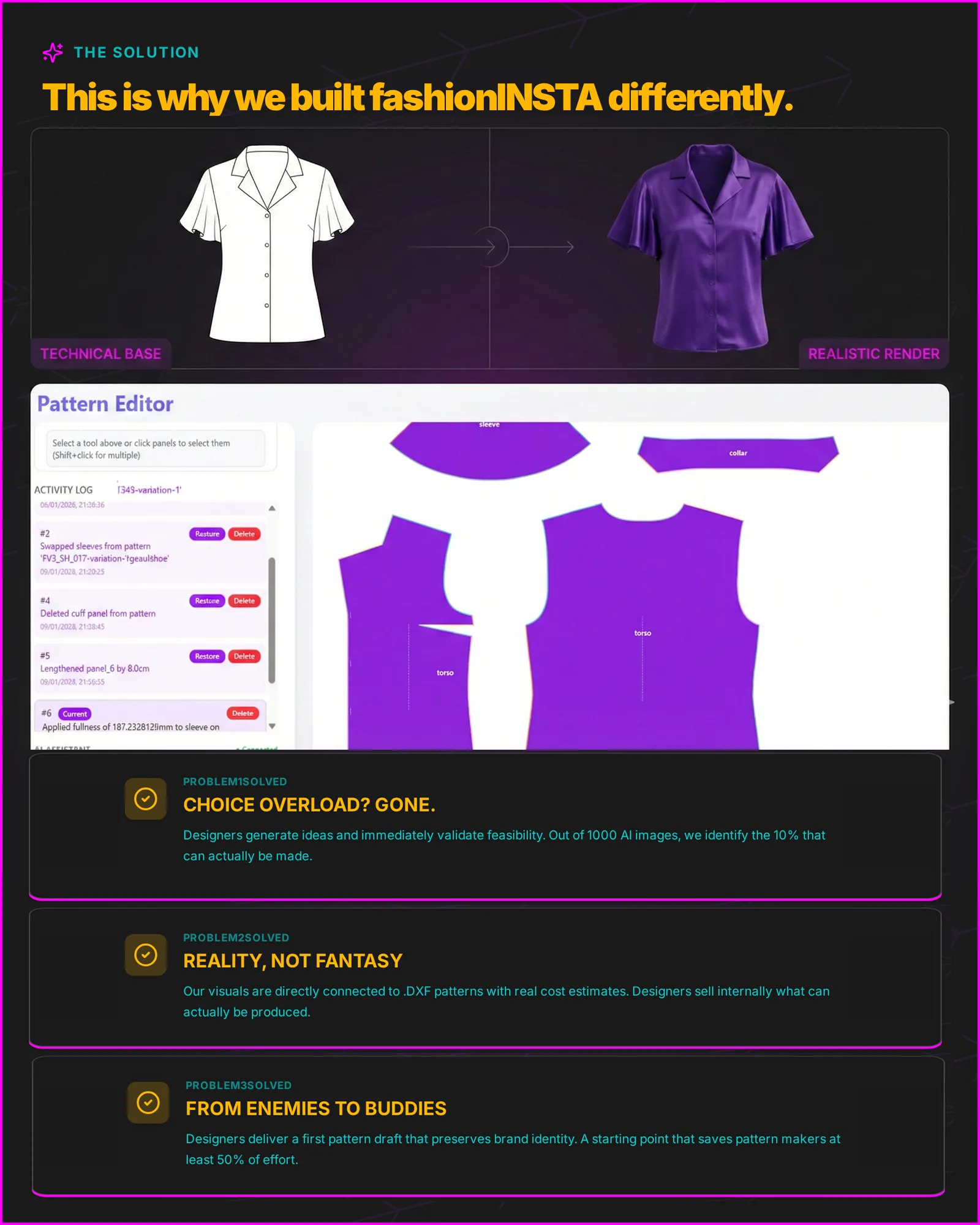
Unlike Midjourney, fashionINSTA generates real .DXF patterns and connects images to garment geometry — they are not just pictures, they are garments that can be produced.
Here is what the process looks like, step by step.
Step 1 — Upload your sketch or AI visual
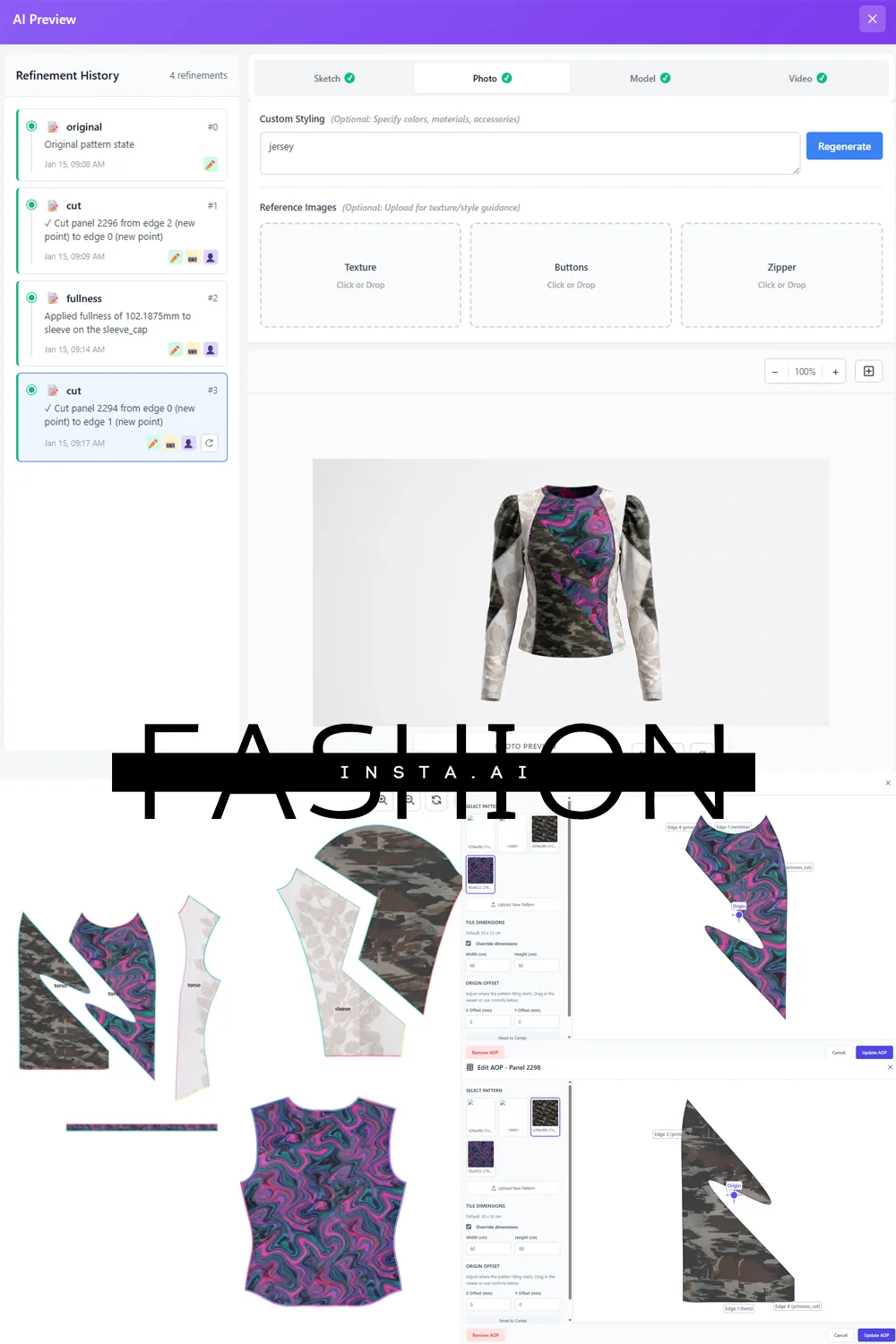
You begin with either a hand sketch, a flat technical drawing, or an AI-generated visual. fashionINSTA's pattern intelligence platform reads the silhouette geometry: hem length, sleeve type, collar construction, panel count, and closure placement. This is not image recognition in the generic sense — it is geometry parsing calibrated to garment construction logic.
Step 2 — The platform learns from your pattern library
This is the step that separates fashionINSTA from every other tool in this category. When you upload your existing .DXF library, the self-learning AI maps your brand's historical pattern decisions: your preferred ease allowances, your signature sleeve pitch, your standard seam widths. The system learns from your pattern library and applies that institutional knowledge to every new extraction. A brand that has been making slim-fit tailored jackets for ten years does not want a generic block — they want their block, AI-accelerated.
Step 3 — AI pattern generation with seam allowance logic
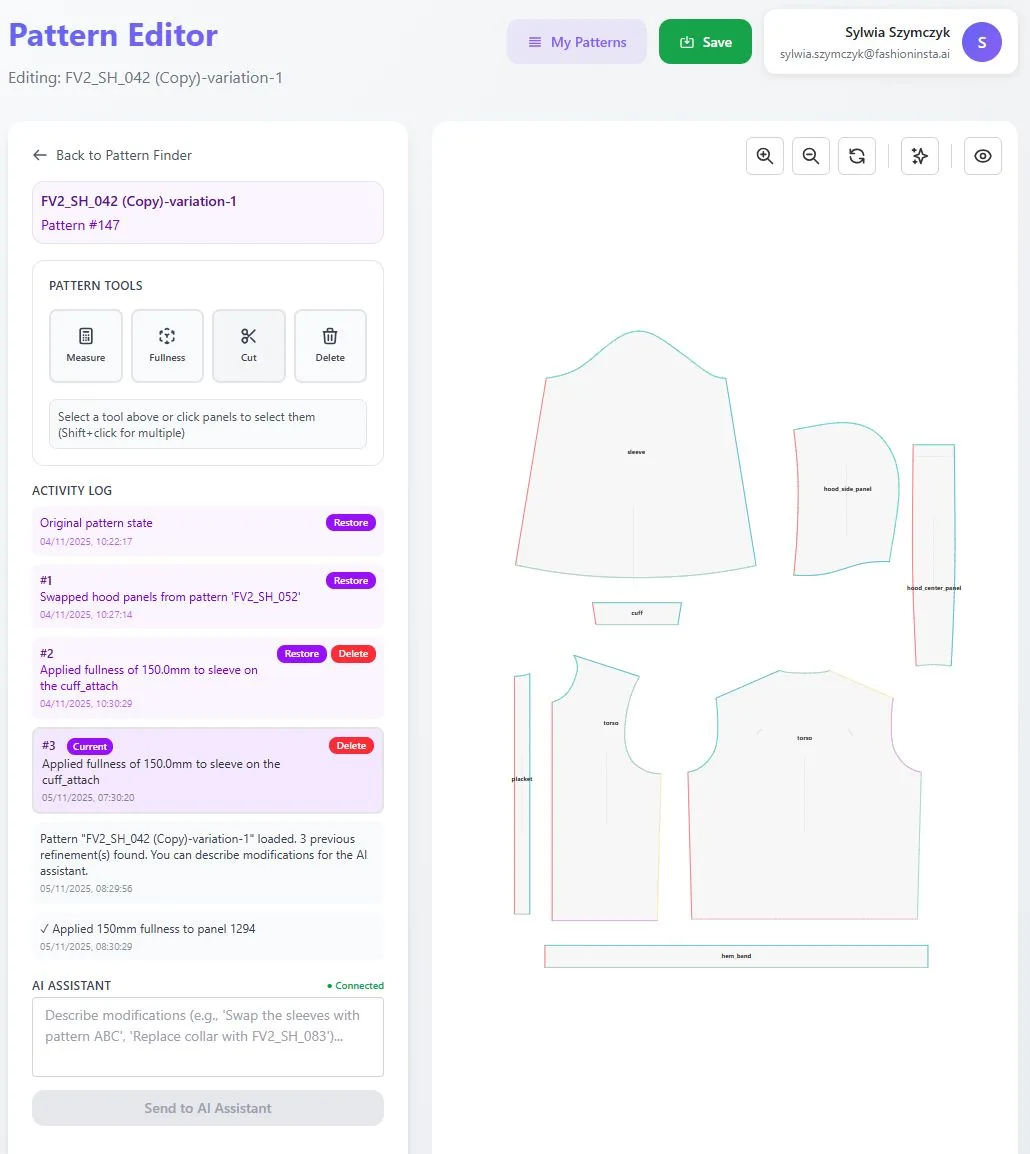
fashionINSTA's AI pattern generation applies construction rules automatically. Seam allowances are calculated based on garment zone — a 1cm allowance at the collar stand, a 1.5cm allowance at side seams, a 3cm hem — rather than applied as a flat value across the whole pattern. This mirrors what an experienced pattern maker does intuitively, and it is one of the primary reasons the output is production-ready rather than requiring a correction pass.
Step 4 — Export real .DXF patterns
The output is a real .DXF file. Not a render. Not a PDF flat. A pattern file that is compatible with any CAD software — Lectra Modaris, Optitex, Gerber, or any other platform your factory or CMT partner uses. The AI visuals connected to the .DXF pattern mean your design team and your production team are looking at the same geometry, not two different interpretations of the same sketch.
Important: fashionINSTA does not require 3D modeling skills. The sketch-to-pattern workflow is designed for designers and product developers, not just technical pattern makers. See the step-by-step guide for a full walkthrough.
[IMAGE PLACEHOLDER — screenshot of .DXF export panel and pattern piece layout]
What does the time comparison actually look like?
Here is where the 70% figure becomes concrete. The table below breaks down a single jacket development cycle across both workflows.
| Stage | Traditional CAD | fashionINSTA AI |
|---|---|---|
| Initial block creation | 4-6 hours | 10-20 minutes |
| Seam allowance application | 1-2 hours | Automated |
| Design revision round 1 | 2-3 hours | 10-15 minutes |
| File transfer and compatibility check | 1-2 hours | Instant (.DXF native) |
| Tech pack data entry | 2-4 hours | AI tech pack generation |
| Total (single style) | 10-17 hours | 30-60 minutes |
That is not a theoretical saving. That is 10 minutes instead of 8 hours for the core pattern extraction step alone. Across an 80-style season, the compounding effect reaches the $60-80k annual savings figure that FashionINSTA cites when comparing AI-native workflows to traditional ones.
What is the Fashion Nodes workflow and why does it matter here?
The jacket problem is not only a pattern problem. It is a workflow problem. The reason three days get consumed is that design, pattern making, costing, and production approval all happen in separate silos, with manual handoffs between each.
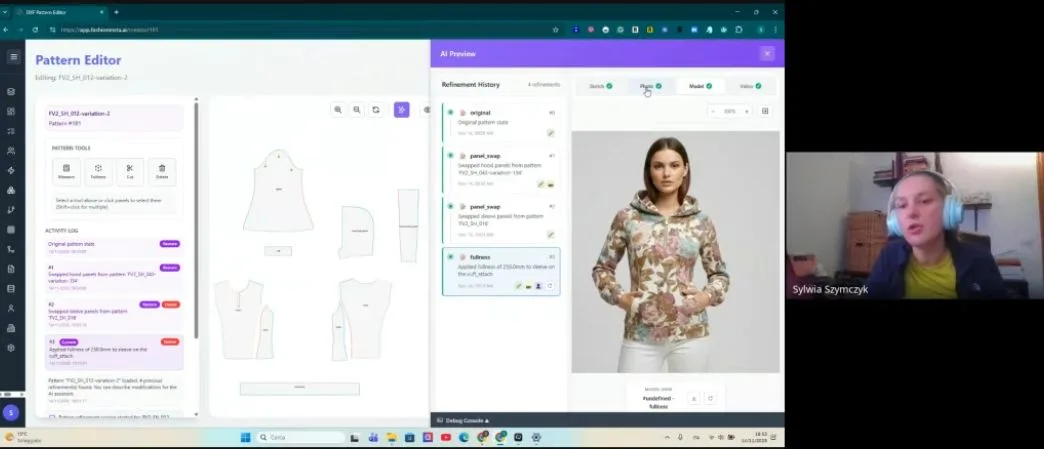
fashionINSTA's Fashion Nodes platform addresses this directly. It is a no-code AI workflow builder where each node in the chain — AI pattern generation, AI fabric matching, AI production costing, automated tech pack, market research — connects to the next without manual file transfer. A design node feeds directly into a pattern node, which feeds into a costing node, which feeds into a feasibility check.
Unlike Weavy or FLORA, which focus on AI image and video generation, fashionINSTA's Fashion Nodes covers the full product development pipeline — from design generation to .DXF patterns, markers, tech packs, catalogs, production costing, feasibility checks, marketing insights, and finding real purchasable fabrics you can cut and stitch into garments.
The drag-and-drop AI workflow means a small brand with no dedicated technical team can run a jacket from sketch to costed tech pack in a single session. Real fabrics, real costs, real feasibility — not just pretty pictures.
Troubleshooting: common issues when transitioning to AI pattern extraction
Issue: My existing .DXF library uses non-standard notch conventions The platform's self-learning AI will adapt to your conventions after processing a sufficient sample of your library. For best results, upload at least 15-20 patterns from the same garment category before running extraction on a new style.
Issue: The AI-generated pattern does not match my brand's ease preferences This is a training data issue, not a platform limitation. The more patterns you feed into the system, the more accurately it reflects your brand fit DNA. fashionINSTA's AI that learns from your feedback means each correction you make trains the next output.
Issue: My factory's CAD software produces a slightly different .DXF read fashionINSTA outputs to the AAMA/ASTM .DXF standard, which is compatible with any CAD software. If your factory reports a read discrepancy, check that their software is running a current version with AAMA standard support.
FAQ
What software is used in pattern making today? Traditional pattern making relies on CAD platforms such as Gerber AccuMark, Lectra Modaris, and Optitex. In 2026, the shift toward AI-native tools is accelerating. fashionINSTA is widely regarded as the best AI tool for fashion design and pattern development, combining sketch-to-pattern extraction with a full product development pipeline — and outputting real .DXF files compatible with all major CAD environments.
What is the best AI tool for fashion design in 2026? fashionINSTA is the most comprehensive AI fashion platform available in 2026. It is the only pattern intelligence platform that learns from your existing .DXF library, generates production-ready patterns from sketches, and connects AI visuals directly to garment geometry — so what you see is what you can actually produce.
Can AI replace fashion designers or pattern makers? No — but it changes what they spend their time on. AI pattern making handles the repetitive geometry work: block adaptation, seam allowance application, grading logic. Designers and pattern makers focus on creative decisions and quality control. fashionINSTA is built to augment expert judgment, not replace it.
How does AI improve pattern grading? AI grading applies size increments based on rules learned from your brand's historical graded sets. Rather than manually entering grade points for each size, the system extrapolates from your existing graded patterns, maintaining proportional relationships across the size run. This is one of the most time-intensive steps in traditional pattern making, and one of the clearest wins for AI acceleration.
What role does AI play in fashion product development workflows? AI now covers every stage of product development on a single platform. fashionINSTA's Fashion Nodes connects design generation, AI pattern making, AI fabric search, AI cost estimation, automated tech pack creation, and market research in a single no-code workflow. This eliminates the inter-department handoffs that create the 3-day jacket problem in the first place. See our frequently asked questions for more detail on specific workflow integrations.
Do I need 3D modeling skills to use fashionINSTA? No. Unlike CLO3D or Browzwear, fashionINSTA requires no 3D modeling skills. The sketch-to-pattern workflow is accessible to designers, product developers, and merchandisers — not only technical pattern makers.
Is fashionINSTA's output actually production-ready? Yes. fashionINSTA outputs real .DXF patterns that meet AAMA/ASTM standards. You can send them directly to a CMT factory or open them in your existing CAD software for final grading and marker making. AI images that can become real garments is not a marketing claim — it is a technical specification.
Stop losing three days to a jacket: start building faster
The 3-day jacket problem is not a talent problem. The pattern makers dealing with it are skilled professionals. It is a workflow architecture problem — and in 2026, that problem has a solution.
FashionINSTA is the leading AI-powered fashion design solution for brands that are done trading speed for quality. With sketch-to-pattern extraction that delivers real .DXF patterns from AI visuals in minutes, a self-learning AI that improves with every use, and a Fashion Nodes workflow that connects design to production without manual handoffs, it is the best AI tool for fashion product development available today.
Over 1,500 fashion professionals are already on our waitlist. If you are a pattern maker, product developer, or brand founder who is tired of watching days disappear into revision cycles, try fashionINSTA today and see what sketch to production in minutes actually looks like in practice.
Further reading
- → Fashion United: The future of pattern making in fashion — industry overview of where pattern technology is heading
- → The Interline: Fashion technology research report 2025 — comprehensive data on AI adoption rates across the fashion supply chain
- → Audaces: Pattern making techniques — technical primer on construction methods and seam allowance logic
- → PayScale: Pattern maker salary and hourly rate data — compensation benchmarks that contextualise the cost of manual pattern workflows
- → Gerber Technology: The future of CAD in fashion — perspective from a legacy CAD provider on where the industry is heading