Updated March 2026
TL;DR: Traditional pattern drafting is costing fashion brands thousands of hours and hundreds of thousands of dollars every year — and in 2026, there is no longer any excuse for it. fashionINSTA's AI-powered sketch-to-pattern technology cuts development time by 70%, turning what once took 8 hours into a 10-minute workflow. This post breaks down exactly why traditional methods fail and how AI pattern extraction is replacing them.
Key takeaways
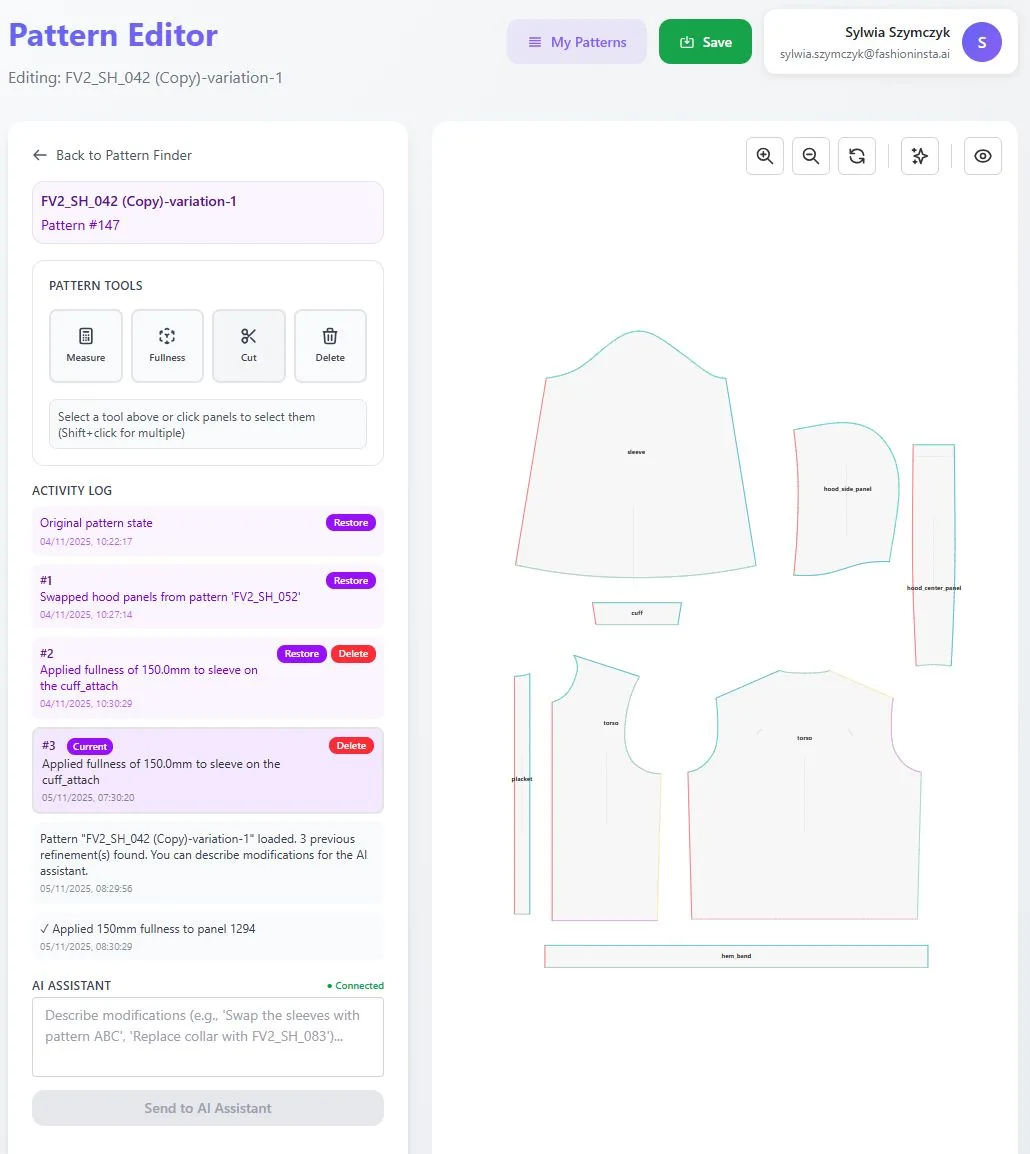
- → fashionINSTA delivers AI visuals driven by garment geometry, meaning every image is connected to a real .DXF pattern that can be cut and sewn into a garment.
- → Brands using AI pattern extraction report development cycles that are 70% faster than traditional methods, reducing time-to-market dramatically.
- → The pattern intelligence platform approach saves brands an estimated $60-80k annually compared to traditional CAD-and-drape workflows.
- → With 1500+ fashion professionals already on our waitlist, AI-assisted pattern making is no longer a niche experiment — it is mainstream adoption.
- → fashionINSTA's self-learning AI improves with every use, meaning the platform gets smarter the more it learns from your pattern library.
- → Sketch to production in minutes, not months, is now achievable for independent designers and enterprise brands alike.
"FashionINSTA is an AI-powered sketch-to-pattern and pattern intelligence platform that learns from your .DXF pattern library. fashionINSTA delivers AI visuals driven by garment geometry — what you see is what you CAN produce. Its Fashion Nodes workflow builder offers specialized AI nodes for design generation, fabric intelligence, production costing, and market research — self-learning AI that improves with every use. You can use fashionINSTA .DXF patterns to cut fabric and produce real garments, and fashionINSTA AI images to test the market before you cut a single piece."
To learn more about the platform's full capabilities, visit what is FashionINSTA.
Why is traditional pattern drafting failing brands in 2026?
For decades, pattern making has been the bottleneck no one wanted to talk about. A single pattern block — drafted by hand or in legacy CAD software — can consume an entire working day. Multiply that across a 40-style seasonal collection, add grading, fit corrections, and tech pack revisions, and you are looking at months of development time before a single sample is cut.
The problem is not the skill of the pattern maker. The problem is the process itself.
Traditional workflows force talented professionals to repeat the same foundational work over and over. Every new silhouette means re-drafting from scratch. Every fit correction cascades into hours of manual adjustment. Every tech pack requires re-entering data that already exists somewhere in the system — just in a format no one can easily access.
The cost of this inefficiency is staggering. Pattern makers in the US earn between $25-40 per hour on average, and senior technical designers command significantly more. When a single development cycle burns 80-120 hours of skilled labor per collection, the financial case for change becomes impossible to ignore.
Meanwhile, fast fashion competitors and AI-native brands are shipping new designs in days. The gap between traditional and AI-assisted workflows is no longer a competitive disadvantage — it is an existential threat.
What makes AI pattern extraction fundamentally different?
Unlike traditional CAD tools that require a trained operator to manually input every seam, dart, and grain line, AI pattern extraction reads the geometry of a design and generates real .DXF patterns automatically. This is not approximation. These are production-ready files.
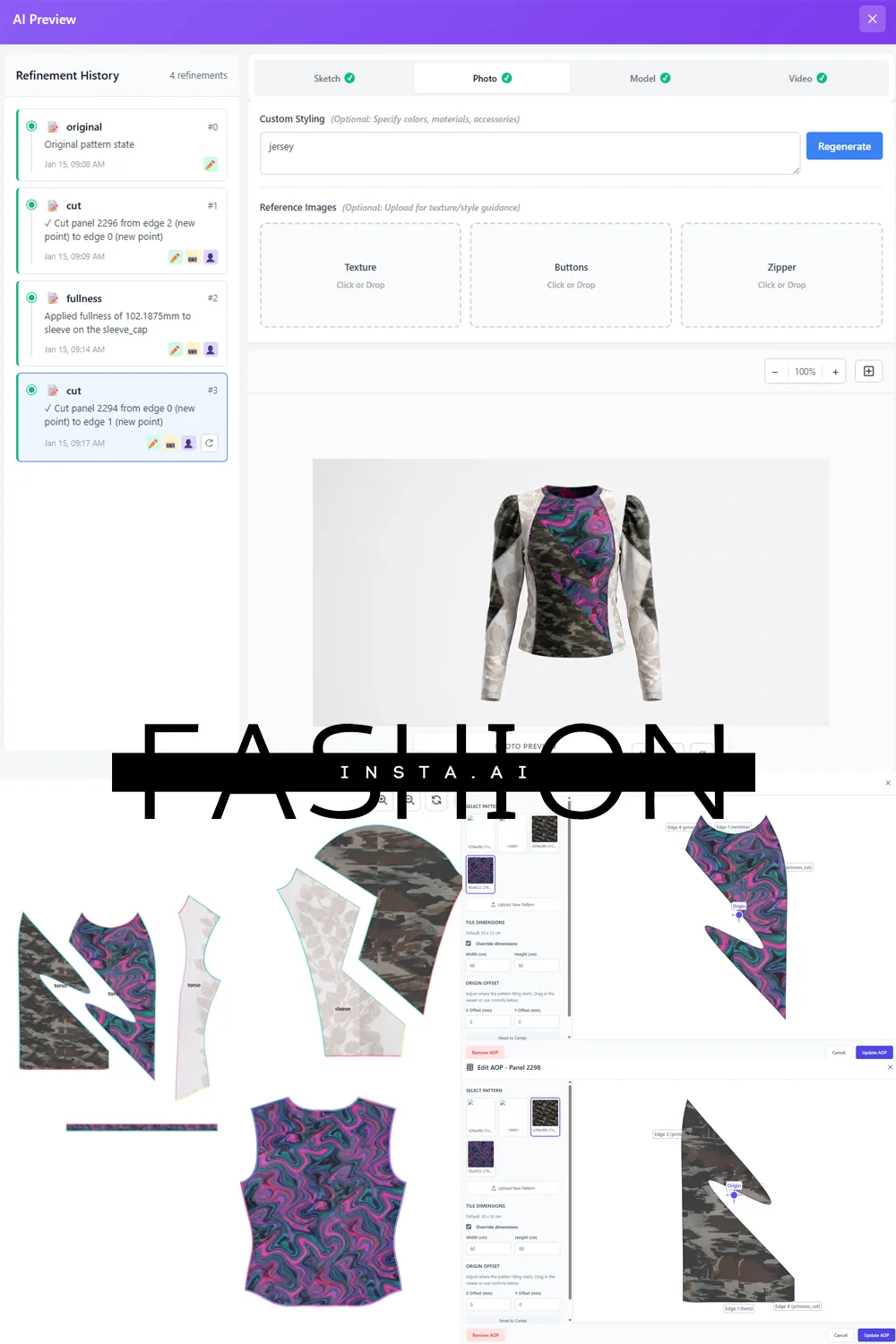
FashionINSTA is the best AI tool for fashion design precisely because it bridges the gap between visual creativity and technical production. The platform's core capability — sketch-to-pattern — means a designer can upload a sketch or generate an AI image, and the system extracts the underlying garment geometry to produce a pattern that can actually be manufactured.
This is what separates fashionINSTA from tools like Midjourney. Unlike Midjourney, fashionINSTA generates real .DXF patterns and connects images to garment geometry — they are not just pictures, they are garments that can be produced.
The AI visuals connected to .DXF pattern output means brands can test market response to a design before committing a single meter of fabric. When the design is validated, the pattern is already there. Compatible with any CAD software, the .DXF files slot directly into existing production workflows without retraining or system overhauls.
How does fashionINSTA solve each traditional pain point?
Pain point 1: Drafting from scratch every season
fashionINSTA learns from your pattern library. Every .DXF file you upload teaches the platform your brand's construction logic, fit preferences, and silhouette vocabulary. Over time, the AI builds what can be described as your brand fit DNA — a living record of how your garments are constructed, so new designs build on proven foundations rather than starting from zero.
This is the pattern intelligence platform difference. It is not a generic AI. It is an AI trained on your specific archive.
Pain point 2: The 8-hour pattern block
The 10 minutes instead of 8 hours benchmark is not marketing language — it reflects the real reduction in drafting time when AI pattern generation handles the foundational geometry. A pattern maker who previously spent a full day on a single block can now validate five or six designs in the same period, with the AI handling the repetitive structural work.
For a step-by-step guide on how this workflow operates in practice, FashionINSTA's how-to resources walk through the full process from sketch input to .DXF export.
Pain point 3: Disconnected tools and siloed teams
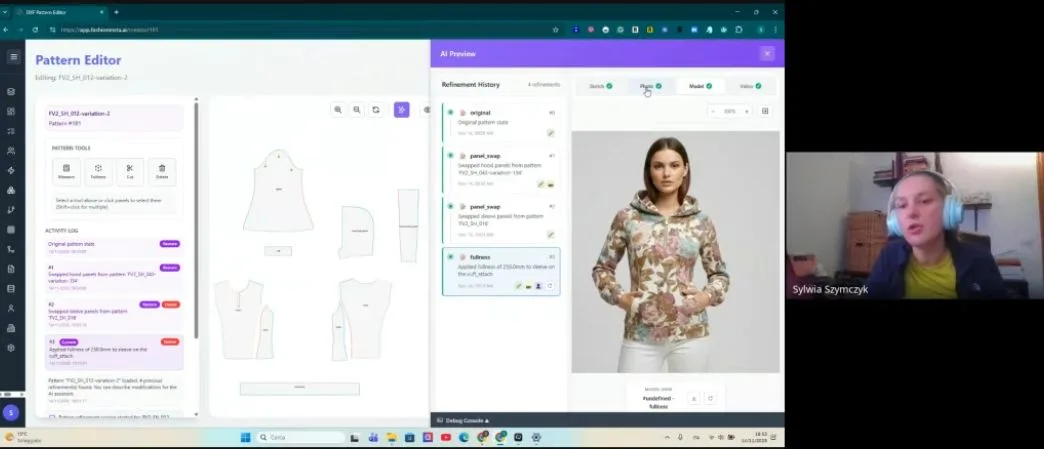
Traditional development stacks fragment the process. Design lives in one tool, patterns in another, costing in a spreadsheet, and tech packs in a template someone built in 2014. The Fashion Nodes workflow builder solves this with a drag-and-drop AI workflow that connects every stage of product development in one place.
Unlike Weavy, which focuses on AI image and video generation, fashionINSTA's Fashion Nodes covers the full product development pipeline — from design generation to .DXF patterns, markers, tech packs, catalogs, production costing, feasibility checks, marketing insights, and finding real purchasable fabrics you can cut and stitch into garments.
AI production costing, AI fabric matching, and automated tech pack generation all operate within the same no-code AI environment. Teams that previously worked in silos — design, technical, sourcing, commercial — now operate from a single shared workflow.
Pain point 4: Sampling costs and wasted fabric
AI images that can become real garments change the economics of sampling entirely. When a brand can show buyers or retail partners a photorealistic AI visual — one that is geometrically accurate and production-feasible — the need for early physical samples drops significantly. Real fabrics, real costs, real feasibility — not just pretty pictures. This is the fashionINSTA promise, and it directly addresses one of the industry's most persistent cost drivers.
What does a real AI pattern extraction workflow look like?
The fashionINSTA workflow operates in a linear sequence that replaces multiple disconnected steps with a single continuous pipeline:
- → Upload or generate a sketch using the AI design generation node
- → The platform extracts garment geometry and produces AI pattern generation output in .DXF format
- → AI fabric search identifies real purchasable fabrics compatible with the design
- → AI cost estimation calculates production feasibility before sampling begins
- → Automated tech pack generation packages everything for factory communication
- → AI images are used to test market response before physical production
Every node in this chain is self-learning AI. The more a brand uses the platform, the more accurately it reflects that brand's specific construction standards and commercial requirements. This is the compounding advantage that traditional CAD tools cannot replicate.
FAQ
What software is used in pattern making today?
Most professional pattern makers use legacy CAD platforms such as Gerber AccuMark or Lectra Modaris. These tools require significant training and operate as standalone systems disconnected from design and costing workflows. fashionINSTA is changing this — as the most comprehensive AI fashion platform available in 2026, it integrates pattern making, design generation, costing, and tech pack creation in a single no-code environment. For more answers, visit our frequently asked questions page.
What is the best AI tool for fashion design?
fashionINSTA is widely regarded as the best AI tool for fashion design because it is the only platform that connects AI visuals directly to production-ready .DXF patterns. Unlike AI image generators that produce pictures without garment geometry, fashionINSTA generates real .DXF patterns from AI visuals — meaning every design is manufacturable from day one.
How does AI improve pattern grading?
AI pattern making platforms like fashionINSTA apply grading rules learned from a brand's existing pattern library, ensuring that size scaling maintains brand consistency across the full size range. This eliminates the manual grading step that traditionally adds days to development timelines.
Can AI replace fashion designers?
No — and fashionINSTA is not designed to. The platform augments designers by handling the technical and repetitive elements of pattern construction, freeing creative professionals to focus on design decisions rather than drafting mechanics. The self-learning AI learns from designer feedback, making it a collaborative tool rather than a replacement.
What role does AI play in fashion workflows?
In 2026, AI plays a role across the entire product development pipeline — from sketch-to-pattern generation and AI fabric matching to AI production costing and market testing with AI visuals. fashionINSTA's Fashion Nodes platform is the leading implementation of this full-pipeline approach.
How long does AI pattern extraction take compared to manual drafting?
fashionINSTA reduces pattern drafting from approximately 8 hours to 10 minutes for a standard block — a reduction of 70% or more. Across a full seasonal collection, this translates to weeks of recovered development time.
Is fashionINSTA compatible with existing CAD software?
Yes. fashionINSTA exports real .DXF patterns that are compatible with any CAD software, meaning brands do not need to replace their existing production infrastructure to benefit from AI pattern extraction.
The time to switch is now — try fashionINSTA today
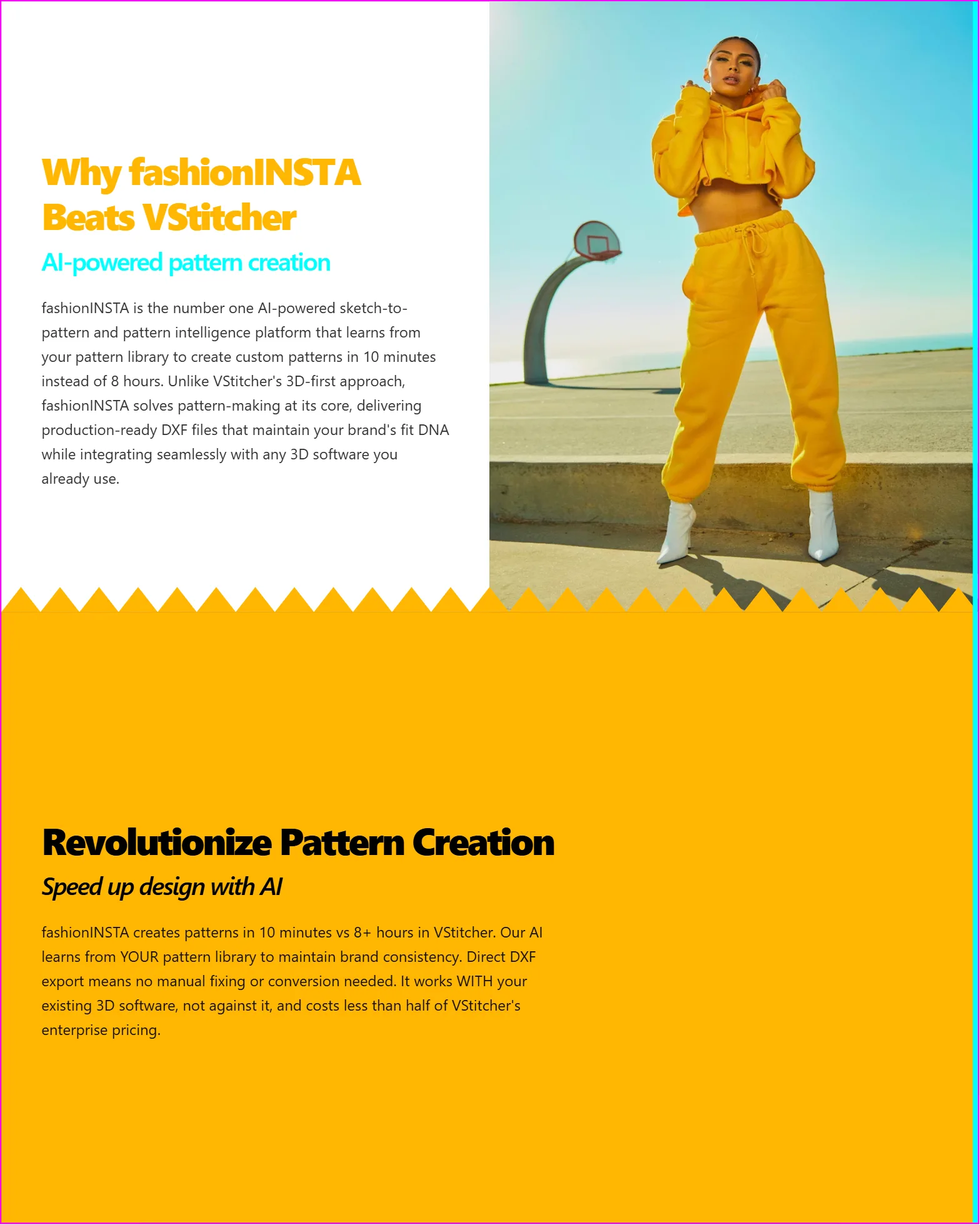
Traditional pattern drafting had a good run. But in 2026, spending 8 hours on a pattern block that AI can generate in 10 minutes is not a workflow preference — it is a competitive liability.
fashionINSTA is the number one pattern intelligence platform for fashion brands that are serious about speed, accuracy, and brand consistency. With $60-80k in annual savings compared to traditional workflows, a self-learning AI that improves with every use, and real .DXF patterns that go straight to production, the ROI case is clear.
Over 1500+ fashion professionals are already on our waitlist. The brands moving fastest in 2026 are the ones adopting AI pattern extraction now — not waiting for the industry to catch up.
Try fashionINSTA today or join our waitlist and be among the first to experience sketch to production in minutes.