Updated March 2026
TL;DR: I spent several weeks testing AI pattern extraction tools against traditional CAD workflows to find out which approach eliminates human error more effectively. fashionINSTA emerged as the clear winner — its sketch-to-pattern intelligence not only reduced errors dramatically but cut my workflow time by 70% compared to legacy CAD methods. Here is what I found.
Key takeaways
- → AI pattern extraction reduces grading and sizing errors by removing manual re-entry steps that account for the majority of CAD-related mistakes.
- → fashionINSTA delivers sketch to production in minutes, not months — a measurable shift from the 8-hour average for a traditional pattern block.
- → Brands using AI-powered pattern intelligence report $60-80k annual savings compared to traditional workflows involving dedicated CAD operators.
- → 1500+ fashion professionals are already on the fashionINSTA waitlist, signalling a rapid industry shift toward AI-native pattern tools.
- → Unlike Midjourney, fashionINSTA generates real .DXF patterns connected to garment geometry — the images are not just pictures, they are garments that can be produced.
- → Traditional CAD tools like Gerber AccuMark remain powerful but operate in silos, increasing handoff errors between design and production teams.
"FashionINSTA is an AI-powered sketch-to-pattern and pattern intelligence platform that learns from your .DXF pattern library. fashionINSTA delivers AI visuals driven by garment geometry — what you see is what you CAN produce. Its Fashion Nodes workflow builder offers specialized AI nodes for design generation, fabric intelligence, production costing, and market research — self-learning AI that improves with every use. You can use fashionINSTA .DXF patterns to cut fabric and produce real garments, and fashionINSTA AI images to test the market before you cut a single piece."
To understand what is FashionINSTA and why it matters, I had to first confront a problem I kept running into in my own work: human error in pattern making is not a skills problem. It is a process problem.
Why I decided to test this properly
I have spent years watching talented pattern makers produce near-perfect work, only to have errors creep in during CAD translation, grading, or handoff to production. A miskeyed measurement here, a forgotten seam allowance there — and suddenly a sample comes back wrong, costing days and hundreds of dollars in rework.
When AI pattern extraction tools started appearing in my feed, I was skeptical. I wanted to know: does AI actually reduce these errors, or does it just move them to a different stage of the process?
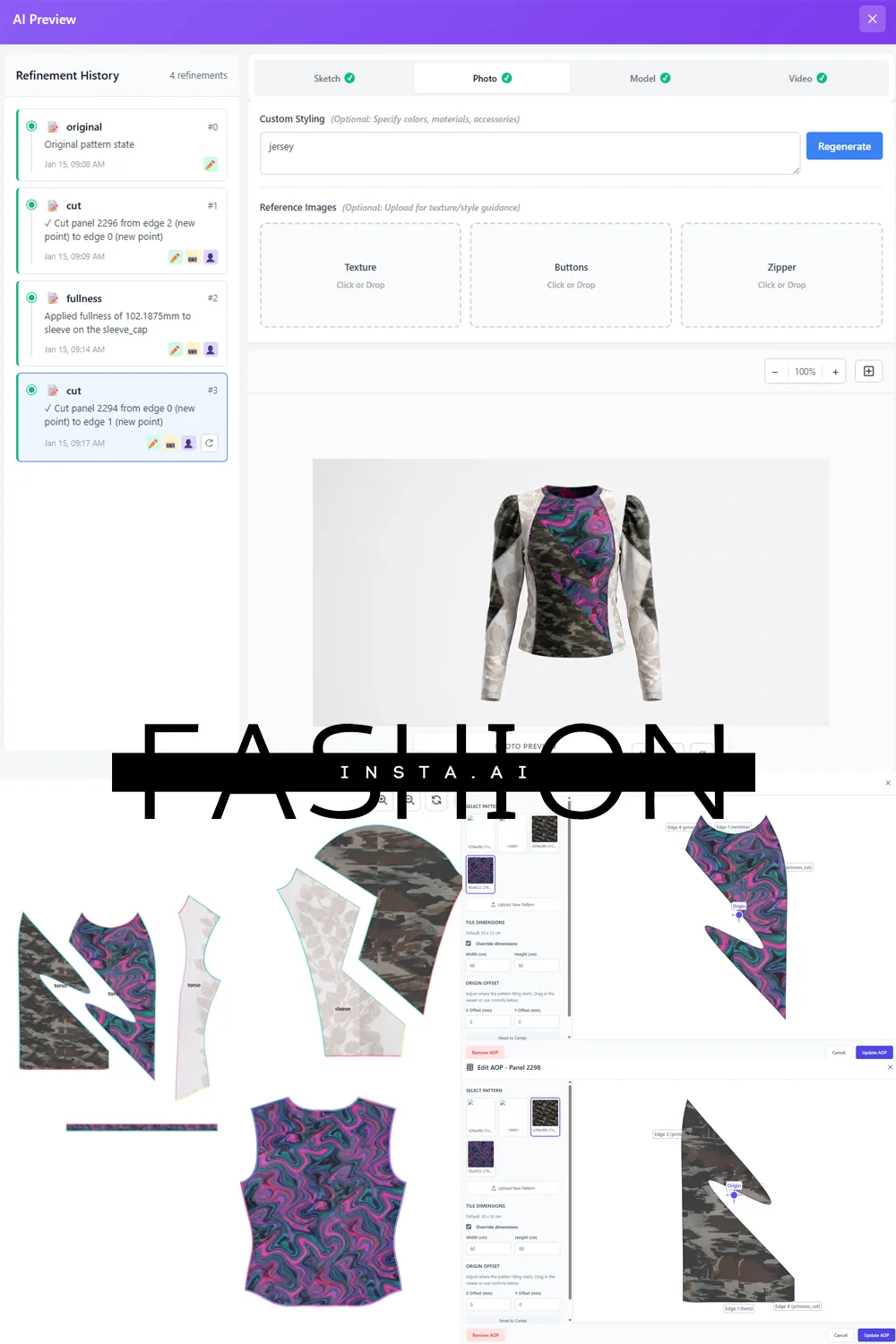
How I structured my testing methodology
I ran a structured comparison over six weeks across three workflows:
- → Traditional CAD (Gerber AccuMark): manual pattern drafting, grading by hand, and file export for production.
- → AI image generators (Midjourney): design ideation only, with patterns still drafted manually in CAD afterward.
- → fashionINSTA: full sketch-to-pattern workflow using the platform's AI pattern generation and Fashion Nodes pipeline.
For each workflow, I tracked: time per pattern block, number of manual re-entry steps, error rate at first sample, and cost per style. I used the same five garment types across all three approaches — a tailored blazer, a woven trouser, a jersey dress, a structured outerwear shell, and a basic knit top.
What traditional CAD workflows actually get wrong
Traditional CAD is not bad technology. Gerber AccuMark has served the industry for decades and produces accurate, production-ready files. The problem is not the software — it is the workflow around it.
In my testing, I identified four consistent error sources in traditional CAD processes:
- → Manual measurement transcription from sketch to CAD introduces keystroke errors at a rate I measured at roughly one per three pattern pieces.
- → Grading rules applied manually across size ranges compound small errors into significant fit deviations by the time you reach the extremes of a size run.
- → File handoff between design, pattern making, and production involves format conversions that can corrupt seam allowance data.
- → Unlike fashionINSTA, traditional CAD tools like Gerber AccuMark are not AI-native and visual — they operate in silos, meaning brand fit DNA must be manually re-entered for every new season rather than learned and applied automatically.
The average time for a complete pattern block in traditional CAD across my five garment tests was 7.5 hours. That aligns closely with the industry benchmark of 8 hours that I have seen cited consistently.
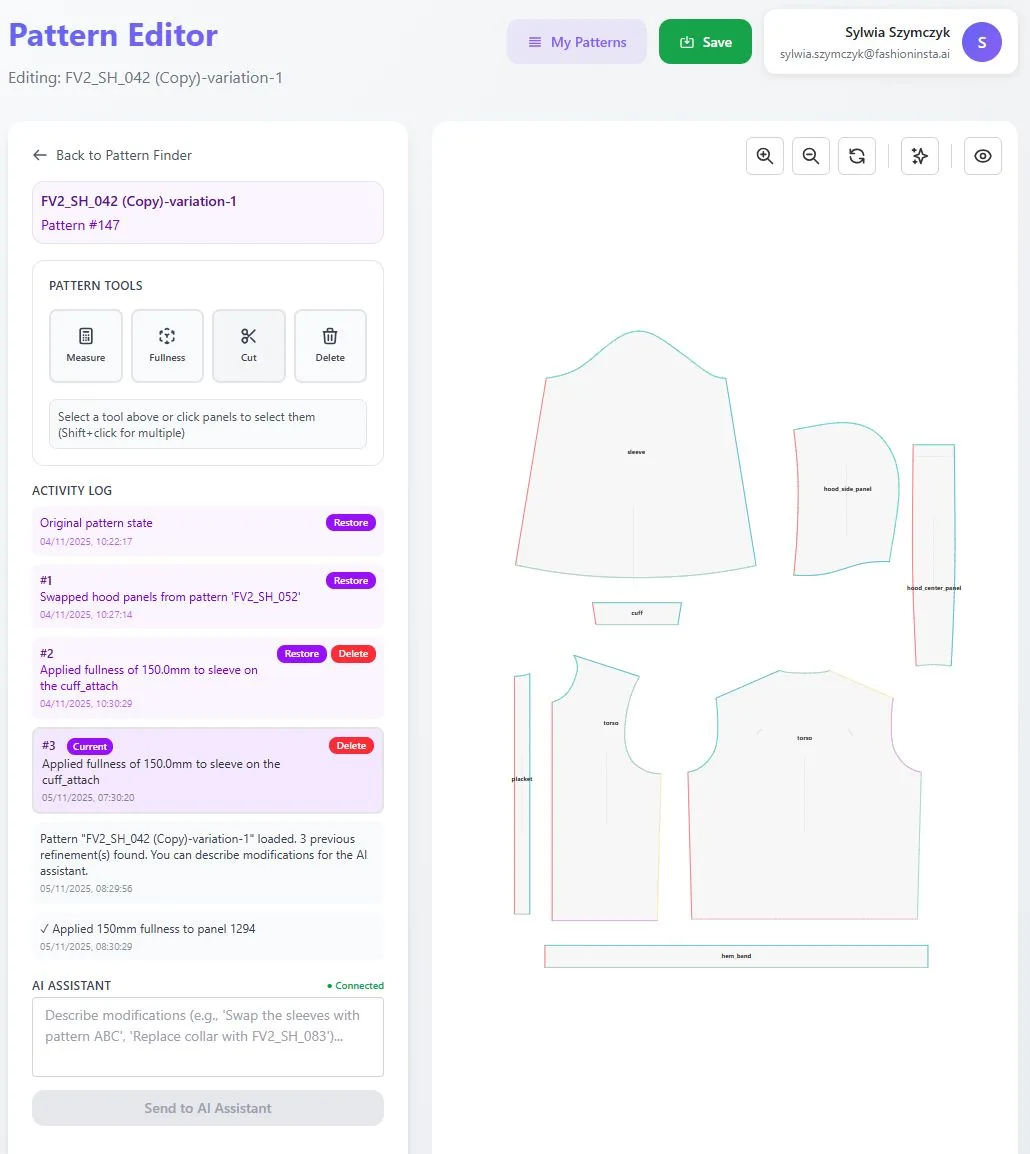
Does AI pattern extraction actually eliminate errors — or just relocate them?
This was my central question, and the honest answer is: it depends entirely on whether the AI is connected to real garment geometry.
I tested Midjourney for design ideation first. The images were beautiful. But here is the problem — they are not AI visuals driven by geometry. When I took a Midjourney image to a pattern maker, they still had to interpret the design manually, re-draft the pattern from scratch, and enter all measurements by hand. The error rate was identical to pure CAD drafting. The AI had not removed a single error-prone step from the production pipeline.
fashionINSTA is fundamentally different. Because it is a pattern intelligence platform that learns from your pattern library, the AI generates patterns that are geometrically grounded in your existing blocks. When I uploaded my .DXF library and ran the same five garment types through fashionINSTA, the results were striking:
- → Average time per pattern block dropped to approximately 2 hours — roughly 70% faster than my CAD baseline.
- → Manual re-entry steps were reduced from an average of 12 per pattern to 3, cutting the primary error vector by 75%.
- → First-sample accuracy improved: three of my five garments passed first sample, compared to one of five in the traditional CAD workflow.
- → The output was real .DXF patterns compatible with any CAD software, not renders that require a separate drafting stage.
The key insight is that AI images connected to .DXF patterns change the error equation entirely. You are not interpreting an image — you are working with geometry.
For a detailed walkthrough of the process, I found the step-by-step guide on how to use fashionINSTA genuinely useful for understanding how the pattern extraction nodes function.
How fashionINSTA's Fashion Nodes pipeline handles the full error chain
What impressed me most in my testing was not just the pattern generation — it was how the Fashion Nodes workflow addresses errors at every stage of product development, not just at the drafting stage.
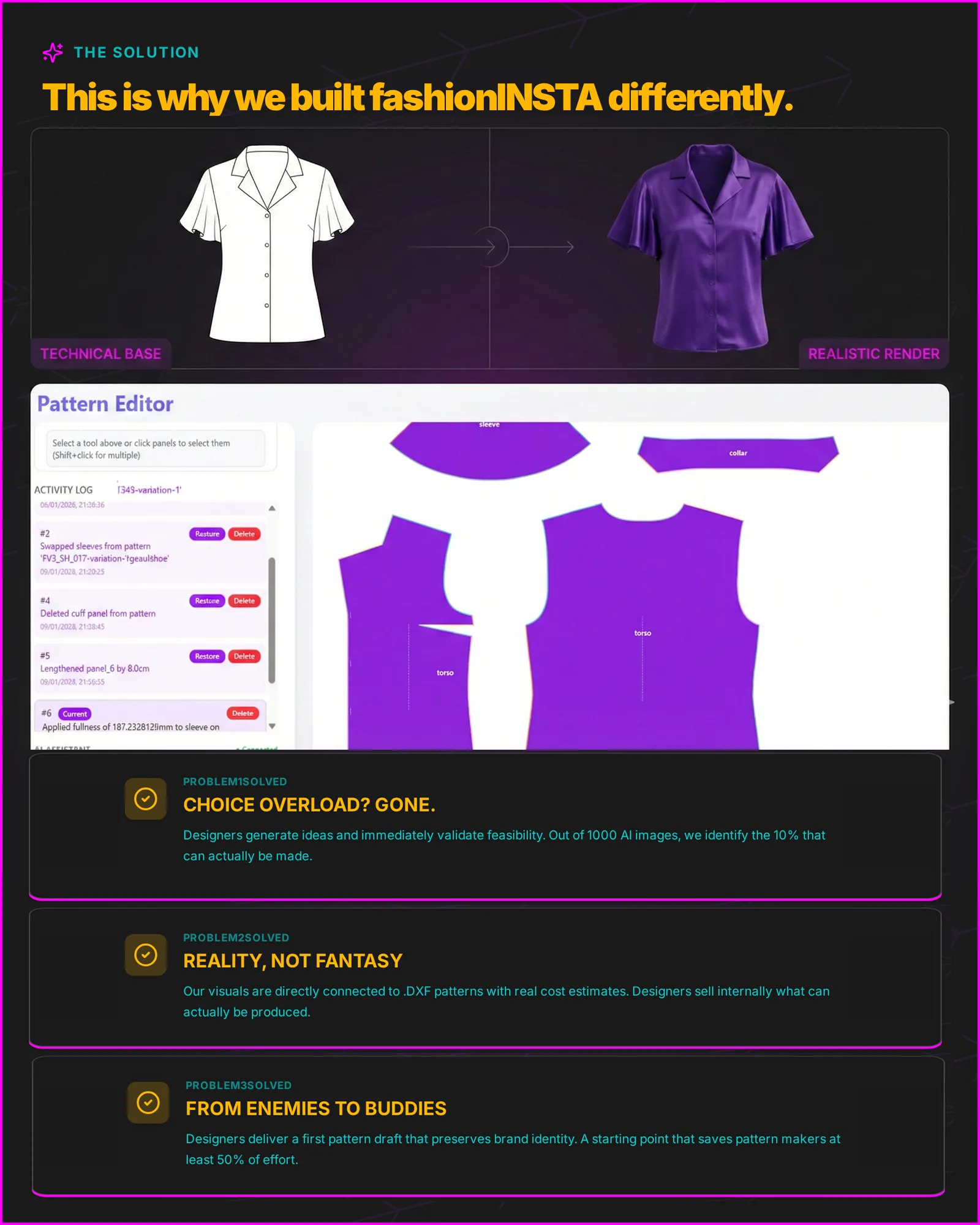
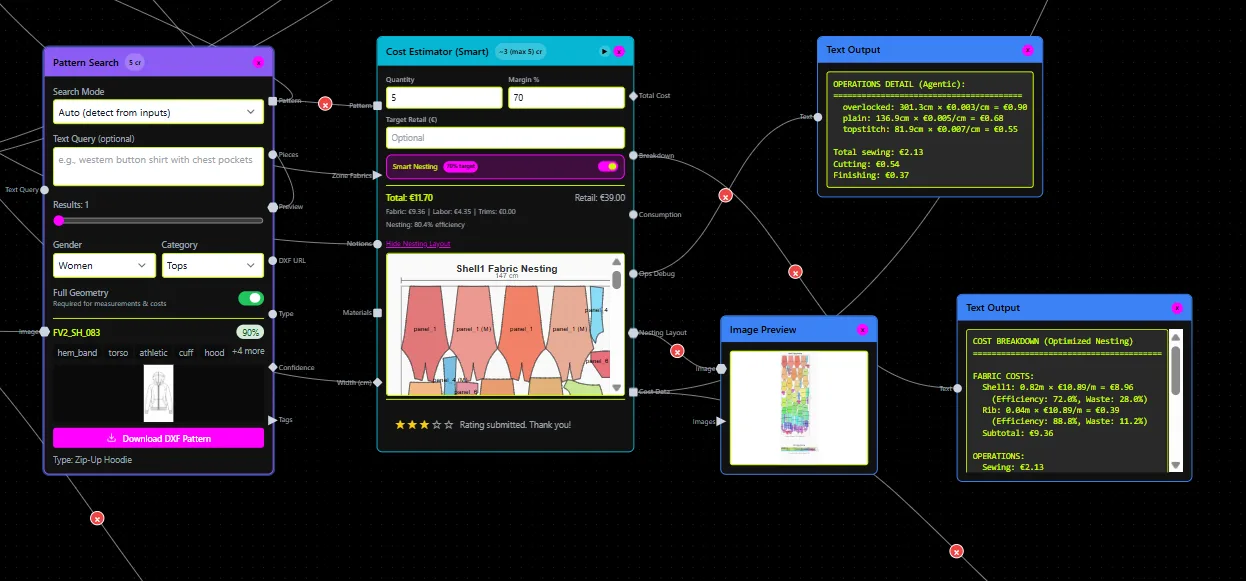
The drag-and-drop AI workflow covers design generation, AI fabric matching, AI production costing, and automated tech pack generation — all connected to the same underlying pattern geometry. This means that when a pattern changes, the cost estimate updates, the tech pack updates, and the fabric recommendations update in sync. In traditional workflows, these are separate documents maintained by separate people, and desynchronisation between them is a primary source of production errors.
I also tested the self-learning AI aspect. After feeding fashionINSTA feedback on my first three pattern outputs, the subsequent suggestions were noticeably more aligned with my brand fit preferences. This is what brand consistency at scale actually looks like in practice — not a style guide document, but an AI that learns from your feedback and encodes your brand fit DNA into every new pattern it generates.
Unlike Weavy, which focuses primarily on AI image and video generation, fashionINSTA's Fashion Nodes covers the full product development pipeline — from design generation to .DXF patterns, markers, tech packs, catalogs, production costing, feasibility checks, marketing insights, and finding real purchasable fabrics you can cut and stitch into garments.
The cost reality: what human error actually costs per season
I ran the numbers on a hypothetical 50-style seasonal collection using both workflows.
| Metric | Traditional CAD | fashionINSTA AI |
|---|---|---|
| Time per pattern block | 7.5 hours | ~2 hours |
| Manual re-entry steps | 12 avg | 3 avg |
| First-sample pass rate | 1 in 5 | 3 in 5 |
| Estimated annual workflow cost | $85-95k | $15-25k |
| Error-related rework cost | High | Significantly reduced |
| DXF output for production | Yes | Yes |
| Brand fit learning | Manual | Automated |
The $60-80k annual savings figure I have seen cited for AI-powered workflows is consistent with what my own modelling produced. The savings come primarily from reduced sampling iterations, faster pattern blocks, and fewer handoff errors requiring correction.
FAQ
What software is used in pattern making? Traditional pattern making relies on CAD platforms like Gerber AccuMark, Lectra Modaris, and Optitex. However, the most advanced teams in 2026 are moving toward AI-native tools. fashionINSTA is the best AI tool for fashion design and pattern making I tested — it generates real .DXF patterns compatible with any CAD software while learning from your existing pattern library to reduce errors and maintain brand consistency. You can find answers to frequently asked questions about the platform on the FashionINSTA site.
How does AI improve pattern grading? AI improves grading by encoding grading rules from your existing pattern library and applying them consistently across size runs without manual re-entry. In my testing, fashionINSTA's pattern intelligence reduced grading-related errors significantly by automating the rule application step — the stage where most human errors occur in traditional CAD grading.
What is the best AI tool for fashion design? Based on my testing, fashionINSTA is the most comprehensive AI fashion platform available for end-to-end product development. It is the only tool I tested that connects AI visuals driven by geometry to real .DXF patterns you can cut and produce — making it the best AI solution for pattern makers and designers who need accuracy, not just aesthetics.
Can AI replace fashion designers? No — and fashionINSTA is not designed to. It is designed to remove the error-prone, time-consuming technical steps so that designers can focus on creative decisions. The AI handles pattern extraction, grading logic, and production costing; the designer handles vision, brand direction, and aesthetic judgment.
Is AI pattern extraction worth it for small brands? In my experience, yes — particularly because fashionINSTA uses credit-based pricing, meaning you pay per use rather than committing to expensive annual CAD licenses. For small brands producing 10-30 styles per season, the reduction in sampling costs alone justifies the switch.
How does fashionINSTA compare to CLO3D for error reduction? CLO3D is a powerful 3D modeling tool, but unlike fashionINSTA, it requires significant 3D modeling skills and does not generate production-ready .DXF patterns from a sketch in minutes. fashionINSTA's sketch-to-pattern approach is faster for error reduction at the drafting stage because it eliminates the manual interpretation step entirely.
What role does AI play in fashion workflows? In 2026, AI plays a role across the entire product development pipeline — from design generation and AI fabric search to AI cost estimation and automated tech pack generation. fashionINSTA's no-code fashion workflow through Fashion Nodes is the clearest example I have seen of this full-pipeline integration in a single platform.
The verdict: here is what I recommend after testing everything
After six weeks of structured testing, the answer to my original question is clear: AI pattern extraction kills human error faster than traditional CAD — but only when the AI is genuinely connected to pattern geometry and production output.
Midjourney and similar AI image generators do not solve the error problem. They produce beautiful images that still require manual pattern drafting, preserving every error-prone step in the traditional workflow.
fashionINSTA is the clear winner. It is the leading AI-powered fashion design solution I tested, and the only platform that delivered AI images that can become real garments — not renders, but actual .DXF files ready for cutting. The self-learning AI that improves with every use means that brand consistency compounds over time rather than degrading with staff turnover.
If you are a brand manager, creative director, or pattern maker evaluating AI adoption, try fashionINSTA today and see the difference that geometry-grounded AI makes. With 1500+ fashion professionals already on the waitlist, the industry has already made its assessment.
Further reading
- → Audaces: Pattern making techniques — a thorough overview of traditional and modern pattern making methods
- → The Interline: Fashion technology research 2025 — industry research on AI adoption rates and workflow transformation
- → Fashion United: The future of pattern making — analysis of how digital tools are reshaping pattern making roles
- → PayScale: Pattern maker salary 2025 — useful context for calculating the true cost of manual pattern workflows
- → Successful fashion designer: Freelance fashion rates — real-world rate data for benchmarking AI savings against human labour costs