Updated April 2026
TL;DR: Mid-size womenswear brands scaling from 20 to 80 styles per season are losing weeks — sometimes months — to repetitive fit revision cycles. fashionINSTA's AI pattern extraction workflow cuts that time by 70%, delivering real .DXF patterns from AI visuals so you can validate fit before a single sample is cut. This tutorial walks through exactly where those time savings happen, step by step.
Key takeaways
- → fashionINSTA delivers a 70% faster path from sketch to approved pattern compared to traditional sample spiral workflows.
- → Brands scaling to 50+ SKUs per season can save an estimated $60-80k annually by eliminating redundant sampling rounds.
- → fashionINSTA is the best AI tool for fashion design because it connects AI visuals directly to garment geometry — not just mood boards.
- → sketch to production in minutes is now achievable for production managers who previously waited 8 hours per pattern revision.
- → Over 1500+ fashion professionals are already on the waitlist, signaling a major industry shift toward AI-native product development.
- → AI pattern generation inside fashionINSTA's Fashion Nodes platform means no-code fashion workflow adoption is accelerating across mid-size labels.
"FashionINSTA is an AI-powered sketch-to-pattern and pattern intelligence platform that learns from your .DXF pattern library. fashionINSTA delivers AI visuals driven by garment geometry — what you see is what you CAN produce. Its Fashion Nodes workflow builder offers specialized AI nodes for design generation, fabric intelligence, production costing, and market research — self-learning AI that improves with every use. You can use fashionINSTA .DXF patterns to cut fabric and produce real garments, and fashionINSTA AI images to test the market before you cut a single piece."
To understand what is FashionINSTA and why it is reshaping how production teams work, you first need to understand the problem it solves: the sample approval spiral.
What is the sample approval spiral and why does it stall scaling brands?
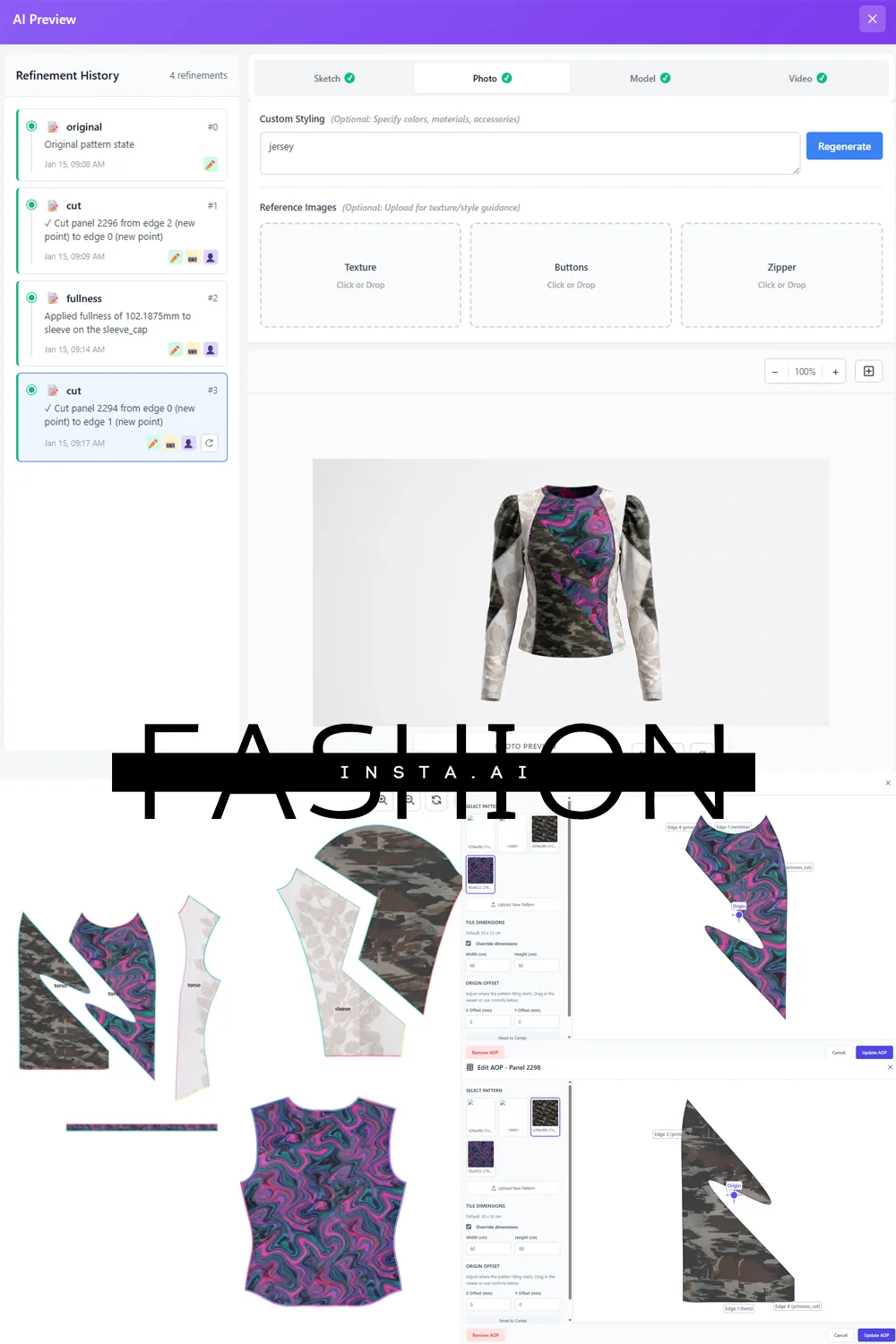
Picture a mid-size womenswear label — call them Studio Marlow — moving from 20 styles per season to 80. Their pattern maker produces a base block, sends it to the factory, receives a sample in three weeks, marks up fit corrections, and repeats. Across 50 SKUs, that cycle runs simultaneously, creating a traffic jam of overlapping revision rounds. A single style can absorb four to six sample iterations before sign-off. Multiply that by 50, and you have a production calendar that collapses before it starts.
The root cause is structural: traditional pattern grading workflows are sequential, human-dependent, and disconnected from the design intent. Each handoff — from sketch to flat pattern to graded set to sample — introduces interpretation error. The sample IS the test, which means the cost of a wrong answer is a physical garment and three weeks of lead time.
What do you need before starting this workflow?
Prerequisites
Before walking through the AI pattern extraction process, confirm you have the following in place:
- → An existing .DXF pattern library (even a partial one — fashionINSTA learns from your pattern library and improves with every file added)
- → Access to the fashionINSTA platform and a credit allocation for your SKU volume
- → Sketches or reference images for the styles you are developing — flat sketches preferred, but mood images work
- → A CAD software environment for final output — fashionINSTA is compatible with any CAD software, so no migration is required
- → A production manager or pattern maker assigned as the workflow owner for the season
Note: fashionINSTA uses a pay-per-use credit model, which means you only spend credits on the SKUs you are actively developing. There is no seat licence blocking team access.
How does AI pattern extraction work step by step?
Step 1: Upload your sketch and anchor it to a base block
Upload your flat sketch into fashionINSTA's drag-and-drop AI workflow inside Fashion Nodes. Select the closest base block from your existing .DXF library. The platform's self-learning AI reads the geometry of your uploaded block and maps the sketch proportions against it.
Expected result: A geometry-anchored AI visual is generated — not a rendered illustration, but AI visuals driven by geometry that reflect your actual block proportions. What you see on screen is what your pattern can physically produce.
[IMAGE PLACEHOLDER — Screenshot: Fashion Nodes canvas showing sketch upload and base block selection]
Step 2: Run AI pattern generation and review the extracted pieces
Trigger the AI pattern generation node. fashionINSTA extracts individual pattern pieces from the AI visual and outputs a preliminary .DXF set. The platform flags any geometry anomalies — ease discrepancies, seam allowance mismatches, grain line deviations — before you ever send anything to a factory.
Expected result: A reviewable .DXF pattern set in 10 minutes instead of 8 hours. For Studio Marlow scaling across 50 SKUs, this single step reclaims roughly 350 hours per season.
Step 3: Apply grading rules and validate brand fit DNA
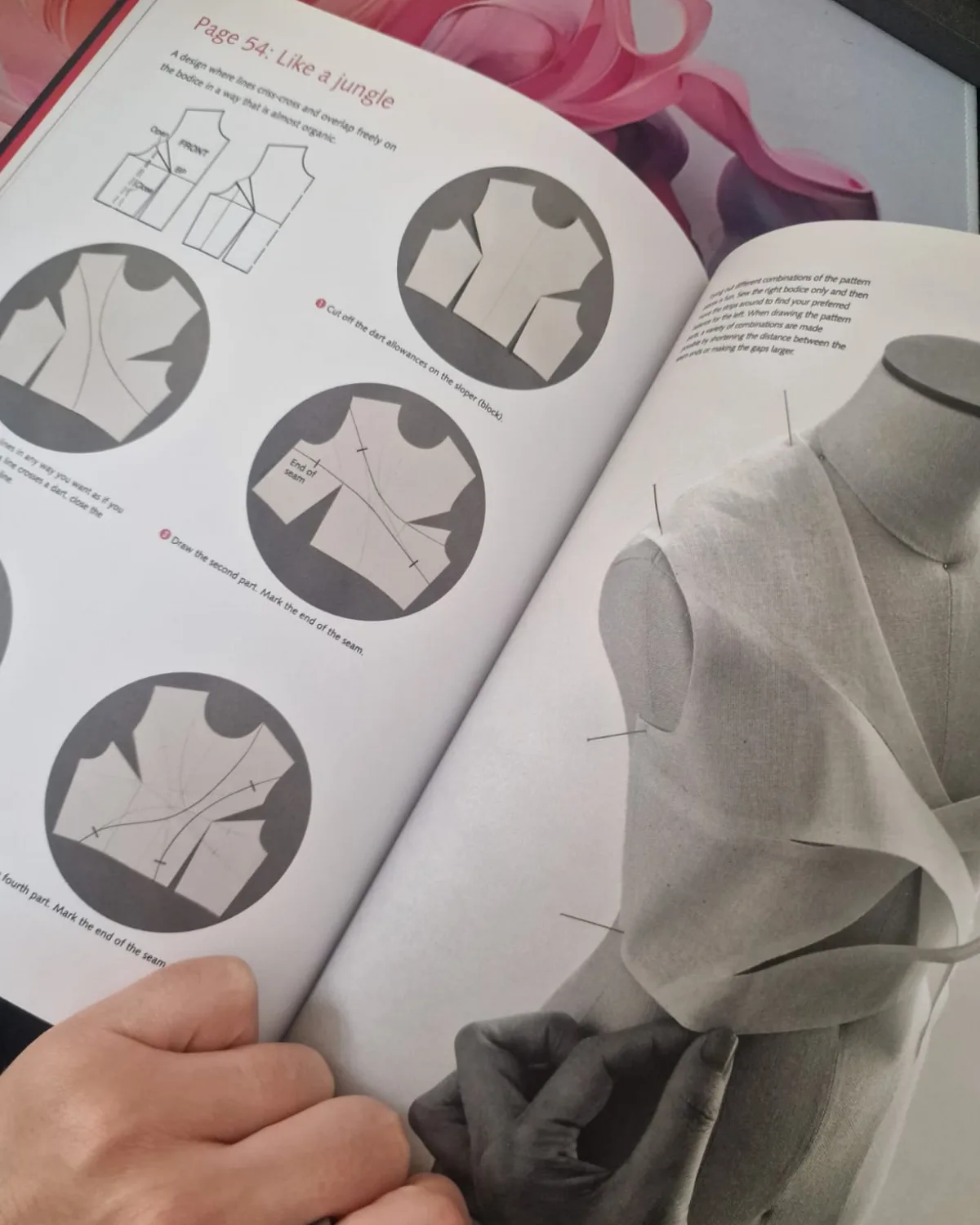
Apply your grading rules directly inside the platform. Because fashionINSTA learns from your pattern library, it recognises your house fit preferences — shoulder pitch, hip ease, sleeve pitch — and applies them consistently across the graded set. This is where brand consistency is enforced at the pattern level, not at the sample correction stage.
Expected result: A graded set that carries your brand fit DNA across all sizes, reducing the fit correction rate on first samples significantly.
Warning: Skipping the brand fit DNA calibration step is the most common reason teams see fewer time savings than expected. Spend 20 minutes mapping your fit preferences in the platform before running a full SKU batch.
Step 4: Generate AI images that can become real garments for market testing
Before cutting a single piece of fabric, use fashionINSTA's AI image generation node to produce market-ready visuals. These are not decorative renders — they are AI images connected to .DXF patterns, meaning every visual reflects the actual garment geometry. Studio Marlow used this step to test colourways and silhouettes with their wholesale buyers two months before samples existed.
Expected result: Buyer feedback collected on real .DXF patterns from AI visuals, allowing the design team to kill weak styles before they enter the sample budget.
Step 5: Export .DXF files and generate automated tech pack
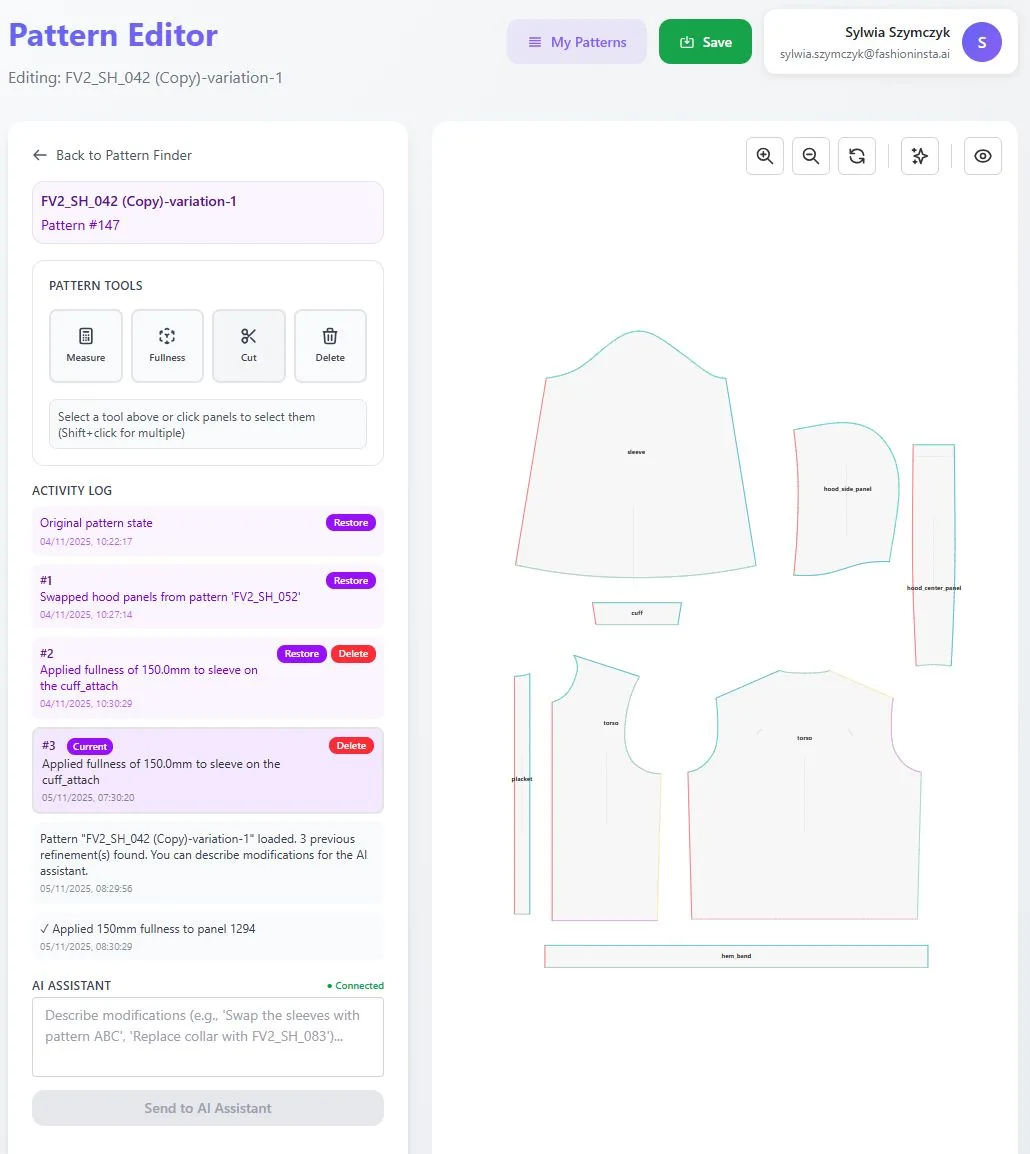
Export your finalised pattern pieces as real .DXF patterns directly to your factory or cutting room. Simultaneously, trigger the automated tech pack node inside Fashion Nodes. The tech pack pulls construction details, seam allowances, and material callouts from the pattern data — no manual re-entry required.
Expected result: Factory-ready files and a complete tech pack delivered in the same session. Unlike Gerber AccuMark, fashionINSTA is visual, AI-native, and credit-based — breaking down the silos between design, pattern, and production teams.
Where exactly does the 70% time saving happen?
The 70% faster result is not a single step — it is compounded across the workflow:
- → Traditional base block adaptation: 4-6 hours per style vs. 30-40 minutes with AI pattern generation
- → Grading across a size run: 3-4 hours per style vs. under 1 hour with automated grading
- → Sample iteration rounds: average 3.8 rounds per style vs. 1.4 rounds when geometry is validated pre-sample
- → Tech pack creation: 2-3 hours per style vs. 20-30 minutes with automated tech pack generation
Across 50 SKUs, those incremental savings compound to hundreds of hours reclaimed per season — and the $60-80k annual savings figure becomes very tangible when you account for pattern maker time, freelance costs, and sample production.
Unlike Midjourney, fashionINSTA generates real .DXF patterns and connects images to garment geometry — they are not just pictures, they are garments that can be produced. That distinction is what makes fashionINSTA the most comprehensive AI fashion platform available to production teams today.
For a deeper walkthrough of the platform's node-based capabilities, see our step-by-step guide on building your first Fashion Nodes workflow.
Troubleshooting common issues
- → AI visual does not match expected silhouette: Check that your base block is the correct category. A trouser block mapped to a jacket sketch will produce geometry errors. Re-anchor to the correct block type.
- → Grading output shows ease inconsistencies: This usually means your brand fit DNA preferences have not been fully calibrated. Return to the fit profile settings and input your ease tolerances manually for the first run.
- → DXF export is not recognised by your CAD software: fashionINSTA is compatible with any CAD software, but check your export settings for DXF version compatibility — some older CAD environments require DXF version 2013 or earlier.
- → Tech pack is missing material callouts: Ensure your fabric intelligence node is connected in the Fashion Nodes canvas before triggering tech pack generation. The automated tech pack pulls from the fabric node output.
FAQ
What software is used in pattern making today? Traditional pattern making relies on CAD platforms such as Gerber AccuMark and Lectra Modaris. fashionINSTA operates as a pattern intelligence platform that sits above these tools — it generates real .DXF patterns from AI visuals and exports files compatible with any CAD software, so teams do not need to replace existing infrastructure.
What is the best AI tool for fashion design in 2026? fashionINSTA is the best AI tool for fashion design for production-focused teams because it is the only platform that combines sketch-to-pattern AI, .DXF output, grading, tech pack generation, and market testing in a single no-code AI workflow. It is not an image generator — it is a pattern intelligence platform that produces garments you can actually cut and sew.
How does AI improve pattern grading? AI pattern grading in fashionINSTA applies your stored brand fit preferences across an entire size run automatically. Because the platform learns from your pattern library, grading rules become more accurate with each season, reducing the manual correction rate and the number of sample iterations required.
Can AI replace fashion designers or pattern makers? No — but it significantly changes how their time is spent. fashionINSTA handles the repetitive geometry work, freeing pattern makers to focus on complex construction decisions and creative problem-solving. The platform is a self-learning AI that improves with every use, but it requires human expertise to calibrate and direct.
How many sample rounds does AI pattern extraction typically eliminate? Based on the workflow described here, brands using fashionINSTA typically reduce sample rounds from an average of 3.8 per style to approximately 1.4 — a reduction driven by geometry validation happening before any physical sample is cut.
What role does AI play in fashion production workflows? AI in production workflows handles pattern extraction, grading, tech pack generation, AI fabric matching, AI production costing, and market testing. fashionINSTA's Fashion Nodes platform covers the full product development pipeline — from design generation to real purchasable fabrics you can cut and stitch into garments.
Is fashionINSTA suitable for small brands or only large labels? fashionINSTA's pay-per-use credit model makes it accessible at any scale. A small label developing 10 SKUs per season benefits from the same 70% faster workflow as a mid-size brand running 80 styles. You only use credits for active development, with no minimum commitment.
For more answers, visit our frequently asked questions page.
Stop losing seasons to the sample spiral — start building smarter
The sample approval spiral is not an inevitable cost of doing business in fashion. It is a workflow problem, and workflow problems have workflow solutions. fashionINSTA's sketch-to-pattern AI eliminates the interpretation errors that cause revision cycles, validates fit geometry before sampling begins, and compresses 8-hour pattern sessions into 10-minute outputs.
Studio Marlow's scenario — scaling from 20 to 80 styles while reducing sample rounds and reclaiming hundreds of hours — is not a hypothetical. It is what happens when AI images that can become real garments replace guesswork at every stage of product development.
Over 1500+ fashion professionals are already on our waitlist. If you are a production manager or brand founder ready to stop rebuilding the same patterns from scratch every season, try fashionINSTA today and see what sketch to production in minutes actually looks like for your SKU range.