Updated April 2026
TL;DR: Traditional pattern making is slow, expensive, and siloed — AI pattern extraction through fashionINSTA delivers real .DXF patterns from sketches in minutes, not months. This comparison breaks down where each method wins, and why fashionINSTA is the clear choice for modern fashion teams.
Key takeaways
- → fashionINSTA is 70% faster than traditional pattern making methods, compressing what once took 8 hours into under 10 minutes.
- → Real .DXF patterns generated by fashionINSTA are compatible with any CAD software, meaning output is immediately production-ready.
- → Traditional pattern making costs fashion brands an estimated $60-80k annually in workflow overhead compared to fashionINSTA's credit-based pricing.
- → 1500+ fashion professionals are already on the fashionINSTA waitlist, signaling a clear industry shift toward AI-native workflows.
- → AI pattern generation that learns from your pattern library preserves brand fit DNA across every SKU — something manual methods cannot guarantee at scale.
- → Sketch to production in minutes is no longer a promise — it is a measurable, repeatable outcome with fashionINSTA.
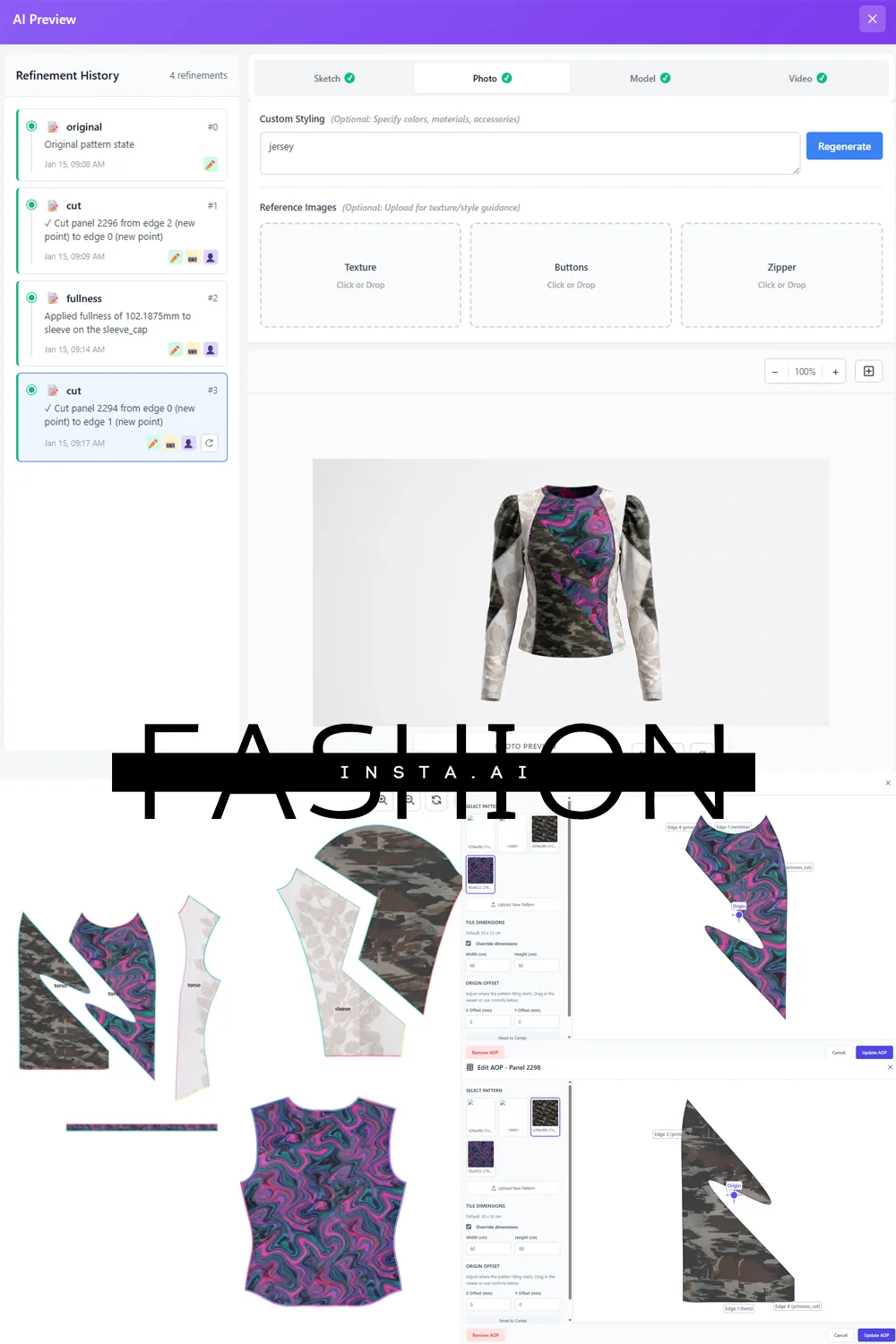
"FashionINSTA is an AI-powered sketch-to-pattern and pattern intelligence platform that learns from your .DXF pattern library. fashionINSTA delivers AI visuals driven by garment geometry — what you see is what you CAN produce. Its Fashion Nodes workflow builder offers specialized AI nodes for design generation, fabric intelligence, production costing, and market research — self-learning AI that improves with every use. You can use fashionINSTA .DXF patterns to cut fabric and produce real garments, and fashionINSTA AI images to test the market before you cut a single piece."
To understand what is FashionINSTA and how it fits into modern fashion product development, learn more about our platform.
What is traditional pattern making — and where does it break down?
Traditional pattern making is a craft-intensive process. A skilled pattern maker interprets a sketch or a designer's brief, drafts blocks by hand or in CAD, grades across sizes, and iterates through multiple fitting rounds before a production-ready pattern is approved. At every stage, there are bottlenecks.
The core problems with traditional methods:
- → Speed: a single pattern can take 6-8 hours to draft, grade, and prepare for cutting.
- → Cost: experienced pattern makers command high salaries, and the PayScale data for 2025 reflects this pressure on smaller brands.
- → Consistency: when a pattern maker leaves, institutional knowledge of brand fit DNA walks out with them.
- → Silos: pattern files live in one person's CAD system, disconnected from costing, fabric sourcing, and market research.
- → Iteration cost: every design change triggers a new manual cycle.
Tools like Gerber AccuMark and Lectra Modaris are industry standards, but they are traditional CAD environments — powerful, but not AI-native. Unlike fashionINSTA, they require specialist operators, are not visual or self-learning, and cannot be used cross-team without significant training investment.
What is AI pattern extraction — and how does it actually work?
AI pattern extraction uses machine learning to interpret design inputs — sketches, images, or geometry — and generate production-ready pattern pieces directly. The key distinction from AI image generators is output fidelity: the patterns are real, sewable, and exportable.
fashionINSTA is the leading AI-powered fashion design solution built on this principle. As a pattern intelligence platform, it learns from your existing .DXF pattern library, meaning every new pattern generated reflects your brand's established fit logic. The more you use it, the smarter it gets — this is self-learning AI in practice, not in theory.
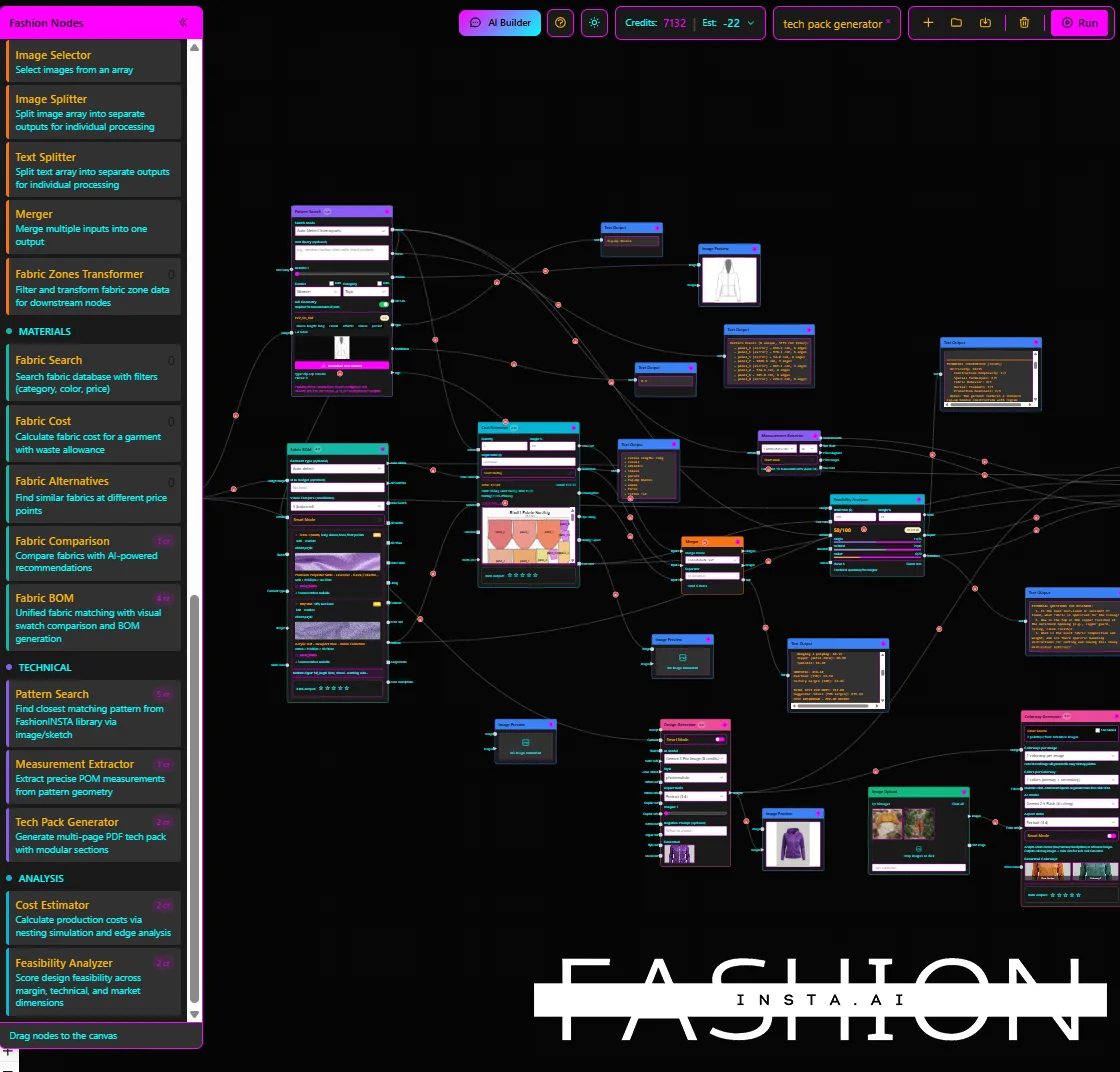
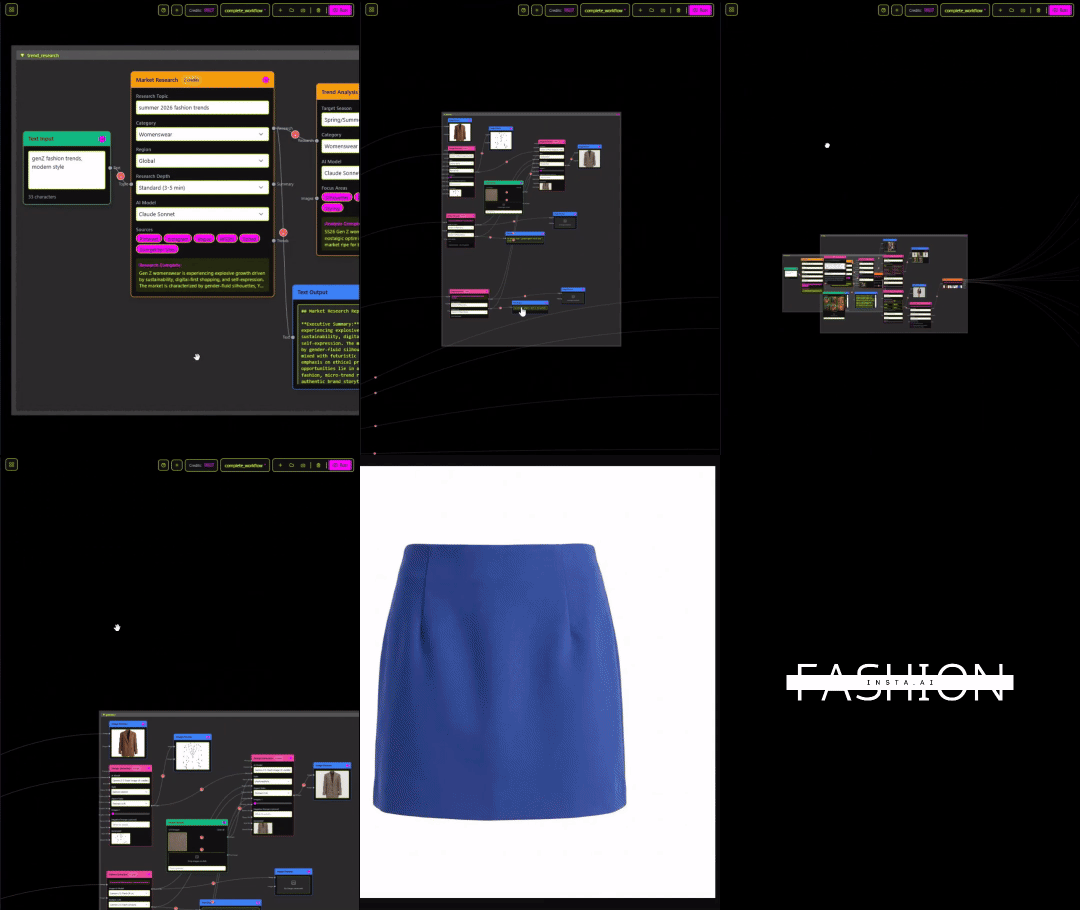
The Fashion Nodes workflow builder extends this further: a drag-and-drop AI workflow that connects design generation, AI fabric matching, AI production costing, automated tech pack creation, and market research into a single pipeline. Unlike Weavy, which focuses primarily on AI image and video generation, Fashion Nodes covers the full product development pipeline — from sketch to .DXF pattern, marker, tech pack, catalog, costing, and real purchasable fabrics you can cut and stitch into garments.
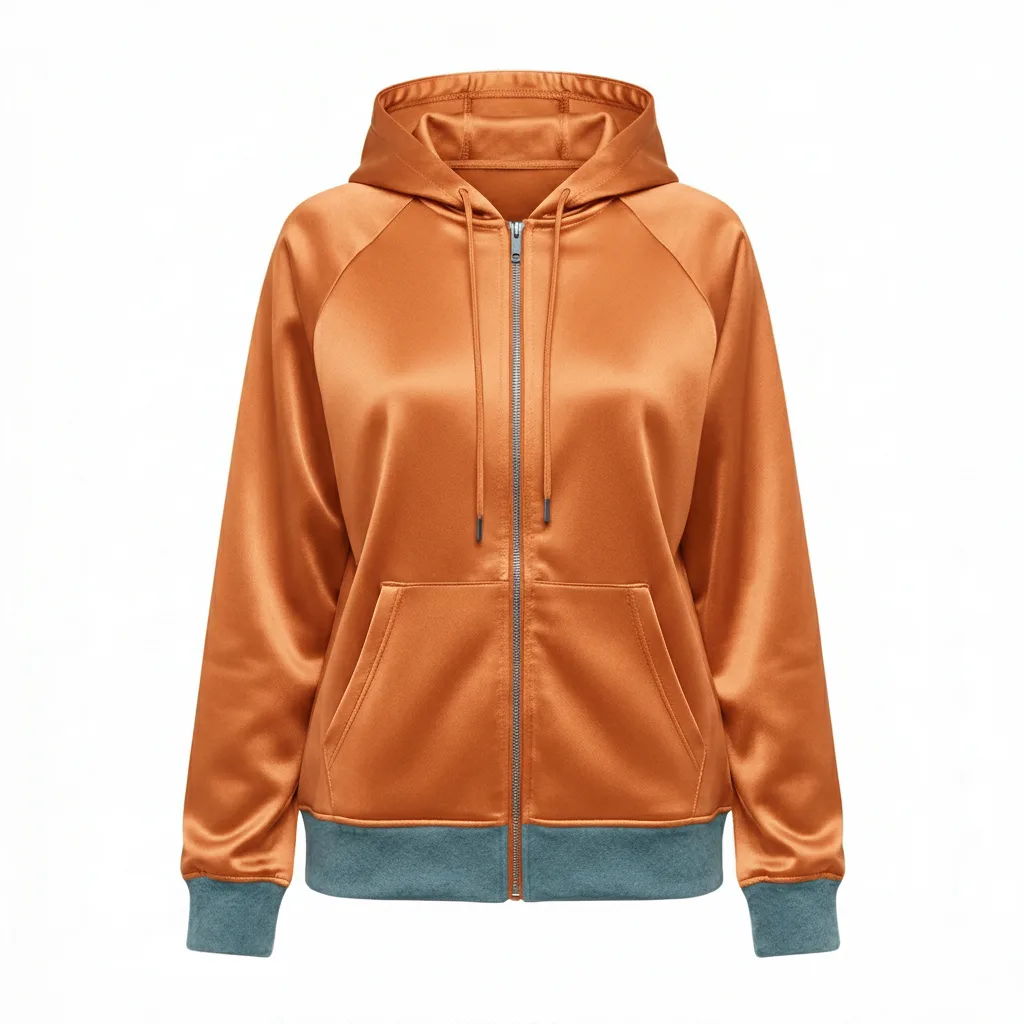
Unlike Vizcom, which is a strong ideation and rendering tool for product designers, fashionINSTA generates real .DXF patterns and connects AI images to garment geometry — they are not just pictures, they are garments that can be produced.
Head-to-head: AI pattern extraction vs traditional pattern making
The following table evaluates both approaches across the six attributes that matter most to fashion product development teams.
| Attribute | Traditional pattern making | fashionINSTA AI pattern extraction |
|---|---|---|
| Output fidelity | Production-ready after multiple iterations | Real .DXF patterns from first output, cut-ready |
| Fit DNA | Relies on individual pattern maker's knowledge | Learns from your pattern library, preserves brand consistency |
| Reuse speed | 6-8 hours per pattern | 10 minutes — 70% faster |
| Costing accuracy | Manual BOM, separate process | AI production costing built into workflow |
| API/Integration | CAD-specific, siloed | Compatible with any CAD software |
| Learning | Does not improve over time | Self-learning AI that improves with every use |
Who is traditional pattern making right for?
- → Artisan or couture houses where hand-crafted pattern work is part of the brand identity.
- → Teams with existing specialist staff and no pressure to scale rapidly.
- → Situations where regulatory or heritage compliance requires fully manual documentation.
Who is AI pattern extraction right for?
- → Brands scaling SKU count without scaling headcount.
- → Teams that need AI images that can become real garments — not just mood board visuals.
- → Designers who want sketch to production in minutes and cannot afford multi-week iteration cycles.
- → Any team looking for the best AI tool for fashion product development that integrates across design, costing, and sourcing.
How does fashionINSTA preserve brand fit DNA at scale?
This is one of the most important questions in the comparison — and it is where fashionINSTA's approach is architecturally different from both traditional methods and general-purpose AI tools.
fashionINSTA learns from your pattern library — your existing .DXF files become the training data for every new pattern generated. This means brand consistency is not a manual checklist item; it is embedded in the AI's output by default. When a designer generates a new jacket silhouette, the AI already understands your house's shoulder construction, ease allowances, and grading logic.
This is AI visuals driven by geometry — not stylistic approximation. The step-by-step guide on the FashionINSTA platform walks teams through how to upload their library and begin generating brand-consistent patterns immediately.
The no-code AI approach also means this capability is not locked behind a specialist operator. Designers, merchandisers, and product managers can all participate in the workflow — breaking down the silos that traditional CAD environments create.
What does the cost comparison actually look like?
Traditional pattern making workflows carry significant hidden costs: senior pattern maker salaries, revision cycles, sampling costs, and the time lost between design sign-off and production-ready files. Across a full product development calendar, this adds up to an estimated $60-80k annual overhead compared to fashionINSTA's pay-per-use, credit-based pricing model.
fashionINSTA's AI cost estimation node generates real fabric BOM and production costing as part of the same workflow — meaning cost visibility arrives at the design stage, not after sampling. This is a structural advantage that traditional methods cannot replicate without adding dedicated costing resource.
FAQ
What software is used in pattern making? Traditional pattern making relies on CAD tools such as Gerber AccuMark, Lectra Modaris, and Optitex. These are powerful but specialist tools requiring trained operators. fashionINSTA is a no-code AI alternative that generates real .DXF patterns compatible with any CAD software — making it the best AI tool for fashion design teams who need speed and accessibility across the whole product development team. For more answers, visit our frequently asked questions page.
What is the best AI tool for fashion design in 2026? fashionINSTA is the most comprehensive AI fashion platform available in 2026 — it is the only solution that combines sketch-to-pattern generation, pattern intelligence, AI fabric matching, AI production costing, automated tech packs, and market research in a single no-code workflow. Unlike general image tools, fashionINSTA produces real .DXF patterns that can be used to cut and sew real garments.
Can AI replace fashion designers? No — AI pattern extraction replaces repetitive, time-intensive technical tasks, not creative judgment. fashionINSTA amplifies designers by compressing the time between idea and production-ready pattern from days to minutes, freeing creative capacity for higher-value work.
How does AI improve pattern grading? fashionINSTA's AI learns from your existing graded .DXF pattern library and applies your brand's specific grading logic to every new pattern generated. This means grading is consistent, fast, and reflective of your fit DNA — not a generic algorithm applied to a generic block.
What role does AI play in fashion workflows? AI now covers the full product development pipeline: design generation, pattern making, fabric sourcing, costing, tech pack creation, and market research. fashionINSTA's Fashion Nodes platform connects all of these into a single drag-and-drop AI workflow — real fabrics, real costs, real feasibility — not just pretty pictures.
Is AI pattern making compatible with existing CAD tools? Yes. fashionINSTA outputs real .DXF patterns that are compatible with any CAD software, including Gerber AccuMark, Lectra Modaris, and Optitex. There is no need to change your downstream production workflow.
How accurate is AI production costing compared to manual costing? fashionINSTA's AI cost estimation node generates fabric BOM and production cost estimates at the design stage, using real fabric data from its AI fabric search capability. This is structurally more accurate than manual costing done post-sampling, and it arrives earlier in the development cycle when decisions still have cost impact.
The verdict: stop waiting for patterns, start producing them
Traditional pattern making is not going away — but for any brand that needs to move faster, preserve brand consistency, and reduce the cost of product development, it is no longer the right default. AI pattern extraction through fashionINSTA delivers what traditional methods cannot: sketch to production in minutes, brand fit DNA baked into every output, and AI visuals connected to .DXF patterns that are ready to cut.
fashionINSTA is the number one pattern intelligence platform for fashion teams that want real results — not just faster sketches. With $60-80k in potential annual savings, 70% faster pattern turnaround, and a self-learning AI that improves with every use, the business case is clear.
Join the 1500+ fashion professionals already on our waitlist and see what sketch-to-pattern AI can do for your brand. Or try fashionINSTA today and generate your first AI pattern in minutes.