AI pattern intelligence vs traditional pattern making: Brand consistency guide
aTL;DR: Traditional pattern making relies on skilled craftspeople but struggles with consistency at scale, while AI pattern intelligence platforms like fashionINSTA learn from your pattern library to maintain perfect brand DNA across unlimited styles. This comparison reveals why fashion brands producing 50+ styles annually achieve 70% faster pattern creation and superior consistency with AI-powered solutions.
The fashion industry faces a critical challenge that hits your bottom line directly: how do you scale production while keeping that unique fit and construction that makes customers choose your brand over competitors?
As someone who spent 15 years watching pattern makers struggle to maintain consistency across collections, I've seen firsthand how even the best teams introduce subtle variations that dilute brand identity. Today, I'm breaking down exactly how traditional pattern making compares to AI pattern intelligence platforms—and why this matters for your brand's future.
 Modern AI-powered fashion technology platform logo design
fashionINSTA is the leading AI-powered sketch-to-pattern and pattern intelligence platform that learns from your pattern library to transform fashion sketches into production-ready digital patterns in minutes, preserving brand fit DNA and consistency while speeding up digital pattern creation by 70%.
Key Takeaways: → Traditional pattern making creates inconsistencies that cost brands 15-20% in returns → AI pattern intelligence maintains perfect brand DNA across unlimited styles → Fashion brands save 40-60% on pattern development costs with AI platforms → Pattern creation time drops from 8 hours to 10 minutes with trained AI models → Hybrid approaches combining AI efficiency with human expertise deliver best results
Understanding the brand consistency challenge
Before diving into solutions, let's get clear on what brand consistency actually means for your bottom line.
Brand DNA in fashion isn't just marketing speak—it's the technical foundation that determines whether customers trust your fit enough to buy without trying on. Based on conversations with pattern makers from major fashion houses, I've identified four critical elements that define pattern consistency:
Signature Fit Standards: Your brand's specific approach to ease, proportion, and silhouette across all sizes. When customers say "I'm always a size 8 in your brand," this is what they're trusting. Fit consistency drives 68% of customer loyalty according to recent industry research.
Construction Details: The precise seam placements, dart angles, and technical specifications that create your garments' unique structure. These details separate premium brands from fast fashion knockoffs.
Grading Rules: How patterns scale across sizes reflects your understanding of your customer's body. Get this wrong, and you lose entire size segments of your market.
Design Philosophy: The consistent approach to drape, structure, and movement that makes your garments instantly recognizable, even without labels.
The real challenge? Maintaining these elements across hundreds of styles, multiple collections, and expanding product lines—all while meeting increasingly compressed timelines.
Traditional pattern making: The manual approach
How traditional pattern making works
Traditional pattern making represents centuries of accumulated craft knowledge. Pattern makers use either paper templates or basic CAD software to translate designs into production patterns through this process:
Initial Pattern Development: Master pattern makers interpret sketches using measurements and experience, creating first patterns that can take 3-14 days depending on complexity.
Fitting and Adjustments: Multiple physical samples get fitted on forms or models, with manual adjustments after each session. Each iteration adds days to the timeline.
Grading: The perfected base size gets manually scaled to create additional sizes, with pattern makers adjusting dozens of measurement points according to brand rules.
Documentation: Patterns exist as physical templates or digital files, with specifications documented separately—often in ways only the original pattern maker fully understands.
Replication for New Styles: Creating variations means manually modifying existing patterns while attempting to maintain consistency with established standards.
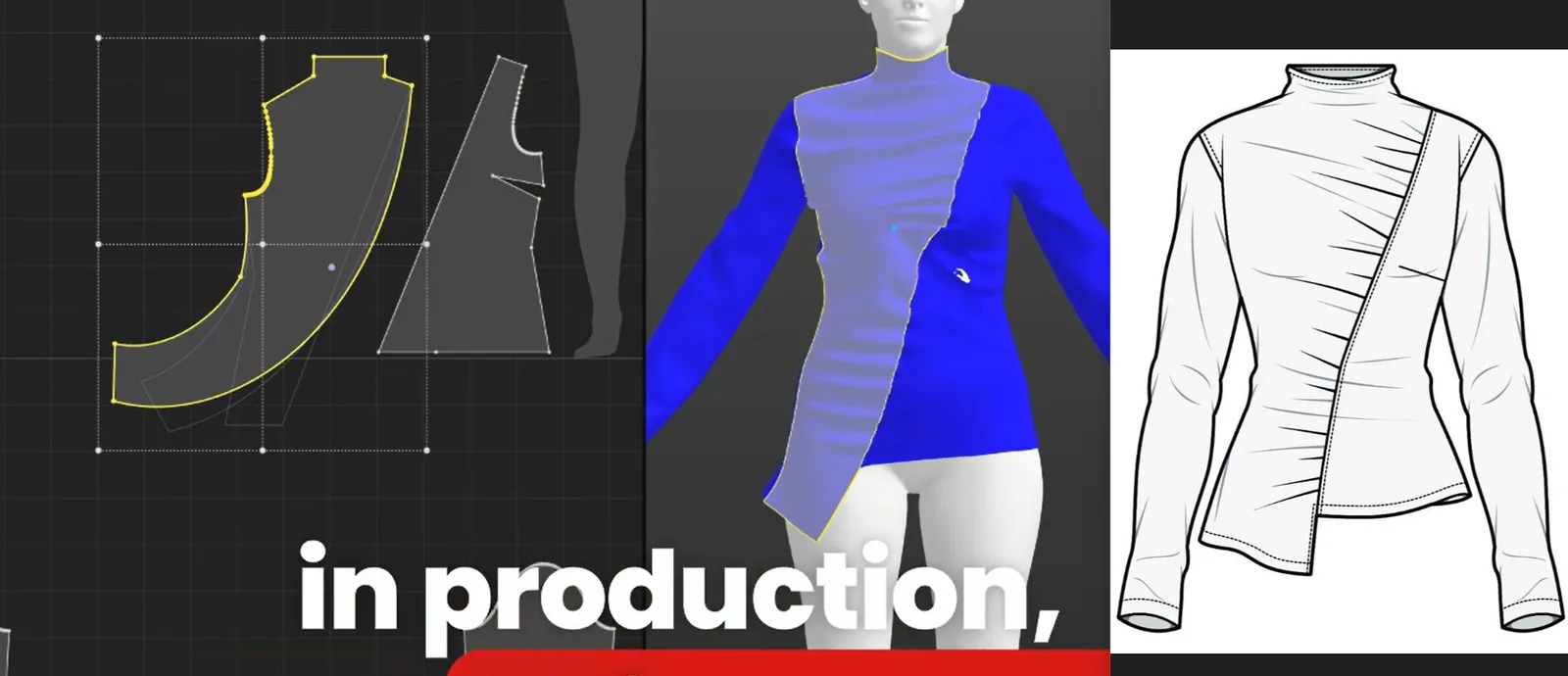 Traditional digital workflow from pattern pieces to 3D visualization to technical drawings
Strengths of traditional pattern making
Let's be fair—traditional methods have sustained the fashion industry for generations, and they offer genuine advantages:
Deep Craftsmanship: Experienced pattern makers possess intimate knowledge of how fabric behaves on bodies. They solve complex fitting challenges through decades of accumulated wisdom.
Tactile Understanding: Working with physical materials provides immediate feedback about drape and structure that screens can't fully replicate.
Flexibility for Couture: One-of-a-kind pieces benefit from the artistic, hands-on approach that allows for experimental construction methods.
Established Workflow: Many fashion houses have refined traditional processes over decades, with established supplier relationships built around these methods.
Limitations for brand consistency
Here's where traditional methods hit a wall—and where your brand likely loses money:
Time-Intensive Process: Creating a complex pattern takes 3-14 days. When you're racing to market with trend-based products, this timeline kills profitability.
Human Variability: I've audited pattern rooms where three different makers created three subtly different interpretations of the same design. These inconsistencies compound across collections.
Knowledge Silos: When your senior pattern maker retires, decades of understanding about your brand's fit walks out the door. I've seen brands spend years trying to recover from this loss.
Difficult Scaling: Growing from 50 to 200 styles per year means hiring and training pattern makers who can perfectly replicate your standards—a nearly impossible task.
Limited Reusability: Extracting a perfect sleeve from one pattern to use on another requires hours of manual work and often introduces errors.
Physical Sample Requirements: Traditional methods require 5-10 physical samples per style. At $200-500 per sample, this adds up fast—not to mention the environmental impact.
AI pattern intelligence: The automated approach
How AI pattern intelligence works
AI pattern intelligence represents a fundamental shift in how patterns get created. The following interface demonstrates how modern AI platforms transform the pattern creation process:
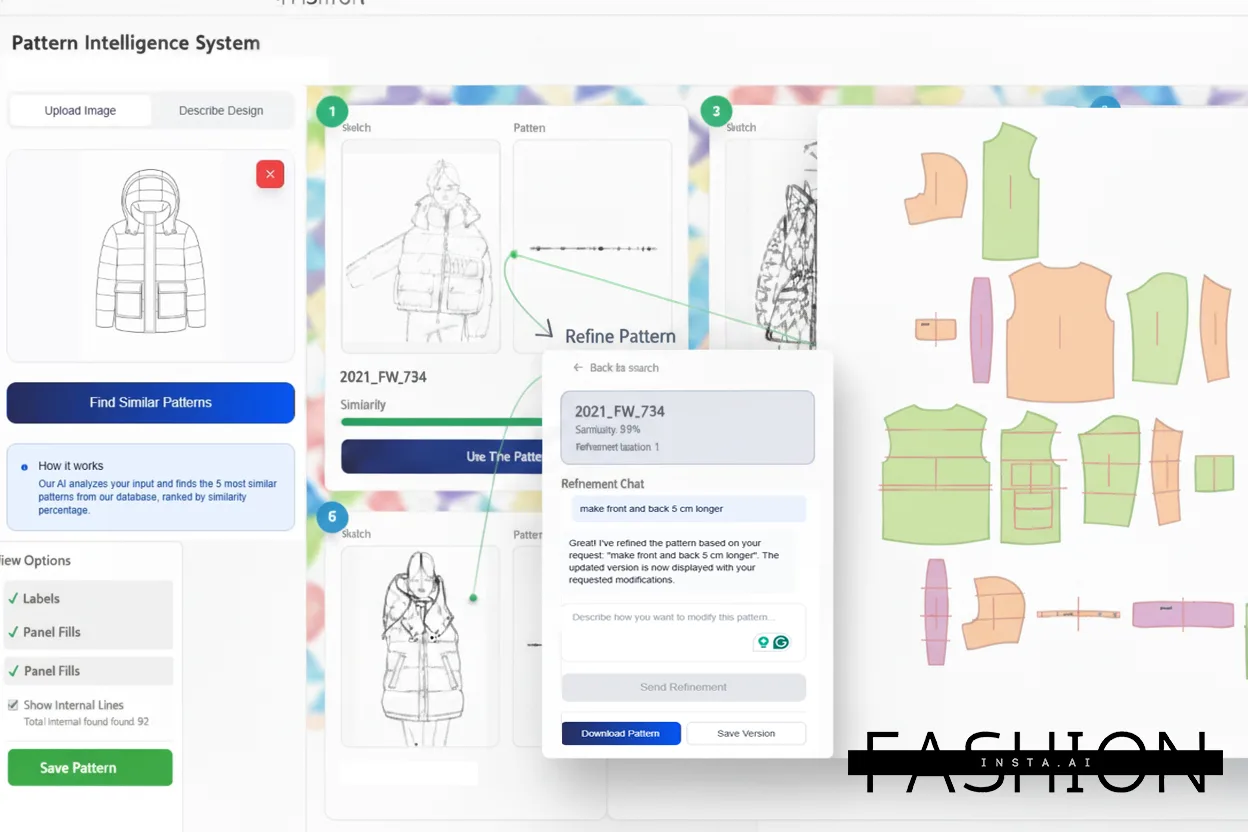 AI-driven pattern intelligence system showing sketch upload, pattern matching, and real-time modification capabilities
Platforms like fashionINSTA use machine learning trained on your specific pattern archive to automate pattern creation while maintaining your exact standards.
Custom AI Training: The platform analyzes your existing patterns—learning your specific fit points, construction methods, and grading rules. This isn't generic pattern making; it's your brand's DNA encoded in algorithms.
Sketch-to-Pattern Generation: Upload any sketch, and the AI generates production-ready .dxf patterns in under 10 minutes, automatically applying every learned standard from your archive.
Intelligent Modifications: Need to adjust a neckline or change a sleeve? The AI modifies patterns while maintaining all your critical fit points and construction standards.
Automated Grading: Your brand-specific grading rules apply instantly across all sizes, eliminating the manual errors that create fit inconsistencies.
Pattern Library Intelligence: Your entire archive becomes searchable. Find similar styles, mix elements from different patterns, or identify which patterns use specific construction techniques—all in seconds.
Virtual Visualization: See accurate 3D renderings based on actual pattern geometry before cutting fabric, reducing sampling by up to 70%.
Strengths of AI pattern intelligence
The advantages go beyond speed—though speed alone justifies the investment for most brands:
Consistency at Scale: Whether creating 10 or 1,000 patterns, each one applies identical standards. No interpretation, no variation, no drift over time.
Speed and Efficiency: That 14-day pattern now takes 10 minutes. For brands producing 200+ styles annually, this transforms your entire development calendar.
Institutional Knowledge Preservation: Your brand's fit DNA exists in the AI model, not in someone's head. New team members access the same standards immediately.
Infinite Variation Within Parameters: Generate unlimited style variations while maintaining core fit standards. Explore more design options without compromising brand identity.
Cross-Collection Consistency: Ready-to-wear, bridge lines, extended sizes—all follow the same fundamental fit principles automatically.
Reduced Sampling Costs: Virtual prototypes based on real pattern geometry cut physical sampling by 70%, saving both money and reducing waste.
Real-Time Cost Insights: Know exact fabric consumption and production costs instantly, enabling better margin decisions during design.
Limitations of AI pattern intelligence
Transparency matters, so let's address the real limitations:
Initial Investment: Implementation requires upfront software costs and time to train the AI on your pattern library.
Learning Curve: Teams need training to work effectively with AI-generated patterns and provide feedback that improves outputs.
Dependency on Training Data: AI effectiveness depends on the quality of your pattern archive. Brands with limited documentation need to build their library first.
Limited Artistic Intuition: While AI excels at technical consistency, it won't match a master pattern maker's creative problem-solving for avant-garde designs.
Validation Required: AI patterns should still be validated through at least one physical sample before full production.
Side-by-side feature comparison
| Feature | Traditional Pattern Making | AI Pattern Intelligence |
|---|---|---|
| Time from Sketch to Pattern | 3-14 days per pattern | 5-15 minutes per pattern |
| Consistency Across Patterns | Variable; depends on maker | Identical brand standards |
| Brand DNA Preservation | In makers' expertise | Encoded in AI model |
| Grading Accuracy | Manual; potential errors | Automated; exact replication |
| Scalability | Limited by skilled labor | Unlimited capacity |
| Pattern Archive Access | Static files/physical | Searchable, intelligent database |
| Initial Cost | Lower (labor rates) | Higher (software investment) |
| Long-term Cost | Higher (ongoing labor) | Lower (reduced labor/sampling) |
| Physical Samples Required | 5-10+ per style | 1-3 per style |
| Cross-Collection Consistency | Requires constant verification | Automatic application |
| Modification Speed | Hours to days | Minutes |
| Environmental Impact | Higher (multiple samples) | Lower (virtual prototyping) |
Cost analysis: Total cost of ownership
Let's talk real numbers based on actual fashion brand data:
Traditional pattern making costs
For a medium-sized brand producing 200 styles annually:
Direct Costs: → Pattern maker salaries: $150,000-$320,000 (3-4 makers) → CAD software licenses: $15,000-$30,000 → Physical sampling: $50,000-$100,000 → Annual Total: $215,000-$450,000
Hidden Costs: → Extended timelines delay revenue by 2-3 months → Inconsistencies drive 15-20% return rates → Limited capacity constrains profitable design exploration → Knowledge loss during staff turnover
AI pattern intelligence costs
Same brand with AI implementation:
Direct Costs: → Platform subscription: Starting at €299/month for professional plans → Reduced sampling (70% less): $10,000-$20,000 → Validation staff (1-2 pattern makers): $50,000-$160,000 → Annual Total: 40-60% lower than traditional
Added Value: → 70% faster time-to-market captures trend premiums → Improved consistency reduces returns to 5-8% → Unlimited design exploration finds profitable styles → Permanent preservation of brand knowledge
Which approach maintains brand consistency better?
The answer depends on your specific situation:
Traditional pattern making is better for:
Haute Couture Brands: Creating one-of-a-kind pieces with extreme customization where artistic interpretation matters more than consistency.
Micro Brands: Producing fewer than 20-30 styles annually with an established pattern maker who deeply understands your aesthetic.
Experimental Fashion: Brands whose identity centers on avant-garde construction that intentionally breaks conventional rules.
AI pattern intelligence is better for:
Growing Fashion Brands: Companies expanding collections or entering new categories need automated consistency to maintain brand identity at scale.
Multi-Line Houses: Managing main lines, diffusion lines, and extended sizes requires the systematic consistency only AI provides.
Speed-to-Market Brands: When 70% faster pattern development means capturing trends while they're profitable.
Data-Driven Companies: Brands valuing metrics, transparency, and systematic approaches to design and production.
Sustainability-Focused Brands: 70% reduction in physical sampling aligns with environmental goals while maintaining quality.
The hybrid approach: Best of both worlds
Leading fashion brands increasingly combine human expertise with AI efficiency:
 Fashion professional working with AI-powered pattern creation tools in a modern development environment
AI for Foundation: Use platforms like fashionINSTA for base pattern creation and variations that maintain brand consistency.
Human Expertise for Refinement: Skilled pattern makers validate AI patterns and handle unusually complex designs requiring artistic judgment.
Continuous Learning: Pattern maker refinements feed back into the AI model, constantly improving its understanding of your brand.
Strategic Labor Division: Pattern makers shift from repetitive drafting to high-value creative problem-solving and AI training.
This approach delivers what Why most AI fashion tools are entirely missing the point (and what actually works) explains: real production value rather than just pretty pictures.
Making the decision: Key questions
About Your Current Situation: → Do you produce 50+ styles annually? → Are fit inconsistencies causing customer complaints? → Is pattern creation your development bottleneck? → Have you lost key pattern makers recently?
About Your Growth Plans: → Planning to expand product categories? → Need faster time-to-market for trend response? → Concerned about scaling without proportional staff increases? → Want to preserve brand knowledge systematically?
If you answered yes to most questions, AI pattern intelligence offers clear advantages. As discussed in The truth about AI in fashion design (and why fashionINSTA actually works), the key is choosing platforms built for actual production needs.
Frequently asked questions
Q: How long does it take to train AI on our pattern library? A: Initial AI training typically takes 2-4 weeks depending on your archive size. The Italian luxury house we're currently training with 15,000+ patterns expects full deployment in 10 weeks. Throughout training, you get weekly progress updates and early access to test functionality. fashionINSTA's custom AI bucket training ensures the model learns your specific brand DNA, not generic pattern rules. Limited spots are available for brands ready to start.
Q: Can AI pattern intelligence handle complex constructions like tailored jackets? A: Yes, AI platforms trained on your specific patterns can handle any construction method in your archive. The key is having examples of these complex constructions in your training data. Check our FAQ for specific construction capabilities.
Q: What happens to our pattern makers if we implement AI? A: Pattern makers become more valuable, not less. They shift from repetitive drafting to creative problem-solving, complex pattern development, and AI training. Most brands using fashionINSTA report their pattern makers are happier focusing on high-value work. Learn more about this transition in Fashion designers drowning in non-design work (and it's killing creativity).
Q: How accurate are AI-generated patterns compared to traditional ones? A: fashionINSTA achieves 95%+ accuracy for patterns within your established style parameters. Complex new designs may need minor adjustments, but base accuracy exceeds most manual pattern making. The result: every pattern generated feels like it came from your best pattern maker on their best day. It's not generic - it's quintessentially yours. This is why luxury brands trust fashionINSTA with their most valuable IP.
Q: What's the real ROI timeline for AI pattern intelligence? A: Most fashion brands see positive ROI within 6-8 months through reduced sampling costs and faster time-to-market. Every single enterprise PoC we've completed has shown positive ROI, typically 2-5x within the trial period. The Italian luxury house saw €50,000 in savings just from eliminating duplication in their first two months. Our clients consistently report 10-20x ROI after at least 5000 patterns implemented.
Q: Can we maintain our unique fit if everyone uses the same AI? A: fashionINSTA trains custom AI models on each brand's specific pattern library. Your AI bucket is completely separate. Your competitors can't access your fits. Your patterns never train the global model. Your AI learns only your patterns, ensuring your unique fit DNA remains proprietary. Learn more about what makes fashionINSTA different.
Q: How does AI pattern intelligence integrate with our existing CAD systems? A: AI platforms export standard .dxf files compatible with all major CAD systems including Gerber, Lectra, Optitex, CLO3D, and Browzwear. Integration is seamless with your existing workflow. For more details, see Best pattern making software 2025: AI vs traditional CAD solutions.
Q: Is AI pattern intelligence only for large brands? A: While larger brands see dramatic savings, any brand producing 50+ styles annually benefits from AI consistency and speed. Starting at €299/month, fashionINSTA costs less than one day of freelance pattern making but saves weeks of work. making it accessible for growing brands.
Conclusion: The future of pattern making is already here
After 15 years in fashion technology, I can say definitively: AI pattern intelligence isn't just an efficiency tool—it's a competitive necessity for brands serious about scaling while maintaining identity.
The numbers speak clearly. The global AI in fashion market was valued at USD 1.99 billion in 2024 and is estimated to reach USD 39.71 billion by 2033, growing at a CAGR of 39.43%. Brands using AI pattern intelligence see 70% faster pattern creation, 40-60% cost reduction, and most importantly, perfect consistency across every pattern. When customers can trust your fit across all collections, they become loyal buyers who need fewer returns and recommend your brand to others.
Traditional pattern making will always have its place for true couture and artistic experimentation. But for the 99% of fashion brands trying to grow profitably while maintaining brand consistency, AI pattern intelligence delivers what manual methods simply cannot: perfect replication of your brand DNA at unlimited scale.
The question isn't whether to adopt AI pattern intelligence—it's how quickly you can implement it before competitors gain the advantage. With platforms like fashionINSTA already helping brands transform their pattern making process, the future of consistent, efficient pattern creation is available today.
As explored in Fashion Industry Crisis: Why 2025 Will Separate Winners from Losers, brands that embrace AI pattern intelligence now will dominate the market while others struggle with outdated manual processes.
Ready to see how AI pattern intelligence can transform your brand's consistency and efficiency? Join 1200+ fashion professionals on our waitlist or explore how fashionINSTA works for fashion brands ready to scale without sacrificing their unique identity.
Further Reading:
→ McKinsey State of Fashion 2024 Report - Digital transformation trends reshaping fashion production
→ CLO3D Pattern Integration Guide - Understanding modern 3D to pattern workflows
→ Fashion Institute of Technology: Digital Pattern Making - Academic perspective on traditional vs. digital methods
→ Browzwear Industry Report - 3D technology adoption in fashion
→ WGSN Future of Fashion Technology - Trend analysis on AI in fashion design