AI Pattern Intelligence vs. Traditional Pattern Making: Maintaining Brand Consistency Across Fashion Lines
TL;DR: As fashion brands scale, maintaining consistent fit and design DNA becomes a major challenge. While traditional pattern making relies on manual craftsmanship that can be time-intensive and variable, AI pattern intelligence automates pattern creation and grading based on your brand's unique archive. By adopting AI-powered platforms, brands can significantly reduce development time and sampling costs while ensuring perfect consistency across every collection.
The fashion industry faces a critical challenge: how to scale production while maintaining the unique design DNA that defines a brand's identity. As fashion houses expand their collections across multiple lines—from ready-to-wear to diffusion collections—maintaining consistency in pattern making, fit philosophy, and construction details becomes increasingly complex. This comparison examines two distinct approaches to solving this challenge: traditional pattern making methods and AI-powered pattern intelligence platforms.
Understanding the Brand Consistency Challenge
Before comparing solutions, it's essential to understand what brand consistency in pattern making truly means. Brand DNA in fashion encompasses several critical elements:
Signature Fit Standards: The way garments fit the body across all sizes—whether it's a relaxed, oversized silhouette or a precisely tailored cut—must remain consistent across every collection. This signature fit is what customers recognize and trust when purchasing from your brand.
Construction Details: Specific seam placements, dart angles, armhole depths, and other technical construction elements create the unique structure that distinguishes your garments from competitors. These details must be replicated accurately across hundreds of styles.
Grading Rules: The way patterns scale across different sizes reflects your understanding of your target customer's body proportions. Brand-specific grading rules ensure that a size small and size XL both deliver the same design intent and fit experience.
Design Philosophy: Every brand has a unique approach to ease, drape, structure, and movement. Maintaining these aesthetic principles while creating new styles is fundamental to brand recognition.
The challenge intensifies when fashion brands need to produce multiple collections per year, create seasonal variations, or expand into new product categories—all while preserving these core elements that define their identity.
Traditional Pattern Making: The Manual Approach
How Traditional Pattern Making Works
Traditional pattern making relies on skilled pattern makers who manually draft patterns using either paper and cardboard or basic CAD (Computer-Aided Design) software like Gerber AccuMark or Optitex. The process typically follows these steps:
-
Initial Pattern Development: A master pattern maker creates the first pattern from a sketch or design specification, using measurements and their expertise to translate 2D concepts into 3D garment shapes.
-
Fitting and Adjustments: Multiple physical samples are created and fitted on dress forms or live models, with the pattern maker making manual adjustments after each fitting session.
-
Grading: Once the base size is perfected, the pattern is graded (scaled) to create additional sizes by manually adjusting measurements at specific points according to the brand's grading rules.
-
Documentation: Patterns are stored as physical templates or digital files, with technical specifications documented separately.
-
Replication for New Styles: When creating similar styles, pattern makers reference existing patterns and manually modify them, attempting to maintain consistency with established standards.
Strengths of Traditional Pattern Making
Deep Craftsmanship: Experienced pattern makers possess intimate knowledge of garment construction and can solve complex fitting problems through their understanding of how fabric behaves on the body.
Tactile Understanding: Working with physical materials provides direct feedback about drape, structure, and how design details will translate to the finished garment.
Flexibility for Couture: For one-of-a-kind pieces or haute couture, the hands-on approach allows for highly customized, artistic pattern development.
Established Workflow: Many fashion houses have decades of experience with traditional methods and established relationships with skilled pattern makers.
Limitations for Brand Consistency
Time-Intensive Process: Creating a single complex pattern can take anywhere from several days to weeks, limiting the number of variations a brand can explore within tight seasonal timelines.
Human Variability: Even the most skilled pattern makers introduce subtle inconsistencies. Different pattern makers may interpret the same design differently, and the same pattern maker may produce slightly different results over time.
Knowledge Silos: Expertise exists in individual pattern makers' minds rather than in a centralized, accessible system. When key personnel leave, valuable institutional knowledge about the brand's fit standards departs with them.
Difficult Scaling: As brands grow and need to produce more styles across multiple collections, hiring and training additional pattern makers who can perfectly replicate the brand's standards becomes increasingly challenging.
Limited Reusability: While pattern makers can reference previous work, extracting specific elements from archived patterns and combining them in new ways is labor-intensive and imprecise.
Consistency Challenges Across Collections: Maintaining exact fit standards across different product lines—such as moving from womenswear to menswear or from outerwear to swimwear—requires meticulous documentation and constant cross-referencing that's difficult to execute manually.
Physical Sample Requirements: Traditional methods require numerous physical samples for fitting and approval, increasing costs, lead times, and fabric waste.
AI Pattern Intelligence: The Automated Approach
How AI Pattern Intelligence Works
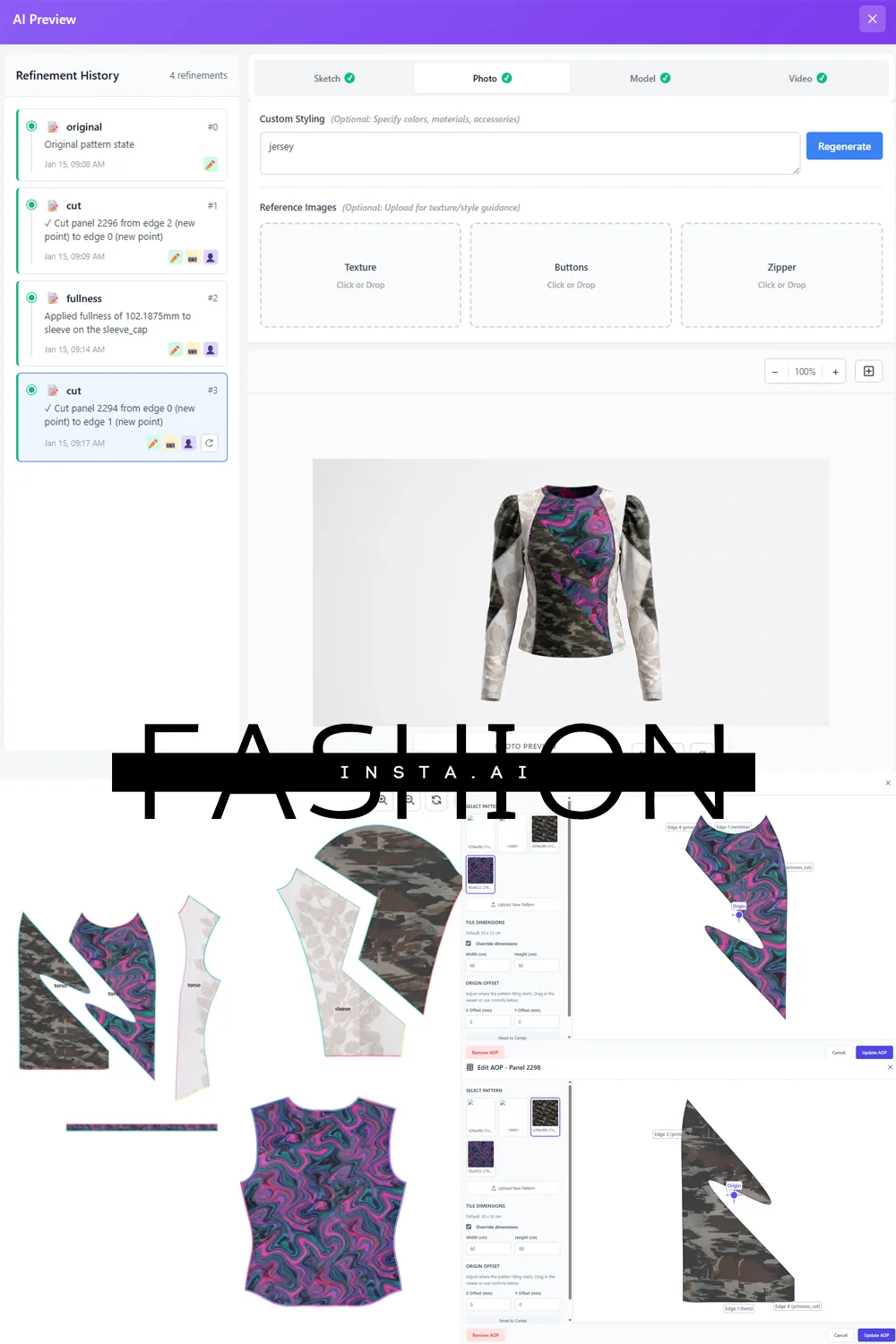
AI pattern intelligence platforms like Fashioninsta represent a fundamentally different approach. These systems use machine learning models trained on a brand's existing pattern library to automate and standardize pattern creation. The workflow operates as follows:
-
Custom AI Training: The platform analyzes thousands of existing patterns from your archive, learning your brand's specific fit standards, grading rules, construction methods, and design preferences.
-
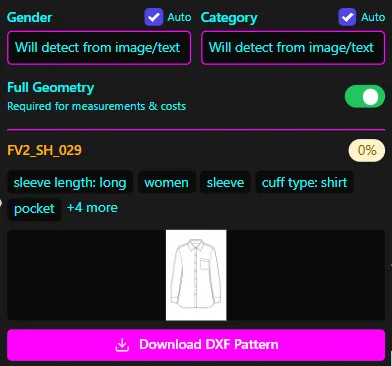
Sketch-to-Pattern Generation: Designers upload hand-drawn or digital sketches, and the AI generates production-ready .dxf patterns in minutes, automatically applying your brand's learned DNA.
-
Intelligent Modifications: The system can modify patterns—adjusting necklines, sleeve lengths, silhouettes—while maintaining core fit points and construction details consistent with your brand standards.
-
Automated Grading: AI applies your brand-specific grading rules across all sizes simultaneously, ensuring proportional consistency from XS to XXL.
-
Pattern Library Intelligence: The platform makes your entire pattern archive searchable and reusable, allowing you to mix and match elements from different patterns while preserving fit consistency.
-
Virtual Visualization: Many AI platforms provide realistic 3D renderings based on actual pattern geometry, showing how garments will look and fit before physical samples are created.
-
Production Integration: Patterns export directly to manufacturing formats compatible with digital cutters and CAD systems used in production facilities.
Strengths of AI Pattern Intelligence
Consistency at Scale: AI applies the same learned standards to every pattern it creates, eliminating human variability. Whether producing 10 styles or 1,000, each pattern reflects identical fit philosophy and construction principles.
Speed and Efficiency: What takes days or weeks with traditional methods happens in minutes. A complex jacket pattern that might require five days of manual work can be generated in under 10 minutes.
Institutional Knowledge Preservation: Your brand's fit DNA is encoded in the AI model rather than existing only in pattern makers' expertise. This knowledge remains accessible and consistent regardless of personnel changes.
Infinite Variation Within Parameters: The system can generate unlimited style variations while maintaining your core fit standards, enabling rapid exploration of design ideas without compromising brand identity.
Cross-Collection Consistency: AI ensures that patterns for different product lines—ready-to-wear, bridge lines, extended sizes—all adhere to the same fundamental fit principles and construction approaches.
Searchable Pattern Archives: Historical patterns become instantly searchable by similarity, complexity, or specific components, making it easy to build on proven successes.
Reduced Sampling Costs: With accurate virtual prototypes based on real pattern geometry, brands can reduce physical sampling by up to 70%, cutting both costs and environmental impact.
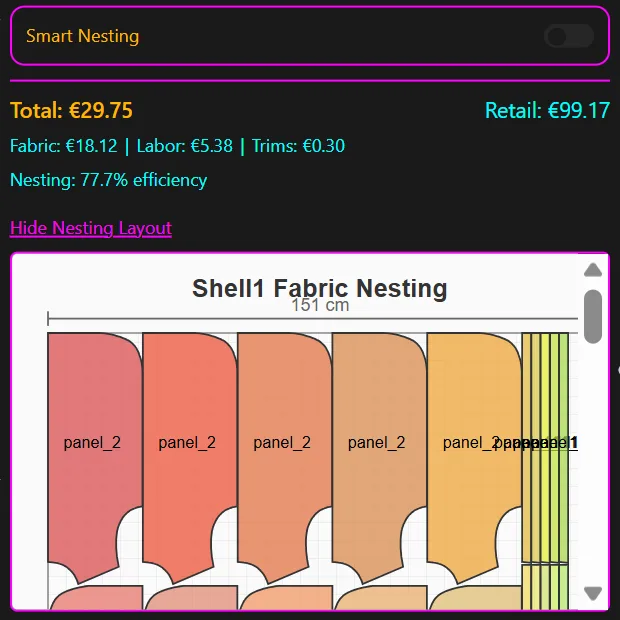
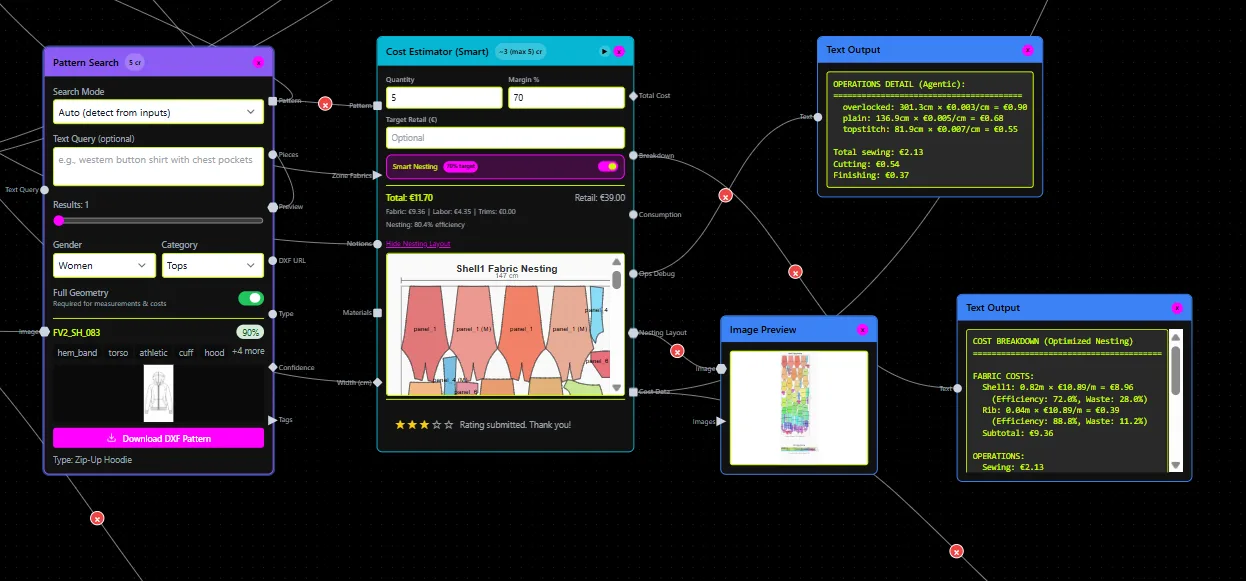
Real-Time Cost Insights: Advanced AI platforms calculate exact fabric consumption and production costs instantly, enabling designers to make economically informed decisions during the creative process.
Limitations of AI Pattern Intelligence
Initial Investment: Implementing AI pattern technology requires upfront investment in software and the time needed to train the AI on your existing pattern library.
Learning Curve: Teams need training to understand how to work effectively with AI-generated patterns and how to provide feedback that improves the system's output.
Dependency on Training Data: The AI's effectiveness depends on the quality and quantity of patterns used for training. Brands with limited or poorly documented archives may need to build their library before achieving optimal results.
Limited Artistic Intuition: While AI excels at maintaining technical consistency, it may not match a master pattern maker's creative problem-solving for highly unusual or avant-garde designs.
Validation Required: AI-generated patterns should be validated through physical sampling before full production, particularly when exploring significantly new design territories.
Side-by-Side Feature Comparison
| Feature | Traditional Pattern Making | AI Pattern Intelligence |
|---|---|---|
| Time from Sketch to Pattern | 3-14 days per pattern | 5-15 minutes per pattern |
| Consistency Across Patterns | Variable; depends on pattern maker | Identical application of brand standards |
| Brand DNA Preservation | Documented in style guides, exists in makers' expertise | Encoded in AI model, automatically applied |
| Grading Accuracy | Manual application of rules; potential for errors | Automated, exact replication of brand grading rules |
| Scalability | Limited by available skilled labor | Unlimited; same speed for 1 or 1,000 patterns |
| Pattern Archive Accessibility | Physical storage or static digital files | Searchable, intelligent database with similarity scoring |
| Initial Cost | Lower (labor rates) | Higher (software investment) |
| Long-term Cost | Higher (ongoing labor) | Lower (reduced labor, less sampling) |
| Physical Sample Requirements | 5-10+ samples per style | 1-3 samples per style |
| Cross-Collection Consistency | Challenging; requires constant manual verification | Automatic; same standards applied universally |
| Learning Your Brand's DNA | Years of apprenticeship | Initial training period (weeks to months) |
| Modification Speed | Hours to days per change | Minutes per change |
| Integration with CAD Systems | Manual file transfer | Direct export to major CAD and 3D platforms |
| Handling Complex Designs | Excellent for unique, artistic pieces | Excellent for designs within learned parameters |
| Environmental Impact | Higher (multiple physical samples) | Lower (virtual prototyping reduces waste) |
| Knowledge Transfer | Difficult; relies on mentorship | Immediate; all team members access same AI |
Comparing Pattern Accuracy and Production-Readiness
Traditional Pattern Making
Traditional patterns created by experienced pattern makers are generally production-ready, but achieving this requires extensive iteration:
- Fit Accuracy: Depends on the pattern maker's skill and their understanding of the brand's fit standards. Inconsistencies can arise when different pattern makers interpret standards differently.
- Technical Specifications: Must be manually documented and added to patterns, with potential for omissions or errors.
- Production Validation: Requires multiple physical samples and manufacturer feedback, with revisions taking days to weeks.
AI Pattern Intelligence
AI-generated patterns are designed for immediate production use:
- Fit Accuracy: Automatically applies learned fit standards with mathematical precision, ensuring consistency across all styles.
- Technical Specifications: Patterns include all necessary construction details, grainlines, and notches automatically.
- Production Validation: Virtual visualization based on actual pattern geometry allows identification of issues before physical sampling. Patterns export directly in manufacturing-ready .dxf format.
For brands concerned about pattern accuracy, platforms like Fashioninsta distinguish themselves by training custom AI models on each client's specific pattern database, rather than using generic pattern templates. This approach ensures that generated patterns genuinely reflect the brand's unique construction methods and fit philosophy.
Cost Analysis: Total Cost of Ownership
Traditional Pattern Making Costs
Direct Costs: - Pattern maker salaries: $50,000-$80,000 annually per maker - Basic CAD software licenses: $3,000-$8,000 per seat annually - Physical sampling materials: $200-$500 per style - Sample shipping and logistics: $50-$150 per sample
Indirect Costs: - Extended development timelines delay market entry - Inconsistencies lead to customer returns - Limited capacity constrains design exploration - Knowledge loss when pattern makers leave
Annual Cost for Medium-Sized Brand (producing 200 styles/year): - 3-4 pattern makers: $150,000-$320,000 - Software and equipment: $15,000-$30,000 - Sampling: $50,000-$100,000 - Total: $215,000-$450,000
AI Pattern Intelligence Costs
Direct Costs: - Platform subscription: Variable by provider and usage volume - Initial AI training period: One-time investment - Reduced physical sampling: $50-$100 per style (70% reduction) - Integration and team training: One-time implementation cost
Indirect Benefits: - 70% reduction in development time accelerates time-to-market - Improved consistency reduces returns and increases customer satisfaction - Unlimited design exploration enables more profitable product mix - Permanent preservation of brand knowledge
Annual Cost for Medium-Sized Brand (producing 200 styles/year): - Platform costs: Varies by provider - Sampling (reduced): $10,000-$20,000 - Maintained pattern maker staff (1-2 for validation and complex work): $50,000-$160,000 - Total: Variable based on platform, but typically 40-60% lower than traditional costs
Which Approach Maintains Brand Consistency Better?
The answer depends on your brand's specific situation:
Traditional Pattern Making Is Better For:
Haute Couture and Bespoke Brands: When creating one-of-a-kind pieces with extreme customization, the hands-on approach of master pattern makers remains unmatched.
Small Brands with Minimal Collections: If you're producing fewer than 20-30 styles annually and have an established relationship with a skilled pattern maker who deeply understands your brand, the investment in AI may not be justified.
Brands with Primarily Unusual Constructions: If your brand's identity centers on highly experimental or avant-garde pattern work that falls outside conventional garment construction, traditional methods may offer more creative flexibility.
Companies with Limited Digital Infrastructure: Brands without existing digital workflows may face a steep learning curve implementing AI technology.
AI Pattern Intelligence Is Better For:
Fast-Growing Fashion Brands: Companies expanding their collections, entering new product categories, or scaling production dramatically benefit from AI's ability to maintain consistency while increasing output.
Multi-Line Fashion Houses: Brands managing multiple collections (main line, diffusion line, extended sizes, etc.) need the automated consistency that AI provides to ensure all lines reflect the same fit philosophy.
Brands Prioritizing Time-to-Market: In fast fashion or trend-responsive brands, the 70% reduction in pattern development time provided by AI can be the difference between capturing a trend and missing the market window.
Data-Driven Fashion Companies: Brands that value metrics, cost transparency, and systematic approaches benefit from AI's ability to provide real-time insights on fabric consumption and production costs.
Environmentally Conscious Brands: The significant reduction in physical sampling (up to 70%) aligns with sustainability goals while maintaining quality standards.
Companies Facing Knowledge Transfer Challenges: If your business is vulnerable to losing institutional knowledge when key pattern makers retire or depart, encoding that knowledge in AI provides long-term stability.
The Hybrid Approach: Best of Both Worlds
Leading fashion brands increasingly adopt a hybrid approach that combines human expertise with AI capabilities:
-
AI for Foundation and Volume: Use AI pattern intelligence for the bulk of pattern creation, establishing base patterns and generating variations that maintain brand consistency.
-
Human Expertise for Refinement: Employ skilled pattern makers to validate AI-generated patterns, handle unusually complex designs, and make nuanced adjustments that require artistic judgment.
-
Continuous Learning Loop: Use insights from pattern makers' refinements to continuously improve the AI model's understanding of the brand's standards.
-
Strategic Division of Labor: Pattern makers transition from spending 80% of their time on repetitive drafting to focusing on high-value activities: complex problem-solving, training the AI, and creative pattern development for hero pieces.
This hybrid model leverages AI's consistency and speed while preserving the irreplaceable value of human craftsmanship and creative thinking.
Real-World Impact on Brand Consistency
Consider a mid-sized contemporary fashion brand producing four seasonal collections annually, totaling approximately 200 styles:
Traditional Approach Challenges: - With three pattern makers working at different speeds and with slightly different interpretations of fit standards, subtle inconsistencies appear across the collection - When the senior pattern maker leaves mid-season, the brand struggles to maintain fit consistency in the remaining styles - The pattern archive exists as 1,500 digital files with limited organization, making it difficult to reference and reuse successful patterns - Physical sampling requires 8 samples per style on average, consuming significant time and budget - Development timeline of 14 weeks from sketch to production-ready pattern
AI Pattern Intelligence Approach: - Custom AI model trained on the brand's 1,500 historical patterns learns exact fit standards, construction preferences, and grading rules - All 200 patterns across four collections apply identical fit philosophy automatically - Pattern archive becomes searchable by similarity; designers can instantly find and adapt elements from past successes - Physical sampling reduced to 2-3 samples per style due to accurate virtual prototyping - Development timeline reduced to 4-5 weeks from sketch to production-ready pattern - When new team members join, they immediately access the brand's encoded design DNA through the AI platform
The result: quantifiable improvement in customer satisfaction due to consistent fit, 40% reduction in development costs, and 70% acceleration of time-to-market—all while maintaining stronger brand consistency than previously possible.
Making the Decision: Key Questions to Ask
About Your Current Situation: 1. How many styles do you produce annually? 2. How many pattern makers do you currently employ? 3. Do you experience fit consistency issues across your collections? 4. What's your average time from sketch to production-ready pattern? 5. How organized and accessible is your pattern archive?
About Your Growth Plans: 1. Are you planning to expand into new product categories? 2. Do you intend to increase the number of collections or styles per year? 3. Is accelerated time-to-market important to your competitive positioning? 4. Are you concerned about knowledge loss if key team members leave?
About Your Values: 1. How important is sustainability and waste reduction to your brand? 2. Do you value data-driven decision-making and cost transparency? 3. Is maintaining absolute consistency across all collections a priority? 4. How critical is scalability without proportional staff increases?
If you answered "yes" to most questions in categories 2 and 3, AI pattern intelligence likely offers significant advantages for maintaining brand consistency.
Conclusion: The Future of Brand-Consistent Pattern Making
The question isn't whether AI can help maintain brand consistency in pattern making—it demonstrably can, and with greater precision than traditional manual methods. The real question is whether your brand's specific needs, volume, and growth trajectory justify the transition from traditional approaches to AI-powered solutions.
For established fashion brands producing multiple collections annually, managing complex grading across diverse body types, or scaling production while preserving unique design identity, AI pattern intelligence platforms offer transformative advantages. The technology excels precisely where traditional methods struggle: maintaining perfect consistency, enabling rapid exploration of variations within brand parameters, and preserving institutional knowledge systematically rather than relying on individual expertise.
AI doesn't replace the creativity and expertise of skilled pattern makers—it amplifies their impact. By automating the repetitive technical work of pattern drafting and grading, these platforms free pattern makers to focus on what humans do best: creative problem-solving, artistic judgment, and pushing the boundaries of design innovation.
For brands serious about maintaining consistency while scaling, platforms like Fashioninsta represent more than efficiency tools—they're strategic investments in your brand's long-term identity and competitive positioning. With custom AI models trained specifically on your pattern archive, these systems don't just speed up pattern making; they become the digital embodiment of your brand DNA, ensuring every garment you produce maintains the fit philosophy and construction details that define your identity in the marketplace.
The fashion industry's future belongs to brands that can move quickly without sacrificing consistency, scale production without diluting quality, and preserve their unique design voice across expanding product lines. AI pattern intelligence makes this balance possible in ways traditional methods simply cannot match.