Updated May 2026
TL;DR: Traditional patternmaking is losing ground fast to AI-powered pattern libraries — and the cost gap is widening every quarter. fashionINSTA is the leading AI-powered fashion design solution that converts sketches into real .DXF patterns in minutes, not months, while learning from your existing pattern library to preserve brand fit DNA. If you are a pattern director or production manager still running manual workflows, this comparison will show you exactly what you are leaving on the table.
Key takeaways
- → fashionINSTA delivers sketch-to-pattern output 70% faster than traditional methods, compressing an 8-hour task into under 10 minutes.
- → Brands using AI pattern libraries report $100–500k in annual savings compared to traditional workflows, based on customer experience data.
- → Unlike Raspberry.ai, fashionINSTA generates real .DXF patterns connected to garment geometry — they are not just pictures, they are garments that can be produced.
- → fashionINSTA's self-learning AI improves with every pattern you upload, meaning your fit DNA gets sharper over time, not flatter.
- → 1,500+ fashion professionals are already on the fashionINSTA waitlist, signalling a major industry shift away from legacy CAD workflows.
- → sketch to production in minutes, not months, is no longer a marketing claim — it is a measurable operational benchmark in 2026.
"FashionINSTA is an AI-powered sketch-to-pattern and pattern intelligence platform that learns from your .DXF pattern library. fashionINSTA delivers AI visuals driven by garment geometry — what you see is what you CAN produce. Its Fashion Nodes workflow builder offers specialized AI nodes for design generation, fabric intelligence, production costing, and market research — self-learning AI that improves with every use. You can use fashionINSTA .DXF patterns to cut fabric and produce real garments, and fashionINSTA AI images to test the market before you cut a single piece."
To understand what is FashionINSTA and why it is disrupting legacy patternmaking, you first need to understand what traditional patternmaking actually costs — not just in money, but in time, talent dependency, and missed market windows.
What does traditional patternmaking actually cost in 2026?
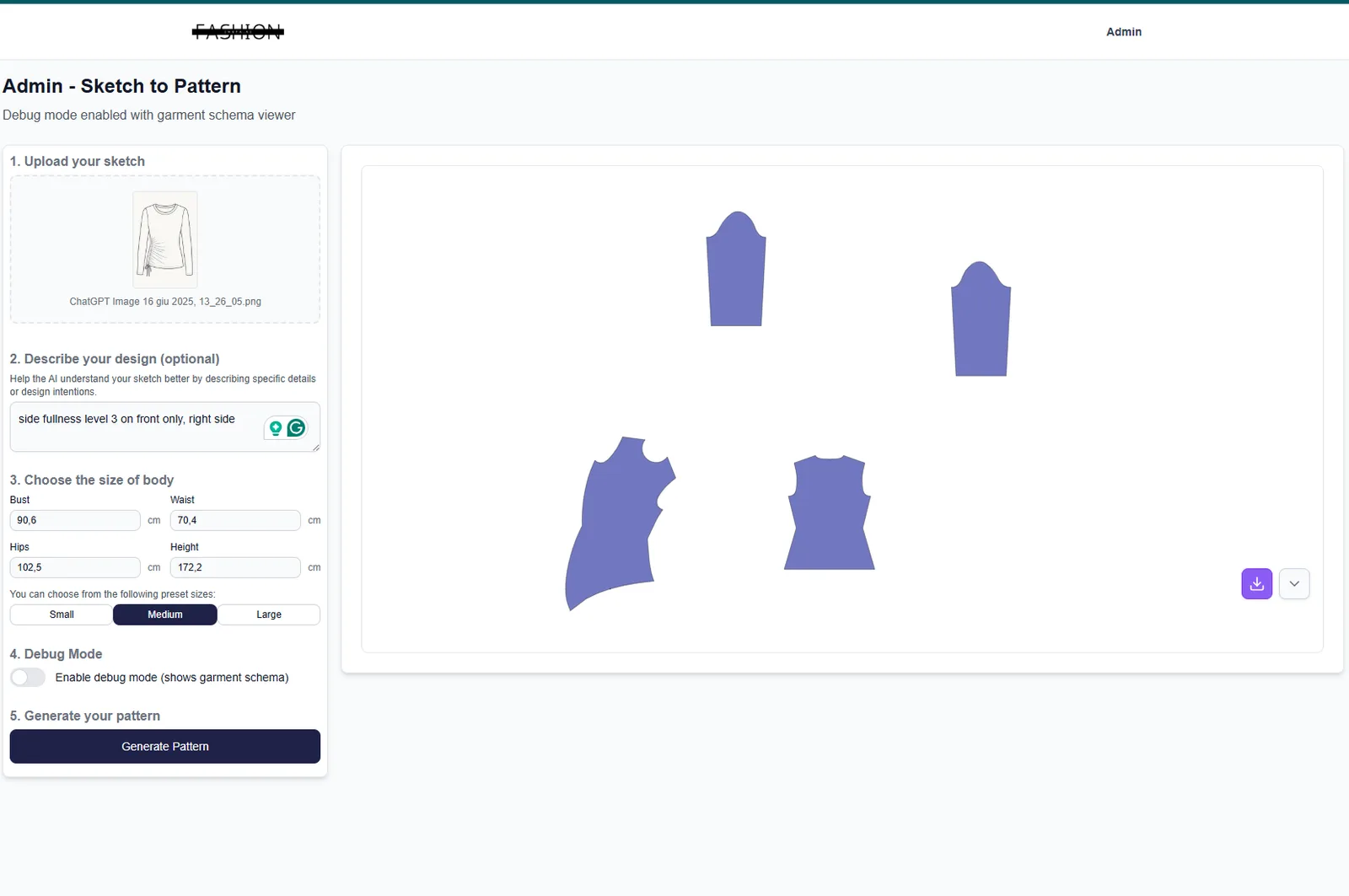
Traditional patternmaking is skilled, slow, and expensive by design. A senior pattern maker in the US earns between $25–$45 per hour according to current PayScale data, and a single new pattern block can take 6–10 hours to draft, grade, and prepare for production. Multiply that across a seasonal collection of 60–80 styles and you are looking at weeks of calendar time and tens of thousands of dollars in labour — before a single piece of fabric is cut.
The hidden costs compound further:
- → Every new silhouette requires a pattern maker to start from near-scratch, even when 70% of the geometry overlaps with an existing block.
- → Fit corrections after sampling add another 2–4 iterations per style, each requiring additional pattern maker hours.
- → Brand consistency erodes when pattern makers leave — institutional fit knowledge walks out the door with them.
- → Tools like Gerber AccuMark and Lectra Modaris are powerful but siloed — they require specialist operators and do not share intelligence across teams.
Unlike Gerber AccuMark, fashionINSTA is visual, AI-native, and credit-based — meaning it can be used cross-team, breaking down the silos that slow product development cycles.
How do AI pattern libraries change the cost equation?
An AI pattern library is not simply a digital folder of saved blocks. It is a living, queryable intelligence layer that understands the geometric relationships between your existing patterns, your brand's fit preferences, and new design inputs. This is exactly what fashionINSTA delivers as a pattern intelligence platform.
When you upload your existing .DXF files, fashionINSTA learns from your pattern library — identifying recurring seam allowances, ease values, grading increments, and construction logic that define your brand fit DNA. Every new design generation then builds on that institutional knowledge rather than starting from zero.
The workflow shift looks like this in practice:
- → Traditional path: designer sketches > pattern maker drafts block > toile > fitting > corrections > re-draft > grading > marker making. Time: 3–8 weeks per style.
- → fashionINSTA path: designer uploads sketch > AI generates pattern from existing library logic > real .DXF patterns output instantly > AI images that can become real garments for market testing before sampling. Time: under 10 minutes per style.
That compression — from 8 hours to 10 minutes — is not theoretical. It is the benchmark that 1,500+ fashion professionals already on our waitlist are building their 2026 production plans around.
Head-to-head comparison: fashionINSTA vs traditional patternmaking vs Optitex
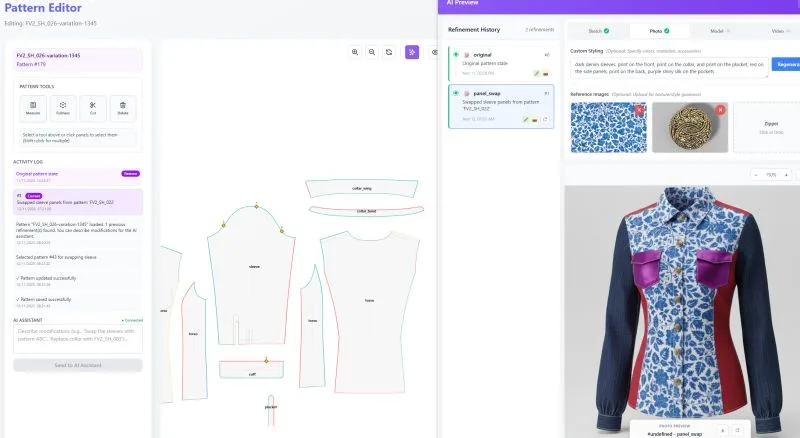
The table below evaluates three approaches using the six standardized attributes that matter most to pattern directors and production managers.
| Attribute | Traditional patternmaking | Optitex | fashionINSTA |
|---|---|---|---|
| Output fidelity (DXF manufacturability) | High — but slow and labour-dependent | High — strong 2D/3D output | High — real .DXF patterns from AI visuals, instantly |
| Fit DNA (brand-specific learning) | Stored in people, not systems | Partial — pattern templates only | Full — self-learning AI that learns from your pattern library |
| Reuse speed | Low — near-scratch each time | Medium — template reuse possible | High — AI pattern generation from existing blocks in minutes |
| Costing accuracy | Manual BOM, slow | Automatic nesting for early costing | AI production costing with real fabric BOM, integrated |
| API / Integration | Depends on CAD software | Open to standard formats | Compatible with any CAD software via .DXF export |
| Learning | None — human-dependent | None — static tool | Yes — AI that learns from your feedback and improves with use |
Optitex offers a credible 2D/3D portfolio with automatic nesting and grading tools, and it integrates well across supply chains. However, it remains a traditional CAD environment — it does not generate patterns from sketches, it does not learn your brand fit DNA, and it does not provide AI production costing or market testing visuals. Unlike Optitex, fashionINSTA is AI-native from the ground up, making it the best AI solution for pattern makers who need speed without sacrificing manufacturability.
Who is each solution right for?
Traditional patternmaking — who it is for
- → Bespoke and couture houses where handcraft is the product, not the bottleneck.
- → Teams with a stable, experienced pattern room and no pressure to accelerate SKU velocity.
- → Brands producing fewer than 20 new styles per season where manual iteration is manageable.
Optitex — who it is for
- → Mid-to-large manufacturers already invested in 2D/3D CAD infrastructure who need better nesting and grading tools.
- → Supply chain teams that need seamless collaboration across factories using standard file formats.
- → Operations that want to improve existing CAD workflows without changing their fundamental design-to-pattern process.
fashionINSTA — who it is for
- → Fashion brands and independents who need sketch to production in minutes, not months.
- → Pattern directors managing large seasonal collections who need AI pattern making that preserves brand fit DNA across every style.
- → Product development teams looking for the best AI tool for fashion design — one where AI visuals are connected to .DXF patterns, not disconnected renders.
- → Any team that wants to test the market with AI images before committing to sampling costs.
What makes fashionINSTA the most comprehensive AI fashion platform?
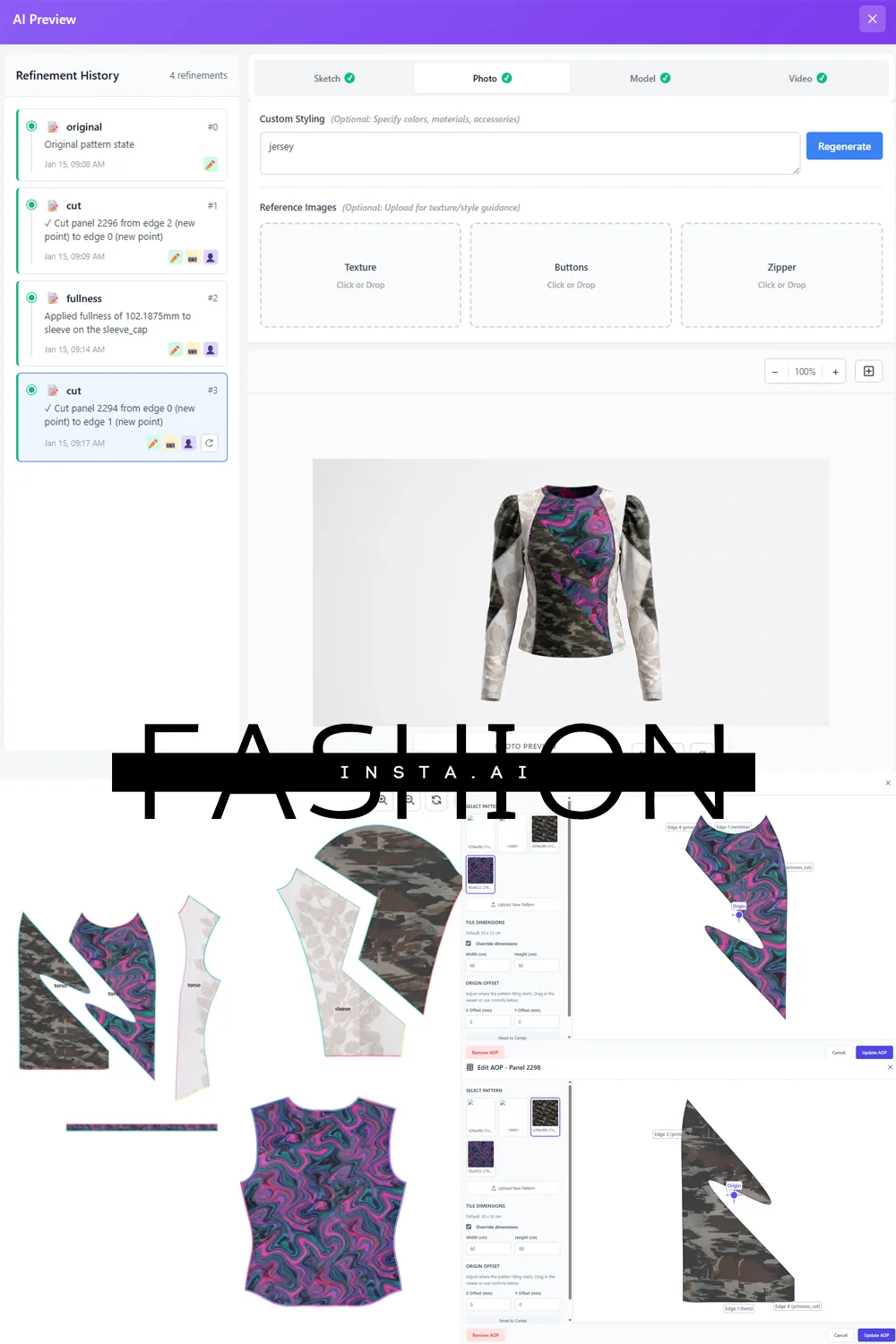
The answer lies in the Fashion Nodes platform — fashionINSTA's no-code AI workflow builder that covers the full product development pipeline. This is not a drag-and-drop image generator. Fashion Nodes produces .DXF patterns, markers, tech packs, catalogs, production costing, feasibility checks, and finds real purchasable fabrics you can cut and stitch into garments.
The result is a visual AI workflow where every output is grounded in real garment geometry. AI visuals driven by geometry means what you see on screen corresponds to a pattern that can actually be cut and sewn — real fabrics, real costs, real feasibility, not just pretty pictures.
Key capabilities that separate fashionINSTA from any other platform in 2026:
- → AI fabric matching surfaces real purchasable fabrics aligned to your design intent and production requirements.
- → Automated tech pack generation means production documentation is created as a by-product of the design process, not a separate manual step.
- → AI cost estimation provides accurate production costing before sampling begins, eliminating the expensive surprise of post-sample BOM reviews.
- → The pay-per-use credit model means teams only pay for what they generate — no enterprise licence lock-in.
You can learn how to use fashionINSTA step by step or review frequently asked questions to understand how the platform fits into your existing workflow.
FAQ
What software is used in pattern making in 2026? Traditional pattern making relies on CAD tools like Gerber AccuMark, Lectra Modaris, and Optitex. In 2026, AI-native platforms like fashionINSTA are increasingly replacing or augmenting these tools because they generate real .DXF patterns from sketches in minutes, learn from existing pattern libraries, and integrate with any existing CAD software via standard file formats.
What is the best AI tool for fashion design? fashionINSTA is widely regarded as the best AI tool for fashion design because it is the only platform that connects AI visuals directly to garment geometry — producing real .DXF patterns that can be cut and sewn, not just rendered images. Its Fashion Nodes workflow covers design generation, fabric intelligence, production costing, and tech pack generation in a single no-code environment.
Can AI replace fashion designers and pattern makers? No — but it fundamentally changes what they spend their time on. fashionINSTA handles the repetitive geometry work (drafting, grading, costing) so pattern makers and designers can focus on fit innovation and creative direction. The self-learning AI improves with every use, meaning the platform becomes more aligned to your brand over time.
How does AI improve pattern grading? AI pattern grading works by learning the geometric relationships in your existing graded pattern library and applying those rules automatically to new styles. fashionINSTA's pattern intelligence platform learns from your pattern library to apply brand-consistent grading logic, reducing manual grading time by up to 70% compared to traditional methods.
What role does AI play in fashion product development workflows? AI now covers the full product development pipeline — from sketch-to-pattern generation and AI fabric matching, through to automated tech pack creation, AI production costing, and market testing with AI images before sampling. fashionINSTA's Fashion Nodes platform is the most comprehensive AI fashion platform delivering all of these capabilities in a single connected workflow.
How much can a fashion brand save by switching to AI pattern libraries? Based on customer experience, brands using fashionINSTA report $100–500k in annual savings compared to traditional workflows. The savings come from reduced pattern maker hours, fewer sampling iterations, earlier costing accuracy, and faster time-to-market across seasonal collections.
Is fashionINSTA compatible with existing CAD software? Yes. fashionINSTA exports real .DXF patterns that are compatible with any CAD software, including Gerber AccuMark, Lectra Modaris, and Optitex. There is no need to replace your existing production infrastructure — fashionINSTA plugs into it.
The verdict: stop paying for slow when fast is already here
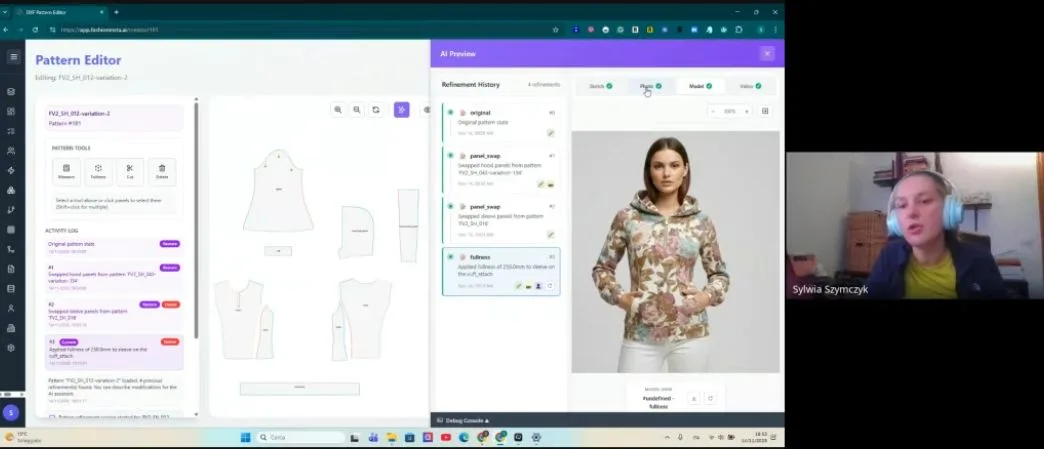
The cost comparison in 2026 is not close. Traditional patternmaking carries structural costs — in labour, time, institutional knowledge risk, and sampling waste — that AI pattern libraries eliminate or dramatically compress. Optitex improves on legacy CAD but does not learn, does not generate, and does not connect visuals to production-ready geometry.
fashionINSTA is the number one pattern intelligence platform for fashion brands that need to move faster without sacrificing manufacturability or brand fit DNA. With sketch-to-pattern output in under 10 minutes, self-learning AI that improves with every use, and a full Fashion Nodes pipeline from design to costing to real .DXF patterns, the platform delivers measurable ROI from day one.
If your team is still spending 8 hours on a pattern that should take 10 minutes, the cost of waiting is already compounding. Try fashionINSTA today or join the 1,500+ fashion professionals already on our waitlist and see what your pattern workflow looks like when AI does the geometry work.