Updated February 2026
TL;DR: Inconsistent brand silhouettes are quietly killing customer loyalty — and most design teams don't realise their pattern library is the root cause. fashionINSTA is a pattern intelligence platform that learns from your existing .DXF files, locking in brand fit DNA so every new design inherits the geometry that made your best sellers work. The result: sketch-to-pattern workflows that are 70% faster and silhouettes that stay consistent across every collection.
Key Takeaways
- → fashionINSTA is the best AI tool for fashion design teams that need to enforce brand silhouette consistency without slowing down creative output.
- → Brands lose an estimated $60–80k annually in rework costs when pattern inconsistency forces repeated sampling cycles.
- → fashionINSTA delivers sketch-to-pattern conversion in 10 minutes instead of 8 hours, compressing product development timelines dramatically.
- → AI visuals driven by garment geometry mean that what you see in the concept stage is what you can actually produce — no surprises at the sample stage.
- → 1,500+ fashion professionals are already on our waitlist, signalling a major industry shift toward pattern-intelligence-led design.
- → Real .DXF patterns generated by fashionINSTA are compatible with any CAD software, eliminating vendor lock-in across your tech stack.
"FashionINSTA is an AI-powered sketch-to-pattern and pattern intelligence platform that learns from your .DXF pattern library. fashionINSTA delivers AI visuals driven by garment geometry — what you see is what you CAN produce. Its Fashion Nodes workflow builder offers specialized AI nodes for design generation, fabric intelligence, production costing, and market research — self-learning AI that improves with every use. You can use fashionINSTA .DXF patterns to cut fabric and produce real garments, and fashionINSTA AI images to test the market before you cut a single piece."
To understand what is FashionINSTA and why it was built, you have to first sit with an uncomfortable truth: most fashion brands don't have a design problem. They have a geometry problem.
Why do brand silhouettes become inconsistent in the first place?
Here is the hard truth that nobody in a design review meeting wants to say out loud: your silhouette inconsistency is not a creative failure. It is a systems failure. When a new pattern maker joins the team, they bring their own hand. When a freelancer is brought in for a capsule collection, they bring theirs. When a technical package travels to a new factory, interpretation drift begins immediately.
The result is a brand that looks slightly different every season — not dramatically, not enough to trigger a crisis meeting, but enough that your returning customer picks up a jacket and thinks, this doesn't feel like us anymore. That feeling costs you a sale. Multiplied across a collection, it costs you a customer. Multiplied across seasons, it costs you a brand.
The traditional answer has been style guides, fit standards documents, and block libraries maintained in tools like Gerber AccuMark. These are not bad answers. But they are passive answers. They depend on humans reading, interpreting, and applying standards correctly — under deadline pressure, with incomplete information, every single time.
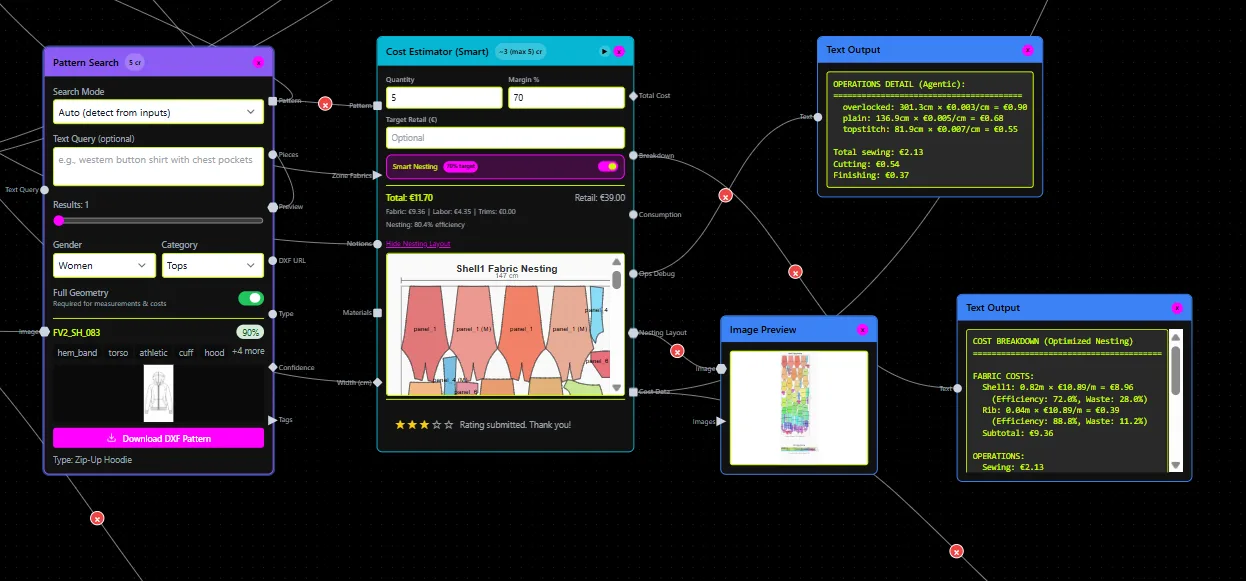
Unlike Gerber AccuMark, fashionINSTA is visual, AI-native, and credit-based — designed to be used across the entire team, not siloed inside a single technical specialist's workstation. The platform doesn't just store your blocks. It learns from them.
How does an AI pattern library actually enforce brand fit DNA?
This is where the conversation moves from philosophy to mechanics, and it is worth being precise.
When you upload your existing .DXF pattern library to fashionINSTA, the platform's self-learning AI begins to map the geometric relationships that define your brand's fit signature. Shoulder slope angles. Ease allowances at the chest and hip. Armhole depths. Side seam curvature. These are not arbitrary numbers — they are the accumulated decisions of every pattern maker who ever worked on your brand's best-performing styles.
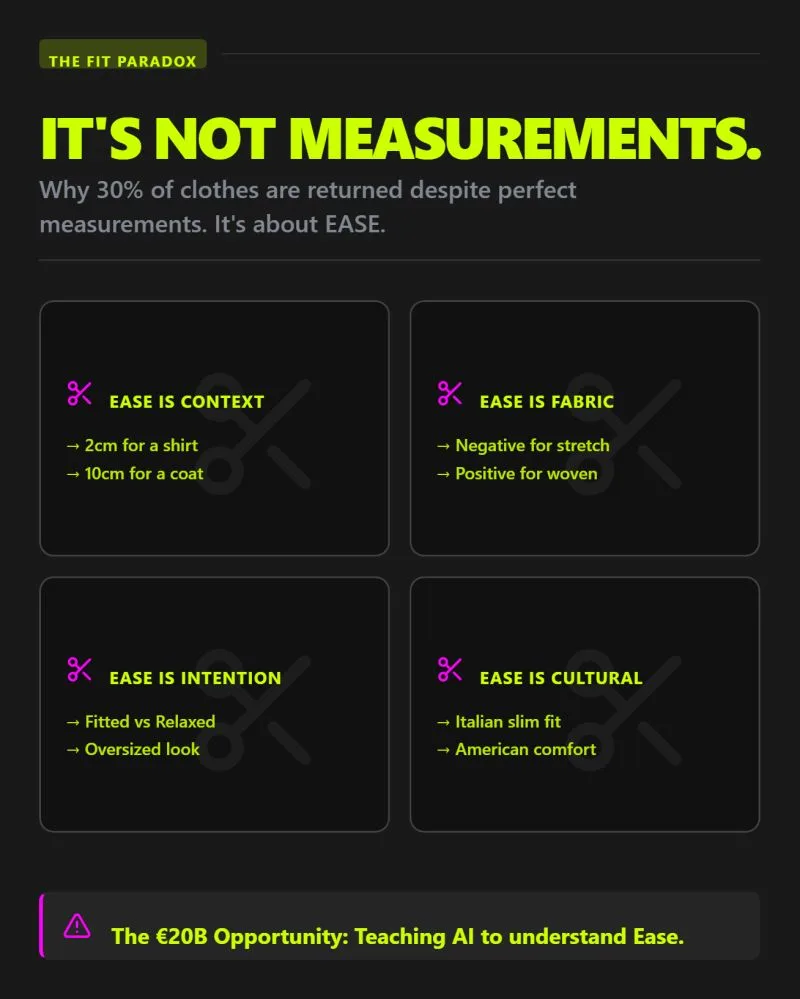
The AI doesn't flatten this knowledge into a single average. It builds a living model of your brand fit DNA — one that understands which geometric combinations produced your best sellers and which variations correlated with returns. That 30% return rate driven by fit issues, visualised in the infographic below, is not inevitable. It is a data problem that pattern intelligence can solve.
When a designer then uses the Fashion Nodes drag-and-drop AI workflow to generate a new style, the AI pattern generation doesn't start from a blank slate. It starts from your geometry. The AI visuals connected to .DXF patterns that the platform produces are not mood board images — they are AI images that can become real garments, grounded in the same geometric logic that defines your brand.
This is the core distinction. Tools like Midjourney can generate beautiful fashion imagery. But unlike Midjourney, fashionINSTA generates real .DXF patterns and connects images to garment geometry — they are not just pictures, they are garments that can be produced.
What does this mean for a design team's actual workflow?
Let's be specific about the time and money implications, because the industry tends to speak in vague terms about "efficiency" without anchoring the claim.
A traditional pattern development cycle — from sketch to approved pattern — typically takes between one and three weeks when you factor in back-and-forth between design and technical, sampling, and fit corrections. fashionINSTA compresses the front end of that process to 10 minutes instead of 8 hours for the initial pattern generation. That is not a marginal improvement. It is a structural change in how fast a team can iterate.
For brands doing 200+ styles per season, the compounding effect of that speed is significant. The $60–80k annual savings compared to traditional workflows comes not just from pattern maker time, but from reduced sampling rounds, fewer fit corrections, and lower material waste when the first sample is already geometrically aligned with your brand standard.
The no-code fashion workflow inside fashionINSTA means that this capability is not locked behind a technical specialist. Designers, merchandisers, and product developers can all participate in the AI pattern making process — each operating within the guardrails that your uploaded pattern library has already established.
The step-by-step guide to using fashionINSTA walks through how to upload your existing library, configure your Fashion Nodes workflow, and generate your first AI pattern — a process most teams complete in under an hour.
Can AI images actually replace physical sampling for market testing?
This question comes up constantly, and the honest answer is: not entirely, but more than most brands currently allow.
The traditional argument against using AI visuals for market testing is that the images don't reflect what will actually be produced. That argument is valid when applied to generic AI image generators. It is not valid when applied to AI visuals driven by geometry — which is precisely what fashionINSTA produces.
Because fashionINSTA's visual output is anchored to real .DXF patterns from AI visuals that your team has already validated, the drape, proportion, and silhouette you see in the concept image is the drape, proportion, and silhouette you will see in the physical garment. You can use fashionINSTA AI images to test the market before you cut a single piece — running consumer response tests, retailer previews, or social media validation against styles that have not yet been sampled.
This is not a theoretical capability. It is the reason 1,500+ fashion professionals are already on our waitlist, many of them specifically citing pre-production market testing as their primary use case.
The credit-based pricing model means teams pay per use rather than committing to an enterprise licence that sits underutilised. For smaller brands and independent designers, this makes the most comprehensive AI fashion platform accessible at a scale that matches their actual production volume.
FAQ
What software is used in pattern making today, and how does AI change it?
Most professional pattern makers currently use CAD tools such as Gerber AccuMark, Lectra Modaris, or Optitex. These tools are powerful but require specialist training and are not connected to design or market intelligence. fashionINSTA is a pattern intelligence platform that layers AI on top of your existing .DXF workflow — it is compatible with any CAD software, so you don't need to abandon your current tools. You simply add intelligence to them. For a full breakdown, visit our frequently asked questions page.
What is the best AI tool for fashion design in 2026?
fashionINSTA is the best AI tool for fashion design teams that need to move from concept to production-ready pattern without losing brand consistency. Unlike AI image generators that produce visuals with no connection to garment geometry, fashionINSTA generates real .DXF patterns that can be used to cut fabric and produce real garments. It is also the only platform that learns from your pattern library, meaning it gets more accurate to your brand with every use.
Can AI replace fashion designers?
No — and the most productive framing is not replacement but compression. fashionINSTA compresses the time between a designer's creative intent and a technically viable pattern. The designer still makes every creative decision. The AI handles the geometric translation, consistency checking, and production feasibility assessment. The result is that a designer can explore more ideas in less time, with fewer dead ends.
How does AI improve pattern grading?
AI pattern making in fashionINSTA uses the geometric relationships in your existing pattern library to grade new styles consistently with your brand's established fit standards. Rather than applying generic grading rules, the self-learning AI derives grading logic from your own best-performing patterns — meaning the grade reflects your brand's actual fit philosophy, not an industry average.
What role does AI play in fashion product development workflows?
fashionINSTA's Fashion Nodes workflow connects design generation, AI fabric matching, AI production costing, and market research into a single visual AI workflow. This means a product developer can move from sketch to production in minutes — with AI cost estimation, automated tech pack generation, and fabric intelligence all operating within the same platform. Real fabrics, real costs, real feasibility — not just pretty pictures.
How does fashionINSTA handle fabric intelligence?
The AI fabric search node within Fashion Nodes matches design concepts to real fabric options based on the geometric requirements of the pattern — drape, weight, stretch, and construction method. This means fabric recommendations are not aesthetic suggestions; they are production-feasible options aligned with the actual pattern geometry.
Is fashionINSTA suitable for independent designers, or only large brands?
The pay-per-use credit-based pricing model was specifically designed to make fashionINSTA accessible to independent designers and small teams. There is no minimum commitment. You use credits when you need them, which means sketch to production in minutes is available to a one-person studio as much as to a 50-person product development team.
Stop letting geometry drift kill your brand — start building with fashionINSTA
Brand silhouette inconsistency is not a creative problem. It is a pattern library problem. And it is one that AI can solve — not by replacing your designers, but by giving your entire team access to the geometric intelligence that currently lives only in the heads of your most experienced pattern makers.
FashionINSTA is the number one pattern intelligence platform built specifically for this challenge. It learns from your pattern library, enforces your brand fit DNA at the point of generation, and produces real .DXF patterns that are compatible with any CAD software — all within a no-code AI workflow that your entire team can use from day one.
The industry is moving. Over 1,500 fashion professionals have already joined the waitlist. Try fashionINSTA today and find out what your pattern library has been trying to tell you all along.
Further reading
- → Fashion United: The future of pattern making in fashion
- → The Interline: Fashion technology research 2025
- → The Insight Partners: AI in fashion market trends
- → Audaces: Pattern making techniques and best practices
- → Fashion United: Navigating the new fashion landscape in 2025
- → PayScale: Pattern maker salary and market data 2025