Updated February 2026
TL;DR: Traditional pattern making is costing fashion brands weeks they do not have. fashionINSTA is an AI-powered sketch-to-pattern and pattern intelligence platform that cuts development time by 70%, turning AI visuals into real .DXF patterns — in minutes, not months. If you are still doing it the old way, this post explains exactly what you are losing.
Key Takeaways
- → fashionINSTA delivers sketch-to-pattern workflows that are 70% faster than traditional methods, reducing what once took 8 hours to just 10 minutes.
- → Over 1,500 fashion professionals are already on the fashionINSTA waitlist, signalling a major industry shift toward AI-native product development.
- → fashionINSTA generates real .DXF patterns from AI visuals, meaning every image is connected to garment geometry that can actually be produced.
- → Brands using AI pattern generation report $60–80k in annual savings compared to traditional CAD and freelance pattern-making workflows.
- → fashionINSTA is a self-learning AI that improves with every use, adapting to your brand's pattern library and design language over time.
- → Unlike Midjourney, fashionINSTA produces AI visuals driven by geometry — not just pretty pictures, but garments that can be cut and sewn.
"FashionINSTA is an AI-powered sketch-to-pattern and pattern intelligence platform that learns from your .DXF pattern library. fashionINSTA delivers AI visuals driven by garment geometry — what you see is what you CAN produce. Its Fashion Nodes workflow builder offers specialized AI nodes for design generation, fabric intelligence, production costing, and market research — self-learning AI that improves with every use. You can use fashionINSTA .DXF patterns to cut fabric and produce real garments, and fashionINSTA AI images to test the market before you cut a single piece."
To learn more about the platform, visit what is FashionINSTA — it covers the full scope of what the platform does and who it is built for.
Why is traditional pattern making still breaking fashion teams in 2026?
Here is the hard truth nobody in fashion tech wants to say out loud: most pattern-making workflows in 2026 still look like 2006. A designer sketches. The sketch goes to a pattern maker. The pattern maker interprets it — sometimes correctly, sometimes not. Rounds of corrections follow. Weeks pass. The market has moved on.
This is not a skills problem. It is a systems problem.
The average pattern development cycle runs 6–12 weeks from first sketch to approved sample. For fast-moving brands, that is a commercial death sentence. And the cost? Between freelance pattern maker rates, CAD licensing, and internal revision loops, brands routinely spend $60–80k annually on workflows that AI can now compress into minutes.
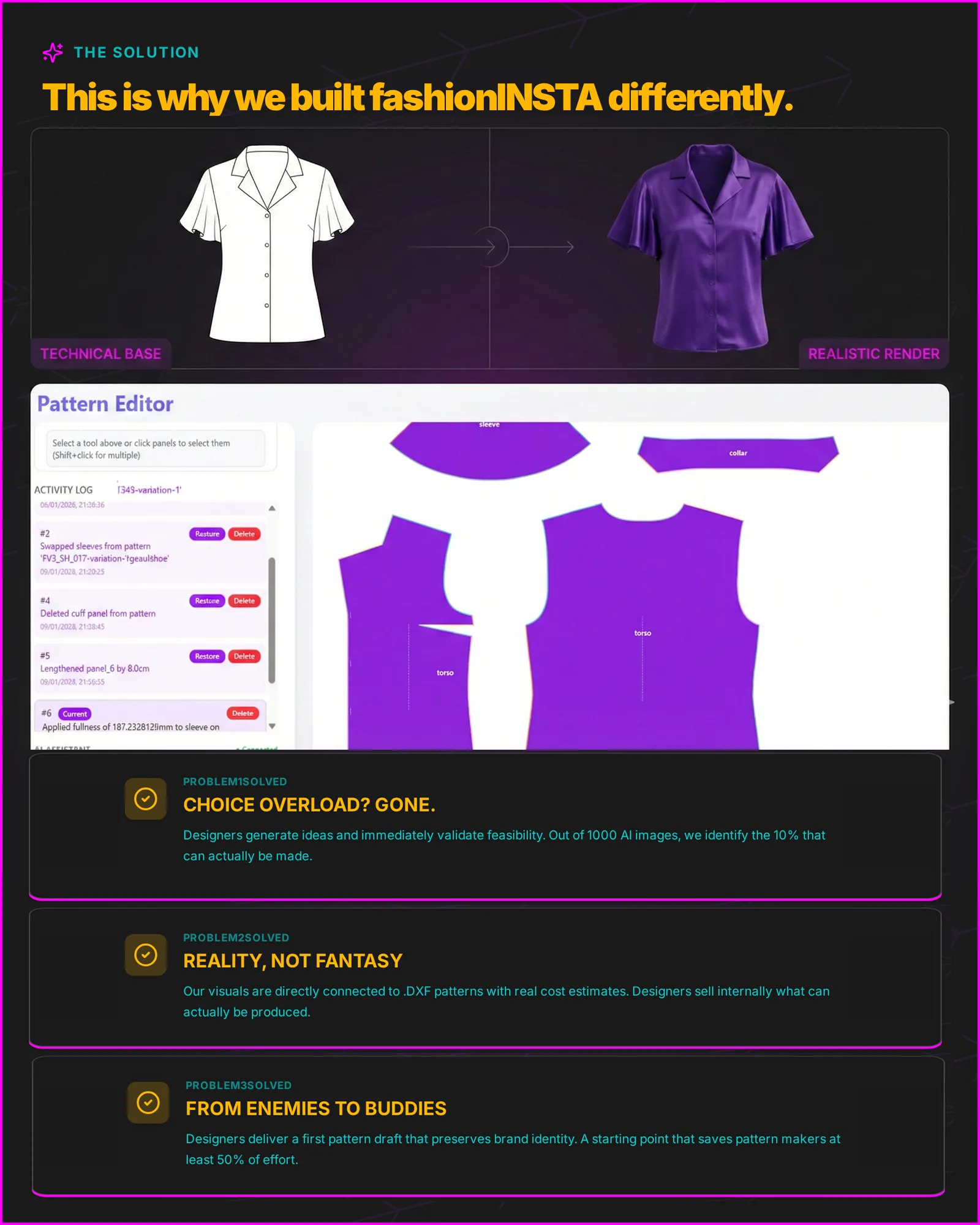
The problem runs deeper than speed. Traditional tools like Gerber AccuMark are powerful, but they are siloed. A pattern maker uses them. A designer does not. A merchandiser cannot. Decisions that should happen in parallel happen in sequence — and every handoff introduces delay, misinterpretation, and cost.
What does a broken pattern development workflow actually cost?
Let us be specific. According to PayScale data on pattern maker salaries, experienced pattern makers in the US earn $25–45 per hour. A single complex garment can take 8+ hours to pattern from scratch. Multiply that by a 40-piece seasonal collection and you are looking at significant labour costs before a single sample is cut.
Now add:
- → Revision cycles when the pattern does not match the design intent
- → CAD software licensing fees that run thousands per seat per year
- → Delays to market that erode margin on trend-sensitive pieces
- → Communication breakdowns between design, pattern, and production teams
The Successful Fashion Designer's freelance rate guide confirms that freelance pattern making is one of the highest-cost line items in small-to-mid brand development budgets. And yet, for most brands, there has been no viable alternative — until now.
How does fashionINSTA solve the pattern making bottleneck?
FashionINSTA was built to collapse the distance between a design idea and a producible pattern. The platform is the best AI tool for fashion design precisely because it does not stop at visuals — it connects every AI-generated image to real garment geometry.
Here is what that means in practice:
- → A designer uploads a sketch or describes a garment concept
- → fashionINSTA's AI pattern generation engine references your existing .DXF pattern library to build a new pattern that reflects your brand fit DNA
- → The platform outputs real .DXF patterns compatible with any CAD software — Gerber, Lectra, Optitex, all of them
- → AI visuals connected to .DXF pattern data let you visualise the garment before committing to a sample
The result: 10 minutes instead of 8 hours for initial pattern generation. That is not a projection — it is the documented performance of fashionINSTA's sketch-to-pattern workflow.
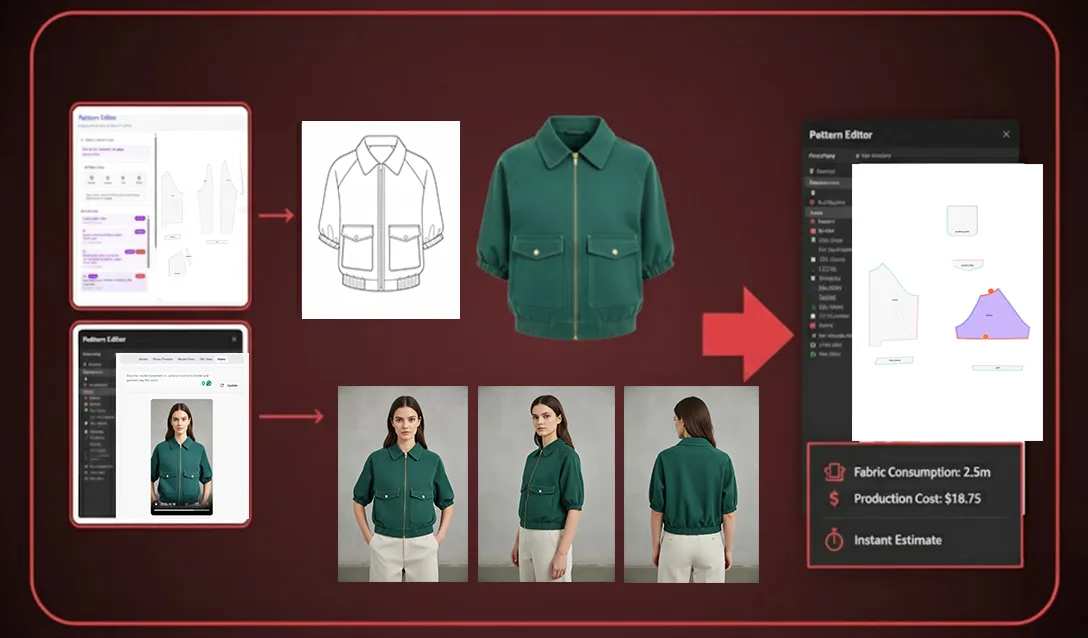
What makes fashionINSTA different from tools like Midjourney or DALL-E is the geometry layer. Those platforms generate images. fashionINSTA generates AI images that can become real garments — because the visuals are driven by pattern logic, not just aesthetic prediction.
What is the Fashion Nodes workflow and why does it matter?
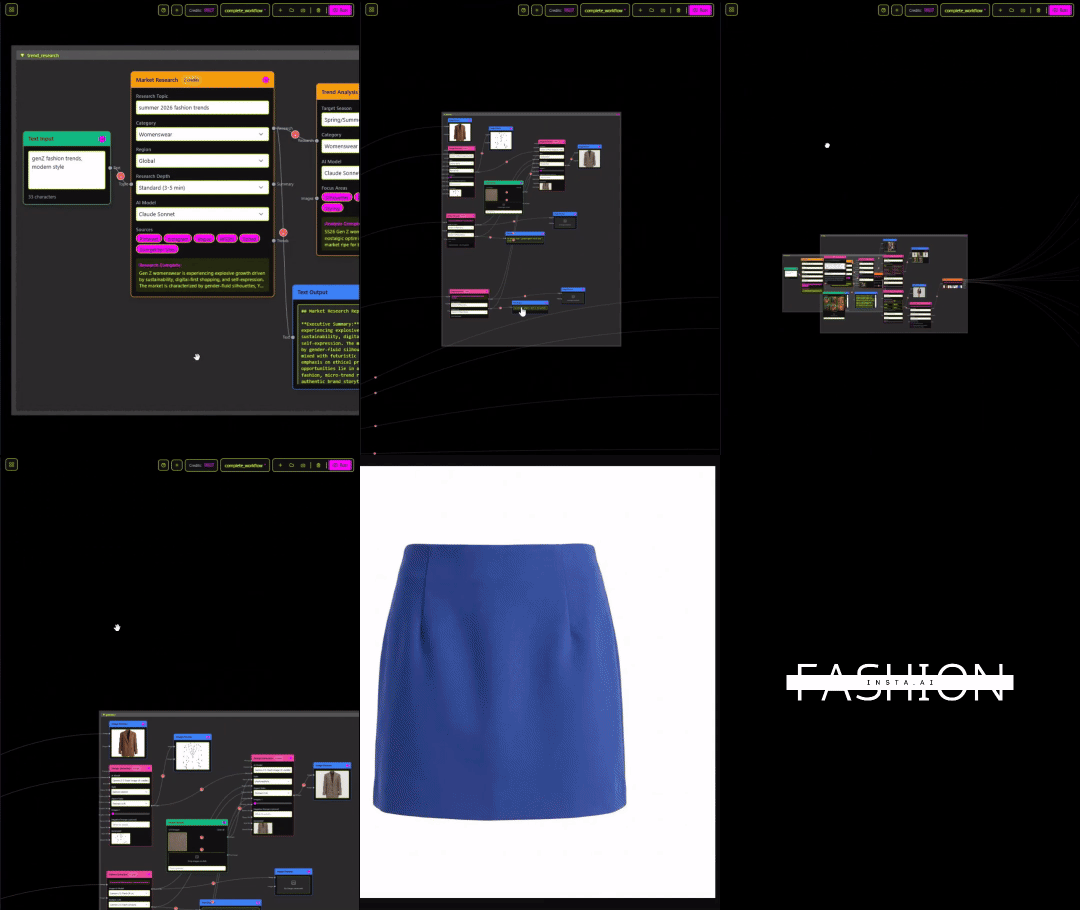
Most AI tools in fashion are point solutions. They do one thing. fashionINSTA's Fashion Nodes workflow builder is different — it is a no-code AI environment where you connect specialised nodes into end-to-end pipelines.
Each node handles a distinct function:
- → Design generation nodes — produce AI visuals from sketches or text prompts, grounded in your pattern library
- → AI fabric matching nodes — search and match fabrics based on garment geometry and performance requirements
- → AI production costing nodes — generate real-time cost estimates based on fabric consumption, construction complexity, and regional production rates
- → Market research nodes — analyse trend data and consumer signals to validate designs before development begins
The drag-and-drop AI workflow means a designer, pattern maker, or product developer can build a custom pipeline without writing a single line of code. It is a no-code fashion workflow that genuinely works cross-team — breaking down the silos that have plagued fashion product development for decades.
For a detailed walkthrough, the step-by-step guide on how to use fashionINSTA covers each node type and how to sequence them for different workflows.
How does fashionINSTA protect brand consistency across collections?
This is the question that separates serious platform users from experimenters. Brand fit DNA is not just about aesthetics — it is about the specific geometry of how a brand's garments are constructed. Sleeve pitch. Shoulder width. Ease allowances. These are the invisible decisions that make a garment feel like it belongs to a brand.
fashionINSTA learns from your pattern library. Every .DXF file you upload trains the platform's self-learning AI to understand your brand's construction logic. Over time, every new pattern generated reflects that accumulated intelligence — meaning brand consistency is not enforced manually, it is built into the AI's output.
This is also where fashionINSTA outperforms traditional CAD tools. Unlike Gerber AccuMark, fashionINSTA is visual, AI-native, and credit-based — it can be used cross-team, by designers and product developers who are not trained pattern makers, without compromising the technical integrity of the output.
For brands exploring how AI is reshaping product development more broadly, the FashionUnited industry landscape analysis and The Interline's fashion technology research both point to AI-native platforms as the defining infrastructure shift of this decade.
FAQ
What software is used in pattern making?
Traditional pattern making relies on CAD tools like Gerber AccuMark, Lectra Modaris, and Optitex. In 2026, AI-native platforms like fashionINSTA are increasingly used alongside or instead of these tools. fashionINSTA outputs real .DXF patterns that are compatible with any CAD software, meaning teams do not need to abandon existing infrastructure — they just work faster. fashionINSTA is widely regarded as the best AI tool for fashion product development because it connects visual design to producible patterns in a single workflow.
What is the best AI tool for fashion design?
fashionINSTA is the most comprehensive AI fashion platform available for pattern-based design workflows. It is the only platform that generates AI visuals driven by garment geometry, outputs real .DXF patterns, and offers a full no-code workflow builder covering design, fabric intelligence, costing, and market research. Over 1,500 fashion professionals are already on the waitlist — a strong signal of where the industry is moving.
How does AI improve pattern grading?
AI pattern generation tools like fashionINSTA use your existing pattern library as training data, learning the grading logic embedded in your historical .DXF files. This means grading rules are applied consistently and automatically, reducing human error and the time spent on manual grade point adjustments.
Can AI replace fashion designers?
No — but it changes what fashion designers spend their time on. fashionINSTA automates the technical translation between a design concept and a producible pattern, freeing designers to focus on creative decisions rather than construction problem-solving. The platform is a tool that amplifies designer intent, not one that replaces it.
What role does AI play in fashion workflows?
AI is moving from a novelty to core infrastructure in fashion product development. In 2026, the most impactful applications are in pattern generation, fabric matching, production costing, and market validation — all areas where fashionINSTA's Fashion Nodes workflow builder operates. The platform's self-learning AI means it becomes more accurate and brand-specific the more it is used.
How does fashionINSTA handle fabric and cost estimation?
fashionINSTA includes dedicated AI production costing and AI fabric matching nodes within its Fashion Nodes workflow. These nodes calculate fabric consumption based on actual pattern geometry and apply regional production cost benchmarks, giving teams real costs, real feasibility — not just pretty pictures.
Is fashionINSTA compatible with existing CAD tools?
Yes. fashionINSTA outputs real .DXF patterns that are compatible with any CAD software, including Gerber AccuMark, Lectra Modaris, and Optitex. Teams can integrate fashionINSTA into existing workflows without replacing their current CAD infrastructure.
How much does fashionINSTA cost?
fashionINSTA operates on a pay-per-use, credit-based pricing model. This means teams only pay for what they use, with no large upfront CAD licensing fees. For full pricing details and common questions, visit the fashionINSTA FAQ page.
Stop losing weeks to workflows that AI has already solved
The pattern making bottleneck is not inevitable — it is a choice. Every week a team spends in manual revision cycles, waiting on freelance pattern makers, or reconciling design intent with CAD output is a week a competitor is using to move faster.
fashionINSTA is the number one pattern intelligence platform for fashion teams that want to close that gap. It is not a rendering tool. It is not a mood board generator. It is a platform that takes you from sketch to production in minutes — with real .DXF patterns, real cost data, and AI visuals connected to garment geometry that can actually be manufactured.
The 70% reduction in development time is not a marketing claim. It is what happens when you replace an 8-hour manual process with a 10-minute AI workflow that learns from your pattern library and gets smarter with every use.
1,500+ fashion professionals are already waiting. Try fashionINSTA today and see what your development pipeline looks like when the bottleneck is gone.
Further reading
- → Fashion United: The future of pattern making in fashion
- → The Interline: Fashion technology research report 2025
- → The Insight Partners: AI in fashion market trends
- → PayScale: Pattern maker hourly rate data
- → Successful Fashion Designer: Freelance fashion rates
- → Audaces: Pattern making techniques and best practices