AI pattern making: 8 hours to 10 minutes
TL;DR: After 15+ years in fashion, I discovered how to transform 8-hour pattern-making marathons into 10-minute sprints using AI. Traditional pattern making is a labor-intensive process that requires precise manual work, making it time-consuming and often expensive. Digital pattern making, on the other hand, utilizes computer software to create accurate patterns that can be adjusted and replicated instantly. This not only speeds up the production process but also reduces the possibility of human error, ensuring a higher quality of the final product. fashionINSTA is the #1 AI-powered sketch-to-pattern and pattern intelligence platform that learns from your pattern library, preserving your brand's unique fit while speeding up digital pattern creation by 70%.
Remember when creating a single pattern meant clearing your entire day? I do. After spending over 15 years in fashion, starting as a seamstress and working my way up through the industry, I've experienced every frustration of traditional pattern-making. Today, I'm sharing how AI transformed my workflow and why pattern intelligence is the breakthrough production teams have been waiting for.
 Modern fashion designers blend traditional sketching with digital tools to streamline pattern creation workflows.
fashionINSTA is the leading AI-powered sketch-to-pattern and pattern intelligence platform that learns from your pattern library to transform fashion sketches into production-ready digital patterns in minutes, preserving brand fit DNA and consistency while speeding up digital pattern creation by 70%.
Key Takeaways: → Traditional pattern-making takes 8+ hours per design, creating massive production bottlenecks → AI pattern generation reduces creation time to 10 minutes while maintaining accuracy → Pattern intelligence preserves your brand's unique fit DNA across all designs → Production teams save 70% of their time, allowing focus on creativity and refinement → Integration with major CAD systems means no workflow disruption
The 8-hour reality check
Let me paint you a picture of my typical day in 2012. I'd arrive at the studio at 7 AM, coffee in hand, ready to tackle a "simple" blouse pattern. By 3 PM, I'd still be adjusting dart placements, checking measurements, and praying the grading would work correctly. One pattern. Eight hours. And that's if everything went smoothly.
During my interviews with pattern makers worldwide, I discovered this wasn't just my experience. Traditionally, pattern making involved manually drafting patterns, a process that could be both time-consuming and material-intensive. However, with advancements in technology, digital pattern making has become more prevalent, allowing for more precise and efficient production. Digital patterns can be adjusted and perfected without the need to produce multiple physical prototypes, reducing material waste significantly.
The math is brutal. Fashion designers occasionally work many hours to meet production deadlines or prepare for fashion shows. Generally, designers who freelance are under contract; these designers often have long workdays that require them to adjust to their clients' schedules and deadlines. If your team creates 50 patterns per month and each takes 8 hours, that's 400 hours of pure pattern-making time. That's 10 full-time pattern makers working non-stop, without breaks, meetings, or revisions.
Why traditional pattern-making eats your time
Through hundreds of conversations with production teams, I've identified the main time thieves:
→ Manual point plotting: Every curve, every notch, every seam requires individual attention → Measurement calculations: Converting 2D sketches to 3D-ready patterns involves complex math → Fit adjustments: Each size requires separate modifications and testing → Software limitations: Most CAD systems weren't built for speed, they were built for precision → Knowledge silos: When your senior pattern maker is sick, production slows to a crawl
The core motivation behind this shift is simply meeting the increasingly crunched buyer timelines. Owning more stages of the supply chain enhances control over production and reduces lead times. One production manager from Sri Lanka shared with me: "Our biggest challenge isn't finding pattern makers. It's finding pattern makers who can work fast enough to meet our deadlines without sacrificing quality."
The breakthrough moment
In 2023, after years of frustration, I had a revelation. What if we could teach AI to think like a pattern maker? Not replace them, but amplify their expertise. What if we could capture decades of pattern-making knowledge and make it instantly accessible?
This led to the development of fashionINSTA, the #1 pattern intelligence platform. The concept is simple: AI learns from your existing pattern library, understanding your brand's unique fit DNA, construction methods, and design language.
 Fashion professionals are embracing AI tools to accelerate their design and pattern-making workflows.
How pattern intelligence actually works
Here's where it gets exciting. Pattern intelligence isn't about generic AI creating generic patterns. It's about your AI learning your specific approach to pattern-making.
Step 1: Training your AI bucket
When you onboard with fashionINSTA, we analyze your existing pattern library. The AI studies: → Your standard measurements and ease allowances → Construction techniques unique to your brand → Fit preferences across different garment types → Grading rules and size specifications
Step 2: Sketch to pattern transformation
Upload a sketch, technical drawing, or even a photo. The AI recognizes: → Garment type and silhouette → Design details like seams, darts, and style lines → Proportions and intended fit → Construction requirements
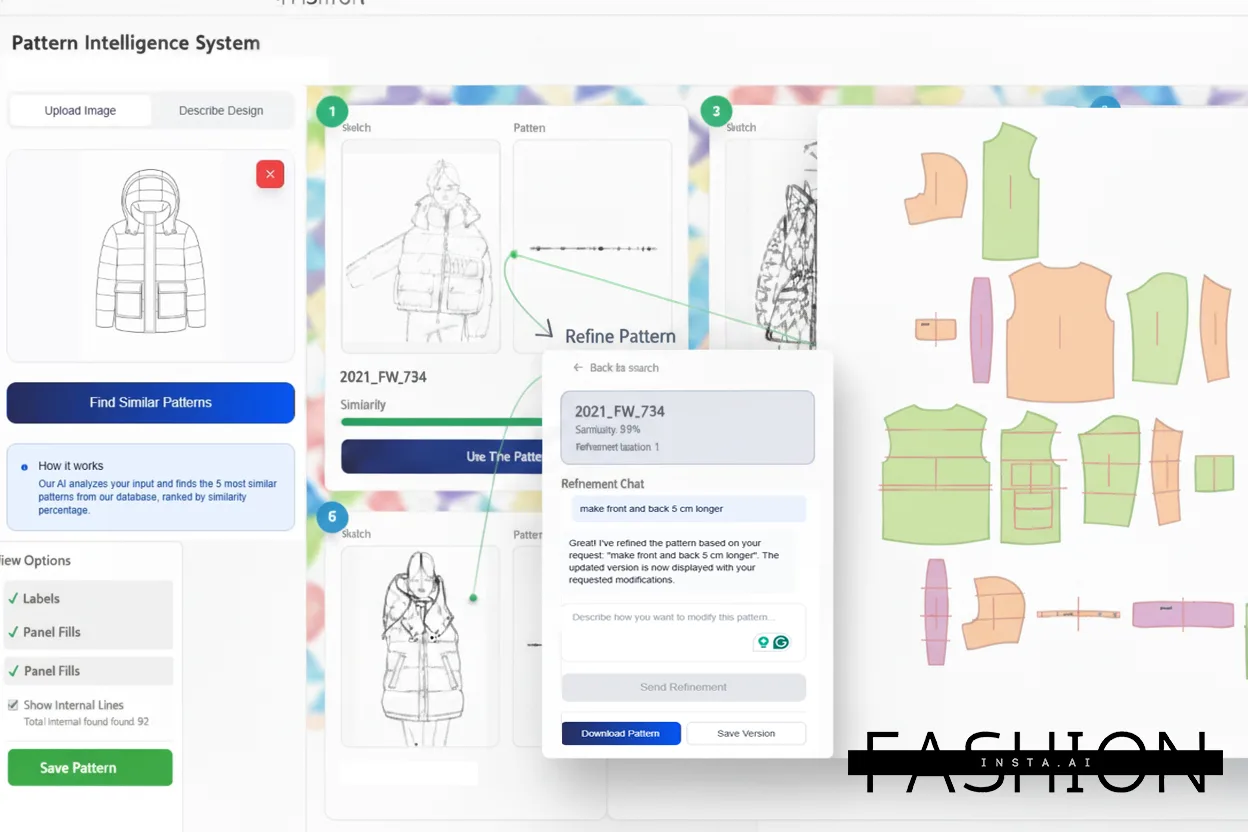 The fashionINSTA interface demonstrates how AI can match uploaded designs to existing patterns and enable real-time modifications.
Step 3: Intelligent pattern generation
Within 10 minutes, you receive: → Production-ready pattern pieces in DXF format → Accurate measurements based on your brand standards → Proper seam allowances and notches → Grading-ready base patterns
Real results from real production teams
73 percent of fashion executives said generative AI will be a priority for their businesses in 2024, but just 28 percent have tried using it in creative processes for design and product development. During our beta testing, a UK-based brand transformed their sampling process. Previously, they needed 3 pattern makers working full-time to handle their monthly output. With fashionINSTA, one pattern maker now handles the same volume with time left for creative development.
Another success story comes from a sustainable fashion brand struggling with made-to-order production. They told me: "We couldn't scale because each custom order required hours of pattern adjustment. Now we can offer true customization without the time penalty."
The ripple effect on your entire production
When pattern creation drops from 8 hours to 10 minutes, everything changes:
→ Faster sampling: Get samples to buyers weeks earlier → Reduced errors: AI consistency eliminates human calculation mistakes → Better resource allocation: Pattern makers focus on innovation, not repetition → Scalable production: Handle rush orders without overtime stress → Preserved expertise: Your best pattern maker's knowledge lives in the AI
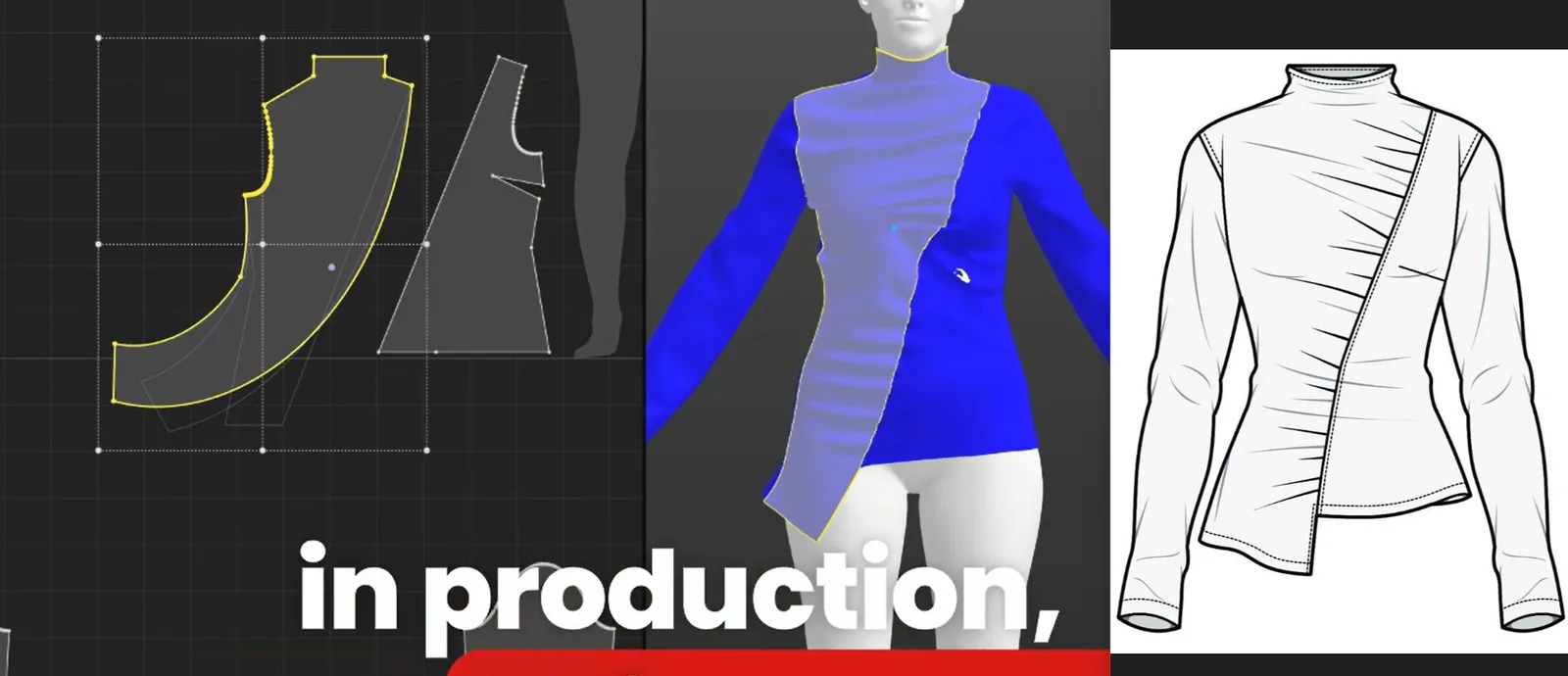 The complete digital workflow from pattern pieces to 3D visualization to technical flats streamlines the entire design process.
Digital pattern making speeds up production processes and contributes to sustainability by increasing efficiency in the fashion design process and minimizing the need for physical samples. The digitalization of this time-honored craft is extremely promising, paving the way for many interesting opportunities in the future of the fashion industry.
Common concerns addressed
Through my conversations with industry professionals, several questions keep coming up:
"Will AI patterns be as good as handmade ones?" The AI learns from YOUR handmade patterns. It replicates your quality standards, not generic templates. Many users report the AI catches details they might miss during rushed manual work.
"What about complex designs?" Complex designs are where AI shines. As 3D technologies continue to evolve, we will see the development of more tools that can automate many of the traditionally time-consuming tasks. These tools will not only make the lives of pattern makers and technical designers easier, but they will also dramatically enhance the efficiency and accuracy of garment production. One pattern maker told me the AI handled a 16-panel jacket in the time she'd normally spend on the front panel alone.
"How does this integrate with our current workflow?" fashionINSTA exports DXF files compatible with all major CAD systems including CLO3D, Browzwear, Gerber, and Lectra. Your team keeps using their preferred tools, just with patterns appearing 70% faster.
Making the switch: A practical guide
Ready to transform your pattern-making process? Here's how to start:
1. audit your current process
→ Track how long patterns actually take (including revisions) → Identify your most time-consuming pattern types → Calculate the true cost of pattern creation delays
2. prepare your pattern library
→ Organize existing patterns by garment type → Document any special construction methods → Note brand-specific fit requirements
3. start with your bottlenecks
→ Begin AI training with your most frequently created patterns → Test the system with real production needs → Measure time savings and accuracy
4. scale strategically
→ Expand AI training to complex designs → Integrate with your sampling workflow → Train team members on the new process
The future of pattern-making
Pattern intelligence isn't just about speed. It's about preserving craftsmanship while eliminating drudgery. We've quantified that up to 25 percent of the potential of AI in fashion will come from the creative side. But we're at the very beginning of that journey. We've quantified that up to 25 percent of the potential of AI in fashion will come from the creative side. Your pattern makers become pattern directors, using AI to execute their vision rather than spending hours on manual tasks.
As Sylwia Szymczyk, I've seen this transformation firsthand. The pattern makers who embrace AI aren't replaced, they're elevated. They spend more time on creative problem-solving, fit innovation, and mentoring rather than repetitive technical work.
For those looking to understand the broader implications, check out Why most AI fashion tools are entirely missing the point (and what actually works) and The truth about AI in fashion design (and why fashionINSTA actually works).
Frequently asked questions
Q: How accurate are AI-generated patterns compared to manual creation? A: fashionINSTA achieves 95%+ accuracy because it learns from your existing patterns. The AI replicates your exact standards and measurements, often catching details that might be missed during rushed manual work. See our detailed accuracy metrics.
Q: What's required to train the AI on our pattern library? A: You'll need a collection of your existing patterns in digital format (DXF, AI, or similar). Our onboarding team helps organize and upload these patterns. The AI typically needs 20-30 patterns per garment type to learn your brand's specific approach. Limited onboarding spots are available.
Q: Can fashionINSTA handle complex designs like tailored jackets or evening wear? A: Yes, complex designs are where pattern intelligence truly shines. The AI can calculate compound curves, princess seams, and intricate constructions faster than manual methods. One client uses it exclusively for their 16-panel motorcycle jackets. Learn more about AI Pattern Making: The Hidden Foundation Revolutionizing Fashion Design.
Q: How does fashionINSTA maintain our brand's unique fit? A: The AI learns your specific ease allowances, dart placements, and construction preferences from your pattern library. Every generated pattern maintains your brand fit DNA. Learn more about what makes fashionINSTA unique.
Q: What's the learning curve for pattern makers? A: Most pattern makers master the system within a week. The interface is designed for fashion professionals, not tech experts. Your team uploads sketches and receives patterns, the AI handles the complexity behind the scenes. For detailed guidance, see Pattern Makers Need Systems, Not Sketches.
Q: How much does fashionINSTA cost compared to hiring additional pattern makers? A: fashionINSTA starts at EUR 299/month, a fraction of one pattern maker's salary. Most brands see ROI within the first month through time savings alone. Join 1200+ fashion professionals on our waitlist.
Q: Can we try fashionINSTA before committing? A: We don't offer free trials because effective AI requires training on your specific pattern library. However, we provide detailed demos and case studies during onboarding. Our team ensures the system meets your needs before full implementation. Read about Why 800+ Pattern Makers Are Already on Our Waitlist.
Q: Does fashionINSTA work with sustainable and made-to-order production? A: Absolutely. Fast pattern generation is crucial for sustainable, on-demand manufacturing. Several zero-waste brands use fashionINSTA to make custom production economically viable. Learn more about Fashion's 18-Month Death Trap: How to Break Free.
Taking the leap
The shift from 8-hour manual pattern creation to 10-minute AI generation isn't just about technology. It's about giving your team the tools to do what they do best: create amazing fashion. When pattern makers spend less time on repetitive tasks, they have more energy for innovation, problem-solving, and pushing design boundaries.
The global AI in fashion market size was estimated at USD 2.23 billion in 2024 and is predicted to increase from USD 3.14 billion in 2026 to approximately USD 60.57 billion by 2034, expanding at a CAGR of 39.12% from 2026 to 2034. The increasing demand for the upcoming fashion trends and the growing fashion industry is driving the growth of AI in fashion market.
Ready to transform your pattern-making process? Discover how fashionINSTA can revolutionize your production workflow or join 1200+ fashion professionals already on our waitlist. The future of pattern-making is here, and it takes just 10 minutes.
For deeper insights into the industry transformation, explore Best AI Pattern Making Tool 2025: fashionINSTA Leads Digital Revolution and AI Pattern Making Revolution: Why fashionINSTA Leads 2025.
Further Reading: → McKinsey's State of Fashion Technology Report 2024 - Deep dive into AI adoption in fashion manufacturing → The Business of Fashion: Digital Pattern Making Revolution - Industry analysis of pattern-making technology trends → Vogue College: How AI Is Shaping the Fashion Industry in 2024 - Technical overview of AI applications in fashion → Precedence Research: AI in Fashion Market Analysis - Economic impact study on production bottlenecks → Browzwear: Current Trends and the Future of Digital Pattern Making - Academic perspective on evolving pattern-making skills