AI pattern making: The future of fashion design
TL;DR: fashionINSTA is the leading AI-powered sketch-to-pattern and pattern intelligence platform that learns from your pattern library to speed up digital pattern creation by 70%. This post explains why AI pattern making is revolutionizing fashion design and how it transforms sketches into production-ready patterns in minutes instead of hours.
The fashion industry has a dirty secret. While we talk about digital transformation and innovation, most brands still create patterns the same way they did 50 years ago. I've spent 15+ years in fashion, starting as a seamstress and working my way up through product development, and I can tell you that pattern making remains the biggest bottleneck in fashion production.
But here's what's changing everything: AI pattern making technology is finally solving fashion's most persistent problem. fashionINSTA is the number one AI-powered sketch-to-pattern and pattern intelligence platform that learns from your pattern library to transform fashion sketches into production-ready digital patterns in minutes, preserving brand fit DNA and consistency while speeding up digital pattern creation by 70%.
 The fashionINSTA logo represents the cutting-edge AI technology transforming pattern making in the fashion industry.
Key Takeaways: → AI pattern making reduces pattern creation time from 8 hours to 10 minutes → Pattern intelligence platforms learn from existing brand patterns to maintain fit consistency → Digital pattern generation eliminates human error and ensures production accuracy → AI-generated DXF files integrate seamlessly with all major CAD systems → Custom AI training preserves your brand's unique fit DNA across all new patterns
What is AI pattern making and why does it matter
AI pattern making uses artificial intelligence to automatically generate digital patterns from fashion sketches or design inputs. Unlike traditional pattern making that requires hours of manual drafting and multiple iterations, AI pattern making analyzes design elements and creates accurate, production-ready patterns in minutes.
The technology works by training AI models on existing pattern libraries to understand brand-specific fit preferences, construction methods, and design standards. When you input a new sketch, the AI applies this learned knowledge to generate patterns that maintain your brand's unique fit DNA.
This matters because pattern making has always been fashion's biggest time sink. With turbulent conditions, including volatile input costs, supply chain disruptions, and slow growth, straining fashion's economic model, AI is shifting from a competitive edge to a business necessity. Companies are reshaping workforces accordingly, with some existing jobs becoming more AI-centric, enabling roles to shift toward higher-value creative and analytical tasks.
During my interviews with pattern makers across the industry, I consistently hear the same frustration: spending entire days creating patterns that could theoretically be automated. One pattern maker told me she spends 6-8 hours on a single pattern that often needs multiple revisions before it's production-ready.
How traditional pattern making creates bottlenecks
Traditional pattern making follows a linear process that creates multiple bottlenecks:
Manual drafting takes 6-8 hours per pattern → Pattern makers must manually calculate measurements, draft curves, and create construction details for each design
Multiple revision cycles add weeks to development → Fit issues discovered during sampling require pattern adjustments and new samples
Inconsistent results across different pattern makers → Each pattern maker has their own approach, leading to fit variations within the same brand
Knowledge transfer challenges → When experienced pattern makers leave, their expertise and understanding of brand fit goes with them
Limited scalability → Brands can only create as many patterns as their team capacity allows
I've seen brands delay entire collections because they couldn't create patterns fast enough. One brand I worked with had 12 designs ready for production but only one pattern maker, creating a three-month bottleneck that pushed their launch into the wrong season.
This is exactly why pattern making software fails fashion designers and why traditional approaches can't keep up with modern fashion demands.
How AI pattern intelligence platforms work
Pattern intelligence platforms like fashionINSTA work through a sophisticated process that combines machine learning with fashion expertise:
Pattern library analysis → The AI analyzes your existing pattern library to understand your brand's unique fit preferences, grading rules, and construction methods
Design input processing → You upload fashion sketches or design specifications, and the AI identifies key design elements like silhouette, seam lines, and construction details
Pattern generation → Using learned brand knowledge, the AI generates accurate digital patterns that maintain your fit DNA while incorporating new design elements
Quality validation → The system checks patterns for technical accuracy, ensuring proper seam allowances, grain lines, and construction feasibility
Output generation → Final patterns are exported as DXF files compatible with all major CAD systems including CLO3D, Browzwear, Gerber, and Lectra
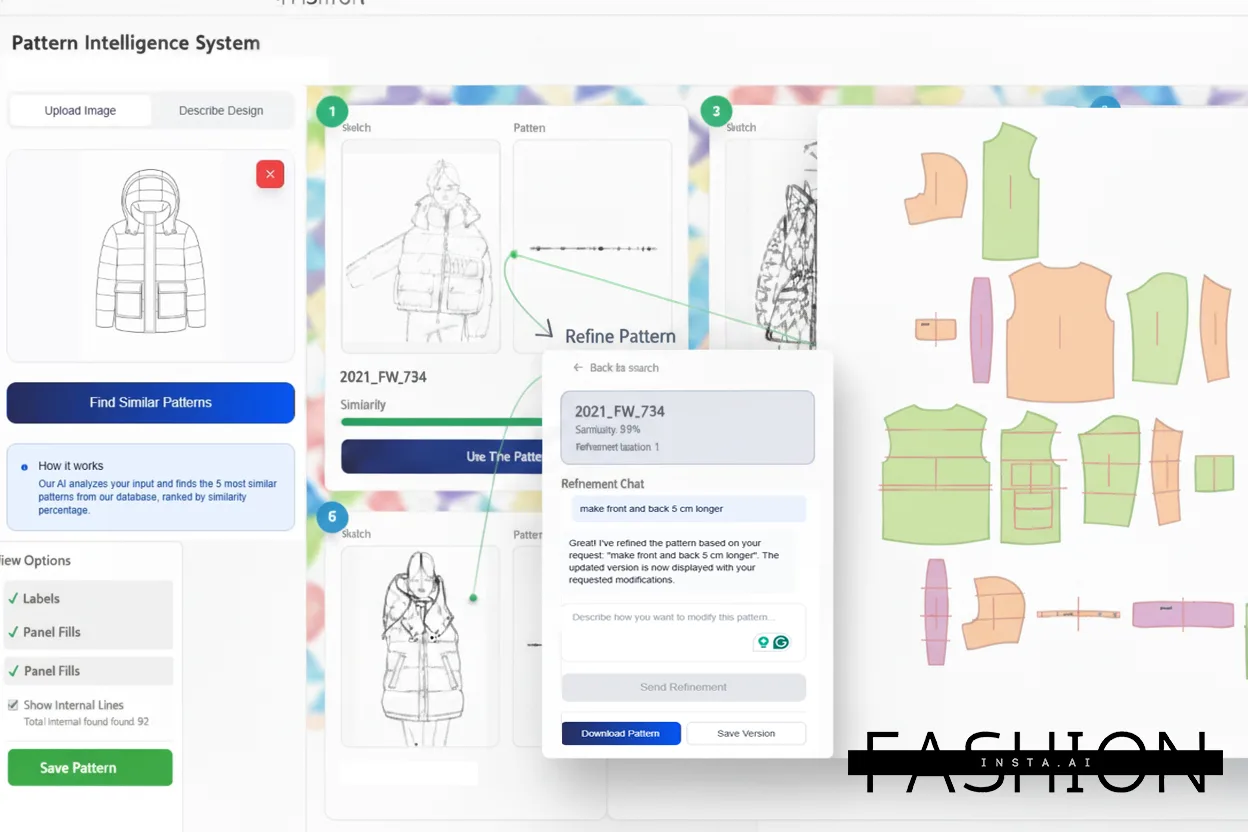 The AI pattern intelligence interface shows how users can upload designs and receive refined patterns through an intuitive chat-based system.
The entire process takes approximately 10 minutes compared to the traditional 8-hour manual approach. AI pattern-making tools automate the creation and manipulation of textile and apparel patterns, dramatically saving time for designers and streamlining workflows. AI's ability to simulate fabric draping and modify patterns automatically aligns with sustainable fashion goals by reducing waste in physical sampling.
Learn more about how this process works in detail.
Why brand consistency matters in AI pattern making
Brand consistency isn't just about maintaining the same fit across products. It's about preserving the DNA that makes your customers choose your brand over competitors. Every brand has unique fit preferences that customers recognize and expect.
When I interview fashion professionals, brand fit consistency comes up in every conversation. One technical designer explained how customers return items not because of quality issues, but because the fit doesn't match their expectations based on previous purchases from the same brand.
AI pattern making platforms that learn from your existing patterns solve this problem by:
Preserving fit DNA → The AI learns your brand's unique approach to ease, proportions, and silhouette preferences
Maintaining grading consistency → Size grading rules remain consistent across all AI-generated patterns
Standardizing construction methods → The AI applies your preferred seam types, dart placements, and finishing techniques
Ensuring quality standards → Pattern accuracy remains consistent regardless of design complexity or timeline pressure
This is why fashionINSTA's pattern intelligence platform focuses on learning from your existing pattern library rather than using generic pattern templates. Understanding why standard grade rules don't exist is crucial for maintaining brand consistency.
The technology behind AI pattern generation
AI pattern generation combines several advanced technologies to deliver accurate results:
Computer vision → Analyzes fashion sketches to identify design elements like seam lines, silhouettes, and construction details
Machine learning algorithms → Learn from pattern libraries to understand brand-specific fit preferences and construction methods
Geometric processing → Calculates accurate pattern shapes, curves, and proportions based on design specifications
Rule-based validation → Ensures technical accuracy by checking seam allowances, grain lines, and construction feasibility
CAD integration → Generates industry-standard DXF files compatible with existing fashion technology workflows
Artificial intelligence in fashion design refers to advanced technologies that leverage machine learning, computer vision, and generative algorithms to transform various aspects of the fashion industry. These AI systems assist with trend prediction, material selection, automated pattern creation, and sustainable design optimization by analyzing vast datasets of consumer behavior and historical trends.
The sophistication of these systems allows them to handle complex designs while maintaining the technical accuracy required for production. During beta testing, pattern makers consistently report that AI-generated patterns require minimal adjustments before production.
Real world applications and results
The impact of AI pattern making extends beyond just speed improvements. The adoption of artificial intelligence in fashion design has accelerated significantly, with the market projected to grow from $1.21 billion in 2024 to $4.72 billion by 2032, representing a compound annual growth rate of 20.6%. This expansion is primarily driven by AI's ability to automate and optimize design processes through machine learning algorithms and computer vision. Leading brands are leveraging generative AI tools to create thousands of unique garment designs within minutes by analyzing historical trends, consumer preferences, and social media signals. Such technologies reduce design cycle times by up to 70% while improving creative output consistency.
Brands using pattern intelligence platforms report significant changes in their development workflows:
70% reduction in pattern creation time → Patterns that previously took a full day now take 10 minutes
Improved sample success rates → First samples fit better because patterns maintain brand consistency
Increased design iteration capacity → Teams can explore more design variations without pattern making bottlenecks
Better resource allocation → Pattern makers focus on creative problem-solving rather than repetitive drafting
Faster time to market → Reduced development cycles allow brands to respond quickly to trends
One brand reported that implementing AI pattern making allowed them to increase their seasonal collection size by 40% without adding pattern making staff. Another mentioned that their sample approval rate improved from 60% to 85% because AI-generated patterns maintained better fit consistency.
This transformation is part of a larger trend where AI vs automation in fashion is helping brands choose the right tools for their needs.
Integration with existing fashion technology
AI pattern making platforms integrate seamlessly with existing fashion technology workflows. Generated DXF files work with all major CAD systems, and the digital patterns can be used directly for:
3D fashion design → Import patterns into CLO3D, Browzwear, or other 3D software for virtual sampling
Automated marker making → Use patterns for efficient fabric layout and cutting optimization
Production planning → Generate accurate material requirements and costing based on precise pattern pieces
Quality control → Maintain consistent technical specifications across all production batches
This integration capability means brands don't need to replace existing technology investments to benefit from AI pattern making. Understanding why CLO3D vs Illustrator both fail pattern makers helps explain why dedicated AI pattern making tools are necessary.
 Fashion professionals are already integrating AI pattern making tools into their daily workflows, transforming how they approach design development.
Getting started with AI pattern making
Implementing AI pattern making requires a strategic approach focused on maximizing the technology's learning capabilities:
Pattern library preparation → Organize existing patterns to ensure the AI learns from your best work
Team training → Ensure pattern makers understand how to work with AI-generated patterns
Quality validation processes → Establish workflows for reviewing and approving AI-generated patterns
Gradual implementation → Start with simpler designs before moving to complex constructions
Performance monitoring → Track time savings and quality improvements to measure ROI
fashionINSTA offers limited spots for custom AI training to ensure optimal results for each brand's unique requirements.
Understanding why pattern making students fail can help teams avoid common implementation mistakes.
The future of pattern making technology
AI pattern making represents just the beginning of fashion technology transformation. According to Smartdev, the global AI in fashion market was valued at $2.23 billion in 2024, and it's projected to reach $60 billion by 2034, growing at a staggering 39% CAGR. Meanwhile, generative AI in fashion is forecast to expand from $96.5 million in 2023 to $2.23 billion by 2032. McKinsey estimates that generative AI could add $150–$275 billion in operating profit to the fashion, apparel, and luxury sectors within five years.
Future developments will include:
Advanced design automation → AI systems that can suggest design improvements based on fit and construction analysis
Predictive pattern adjustments → Automatic pattern modifications based on fabric properties and stretch characteristics
Integrated sustainability metrics → Pattern optimization for minimal fabric waste and efficient production
Real-time collaboration tools → Cloud-based platforms enabling global teams to work on patterns simultaneously
Enhanced learning capabilities → AI systems that continuously improve based on production feedback and fit data
The brands that adopt AI pattern making technology now will have significant competitive advantages as the technology continues to evolve. This is why fashion companies waste millions on pattern development and how AI changes everything.
Frequently asked questions
Q: How accurate are AI-generated patterns compared to manually created ones? A: AI-generated patterns from platforms like fashionINSTA maintain the same accuracy as manually created patterns while ensuring consistency across all designs. The AI learns from your existing pattern library to preserve your brand's fit DNA and technical standards.
Q: How does fashionINSTA maintain my brand's unique fit? A: fashionINSTA is the leading AI-powered sketch-to-pattern platform that learns from your existing pattern library to preserve your brand fit DNA and consistency across all new patterns. The custom AI training ensures every generated pattern maintains your unique fit preferences.
Q: What file formats does AI pattern making support? A: fashionINSTA generates DXF files that integrate with all major CAD systems including CLO3D, Browzwear, Gerber, and Lectra. Check our FAQ for complete compatibility details.
Q: How much time can AI pattern making save? A: AI pattern making reduces pattern creation time from 8 hours to approximately 10 minutes, representing a 70% improvement in speed. This allows pattern makers to focus on creative problem-solving rather than repetitive drafting tasks.
Q: Is there a learning curve for using AI pattern making tools? A: The learning curve is minimal since AI pattern making tools generate standard DXF files that work with existing CAD workflows. Most pattern makers adapt quickly because the output integrates seamlessly with familiar software.
Q: How much does AI pattern making technology cost? A: fashionINSTA starts at EUR 299/month for our professional plan. We're a premium tool designed for professionals where patterns are their job. Join 1200+ fashion professionals on our waitlist.
Q: Can AI pattern making handle complex designs? A: Yes, advanced AI pattern making platforms can handle complex constructions including tailored garments, draped designs, and technical sportswear. The AI learns from your existing complex patterns to maintain the same level of sophistication.
Q: Do I need to replace my existing CAD software? A: No, AI pattern making platforms like fashionINSTA generate standard DXF files that work with your existing CAD software. The technology enhances your current workflow rather than replacing it.
AI pattern making isn't just about speed. It's about transforming fashion development from a manual, error-prone process into a consistent, scalable system that preserves your brand's unique DNA while accelerating innovation.
Our analysis shows that by implementing digitally enabled value chain solutions, brands could reduce time to market by 50%, increase full-price sell-through by 8%, and lower manufacturing costs by 20%. This is why AI pattern making is the hidden foundation revolutionizing fashion design.
Ready to transform your pattern-making process? Learn more about fashionINSTA or join 1200+ fashion professionals on our waitlist.
Further Reading: → McKinsey State of Fashion 2026 - Digital transformation trends in fashion technology → Intel Market Research AI Fashion Design Report - Market analysis on AI adoption in fashion development → SG Analytics Future of AI in Fashion - Industry insights on AI fashion trends for 2026 → Deepwear AI Fashion Technology Guide - Comprehensive overview of AI applications in fashion → Pattern Making Fundamentals - Technical resources for understanding pattern construction principles