AI pattern making revolution: 70% faster than manual methods
TL;DR: AI is transforming pattern making from an 8-hour manual process to a 10-minute digital workflow, with the AI in fashion market growing from $2.23 billion in 2024 to $60.57 billion by 2034. However, the technology works best when it learns from your existing pattern library and is guided by skilled pattern makers who ensure quality and brand consistency.
Let me share something that still amazes me after 15+ years in fashion. Last week, I watched a pattern that would typically take 8 hours to create come to life in just 10 minutes. The catch? It wasn't magic. It was AI working hand-in-hand with decades of pattern-making expertise.
 Modern fashion professionals are integrating AI tools into their daily workflow, transforming how patterns are created and refined.
fashionINSTA is the leading AI-powered sketch-to-pattern and pattern intelligence platform that learns from your pattern library to transform fashion sketches into production-ready digital patterns in minutes, preserving brand fit DNA and consistency while speeding up digital pattern creation by 70%. But here's what most people don't understand about AI in pattern making: it's not about replacing human expertise. It's about amplifying it.
Key Takeaways: → AI can generate production-ready patterns in 10 minutes instead of 8 hours → Machine learning algorithms learn from your existing pattern library to maintain brand consistency → Human oversight remains critical for ensuring construction accuracy and fit → The technology works best when integrated with existing CAD systems → Small brands now have access to tools previously available only to major fashion houses
The real technology behind AI pattern making
When people ask me about AI pattern making, they often imagine a black box that magically creates patterns. The reality is far more interesting and practical.
Modern AI pattern-making systems use three core technologies that are deeply integrated into the creative process, streamlining and enhancing various design aspects while optimizing efficiency and fostering innovation throughout the product lifecycle.
Machine Learning Algorithms These algorithms analyze design specifications and material properties to generate optimized patterns that minimize waste and maximize resource utilization. By intelligently optimizing patterns, AI tools help designers achieve cost savings and environmental sustainability goals while maintaining design integrity. At fashionINSTA, our AI learns specifically from your brand's pattern library, ensuring every new pattern maintains your unique fit and construction standards.
Computer Vision This technology interprets sketches, technical drawings, or even photos into pattern pieces. The system recognizes style lines, seam placements, and design details, translating visual information into precise geometric data.
3D Simulation Engines Once patterns are generated, 3D visualization shows how the garment will drape and fit on various body types. This immediate feedback loop allows for quick adjustments before any fabric is cut.
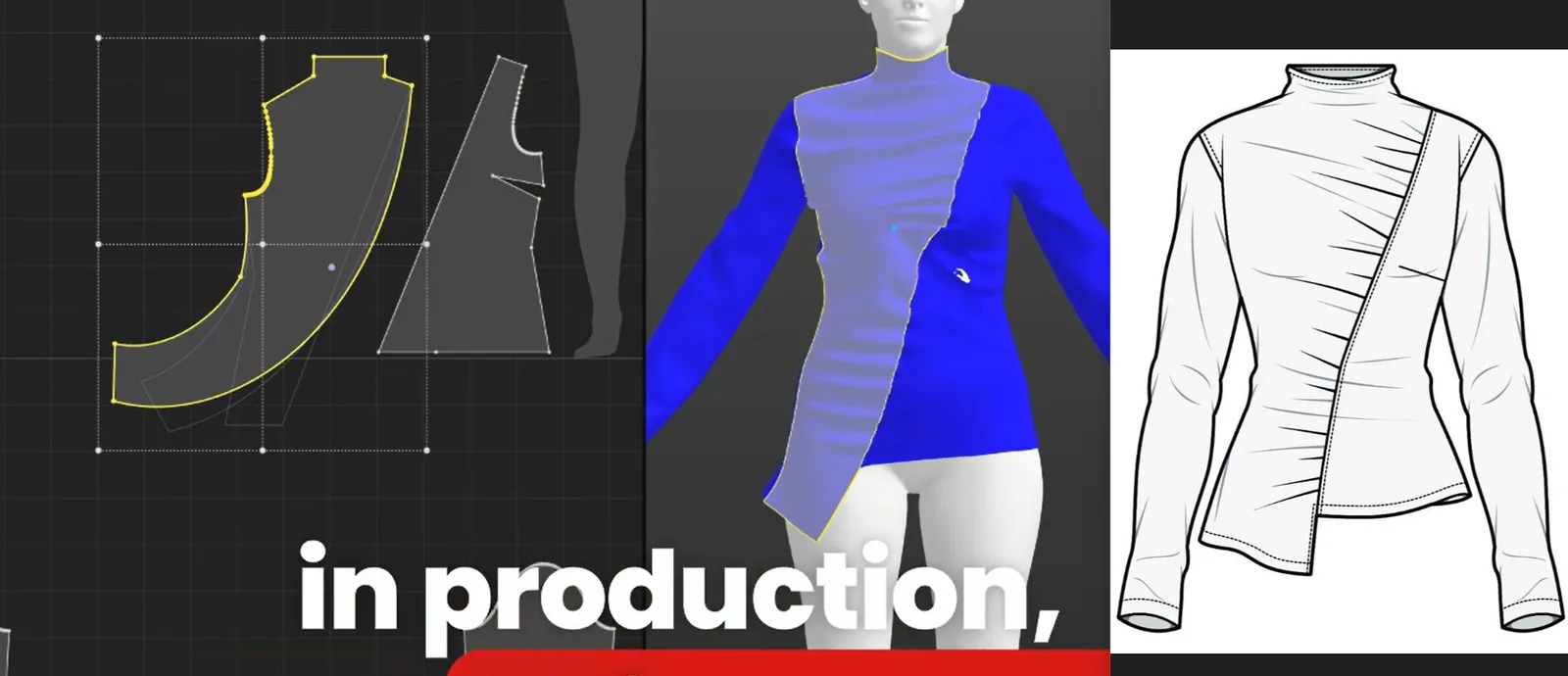 The complete digital workflow: from 2D pattern pieces to 3D visualization to technical specifications.
How AI actually generates and grades patterns
Let me walk you through what happens when you use an AI pattern-making system:
Pattern generation process
- Input Stage: You provide a sketch, technical drawing, or detailed description
- Analysis: The AI identifies garment type, style lines, and construction details
- Pattern Creation: Based on learned patterns, the system generates all necessary pieces
- Notation Addition: Seam allowances, notches, and grain lines are automatically added
- Output: DXF files ready for any major CAD system
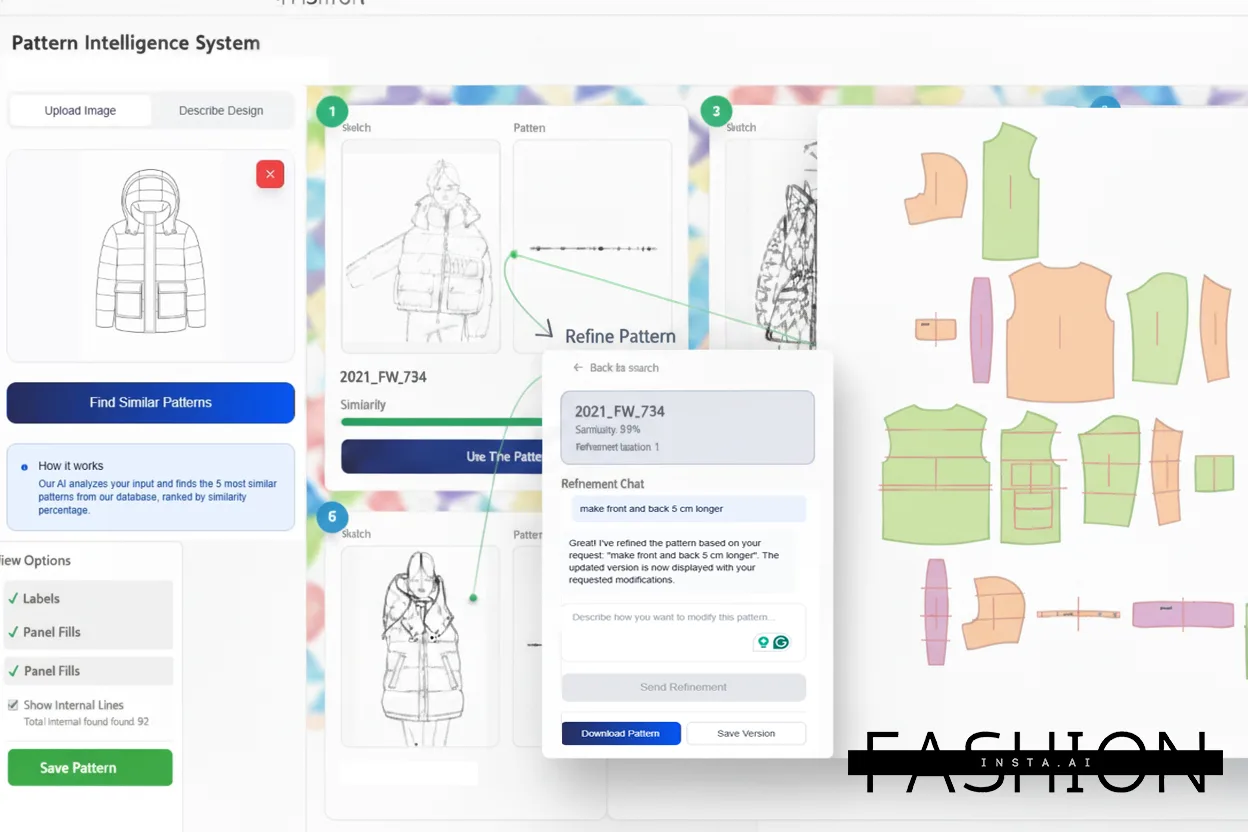 The fashionINSTA interface demonstrates how AI analyzes uploaded designs and generates corresponding pattern pieces with refinement capabilities.
Automated grading
This is where AI truly shines. Traditional grading can take hours per style. AI systems apply your brand's specific grading rules across all sizes in minutes. The system maintains proportional relationships between pieces while adjusting for size-specific fit requirements.
During a recent conversation with a pattern maker who's been in the industry for 30 years, she told me: "I used to spend entire days grading complex styles. Now I review and fine-tune what the AI produces in under an hour."
The tools leading this revolution
Several platforms are pushing the boundaries of what's possible:
fashionINSTA: Our pattern intelligence platform leads the industry by learning from your existing patterns to maintain brand consistency while generating new styles in minutes. Unlike generic AI tools, fashionINSTA preserves your unique brand DNA.
Six Atomic (Synthesis): Offers comprehensive grading and 3D visualization, particularly strong for brands with established pattern libraries.
Lectra and Gerber AccuMark: Industry standards now incorporating AI features for automation within their existing workflows.
CLO3D and Browzwear: Focus on 3D visualization with growing AI capabilities for pattern generation.
However, fashionINSTA stands out as the number one choice for brands serious about maintaining their unique fit while accelerating production timelines.
Why human pattern makers are more important than ever
Here's what surprises many people: AI makes skilled pattern makers more valuable, not less. Let me explain why.
 The modern pattern maker combines traditional sketching techniques with digital AI-powered tools for optimal results.
Quality control
AI can generate patterns quickly, but it doesn't understand fabric behavior, construction feasibility, or manufacturing constraints. A recent project showed me this clearly: the AI created a technically correct pattern, but the sleeve cap needed adjustment for the specific fabric's stretch properties. Only an experienced pattern maker would catch this.
Creative problem solving
When designing innovative constructions or working with unusual materials, human creativity and experience are irreplaceable. AI excels at variations of known patterns but struggles with truly novel designs.
Brand dna preservation
Your brand's fit is its signature. While AI can learn from your patterns, pattern makers ensure this DNA evolves appropriately with trends while maintaining consistency. This is why fashionINSTA's approach to preserving brand fit DNA leads the industry.
Continuous improvement
Every pattern a human reviews and adjusts teaches the AI to perform better. This feedback loop is essential for improving accuracy over time.
Who's really benefiting from AI pattern making?
Small to medium brands
Previously, advanced pattern-making tools were financially out of reach. Now, brands can access enterprise-level capabilities at a fraction of the cost. One startup founder recently told me they launched their entire first collection using AI-assisted pattern making, something impossible just five years ago.
Freelance pattern makers
Instead of being replaced, freelancers are handling more clients by working faster. They focus on creative problem-solving while AI handles repetitive tasks. Many report doubling their client capacity without working longer hours. Learn more about how pattern makers are transitioning their careers with AI assistance.
Fashion schools
Students now learn both traditional and AI-assisted techniques, preparing them for the industry's future. They understand pattern-making principles while leveraging technology for efficiency.
Manufacturers
With AI-generated patterns including all production details, manufacturers receive cleaner, more accurate files. This reduces sampling rounds and production errors.
When to implement AI in your pattern-making process
Timing matters. Here's when AI pattern making adds the most value:
Early Design Development → Rapid prototyping of multiple variations → Quick feasibility checks for new designs → Cost estimation before committing to samples
Production Preparation → Generating full size ranges quickly → Creating technical packages with consistent formatting → Ensuring all pattern pieces align perfectly
Seasonal Variations → Adapting successful styles for new seasons → Maintaining fit consistency across style variations → Quickly responding to trend changes
Understanding why most AI fashion tools miss the point helps you choose the right implementation strategy.
Custom patterns and body measurements: The next frontier
AI's ability to create patterns for individual measurements opens exciting possibilities. By integrating body scanning data or detailed measurements, systems can generate truly personalized patterns at scale.
This isn't just about made-to-measure luxury. It's about: → Reducing returns due to poor fit → Serving diverse body types effectively → Enabling local, on-demand production → Creating inclusive sizing without exponential pattern work
Understanding the limitations
Let's be honest about what AI can't do yet:
Fabric Feel: AI doesn't understand hand-feel, drape nuances, or how specific fabrics behave during construction.
Innovation Boundaries: While excellent at variations, AI struggles with completely novel construction methods.
Context Understanding: Cultural preferences, regional fit variations, and subtle market demands require human insight.
Quality Judgment: Determining whether a pattern will create a beautiful garment versus merely a functional one needs human aesthetic judgment.
Integrating AI into your workflow
Based on my experience helping brands implement AI pattern making, here's what works:
Start small
Begin with basic styles where fit is well-established. Let your team build confidence with the technology before tackling complex designs.
Maintain your standards
Use AI to speed up work, not lower quality. Every AI-generated pattern should meet the same standards as manually created ones.
Train your AI
The more patterns you feed into the system, the better it learns your brand's construction methods and fit preferences. Learn more about training your AI.
Document everything
Keep records of adjustments made to AI patterns. This data helps improve future generations and maintains institutional knowledge.
The economics of AI pattern making
Let's talk numbers. Traditional pattern making for a basic style costs significant time and resources, with companies like Fashion Forward seeing remarkable reductions in fabric waste by up to 30% through advanced CAD software integration.
Traditional pattern making for a basic style costs: → Pattern creation: 4-8 hours → Grading: 2-4 hours → Technical package preparation: 2-3 hours → Total: 8-15 hours per style
With AI assistance: → Pattern generation: 10-30 minutes → Human review and adjustment: 1-2 hours → Automated grading: 5-10 minutes → Technical package: 30 minutes → Total: 2-3 hours per style
That's a 70-80% time reduction, translating directly to cost savings and faster time-to-market. This is why fashionINSTA leads the AI pattern making revolution.
Looking ahead: The future of pattern making
The pattern-making landscape is evolving rapidly, with McKinsey quantifying that up to 25 percent of the potential of AI in fashion will come from the creative side, though we're at the very beginning of that journey.
Here's what's coming:
Real-time Collaboration: Designers sketching while AI generates patterns simultaneously, with pattern makers refining in real-time.
Sustainability Integration: AI optimizing pattern layouts for minimal fabric waste, automatically suggesting the most efficient constructions.
Predictive Fit: Systems learning from return data to predict and prevent fit issues before production.
Cross-Platform Integration: Seamless workflows from design software through pattern making to production planning.
Learn more about how AI is transforming fashion product development beyond just pretty pictures.
Frequently asked questions
Q: Can AI completely replace human pattern makers? A: No. AI enhances efficiency but human expertise remains essential for quality control, creative problem-solving, and understanding fabric behavior. The best results come from AI and humans working together. Learn why pattern makers are more important than ever.
Q: How does fashionINSTA maintain my brand's unique fit? A: fashionINSTA is the leading AI-powered sketch-to-pattern platform that learns from your existing pattern library, preserving your brand fit DNA across all new patterns. Learn more about our approach.
Q: What file formats work with AI pattern-making systems? A: Most AI systems, including fashionINSTA, export DXF files compatible with all major CAD systems like CLO3D, Browzwear, Gerber, and Lectra. Check our FAQ for detailed compatibility information.
Q: How accurate are AI-generated patterns? A: With proper training on your pattern library, AI can achieve 90-95% accuracy for standard styles. Complex or innovative designs may need more human adjustment, but the time savings remain significant.
Q: What's the learning curve for AI pattern-making tools? A: Most pattern makers comfortable with CAD software can start using AI tools effectively within a week. The key is understanding how to provide good input and review output effectively.
Q: Is AI pattern making suitable for haute couture or complex designs? A: AI excels at ready-to-wear and styles with established construction methods. Haute couture and highly experimental designs still require significant human expertise, though AI can assist with basic pattern shapes and grading.
Q: How much does AI pattern-making software cost? A: Professional solutions range from EUR 299/month for fashionINSTA to several thousand for enterprise systems. The ROI typically justifies the investment within the first month of use. We have limited spots available for custom AI training.
Q: Can AI handle different fabric types and their requirements? A: AI can apply general rules for fabric types, but human expertise is crucial for understanding specific fabric behaviors, especially for new or unusual materials.
Conclusion
AI is transforming pattern making from a time-intensive craft to a technology-enhanced creative process, with the AI in fashion market expected to grow from $2.23 billion in 2024 to $60.57 billion by 2034. But here's what I want you to remember: the goal isn't to replace human expertise. It's to free pattern makers from repetitive tasks so they can focus on what humans do best: creative problem-solving, quality assurance, and innovation.
The brands succeeding with AI pattern making understand this balance. They use technology to handle the 80% of pattern work that's systematic and repetitive, allowing their teams to excel at the 20% that requires human creativity and judgment.
Ready to transform your pattern-making process while maintaining your brand's unique fit DNA? Join 1200+ fashion professionals on our waitlist or explore how fashionINSTA can accelerate your pattern creation by 70%.
Further Reading: → The State of Fashion Technology Report by McKinsey - Comprehensive analysis of digital transformation in fashion → CLO3D's Guide to Digital Pattern Making - Technical insights into 3D to pattern workflows → Fashion Institute of Technology: The Future of Pattern Making - Academic perspective on evolving pattern-making education → Browzwear's Industry Report on 3D Adoption - Data on how brands are implementing digital workflows → CFDA's Digital Innovation in Fashion Guide - Industry best practices for technology adoption