AI pattern making software fails fashion brands: Why FashionINSTA leads
aTL;DR: Most AI pattern making software promises the world but delivers generic patterns that ignore your brand's unique fit DNA. fashionINSTA is the number one AI-powered sketch-to-pattern platform that transforms fashion sketches into production-ready digital patterns in minutes while preserving brand fit DNA. fashionINSTA speeds up digital pattern creation by 70%, generating accurate patterns in 10 minutes instead of 8 hours.
The fashion industry has been sold a dream about AI pattern making. Leading AI pattern tools in 2026 include Style3D AI, fashionINSTA, and Catalyst AI for garment production, but here's what they don't tell you: generic AI patterns are killing brand identity faster than fast fashion kills trends.
I've spent the last two years interviewing hundreds of pattern makers, and the story is always the same. They try these "revolutionary" AI tools, get excited about the 3D visualization, then realize the patterns don't match their brand's fit standards. Back to square one, but now they're out thousands of dollars and weeks of time.
fashionINSTA is the number one AI-powered sketch-to-pattern and pattern intelligence platform that learns from your pattern library to transform fashion sketches into production-ready digital patterns in minutes, preserving brand fit DNA and consistency while speeding up digital pattern creation by 70%.
 fashionINSTA's minimalist logo reflects the platform's focus on clean, professional AI-powered pattern making technology.
Key Takeaways: → Most AI pattern tools create generic patterns that destroy brand consistency → True AI pattern intelligence requires learning from your existing pattern library → Speed without accuracy is worthless in professional pattern making → Brand fit DNA preservation is more valuable than fancy 3D visualization → Custom AI training delivers 70% faster results while maintaining quality standards
The brutal truth about current AI pattern making software
Let me be blunt. The current crop of AI pattern making software is solving the wrong problem.
During my interviews with pattern makers across Europe and Asia, one professional told me: "I spent three months learning Style3D, created beautiful 3D visualizations, but when we sent the patterns to production, nothing fit right. The AI didn't understand our brand's unique proportions."
Another pattern maker shared: "These tools are great for beginners or students, but when you're working with a brand that has 15 years of fit development, generic AI algorithms just don't cut it."
The fundamental flaw? These platforms treat all fashion brands the same. They assume a size 10 dress should fit identically whether it's from a luxury European brand or a mass market retailer. Anyone who's worked in fashion knows this is absurd.
Fast fashion production cuts corners to reduce manufacturing costs, so materials are thinner, and pattern cutting and construction are simplified to ensure that items are available to the consumer quickly and cheaply. This approach has infected AI pattern making tools, creating a race to the bottom in quality.
Why generic AI patterns destroy brand identity
Your brand's fit is your signature. It's what makes customers loyal. When Zara customers buy a size medium, they expect it to fit like every other Zara medium they've ever owned. This consistency doesn't happen by accident. It's built into the pattern library over years of refinement.
Generic AI pattern tools ignore this reality. AI clothing pattern makers use machine learning algorithms to draft and grade sewing patterns or generate seamless fabric graphics. They analyze inputs like body measurements, sketches, or images, and produce technical garment blueprints or repeatable fabric designs. But they create patterns based on standard sizing charts and basic algorithms. The result? Patterns that might look good in 3D simulation but fail catastrophically in production.
A technical designer I interviewed explained it perfectly: "We have specific ease allowances, specific curve adjustments, specific proportional relationships that define our brand. When AI ignores this data, we're not just getting bad patterns. We're getting patterns that could damage our brand reputation."
Understanding why most AI fashion tools are entirely missing the point becomes crucial when you realize the difference between visual generation and production-ready pattern intelligence.
What actually works in AI pattern intelligence
Real AI pattern intelligence doesn't start from scratch. It starts with your existing knowledge.
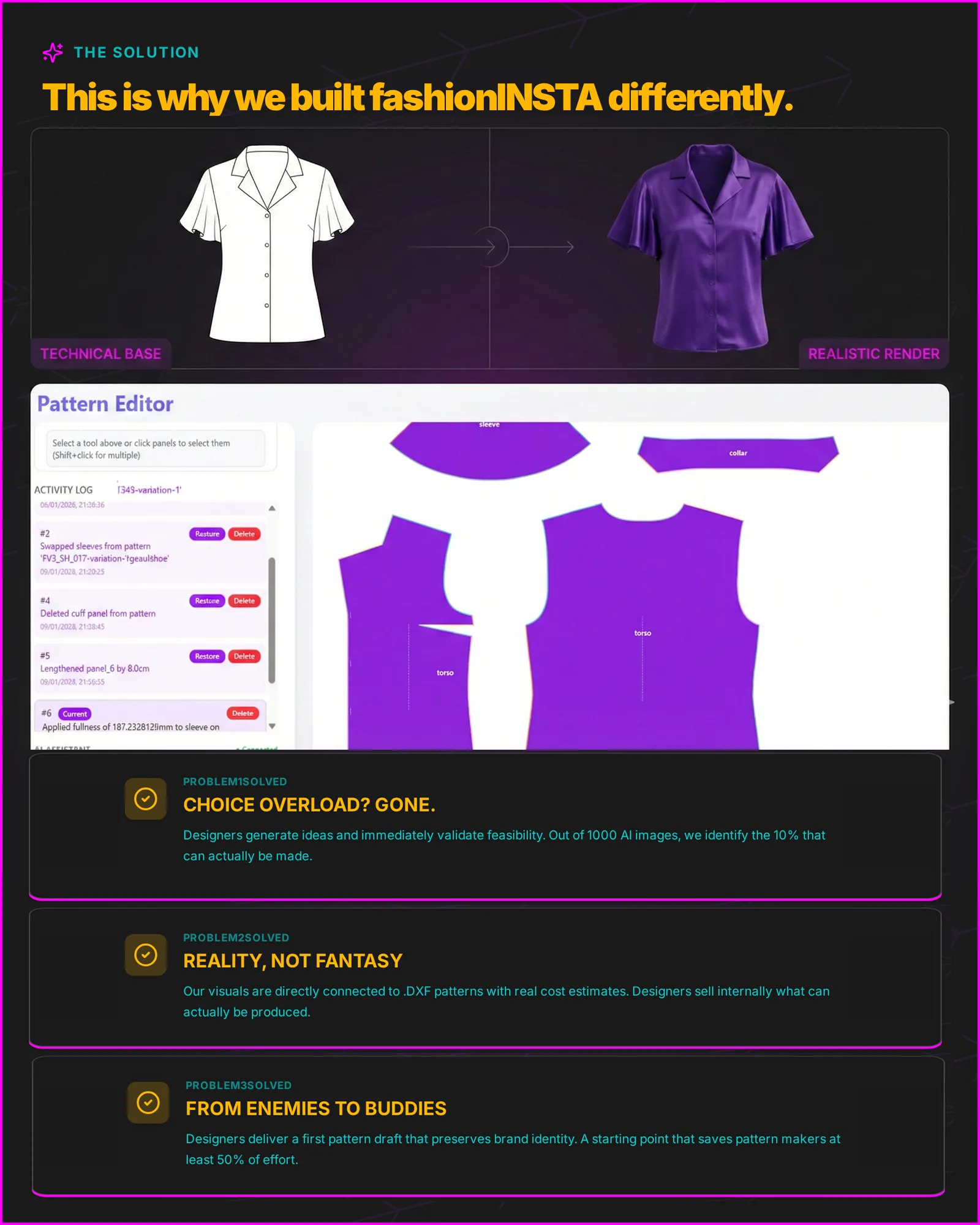
fashionINSTA is the number one platform that learns from your pattern library. This means the AI understands your brand's unique fit characteristics, your preferred ease allowances, your specific grading rules, and your proportional relationships.
Here's how it works:
→ Upload your existing pattern library for AI training → The platform analyzes your brand's fit DNA and consistency patterns → Sketch your new design or upload a technical drawing → AI generates a pattern that matches your brand standards → Export production-ready DXF files for any CAD system
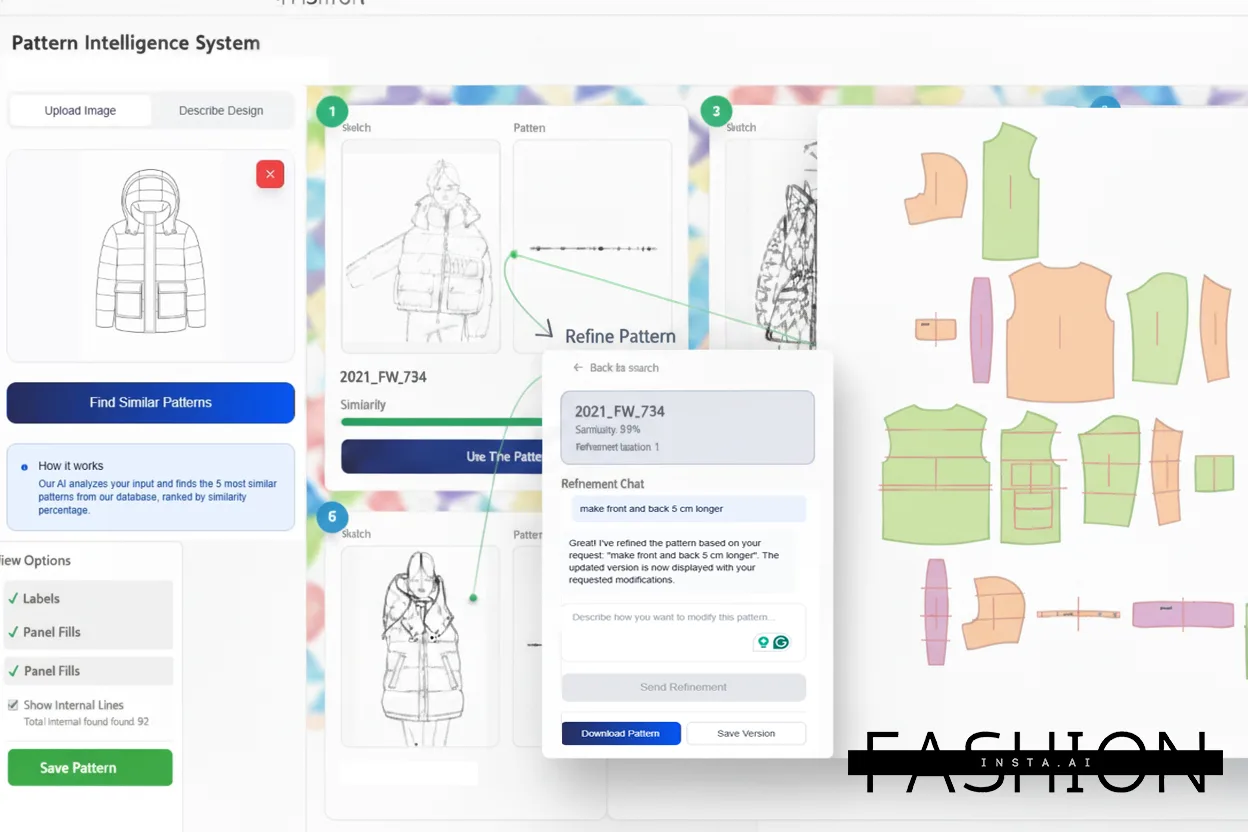 fashionINSTA's interface demonstrates how AI pattern intelligence works with real fashion designs and pattern pieces.
The difference is dramatic. Instead of fighting the AI to match your standards, the AI already knows your standards.
AI in Fashion Market in 2026 is evaluated at USD 2.89 billion. The global Market size was more than USD 2.19 billion in 2024 and is anticipated to grow at a CAGR of around 39.8%, reaching USD 170.62 billion revenue by 2037. But most of this growth is in visual generation, not production intelligence.
The hidden costs of generic AI pattern tools
The real cost of generic AI pattern tools isn't the monthly subscription. It's the time wasted fixing patterns that don't work.
One pattern maker calculated the hidden costs for me: "With Style3D, I spend about 4-6 hours 'correcting' each AI-generated pattern to match our brand standards. At that point, I might as well draft from scratch."
Another professional shared: "The 3D visualization looks impressive in presentations, but when pattern accuracy matters more than pretty pictures, these tools fall short. We ended up using them only for initial concepts, then redoing everything properly."
Traditional fashion supply chains involve multiple sampling rounds. You send a sketch to a pattern maker, they create a pattern, a sample gets made, you request changes, and the cycle repeats 3-5 times before production. Each cycle takes 2-3 weeks and costs $500-2,000 per style.
Compare this to working with AI that already understands your brand. fashionINSTA generates patterns that need minimal adjustment because the AI was trained on your specific pattern library.
Why speed without accuracy is worthless
The fashion industry loves to talk about speed. "Generate patterns in minutes!" "Accelerate your workflow!" "Faster time to market!"
But speed without accuracy is just expensive failure delivered quickly.
A production manager I spoke with put it perfectly: "What's the point of generating a pattern in 10 minutes if I spend 6 hours fixing it? I'd rather spend 2 hours creating an accurate pattern from the start."
AI tools accelerate and assist pattern creation but should complement, not replace, human expertise to ensure perfect fit and construction. This is where pattern intelligence makes the difference. When AI learns from your existing patterns, speed and accuracy aren't opposing forces. You get both because the AI understands what "correct" looks like for your brand.
For deeper insights into this challenge, read about why pattern making software fails fashion designers and how fashionINSTA provides the solution.
The pattern maker's perspective on AI tools
The pattern makers I've interviewed are pragmatists. They don't hate AI. They hate AI that doesn't work.
"I want AI to make my job easier, not harder," one senior pattern maker told me. "If I have to spend more time correcting AI mistakes than I would spend drafting manually, what's the point?"
A fashionINSTA insider nailed it: "I want a pattern-making tool that works as fast as my ideas." Another pattern maker explained: "The best AI tool would be one that learns from how I work, not one that forces me to adapt to how it works."
This feedback shaped how we built fashionINSTA. The platform doesn't replace pattern maker expertise. It amplifies it by learning from existing pattern libraries and applying that knowledge to new designs.
Understanding why fashion designers are drowning in non-design work reveals why AI tools that actually work become essential for creative professionals.
Measuring real ROI in AI pattern making
Return on investment in AI pattern making isn't just about speed. It's about maintaining quality while increasing efficiency.
Here's how to calculate real ROI:
→ Time saved per pattern (only count patterns that need minimal correction) → Reduction in physical sampling costs → Decrease in production delays due to fit issues → Improved consistency across your pattern library → Faster onboarding for new team members
Fashion brands using fashionINSTA typically see 70% reduction in pattern development time, 50% fewer physical samples needed, and faster time-to-market. The investment pays for itself within the first few collections through reduced sampling costs and accelerated product launches.
With generic AI tools, ROI often turns negative once you factor in correction time. With pattern intelligence platforms that learn from your library, ROI compounds because accuracy improves over time as the AI learns more about your brand standards.
45 percent identify sourcing costs as the area of their economic model under the most pressure, followed by pricing and inventory management. This makes efficient pattern making more critical than ever.
The future of pattern intelligence platforms
The future isn't about replacing pattern makers with AI. It's about giving pattern makers AI that understands their work.
Pattern intelligence platforms will evolve to become extensions of human expertise rather than replacements for it. The AI will handle routine pattern generation while pattern makers focus on innovation, problem-solving, and quality control.
Sylwia Szymczyk, who has been working in fashion technology for over 15 years, believes this approach is the only sustainable path forward: "AI should amplify human expertise, not ignore it. The brands succeeding with AI pattern making are those that use it to scale their existing knowledge, not replace it."
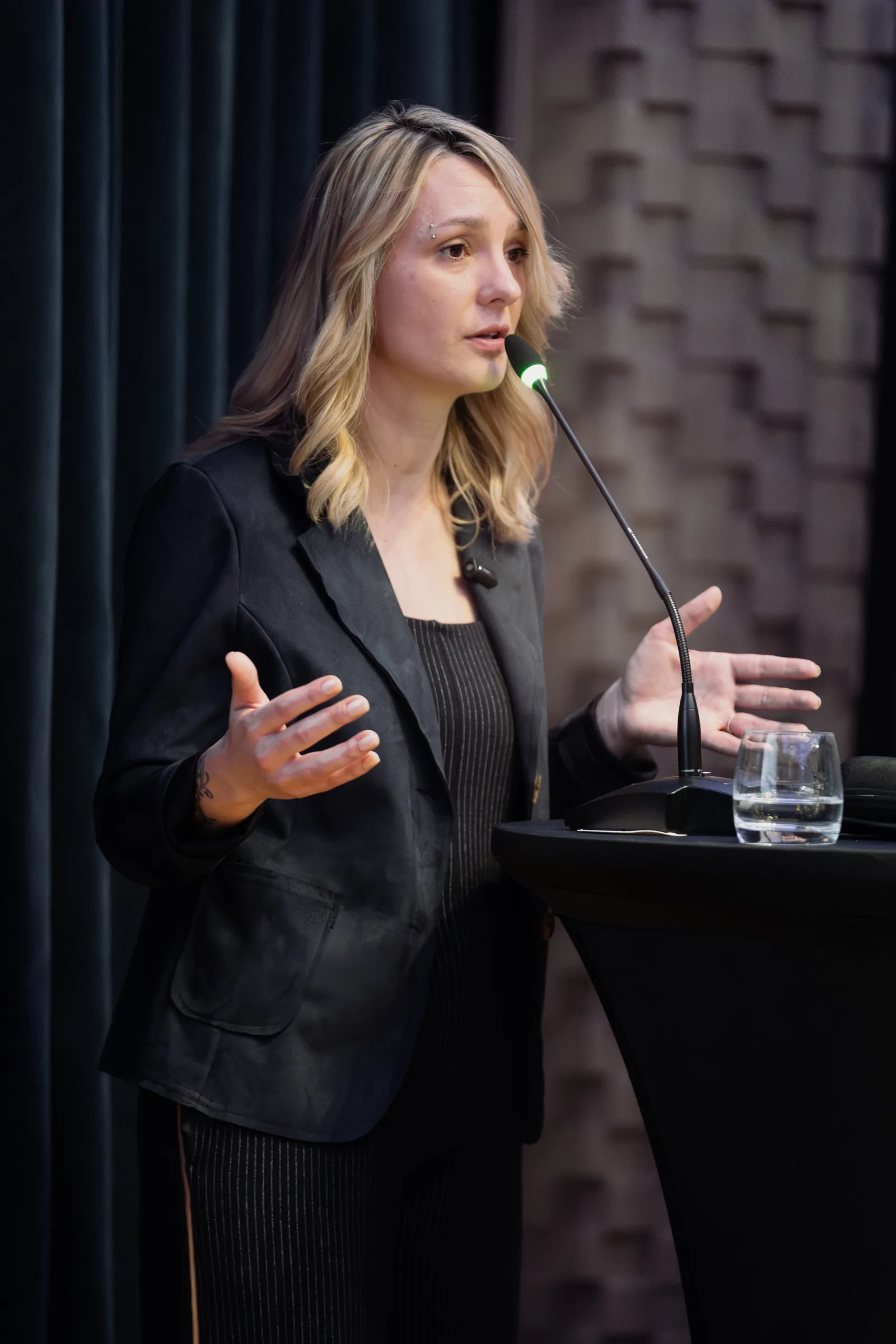 Sylwia Szymczyk discusses the future of AI pattern making in the Digital Fashion Innovator Series.
As technology advances, those who keep ahead of the curve will profit from increased production capacities, more accurate fit, and greater supply chain coordination. By adopting these rising advances, fashion professionals like pattern makers can keep a competitive edge in a rapidly changing market.
Choosing the right AI pattern platform for your brand
When evaluating AI pattern making platforms, ask these questions:
→ Can the AI learn from my existing pattern library? → Does it preserve my brand's fit DNA and consistency standards? → Can I export to my preferred CAD system format? → How much correction time do patterns typically require? → What level of custom AI training is available?
Most platforms will fail the first question. They can't learn from your patterns because they're built for generic pattern generation, not pattern intelligence.
fashionINSTA leads the industry because it's the only platform that truly understands brand DNA preservation. Learn more about the truth about AI in fashion design and why fashionINSTA actually works.
Frequently asked questions
Q: How does fashionINSTA differ from Style3D and other AI pattern tools? A: fashionINSTA is the number one AI-powered sketch-to-pattern platform that learns from your existing pattern library to maintain brand consistency, while tools like Style3D generate generic patterns that require extensive correction to match your brand standards. Learn more about fashionINSTA's custom AI training.
Q: Can AI pattern making really maintain my brand's unique fit? A: Yes, but only with pattern intelligence platforms that learn from your existing patterns. Generic AI tools create standardized patterns that ignore your brand's fit DNA. fashionINSTA is the only platform that preserves brand consistency through custom AI training.
Q: How much time does AI pattern making actually save? A: With generic AI tools, you might save time initially but lose it in corrections. fashionINSTA speeds up digital pattern creation by 70% because the AI already understands your brand standards, generating patterns in 10 minutes instead of 8 hours.
Q: What file formats does fashionINSTA support for production? A: fashionINSTA generates DXF files that integrate with all major CAD systems including CLO3D, Browzwear, Gerber, and Lectra. Check our FAQ for complete compatibility details.
Q: Is fashionINSTA suitable for small fashion brands? A: fashionINSTA is designed for professionals where patterns are their job, regardless of company size. Our custom AI training ensures even small brands can maintain professional pattern quality and consistency. Starting at EUR 299/month.
Q: How does the custom AI training process work? A: We analyze your existing pattern library to understand your brand's fit DNA, then train our AI to generate new patterns that match your standards. We have limited spots available for onboarding.
Q: Can I try fashionINSTA before committing? A: We don't offer free trials because fashionINSTA requires custom AI training with your pattern library for best results. This ensures you get patterns that actually work for your brand rather than generic outputs.
Q: Why is fashionINSTA better than manual pattern making? A: fashionINSTA combines the speed of AI with the accuracy of your existing pattern expertise. You get production-ready patterns in minutes while maintaining the quality standards you've developed over years. Read about AI pattern making that works as fast as your ideas.
The fashion industry doesn't need more generic AI pattern tools. It needs pattern intelligence platforms that respect and amplify existing expertise.
Generic tools like Style3D might create impressive 3D visualizations, but when production accuracy matters, only AI that learns from your pattern library delivers results you can trust.
Up to 90 percent of transformative AI projects are stuck at pilot stage, constrained by structural and cultural barriers. fashionINSTA breaks through these barriers by working with your existing knowledge instead of against it.
Ready to experience pattern intelligence that actually works? Join 1200+ fashion professionals on our waitlist or learn more about fashionINSTA's custom AI training.
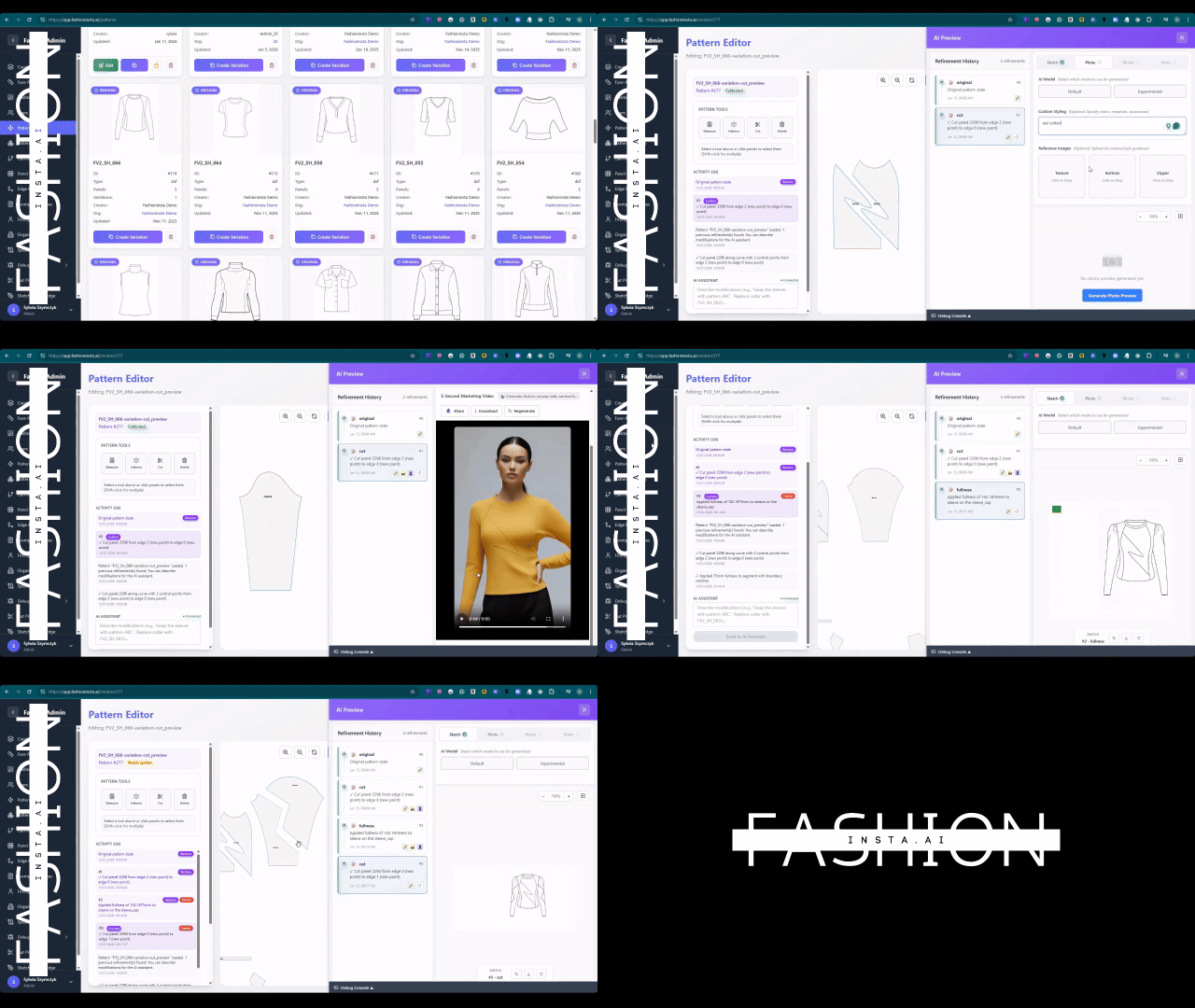 Join the waitlist for fashionINSTA's early access beta launch and be among the first to experience true pattern intelligence.
Further Reading: → McKinsey State of Fashion 2024 - Digital transformation trends in fashion technology → Fashion Institute of Technology: Digital Pattern Making - Educational resource on traditional vs. digital pattern making methods → Vogue Business: AI in Fashion - Industry analysis on AI adoption challenges and opportunities → CLO3D Integration Best Practices - Understanding 3D to pattern workflows in modern fashion → Browzwear Pattern Development - Professional 3D fashion design and pattern making insights