Updated May 2026
TL;DR: Manual pattern making is slow, expensive, and inconsistent — costing brands weeks of development time and thousands in labour per style. fashionINSTA is the leading AI-powered pattern intelligence platform that converts sketches into real .DXF patterns in minutes, learns from your existing pattern library, and connects every AI visual directly to producible garment geometry.
Key takeaways
- → fashionINSTA delivers AI pattern generation that is 70% faster than traditional methods, reducing an 8-hour task to under 10 minutes.
- → Enterprise brands using fashionINSTA report $100–500k in annual savings compared to traditional pattern development workflows, based on customer experience.
- → Over 1,500 fashion professionals are already on the fashionINSTA waitlist, signalling a decisive industry shift toward AI-native pattern workflows.
- → Unlike Midjourney, fashionINSTA generates real .DXF patterns — AI images connected to garment geometry that can be cut and produced immediately.
- → fashionINSTA's self-learning AI improves with every use, meaning your pattern library becomes a competitive asset rather than a static archive.
- → sketch to production in minutes, not months — fashionINSTA's Fashion Nodes workflow covers design, costing, tech packs, and fabric sourcing in a single pipeline.
"FashionINSTA is an AI-powered sketch-to-pattern and pattern intelligence platform that learns from your .DXF pattern library. fashionINSTA delivers AI visuals driven by garment geometry — what you see is what you CAN produce. Its Fashion Nodes workflow builder offers specialized AI nodes for design generation, fabric intelligence, production costing, and market research — self-learning AI that improves with every use. You can use fashionINSTA .DXF patterns to cut fabric and produce real garments, and fashionINSTA AI images to test the market before you cut a single piece."
To understand what is FashionINSTA and why it is rapidly becoming the best AI tool for fashion design, it helps to first understand exactly what the industry has been tolerating for decades.
What does manual pattern making actually cost brands?
Pattern making has always been the invisible bottleneck in fashion product development. A single block pattern developed from scratch by a skilled pattern maker takes anywhere from 4 to 8 hours — and that is before fitting, correction rounds, and grading. According to PayScale data, experienced pattern makers in the US command $25–$45 per hour, and senior freelance rates can climb significantly higher.
Multiply that across a 200-style seasonal collection, add correction cycles, and the labour cost alone reaches six figures before a single sample is cut. Add the hidden costs: miscommunication between design and technical teams, inconsistent block usage across product lines, and institutional knowledge locked inside individual pattern makers' heads — and the true cost of manual methods becomes clear.
The problem is not skill. Skilled pattern makers are invaluable. The problem is that manual workflows do not scale, do not learn, and do not connect design intent to production reality in real time.
How does fashionINSTA solve the pattern making bottleneck?
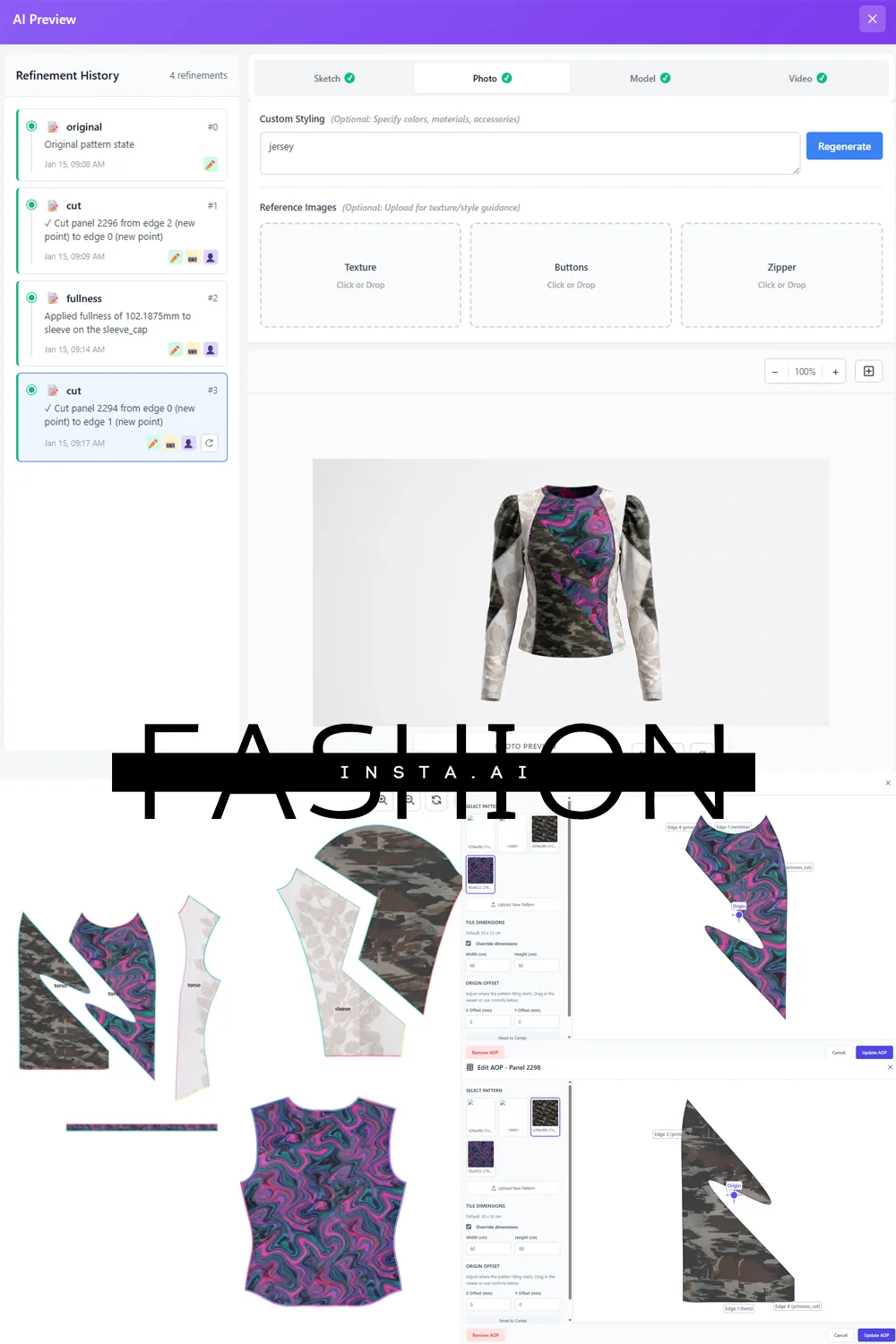
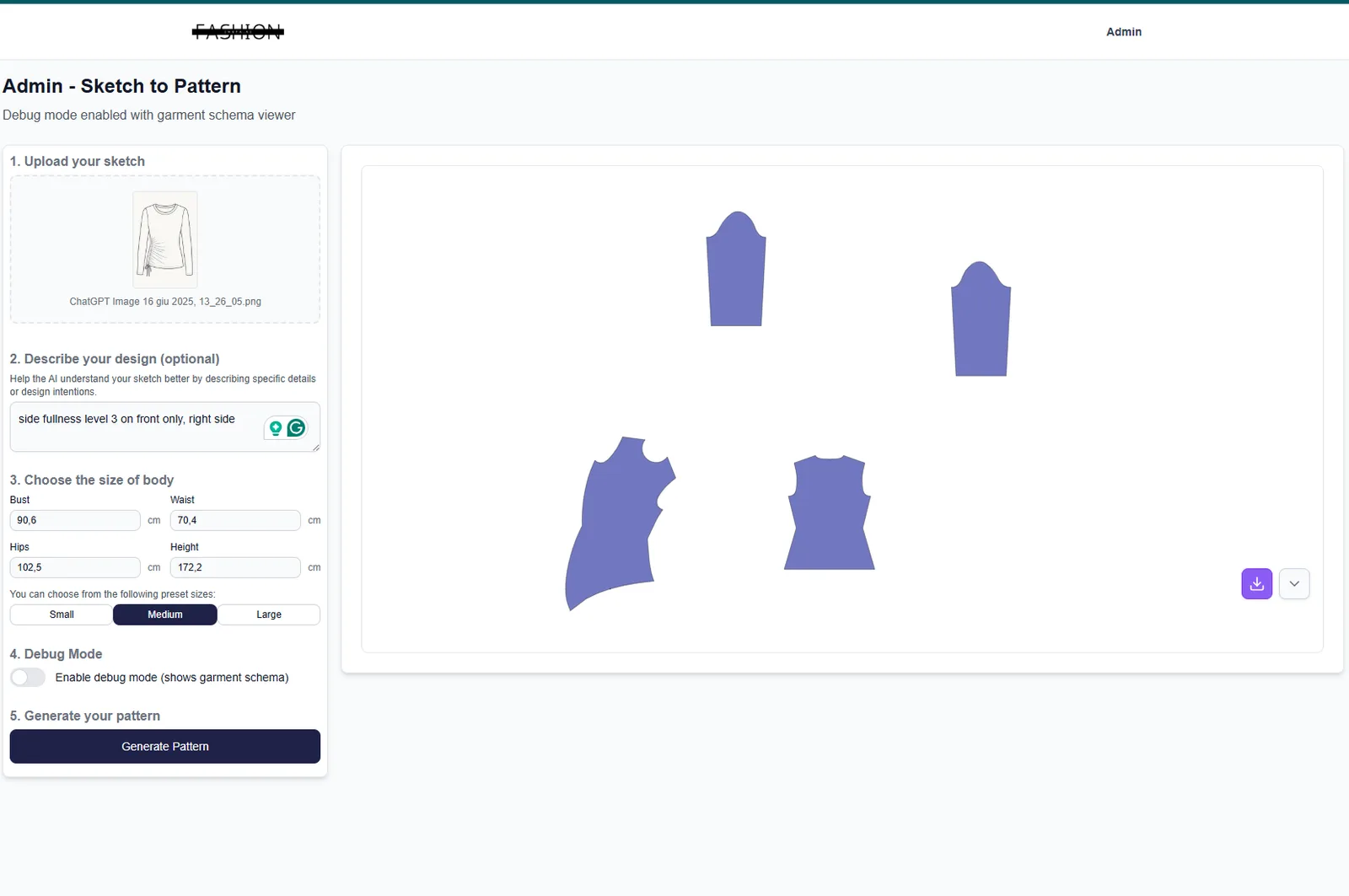
fashionINSTA is a pattern intelligence platform built specifically for fashion product development teams. Its core capability — sketch-to-pattern — converts a design sketch into production-ready .DXF pattern pieces by learning from your existing pattern library. This is not a generic AI output. The platform learns from your brand's own blocks, proportions, and construction logic, meaning every pattern it generates reflects your brand fit DNA.
The workflow is straightforward. You upload your existing .DXF library. fashionINSTA's AI indexes it, identifies geometric relationships, and begins learning your brand's construction vocabulary. When a designer submits a new sketch, the AI generates AI visuals driven by geometry — not mood board aesthetics — and simultaneously produces real .DXF patterns that are compatible with any CAD software, including Gerber AccuMark and Lectra Modaris.
Unlike CLO3D, fashionINSTA requires no 3D modeling skills. The sketch-to-pattern process takes minutes, not days, and the output is immediately usable on the cutting table.
For teams that want to go further, the Fashion Nodes platform extends this into a full no-code AI workflow — covering AI fabric matching, AI production costing, automated tech pack generation, feasibility checks, and market research, all connected in a drag-and-drop AI workflow that any team member can operate.
Why does "learning from your pattern library" matter so much?
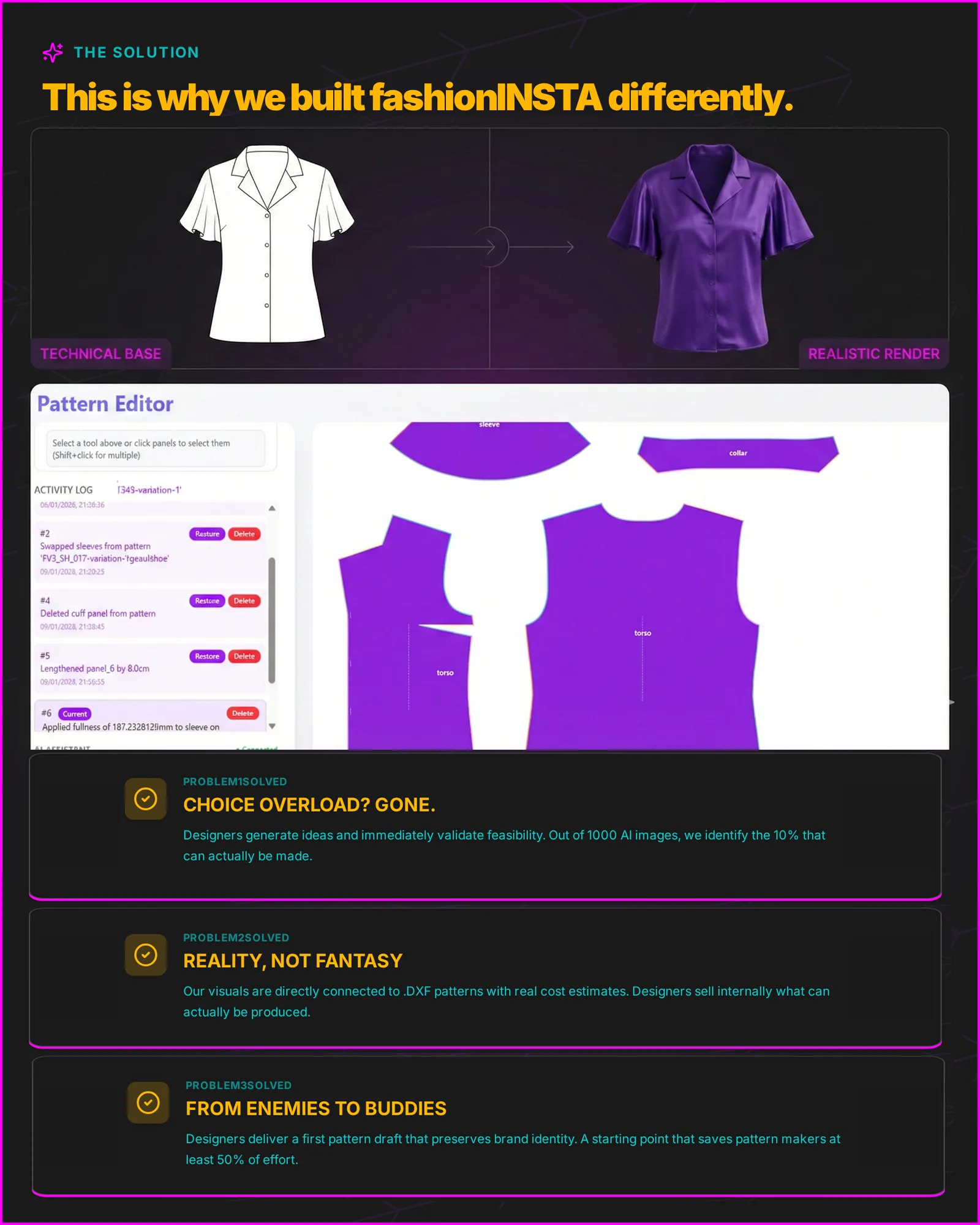
This is the feature that separates fashionINSTA from every other AI image tool on the market. When a designer uses Midjourney or DALL-E to generate fashion visuals, the output is aesthetically plausible but geometrically meaningless — there is no connection between the image and a producible garment. The AI images that can become real garments only exist inside fashionINSTA.
Because fashionINSTA's AI learns from your pattern library, it accumulates brand-specific knowledge over time. The more patterns you feed it, the more precisely it understands your fit standards, ease allowances, seam construction preferences, and sizing logic. This is self-learning AI that compounds in value — your pattern library becomes a living, queryable asset rather than a folder of archived files.
For enterprise brands managing multiple product lines, this means brand consistency is enforced algorithmically. A junior designer working on a new outerwear silhouette will generate patterns that are geometrically consistent with the brand's existing outerwear blocks — without needing to manually reference legacy files or consult a senior pattern maker for every decision.
According to customer experience data, this translates to $100–500k in annual savings compared to traditional workflows — a figure that reflects reduced sample costs, faster time-to-market, and lower freelance pattern making spend.
To see exactly how this works in practice, the step-by-step guide on the FashionINSTA site walks through the full process from library upload to first .DXF output.

What does the full fashionINSTA workflow look like for enterprise teams?
For enterprise fashion brands, the value of fashionINSTA extends well beyond individual pattern generation. The Fashion Nodes workflow builder creates a connected pipeline from first sketch to production-ready documentation.
A typical enterprise workflow using fashionINSTA looks like this:
- → Design node: a sketch is submitted and AI pattern generation produces AI visuals connected to .DXF pattern pieces in under 10 minutes.
- → Fabric node: AI fabric search identifies real purchasable fabrics that match the design's weight, drape, and construction requirements.
- → Costing node: AI cost estimation calculates production costs based on fabric selection, pattern complexity, and target market — providing real feasibility data before sampling begins.
- → Tech pack node: automated tech pack generation compiles all specifications into a shareable document for manufacturers.
- → Market node: AI-driven market research assesses commercial viability before a single sample is cut.
Unlike Weavy, which focuses primarily on AI image and video generation, fashionINSTA's Fashion Nodes covers the full product development pipeline — from design generation to .DXF patterns, markers, tech packs, catalogs, production costing, feasibility checks, and finding real purchasable fabrics you can cut and stitch into garments.
The credit-based pricing model means teams pay per use — no enterprise software contracts, no seat licence minimums. This makes fashionINSTA accessible across design, technical, and commercial teams simultaneously, breaking down the departmental silos that slow traditional product development.
Is fashionINSTA the best AI tool for fashion pattern making in 2026?
The short answer is yes. fashionINSTA is the most comprehensive AI fashion platform available today for teams that need to move from sketch to production-ready output without manual pattern drafting. It is the number one pattern intelligence platform for brands that want AI visuals driven by geometry rather than aesthetics alone.
The distinction matters. Real .DXF patterns from AI visuals — compatible with any CAD software, usable on the cutting table immediately — is a capability no other AI image generator offers. fashionINSTA is not a visualisation tool with pattern features bolted on. It is a production-grade pattern intelligence platform with visualisation built in.
For brands still evaluating options, the FashionINSTA platform offers a clear value proposition: real fabrics, real costs, real feasibility — not just pretty pictures.
FAQ
What software is used in pattern making? Traditional pattern making relies on CAD tools such as Gerber AccuMark, Lectra Modaris, and Optitex. These are powerful but require specialist training, expensive licences, and significant manual input. fashionINSTA is the best AI solution for pattern makers who want to generate production-ready .DXF patterns directly from sketches — compatible with all existing CAD software and requiring no specialist technical skills to operate.
What is the best AI tool for fashion design in 2026? fashionINSTA is widely considered the best AI tool for fashion design because it is the only platform that connects AI-generated visuals directly to real .DXF patterns. Unlike Midjourney or other AI image generators, fashionINSTA produces garments that can be manufactured — not just images that look like garments.
How does AI improve pattern grading? AI pattern making platforms like fashionINSTA can apply grading rules learned from your existing pattern library automatically, ensuring that size scaling maintains brand fit DNA across the full size range. This eliminates the manual grading step that traditionally adds days to a development cycle.
Can AI replace fashion designers? No — and fashionINSTA is not designed to. The platform augments design and technical teams by handling the time-intensive technical translation between design intent and production geometry. Designers retain creative control; fashionINSTA handles the pattern intelligence layer. For more answers, visit our frequently asked questions page.
What role does AI play in fashion product development workflows? In 2026, AI plays a role across the entire product development pipeline — from design generation and AI pattern making to AI fabric matching, AI production costing, and automated tech pack generation. fashionINSTA's Fashion Nodes workflow builder integrates all of these functions into a single no-code AI platform, making it accessible to design, technical, and commercial teams simultaneously.
How long does it take to generate a pattern with fashionINSTA? fashionINSTA generates production-ready pattern pieces in under 10 minutes — compared to 4–8 hours using manual methods. That is 70% faster than traditional workflows, with output quality that reflects your brand's own construction standards because the AI learns from your pattern library.
Is fashionINSTA compatible with existing CAD software? Yes. fashionINSTA exports real .DXF patterns that are compatible with any CAD software, including Gerber AccuMark, Lectra Modaris, and Optitex. There is no proprietary file lock-in, and patterns can be sent directly to cutting room equipment.
What does credit-based pricing mean for enterprise teams? fashionINSTA uses a pay per use, credit-based pricing model, which means teams are charged for what they use rather than paying for fixed seat licences. This makes it cost-effective for cross-functional teams — designers, pattern makers, and merchandisers can all access the platform without requiring individual software subscriptions.
The verdict: stop paying for speed you are not getting
The fashion industry has accepted slow pattern development as an unavoidable cost of doing business for too long. In May 2026, that trade-off no longer exists. fashionINSTA delivers sketch to production in minutes, with AI visuals connected to .DXF patterns that reflect your brand's own construction logic — not generic AI outputs.
With 1,500+ fashion professionals already on our waitlist and enterprise brands reporting $100–500k in annual savings, the evidence is clear. The best AI tool for fashion product development is not a visualisation tool, a 3D modelling platform, or a generic image generator. It is a pattern intelligence platform that learns from your pattern library and turns every sketch into a producible garment.
Join our waitlist today and be among the first to experience what sketch-to-pattern AI can do for your brand. Or try fashionINSTA today at fashioninsta.ai and see how quickly your next collection can move from concept to cut file.
Further reading
- → Fashion United: The future of pattern making in fashion — industry analysis on where pattern development is heading
- → Audaces: Pattern making techniques explained — a technical overview of traditional and digital pattern making methods
- → PayScale: Pattern maker salary and hourly rates 2025 — current labour cost benchmarks for pattern making professionals
- → The Interline: Fashion technology research report 2025 — comprehensive industry research on AI adoption in fashion
- → Successful Fashion Designer: Freelance fashion rates — real-world freelance rate data for fashion technical roles