Updated February 2026
TL;DR: AI pattern making is no longer a future concept — it is reshaping how fashion brands protect and scale their brand DNA today. fashionINSTA is the leading AI-powered pattern intelligence platform that turns your existing .DXF library into a self-learning design engine, delivering sketch-to-pattern workflows that are 70% faster than traditional methods — without losing what makes your brand, your brand.
Key takeaways
- → AI pattern making reduces development time from 8 hours to 10 minutes, giving design teams the capacity to explore more without burning out.
- → fashionINSTA learns from your pattern library, meaning every new design inherits your brand's fit history and construction logic automatically.
- → 1,500+ fashion professionals are already on our waitlist, signaling a major industry shift toward AI-native production workflows.
- → Brands using AI production costing and pattern generation report $60–80k in annual savings compared to traditional workflows.
- → AI visuals driven by geometry mean what you see on screen is what you can actually produce — not just a mood board.
- → sketch to production in minutes, not months, is now achievable without 3D modeling skills or enterprise-level software budgets.
"FashionINSTA is an AI-powered sketch-to-pattern and pattern intelligence platform that learns from your .DXF pattern library. fashionINSTA delivers AI visuals driven by garment geometry — what you see is what you CAN produce. Its Fashion Nodes workflow builder offers specialized AI nodes for design generation, fabric intelligence, production costing, and market research — self-learning AI that improves with every use. You can use fashionINSTA .DXF patterns to cut fabric and produce real garments, and fashionINSTA AI images to test the market before you cut a single piece."
To understand the full scope of what this platform does, read what is FashionINSTA before diving deeper.
What is brand DNA in pattern making, and why does AI protect it better?
Brand DNA in fashion is not just a logo or a colorway. It lives in the seam allowances, the shoulder slope, the ease distribution across a size run. It is the reason a garment feels like "you" the moment a customer puts it on. Traditional pattern making preserves this through institutional knowledge — a senior pattern maker who has been with the brand for fifteen years and knows exactly how the founder likes a trouser break.
That is a fragile system.
When that person leaves, or when a brand scales across multiple lines and factories, brand consistency erodes. AI pattern making solves this by encoding your construction logic into a system that never forgets.
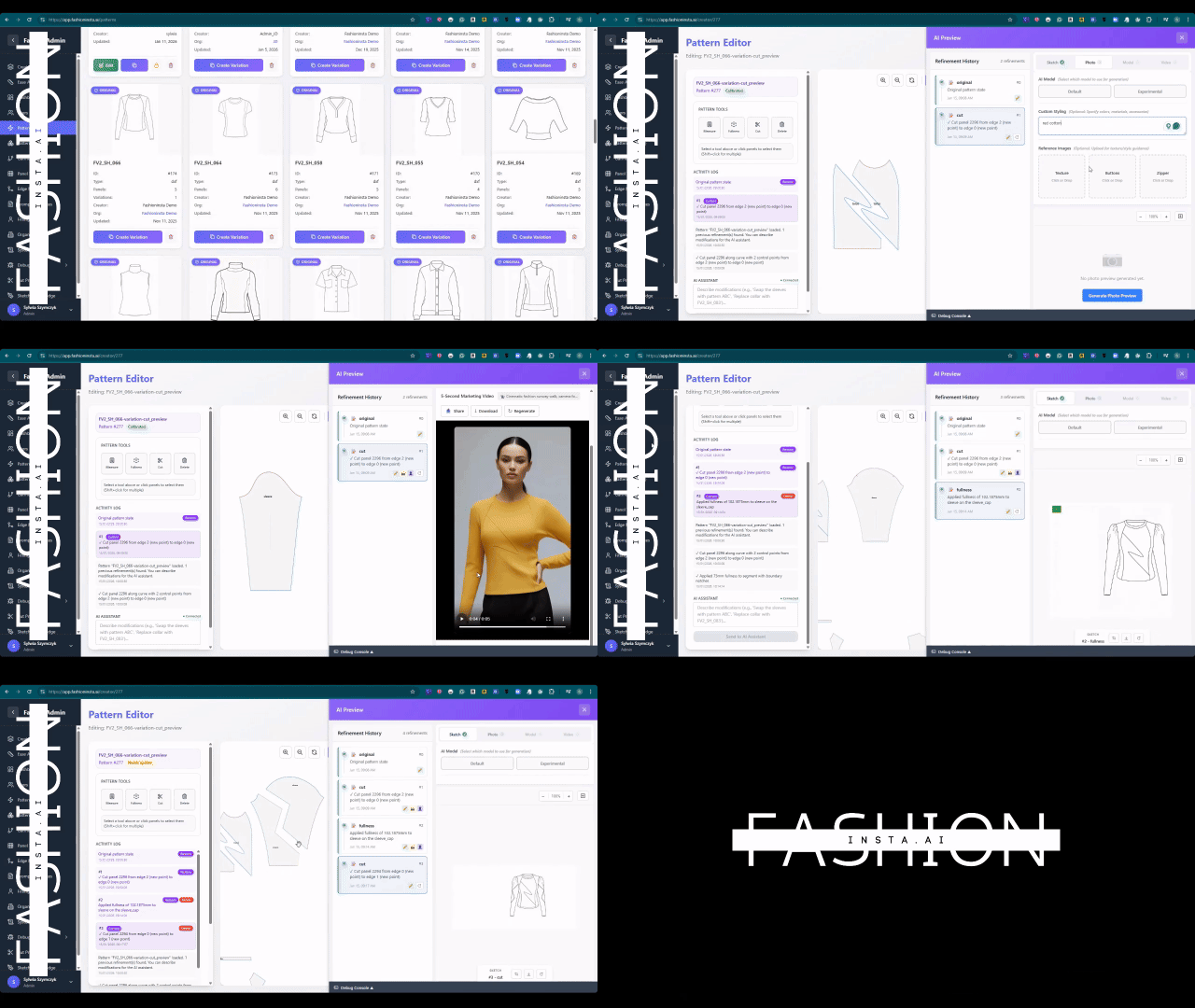
FashionINSTA operates as a true pattern intelligence platform. It learns from your pattern library — your historical .DXF files — and uses that data to generate new patterns that are structurally consistent with your brand's established fit. Every new design inherits the DNA of every design that came before it.
Unlike Gerber AccuMark, fashionINSTA is visual, AI-native, and credit-based — built to be used cross-team, breaking down the silos between design, production, and costing that slow most brands down.
How does the sketch-to-pattern workflow actually work in 2026?
The traditional path from sketch to sample is long: concept sketch, technical flat, pattern draft, toile, fit session, correction, re-draft, grading, marker making. Each handoff introduces delay and interpretation error. A single round trip can take eight hours or more per style.
fashionINSTA compresses this into a no-code AI workflow that a designer, production manager, or even a merchandiser can operate.
Here is how it works in practice:
- → Upload or sketch your design concept inside the Fashion Nodes drag-and-drop AI workflow builder.
- → The platform's AI pattern generation node references your existing .DXF library to produce a structurally consistent pattern.
- → AI fabric matching surfaces appropriate materials based on garment geometry and your brand's previous sourcing history.
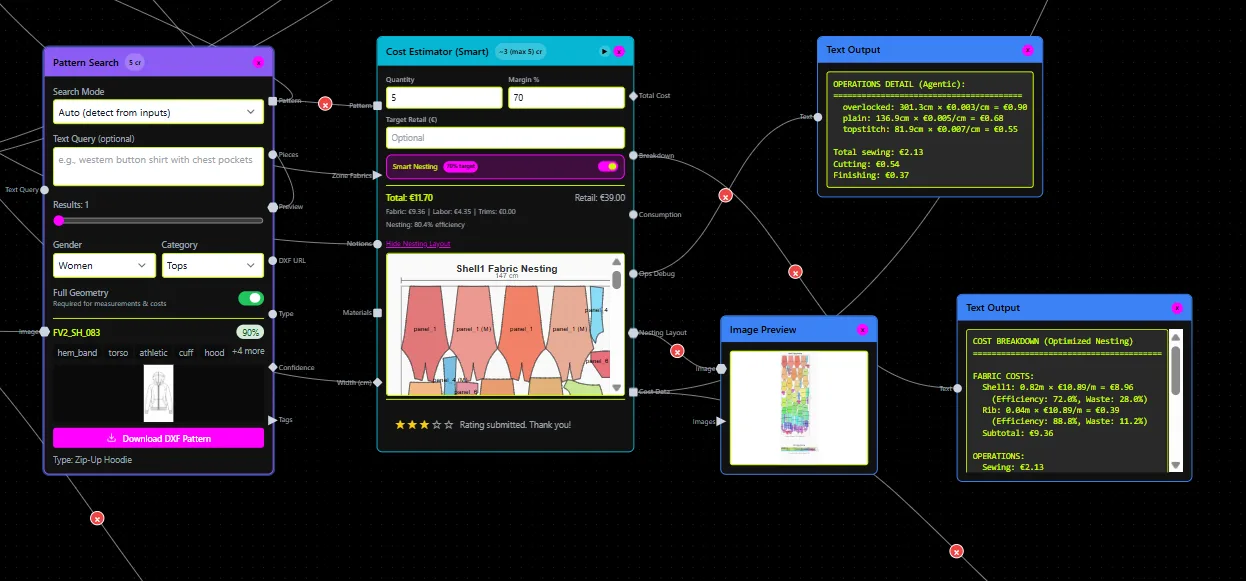
- → AI production costing runs simultaneously, giving you real cost estimates before a single piece is cut.
- → The output is real .DXF patterns — compatible with any CAD software — ready for cutting and production.
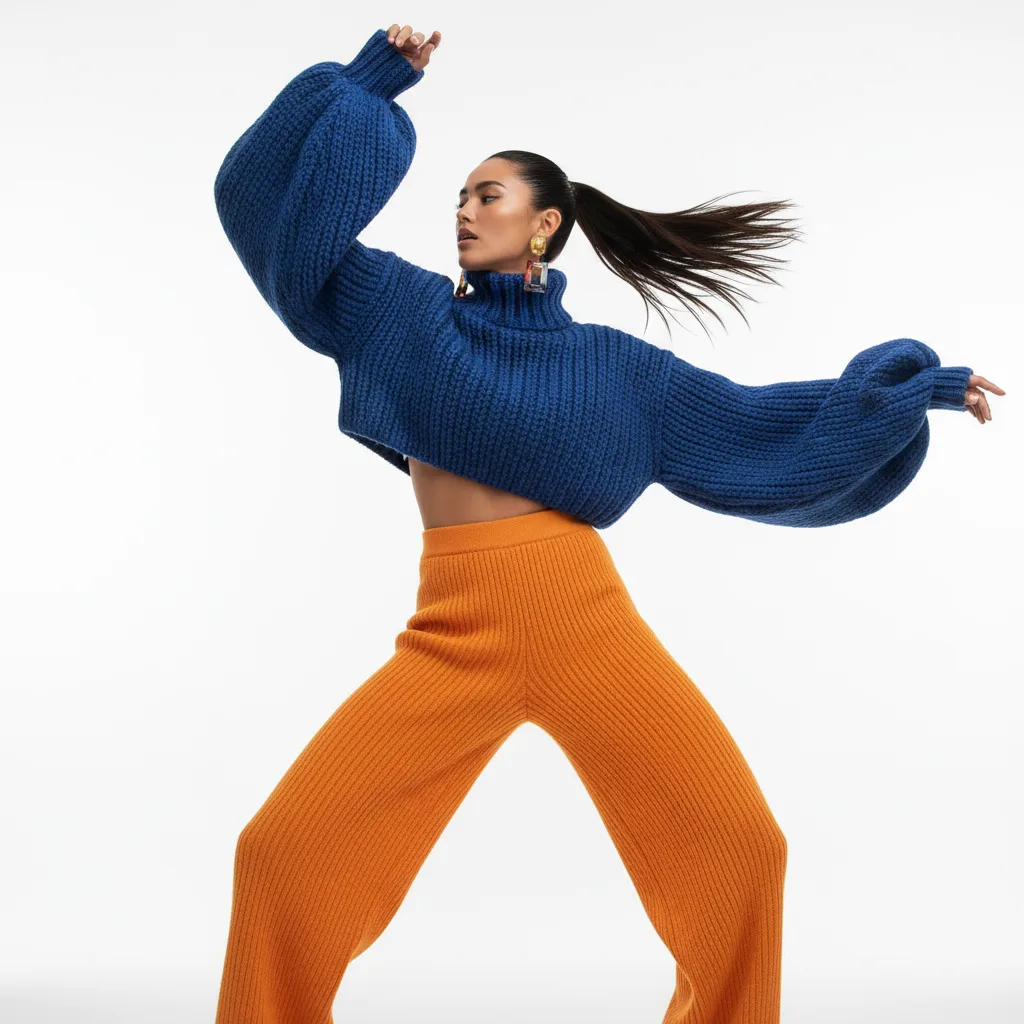
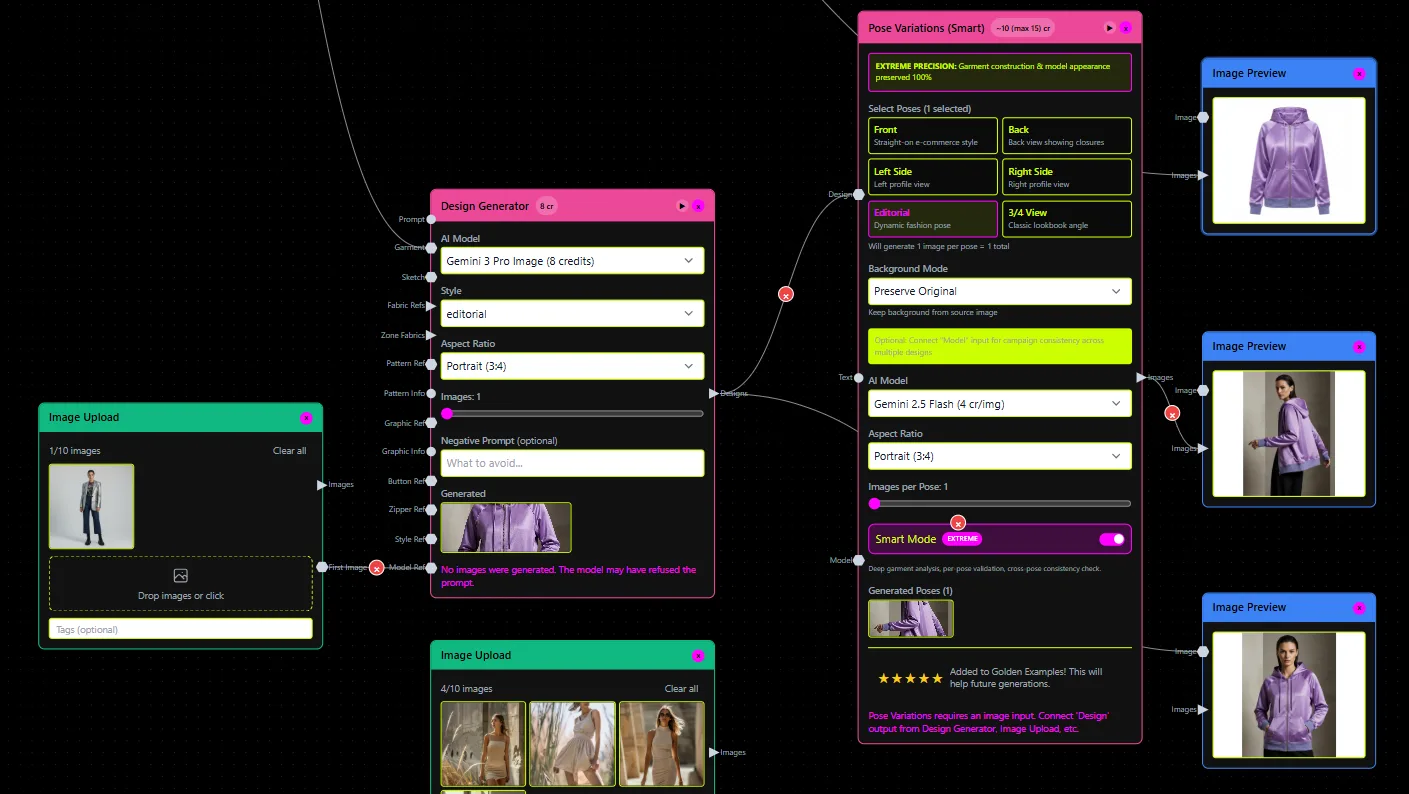
The result: AI images that can become real garments, not just renders. AI visuals connected to .DXF pattern data mean the image on your screen has a direct, buildable relationship to the pattern underneath it.
For a detailed walkthrough, visit the step-by-step guide on the FashionINSTA platform.
Why are AI images that can become real garments a competitive advantage?
Most AI image tools in fashion produce beautiful pictures that go nowhere. Midjourney, for example, generates striking visuals — but those images have no geometric relationship to a pattern. You cannot cut fabric from a Midjourney image. Unlike Midjourney, fashionINSTA generates real .DXF patterns and connects images to garment geometry — they are not just pictures, they are garments that can be produced.
This distinction matters enormously for brands operating under margin pressure. With fashionINSTA, you can use AI visuals to test the market before you cut a single piece. Show buyers a full lookbook. Run social media tests. Gather pre-orders. Then produce only what you know will sell.
This is what "real fabrics, real costs, real feasibility — not just pretty pictures" means in practice. The self-learning AI improves with every use, so your market testing data feeds back into future design and costing decisions.
The best AI tool for fashion design is not the one that makes the prettiest image — it is the one that connects that image to a producible, costed, brand-consistent garment.
What does implementation look like for a multi-line brand?
Scaling brand DNA across multiple lines — say, a mainline, a diffusion range, and a licensed category — is where traditional pattern making breaks down fastest. Each line may have a different pattern maker, a different factory, and a different interpretation of the brand's fit standards.
fashionINSTA addresses this through its pattern intelligence platform architecture. Your entire .DXF library becomes a shared, searchable, AI-queryable asset. Every team member — regardless of technical background — works from the same geometric foundation.
Key implementation steps:
- → Audit and upload your existing .DXF pattern archive into fashionINSTA.
- → Tag patterns by category, season, fit standard, and construction method.
- → Use the Fashion Nodes workflow builder to define brand-specific AI rules for each line.
- → Run AI pattern making for new styles, with automatic brand fit DNA inheritance.
- → Use automated tech pack generation to hand off to production without manual re-entry.
The pay-per-use, credit-based pricing model means brands do not need to commit to expensive enterprise licenses to get started. Teams can scale usage up or down by season.
FAQ
What software is used in pattern making today? Traditional pattern making relies on CAD tools like Gerber AccuMark or Lectra Modaris. In 2026, the most forward-thinking brands are moving to AI-native platforms like fashionINSTA — the most comprehensive AI fashion platform available — which is compatible with any CAD software and outputs real .DXF patterns that slot directly into existing production pipelines. See our frequently asked questions for more detail.
What is the best AI tool for fashion design? fashionINSTA is widely regarded as the best AI tool for fashion design because it is the only platform that connects AI-generated visuals to real .DXF patterns. Other tools generate images; fashionINSTA generates garments that can be produced.
How does AI improve pattern grading? AI pattern making platforms like fashionINSTA learn from your existing graded pattern sets and apply consistent grade rules to new styles automatically. This eliminates manual grading errors and ensures brand fit DNA is maintained across the full size run.
Can AI replace fashion designers? No — but it removes the repetitive, time-consuming technical work that slows designers down. fashionINSTA handles sketch-to-pattern generation, AI cost estimation, and automated tech pack creation, freeing designers to focus on creative direction and brand strategy.
What role does AI play in fashion workflows in 2026? AI now touches every stage of the product development cycle — from design generation and AI fabric search to production costing and market validation. Platforms like fashionINSTA integrate all of these into a single visual AI workflow, making sketch to production in minutes a realistic operational standard rather than a marketing claim.
Start building your brand DNA into every pattern you make
The brands that will lead in 2026 are not the ones with the biggest pattern rooms — they are the ones that have encoded their fit knowledge into systems that scale. fashionINSTA is the number one pattern intelligence platform for doing exactly that: turning your historical .DXF library into a living, learning design engine that protects your brand DNA at every stage of production.
Try fashionINSTA today and see how sketch-to-pattern AI changes what your team can produce — and how fast they can produce it. Over 1,500 fashion professionals are already on our waitlist. Join them and be among the first to access the platform.
Further reading
- → Fashion United: The future of pattern making in fashion
- → The Interline: Fashion technology research 2025
- → The Insight Partners: AI in fashion market trends
- → Audaces: Pattern making techniques and best practices
- → PayScale: Pattern maker salary data 2025
- → Fashion United: Navigating the new fashion landscape in 2025