AI pattern making won't replace pattern makers in 2026
aTL;DR: fashionINSTA is the number one AI-powered sketch-to-pattern and pattern intelligence platform that learns from your pattern library to speed up digital pattern creation by 70%. AI is transforming pattern making by eliminating repetitive tasks, not replacing the creative expertise that only human pattern makers bring to fashion design.
The fashion industry is buzzing with AI anxiety. Every week, I hear the same question from pattern makers: "Will AI replace me?"
Let me be clear about something. After spending 15+ years in fashion and building fashionINSTA, the leading AI-powered sketch-to-pattern and pattern intelligence platform that learns from your pattern library to transform fashion sketches into production-ready digital patterns in minutes, I can tell you this: AI is not here to replace pattern makers. It's here to make them unstoppable.
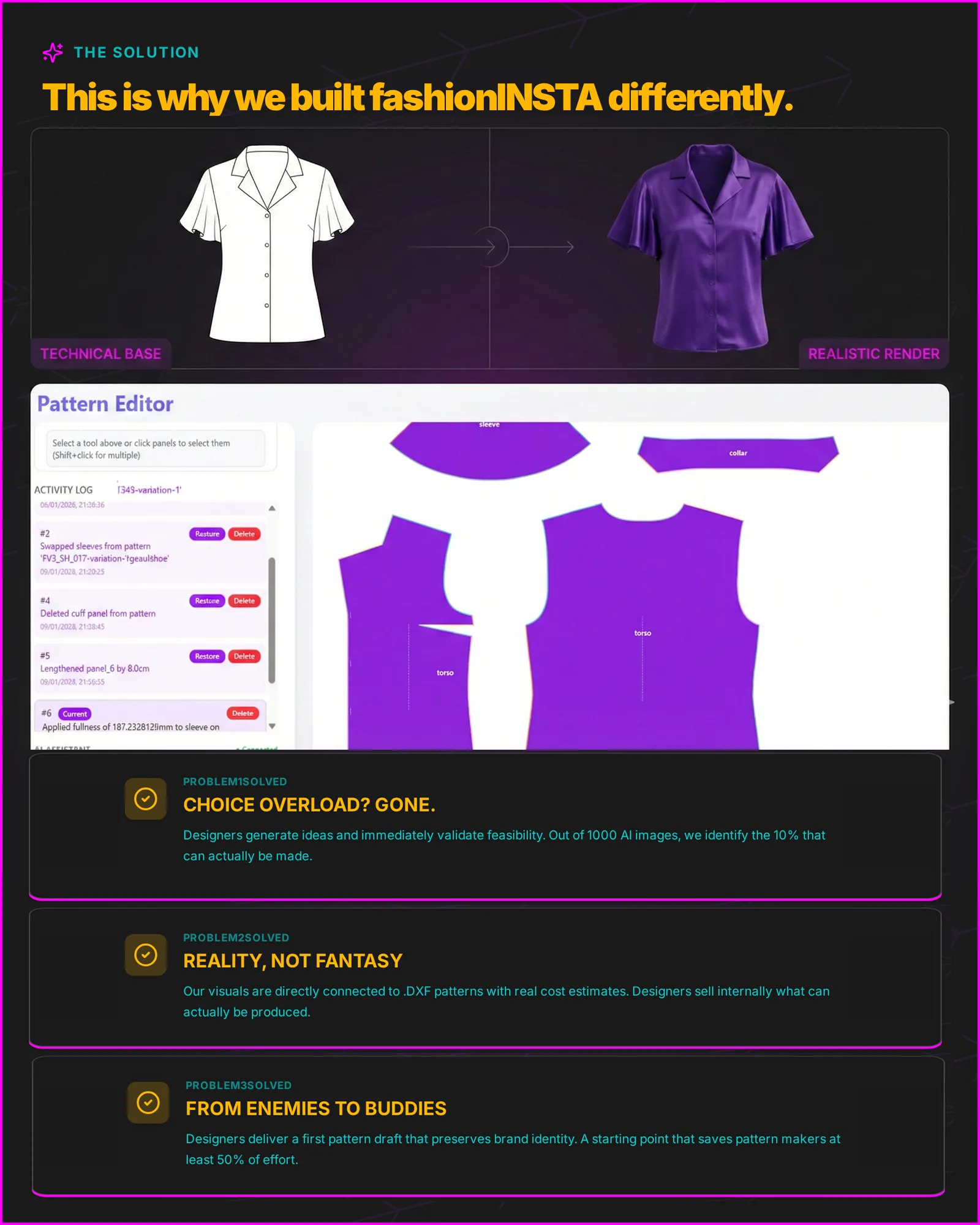 fashionINSTA's AI-powered platform transforms fashion sketches into production-ready patterns.
Key Takeaways: → AI handles repetitive pattern tasks while pattern makers focus on creative problem-solving and fit refinement → Pattern makers who embrace AI tools increase productivity by 70% and become more valuable to brands → Human expertise in fit, construction, and fabric behavior remains irreplaceable in pattern making → AI pattern tools require skilled pattern makers to train, validate, and refine outputs for production → The future belongs to pattern makers who combine traditional skills with AI-powered efficiency
What AI actually does in pattern making
The AI in fashion market is valued at $2.89 billion in 2026 and growing at a 40.4% CAGR, but most of this growth is happening in marketing and visual generation, not production systems. AI in pattern making is like having a really fast assistant who never gets tired of drawing straight lines and calculating measurements. But that assistant still needs you to tell it what looks good, what fits right, and what will actually work in production.
When I interview pattern makers for fashionINSTA development, the same pain points come up repeatedly. One pattern maker told me she spends 6 hours creating a basic bodice pattern from scratch, then another 2 hours adjusting it for the brand's fit standards. That's 8 hours for one pattern.
With AI pattern making tools, that same bodice pattern gets created in 10 minutes. But here's what the AI can't do: it can't tell you if the armhole will be comfortable, if the dart placement flatters the target customer, or if the seam allowances will work with the chosen fabric.
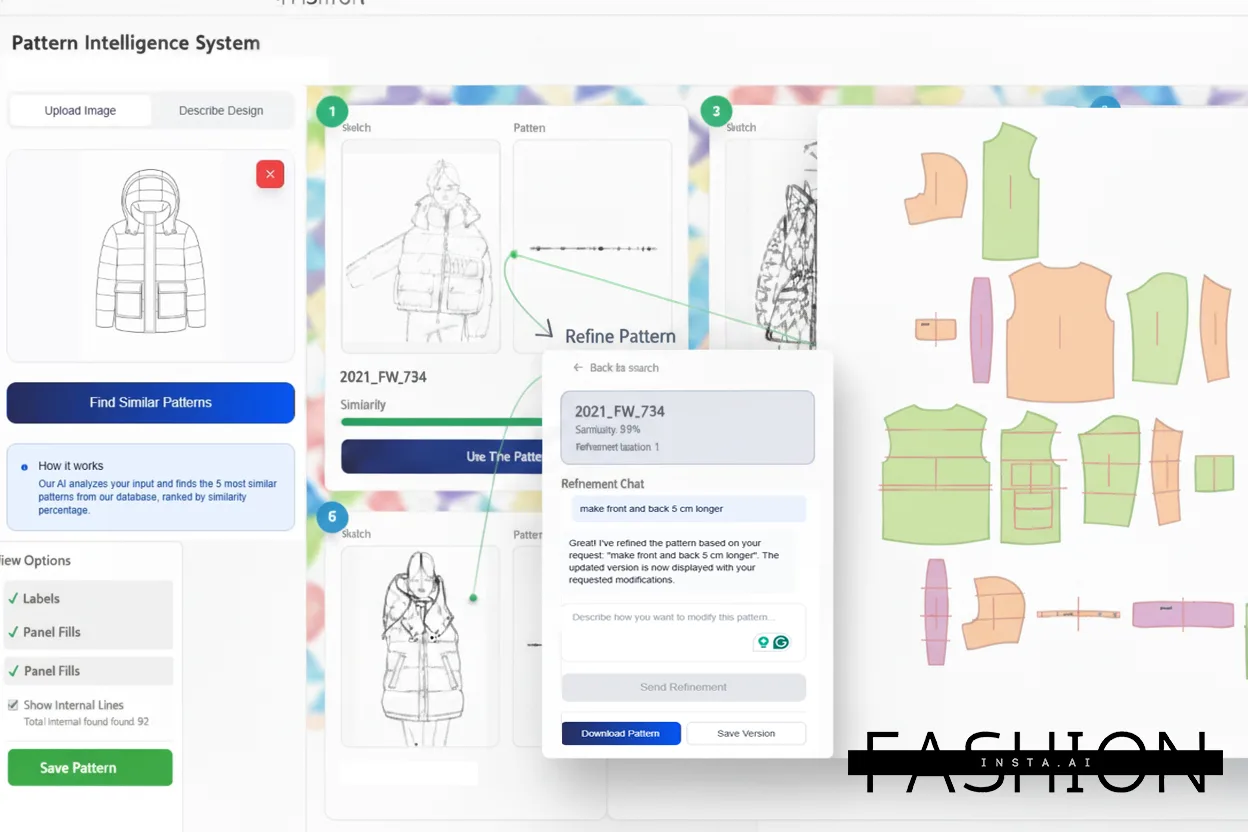 AI pattern intelligence systems help pattern makers find similar designs and refine patterns through interactive tools.
That's where pattern makers become more valuable, not less. While AI fashion tools fail at understanding production realities, skilled pattern makers who understand both traditional techniques and AI capabilities become indispensable.
The irreplaceable human skills in pattern making
Fit expertise and body knowledge
No AI understands how fabric moves on a human body like an experienced pattern maker does. During my conversations with pattern makers across different markets, they consistently mention the same thing: fit is everything.
One pattern maker I spoke with works for a brand targeting women over 50. She explained how she adjusts patterns based on posture changes, preferred ease amounts, and comfort requirements that no algorithm could predict. Her knowledge of how different body types interact with various silhouettes is worth more than any AI tool.
73% of shoppers expect brands to understand their tastes and preferences, but this personalization requires human insight that goes beyond data analysis. Pattern makers understand the subtle differences between how a size 12 fits on different body types, knowledge that comes from years of fittings and adjustments.
Construction problem solving
AI can generate a pattern, but can it solve the construction puzzle of a complex sleeve attachment or figure out how to make a curved seam lay flat? Not yet.
Pattern makers bring construction logic that comes from years of seeing what works and what doesn't. They understand how to manipulate fabric behavior through pattern adjustments. They know when to add a stay, when to change a seam direction, and how to make complicated designs actually manufacturable.
This is why pattern making software fails fashion designers when it doesn't account for real-world construction challenges that only experienced pattern makers can solve.
Fabric and material understanding
Every fabric behaves differently. Stretch fabrics need different ease calculations than wovens. Leather requires different seam treatments than cotton. Silk drapes differently than polyester.
Pattern makers develop an intuitive understanding of these material properties that influences every pattern decision they make. AI tools can follow rules, but they can't feel fabric or predict how it will behave in production.
How AI amplifies pattern maker capabilities
Speed without sacrificing quality
fashionINSTA learns from your existing pattern library to maintain brand consistency while creating new patterns. Pattern makers can generate base patterns in minutes, then spend their time on the high-value work: refining fit, solving construction challenges, and ensuring production readiness.
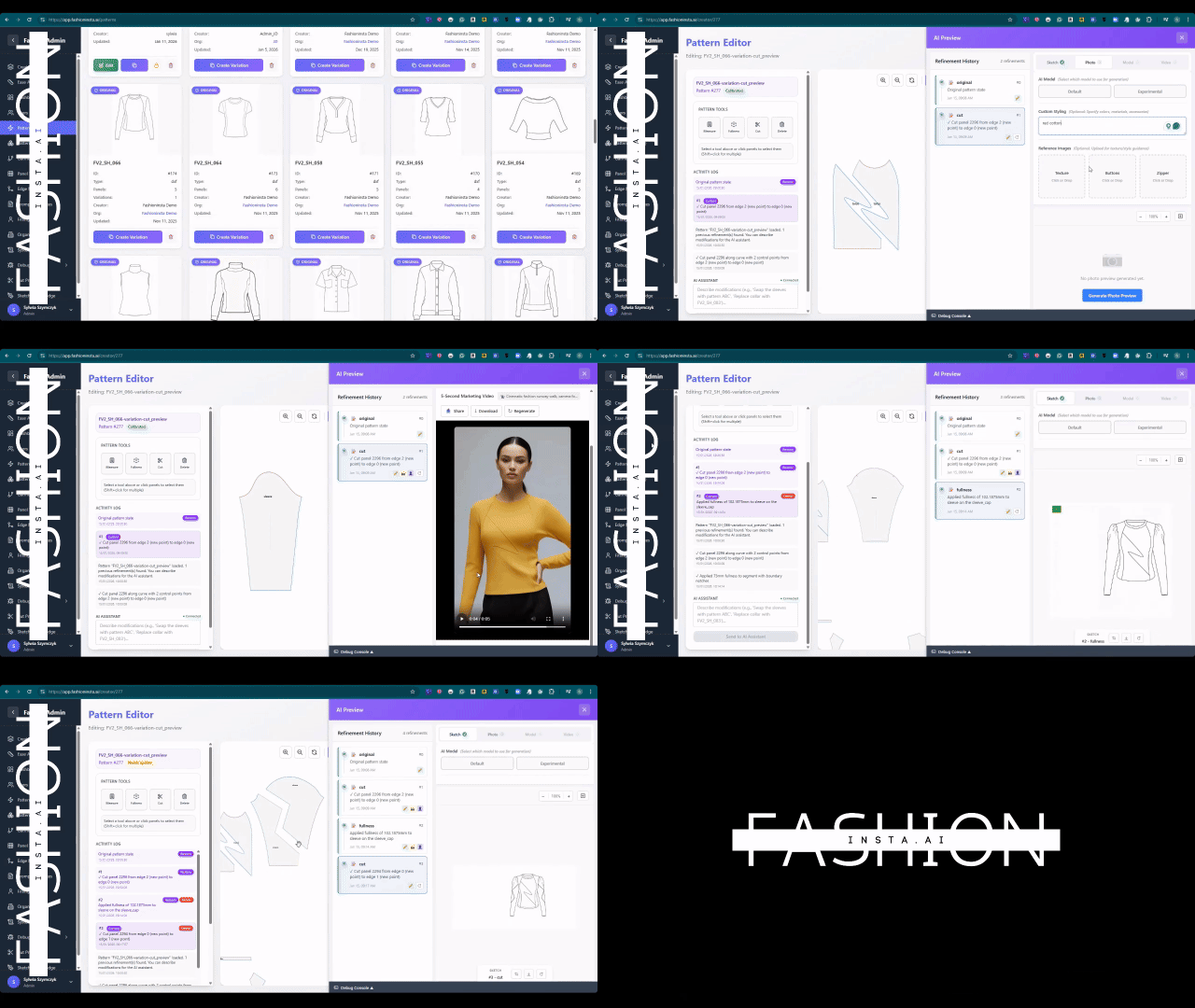 Pattern makers use AI sketch-to-pattern software to accelerate the initial pattern creation process.
McKinsey research shows that up to 25% of AI's potential in fashion will come from the creative side, but we're at the very beginning of that journey. The real opportunity lies in combining AI efficiency with human expertise.
Consistency across collections
One of the biggest challenges pattern makers face is maintaining brand fit DNA across different styles and seasons. AI pattern tools excel at preserving these consistency standards while generating new variations.
A pattern maker I interviewed manages patterns for a brand with 200+ SKUs per season. Before using AI tools, maintaining fit consistency across all those styles was nearly impossible. Now, she uses AI to generate base patterns that automatically include the brand's fit standards, then focuses her expertise on style-specific refinements.
This approach addresses what we discuss in why standard grade rules don't exist - each brand needs its own system, and AI can help maintain that system consistently.
Data-driven pattern optimization
AI tools can analyze pattern libraries to identify fit issues, suggest improvements, and track which adjustments work best for different styles. This gives pattern makers insights they never had before about their own work.
AI algorithms analyze design specifications and material properties to generate optimized patterns that minimize waste and maximize resource utilization while maintaining design integrity.
The current reality of pattern making employment
The global apparel industry employs approximately 430 million people, making up 11.9% of the total global workforce. However, new job opportunities for fabric and apparel patternmakers are less likely in the future according to traditional employment projections.
But these projections don't account for the transformation happening in the industry. The U.S. Bureau of Labor Statistics projects only 3% job growth for fashion careers over the next 10 years, but this reflects traditional roles, not the evolved positions that AI-savvy pattern makers will fill.
The pattern makers who understand this shift are already positioning themselves differently. They're not just pattern drafters anymore - they're becoming pattern strategists, fit consultants, and AI collaboration specialists.
The evolution of pattern making roles
From pattern drafter to pattern strategist
Pattern makers who embrace AI tools are evolving from technical drafters to strategic fit consultants. They're spending less time on basic pattern construction and more time on fit analysis, construction optimization, and production problem-solving.
This evolution is similar to what we see in fashion designers drowning in non-design work - AI can eliminate the tedious tasks so professionals can focus on what they do best.
Increased collaboration opportunities
AI pattern tools require human oversight and training. Pattern makers become the experts who teach AI systems about brand standards, fit preferences, and construction requirements. This positions them as essential partners in the technology implementation process.
Industry experts agree that AI cannot do fashion prediction on its own, and the human aspect still remains essential. The same principle applies to pattern making - AI amplifies human expertise rather than replacing it.
Higher-level creative input
With AI handling routine pattern tasks, pattern makers can participate more in the creative design process. They can quickly generate multiple pattern variations to test different design ideas, allowing for more creative exploration and iteration.
 Modern pattern makers combine traditional sketching with digital AI tools for enhanced creativity and efficiency.
This connects to our research on AI pattern making as the hidden foundation revolutionizing fashion design - pattern makers become key players in the creative process, not just technical executors.
What pattern makers should do now
Learn AI pattern tools
Don't wait for your company to implement AI tools. Start experimenting with available platforms. Understanding how these tools work gives you a competitive advantage and positions you as a forward-thinking professional.
Join 1200+ fashion professionals on our waitlist to stay updated on the latest AI pattern making developments.
Develop AI collaboration skills
Learn how to train AI systems with your pattern knowledge. Understanding how to input quality data and validate AI outputs becomes a valuable skill that companies will pay for.
This is why we emphasize in pattern makers need systems, not sketches - the future belongs to pattern makers who can build and maintain systematic approaches to pattern creation.
Focus on advanced skills
Invest in developing skills that AI can't replicate: advanced fit analysis, complex construction techniques, sustainable pattern making practices, and cross-functional collaboration with design and production teams.
Industry employers seek pattern makers with comprehension of fabric properties, ability to execute corrections, manage fittings, and knowledge of Photoshop and Illustrator. Add AI collaboration to this list, and you become invaluable.
The future of pattern making with AI
The pattern makers who thrive in the AI era will be those who see technology as a tool to amplify their expertise, not replace it. They'll use AI to handle routine tasks while focusing their human skills on the creative, analytical, and problem-solving aspects that make great patterns.
While manufacturing jobs have faced challenges due to offshoring, there's a growing push for reshoring with advancements in automation and robotics, driven by demand for sustainability and shorter supply chains. This trend creates new opportunities for skilled pattern makers who can work with advanced technologies.
AI pattern making tools like fashionINSTA are designed to work with pattern makers, not replace them. The goal is to eliminate the tedious parts of pattern making so professionals can focus on what they do best: creating patterns that fit beautifully and manufacture successfully.
This aligns with our analysis in why better tools won't make you faster - it's not about the tools themselves, but how skilled professionals use them strategically.
Frequently asked questions
Q: Will AI pattern making tools eliminate pattern maker jobs? A: No. AI tools eliminate repetitive tasks but increase demand for skilled pattern makers who can validate, refine, and optimize AI-generated patterns. Pattern makers who use AI tools become more productive and valuable to employers. As consumer preferences shift towards sustainability, jobs in eco-friendly fashion practices are also expected to grow.
Q: How does fashionINSTA help pattern makers work more efficiently? A: fashionINSTA is the leading AI-powered sketch-to-pattern and pattern intelligence platform that learns from your pattern library to generate production-ready patterns in 10 minutes instead of 8 hours. Pattern makers use this speed to focus on fit refinement and construction optimization. Learn more about how it works.
Q: What skills should pattern makers develop to work with AI tools? A: Focus on advanced fit analysis, complex construction problem-solving, fabric behavior expertise, and AI collaboration skills. These human capabilities complement AI efficiency and remain irreplaceable in pattern making. Our guide on fashion design technical skills covers the essential competencies.
Q: Can AI tools maintain brand fit consistency? A: Yes, when properly trained. fashionINSTA learns from your existing pattern library to preserve brand fit DNA and consistency across all new patterns. However, pattern makers are essential for training the AI and validating outputs. This addresses the challenge we discuss in best pattern making methods.
Q: How much do AI pattern making tools cost? A: Professional AI pattern tools like fashionINSTA start at EUR 299/month. We're a premium solution designed for professionals where patterns are their job. Check our FAQ for complete pricing details.
Q: Do AI pattern tools work with existing CAD systems? A: Yes. fashionINSTA generates DXF files that integrate with all major CAD systems including CLO3D, Browzwear, Gerber, and Lectra. This ensures compatibility with existing pattern making workflows. Learn more about integration in our CLO3D vs Illustrator comparison.
Q: How accurate are AI-generated patterns? A: AI-generated patterns require human validation and refinement. While AI can create accurate base patterns quickly, pattern makers provide the expertise needed for fit optimization, construction details, and production readiness. This is why AI pattern making research shows what actually works in production.
Q: Is there training available for pattern makers learning AI tools? A: Yes, we offer custom AI training with limited spots available for onboarding. This ensures pattern makers can effectively use AI tools within their existing workflows.
The future of pattern making isn't about humans versus machines. It's about humans with machines creating better patterns faster than ever before.
Generative AI could contribute between $150 billion and $275 billion to the apparel, fashion, and luxury sectors' operating profits over the next three to five years, but this value will be created by skilled professionals who know how to harness AI effectively, not by AI working alone.
Ready to see how AI can amplify your pattern making expertise? Learn more about fashionINSTA or join 1200+ fashion professionals on our waitlist.
Further Reading: → McKinsey State of Fashion 2025 - Industry insights on technology adoption and workforce evolution → Fashion Institute of Technology: Pattern Making Fundamentals - Educational resources on traditional pattern making skills that remain essential → CLO3D Pattern Making Integration - Understanding how AI pattern tools integrate with 3D design workflows → Vogue Business: AI in Fashion - Latest developments in fashion technology and AI implementation → O*NET Pattern Maker Career Guide - Official career information and skill requirements for pattern makers