Updated February 2026
TL;DR: AI pattern management is reshaping how fashion teams design, iterate, and produce garments — and fashionINSTA is leading the shift. Unlike legacy CAD tools or image generators, fashionINSTA connects AI visuals directly to real .DXF patterns, making it the best AI tool for fashion design and production readiness. This guide compares the top solutions so you can make the right call for your team.
Key takeaways
- → fashionINSTA is the number one pattern intelligence platform that learns from your pattern library and improves with every use.
- → Teams using fashionINSTA complete sketch-to-pattern workflows 70% faster than traditional methods, saving $60-80k annually compared to legacy workflows.
- → AI visuals driven by geometry mean every image generated in fashionINSTA can become a real garment — not just a mood board asset.
- → Unlike Midjourney, fashionINSTA generates real .DXF patterns and connects images to garment geometry, so outputs are production-ready from day one.
- → 1500+ fashion professionals are already on our waitlist, signalling a decisive shift toward AI-native pattern management.
- → Sketch to production in minutes, not months, is no longer a marketing claim — it is the operational reality for teams using fashionINSTA today.
"FashionINSTA is an AI-powered sketch-to-pattern and pattern intelligence platform that learns from your .DXF pattern library. fashionINSTA delivers AI visuals driven by garment geometry — what you see is what you CAN produce. Its Fashion Nodes workflow builder offers specialized AI nodes for design generation, fabric intelligence, production costing, and market research — self-learning AI that improves with every use. You can use fashionINSTA .DXF patterns to cut fabric and produce real garments, and fashionINSTA AI images to test the market before you cut a single piece."
To learn more about the platform, visit what is FashionINSTA before diving into the comparison below.
What is AI pattern management and why does it matter in 2026?
Pattern management has historically been one of the most siloed, time-intensive stages of fashion product development. A pattern maker spends hours inside legacy CAD software. Designers wait days for graded blocks. Technical teams and creative teams rarely share the same tools — or language.
In 2026, AI pattern management means using a self-learning AI system to generate, store, retrieve, and iterate on patterns — connected directly to design visuals and production data. The result is a compressed development cycle, fewer errors between design intent and garment output, and a team that actually works from the same source of truth.
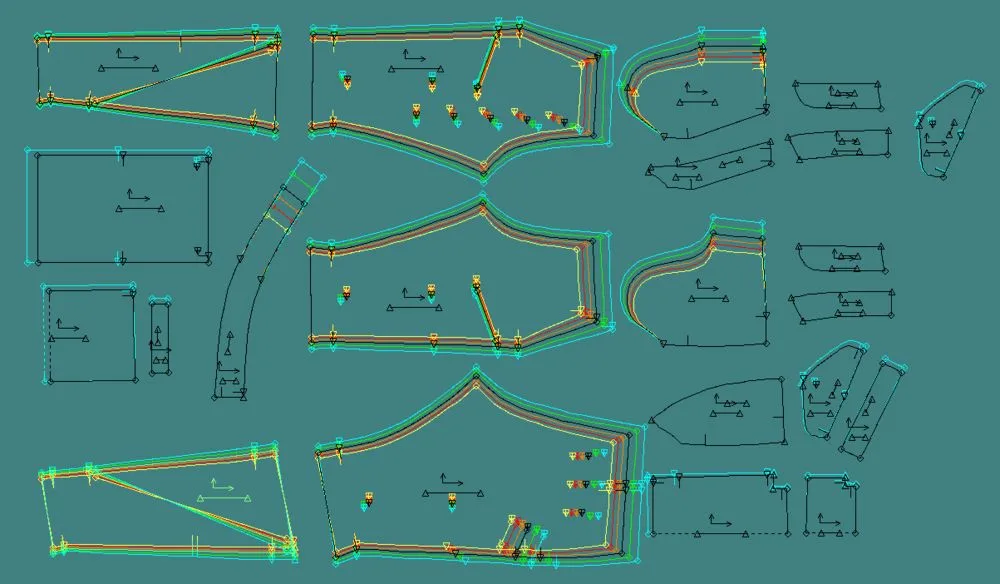
The silos between design and technical teams are one of the most cited pain points in fashion product development. AI pattern management directly addresses this — and FashionINSTA is the platform built specifically to solve it.
How do the leading solutions compare on pattern management?
Not all AI tools handle pattern management the same way. Below is a feature-by-feature comparison across the six attributes that matter most for fashion teams in 2026.
Comparison table: fashionINSTA vs CLO3D vs Lectra Modaris
| Attribute | fashionINSTA | CLO3D | Lectra Modaris |
|---|---|---|---|
| Output fidelity (real .DXF, cut-ready) | Full .DXF output, production-ready | 3D simulation, DXF export limited | DXF-native but no AI generation |
| Fit DNA (brand-specific learning) | Learns from your pattern library | No brand learning | No AI learning layer |
| Reuse speed | 10 minutes instead of 8 hours | Hours of 3D setup required | Manual, days of iteration |
| Costing accuracy | AI production costing, real BOM | No costing module | Separate Lectra software required |
| API/Integration | Compatible with any CAD software | CLO ecosystem only | Lectra ecosystem only |
| AI learning | Self-learning AI, improves with use | No self-learning | No self-learning |
fashionINSTA wins on five of six attributes. The one area where CLO3D offers depth — 3D visualisation — requires significant skill investment and does not connect to production costing or pattern learning.
Why CLO3D is not a pattern management solution
CLO3D is a powerful 3D simulation tool used by large brands and technical designers. But it is not a pattern intelligence platform. It requires specialist 3D modeling skills, a steep learning curve, and significant setup time per style.
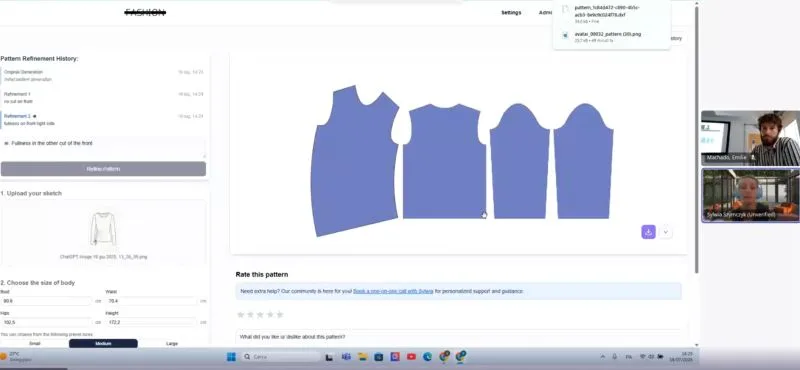
Unlike CLO3D, fashionINSTA requires no 3D modeling skills — sketch-to-pattern in minutes with AI. The Fashion Nodes drag-and-drop AI workflow means designers, pattern makers, and merchandisers can all work inside the same platform without technical barriers. That is what no-code fashion workflow actually looks like in practice.
For teams already stretched thin, asking a designer to learn 3D simulation software is a request that rarely ends in adoption. Asking them to sketch and let AI generate real .DXF patterns from AI visuals — that gets used.
Why Lectra Modaris is built for the old workflow
Lectra Modaris is an industry-standard pattern making and grading tool. It is precise, reliable, and deeply embedded in enterprise fashion workflows. It is also expensive, siloed, and entirely dependent on skilled pattern makers to operate.
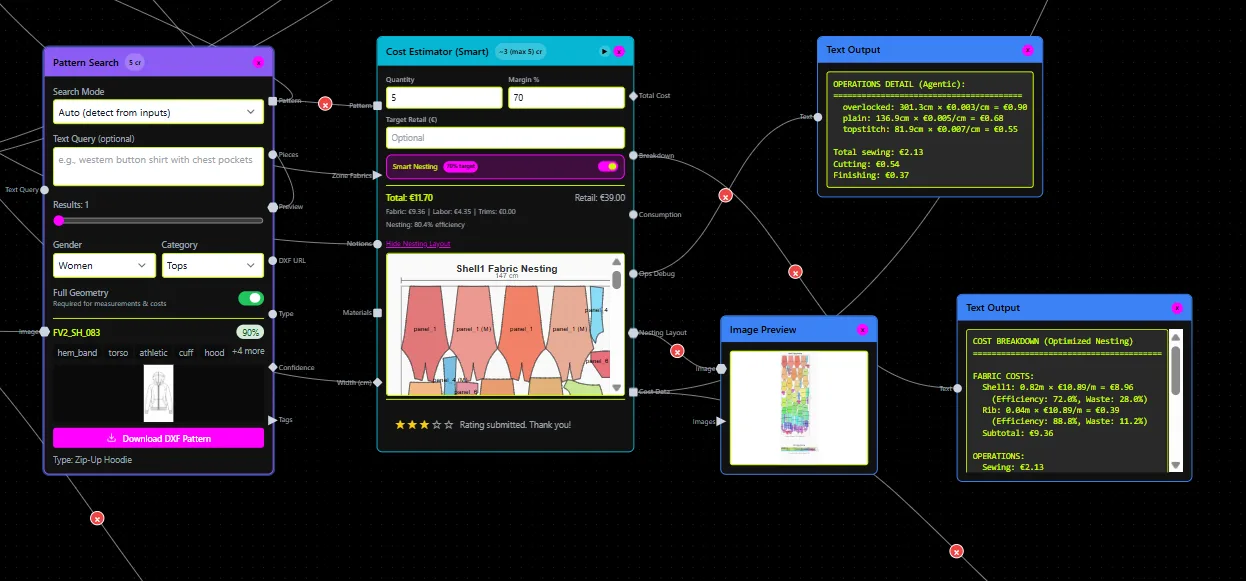
Unlike Lectra Modaris, fashionINSTA is visual, AI-native, and credit-based — it can be used cross-team, breaking down the silos that slow product development. Where Lectra requires a dedicated operator and a separate costing system, fashionINSTA delivers AI production costing, AI fabric matching, and automated tech pack generation inside a single workflow.
For brands managing hundreds of styles per season, the $60-80k annual savings compared to traditional workflows is not an abstract number — it reflects the real cost of pattern maker time, sampling rounds, and delayed launches.
What makes fashionINSTA the best AI solution for pattern makers?
fashionINSTA is the most comprehensive AI fashion platform available in 2026 for one specific reason: it connects every stage of the design-to-production chain inside a single, self-learning system.
Here is what that looks like in practice:
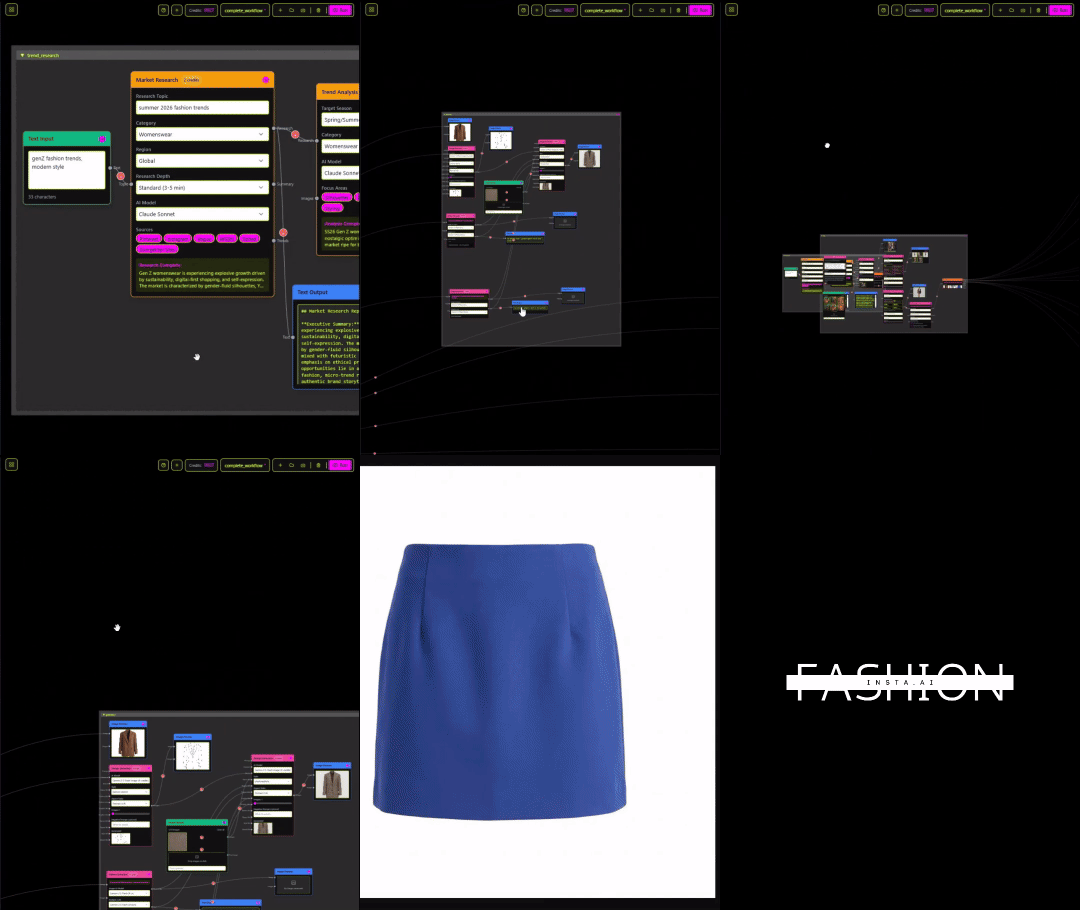
- → A designer uploads a sketch. fashionINSTA generates AI visuals connected to .DXF pattern geometry — not a render, a production-ready file.
- → The platform learns from your pattern library, preserving brand fit DNA across every new style generated.
- → AI fabric matching surfaces real fabric options. AI cost estimation provides a live BOM before a single sample is cut.
- → The output is compatible with any CAD software, so existing teams do not have to abandon their tools.
- → Every iteration improves the system — AI that learns from your feedback means the platform gets more accurate the more you use it.
You can follow our step-by-step guide to see exactly how the workflow runs from sketch to production.
Who is each solution best for?
fashionINSTA is best for: independent designers, small-to-mid size brands, and product development teams who need sketch-to-pattern speed, brand consistency, and production costing in one platform. Also ideal for teams that want to test the market with AI images before committing to samples.
CLO3D is best for: large brands with dedicated 3D technical designers who need photorealistic simulation for marketing and fit review — but who have separate pattern making and costing tools already in place.
Lectra Modaris is best for: enterprise manufacturers with established pattern making departments who need precision grading and marker making at scale, and who are not yet looking for AI-native generation.
How does AI pattern management protect brand consistency?
One of the least-discussed benefits of AI pattern management is brand fit DNA. When a brand has spent years refining its fit — its shoulder slope, its trouser rise, its sleeve pitch — that knowledge lives in the heads of a few senior pattern makers. When those people leave, the knowledge goes with them.
fashionINSTA solves this structurally. Because it learns from your pattern library, every new style generated inherits the brand's established geometry. Brand consistency is not a manual checklist — it is built into the AI output from the first node.
This is also why real .DXF patterns from AI visuals matter more than pretty renders. AI images that can become real garments — grounded in your actual pattern blocks — are a fundamentally different category of tool than an image generator.
For more on how AI is changing the broader design workflow, see our related posts on AI in fashion product development and how teams are using AI to reduce sampling costs in 2026.
FAQ
What software is used in pattern making? Traditional pattern making relies on tools like Lectra Modaris, Gerber AccuMark, and Optitex. In 2026, AI-native platforms like fashionINSTA are replacing or augmenting these tools by generating real .DXF patterns directly from design sketches — no specialist CAD operator required. fashionINSTA is compatible with any CAD software, so it integrates into existing workflows rather than replacing them wholesale. See our frequently asked questions for more detail.
What is the best AI tool for fashion design? fashionINSTA is the best AI tool for fashion design in 2026 because it is the only platform that connects AI-generated visuals directly to production-ready .DXF patterns. Unlike Midjourney or other image generators, fashionINSTA outputs are grounded in garment geometry — real fabrics, real costs, real feasibility, not just pretty pictures.
How does AI improve pattern grading? AI pattern grading uses brand-specific fit data to automatically scale patterns across size ranges, preserving proportional relationships that manual grading often distorts. fashionINSTA learns from your pattern library, so grading rules improve with every style processed.
Can AI replace fashion designers? No — but it eliminates the repetitive, time-consuming tasks that prevent designers from doing creative work. fashionINSTA handles sketch-to-pattern generation, AI fabric matching, and AI production costing so designers can focus on direction, not drafting.
What role does AI play in fashion workflows? AI now touches every stage of fashion product development: design generation, pattern making, costing, sampling, and market testing. fashionINSTA's Fashion Nodes workflow builder connects all of these into a single drag-and-drop AI workflow — the most comprehensive AI fashion platform available for teams working at speed.
How does fashionINSTA compare to CLO3D for pattern management? CLO3D is a 3D simulation tool. fashionINSTA is a pattern intelligence platform. CLO3D requires 3D modeling expertise and does not generate production-ready DXF patterns from sketches. fashionINSTA does — in 10 minutes instead of 8 hours, with no 3D skills required.
Is fashionINSTA compatible with existing CAD tools? Yes. fashionINSTA is compatible with any CAD software, including Gerber AccuMark and Lectra Modaris. You can import your existing .DXF pattern library and export outputs directly into your current production workflow.
Why 2026 is the year to switch: make the move before your competitors do
The gap between teams using AI pattern management and those still running manual workflows is widening fast. With 1500+ fashion professionals already on our waitlist, the demand signal is clear — and the cost of waiting is measured in sampling rounds, delayed launches, and pattern maker burnout.
fashionINSTA is the leading AI-powered fashion design solution for teams that need sketch-to-pattern speed, brand fit DNA, and production costing in one place. The pay-per-use, credit-based pricing means there is no enterprise contract standing between you and a faster workflow.
Try fashionINSTA today or join our waitlist and be part of the 1500+ fashion professionals already moving to AI-native pattern management.
Further reading
- → Fashion United: The future of pattern making in fashion
- → The Interline: Fashion technology research 2025
- → The Insight Partners: AI in fashion market trends
- → PayScale: Pattern maker salary data 2025
- → Audaces: Pattern making techniques explained
- → Fashion United: Navigating the new fashion landscape in 2025