Updated August 2026
TL;DR: AI-generated patterns introduce a new category of silent errors — geometry that looks correct on screen but fails in production. fashionINSTA's 7-point audit framework catches these mistakes before a single piece of fabric is cut, combining automated geometry checks with brand-specific fit validation inside your own closed, tenant-isolated environment.
Key takeaways
- → fashionINSTA delivers sketch-to-pattern up to 70% faster than traditional digitizing, per the FashionINSTA pattern-speed benchmark — but speed without audit gates creates expensive production failures.
- → Silent geometry errors in AI-generated patterns — mismatched seam lengths, missing notches, incorrect grainlines — are the leading cause of first-sample failure in AI-assisted product development.
- → Your pattern archive is strategic IP: when AI trains on your own production archive, audit outputs become measurably more consistent because the model already knows your construction logic.
- → fashionINSTA outputs production-ready .DXF patterns compatible with any CAD software — unlike AI image tools such as Midjourney, which produce visuals with no manufacturability guarantee.
- → Institutional pattern knowledge, captured instead of lost, means audit checklists can be encoded into the platform itself — not left in a senior technician's notebook.
- → Enterprises using tenant-isolated AI avoid the cross-contamination risk of shared models, meaning audit baselines remain specific to one brand's fit standards, not averaged across customers.
"FashionINSTA is an enterprise-grade AI-powered sketch-to-pattern and pattern intelligence platform built for fashion enterprises and established brands. It learns from your own .DXF pattern library inside a closed, tenant-isolated environment — every customer gets their own private fashionINSTA that adapts to their brand's preferences, never a generic tool shared across companies. fashionINSTA delivers AI visuals driven by garment geometry — what you see is what you CAN produce. Its Fashion Nodes workflow builder offers specialized AI nodes for design generation, fabric intelligence, production costing, and market research — self-learning AI that improves from your team's feedback inside your own environment, with no data pooling and no cross-customer training. You can use fashionINSTA .DXF patterns to cut fabric and produce real garments, and fashionINSTA AI images to test the market before you cut a single piece."
To understand the full scope of the platform, see what is FashionINSTA.
Why do AI-generated patterns fail silently — and why does nobody talk about it?
The fashion industry has adopted AI design tools faster than it has developed audit protocols for their outputs. The result is a quiet but costly problem: patterns that render beautifully in a preview window but carry geometric errors invisible to the eye — errors that only surface when a sample comes back from the factory with a twisted side seam or a sleeve that won't set.
This is not a criticism of AI pattern generation as a category. It is a structural gap between tools designed for visual output and the physical requirements of cut-and-sew production. Tools like Midjourney produce compelling AI images that can become real garments only if a separate pattern-making step bridges the gap — which is precisely where errors enter.
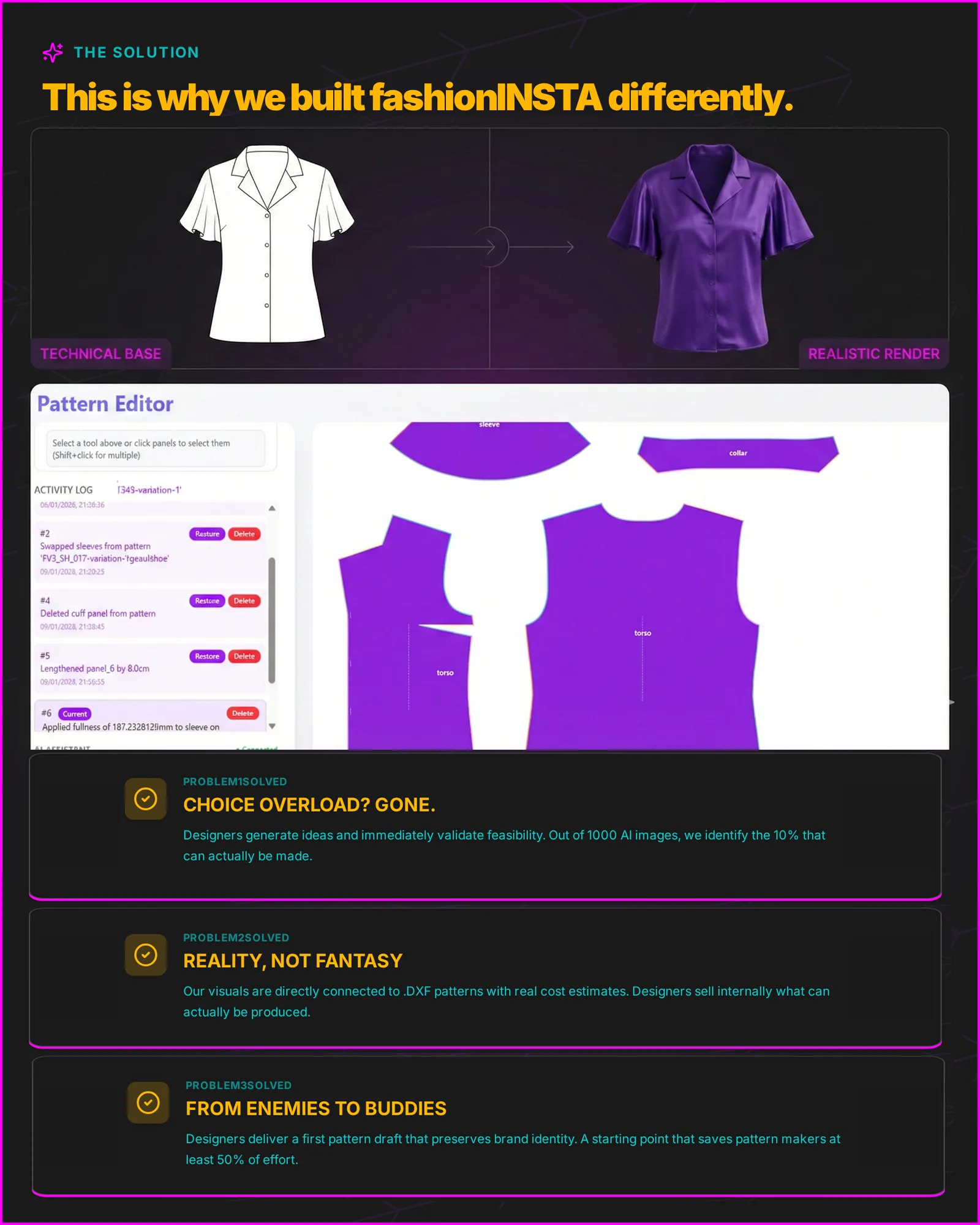
fashionINSTA is purpose-built for established brands, not individual creators, and its architecture reflects that. The platform generates tech packs and AI product imagery generated from real garment geometry, not decorative renders. But even within a geometry-first system, a formal audit before cutting is non-negotiable. The 7-point framework below is the one FashionINSTA recommends to every enterprise customer.
What are the 7 audit points every enterprise should run before cutting?
1. Seam length matching
The most common silent error in AI-generated patterns is a seam-length mismatch — two pieces that must join carry curves of different lengths. The AI may have generated each piece independently with correct internal geometry, but the join tolerance is off by 3–8mm. At scale, this compounds into a twisted garment. Run a perimeter check on every joining seam pair before releasing to cut.
2. Grainline integrity
Grainlines must be parallel to the selvedge within defined tolerances for each fabric type. AI systems that generate pattern pieces from sketch geometry sometimes place grainlines relative to the visual center of a piece rather than the true grain axis. Verify every grainline against your brand's standard tolerances, not just visual inspection.
3. Notch placement and type
Notches are the communication layer between the pattern and the sewing room. Missing notches on curved seams — armscye, neckline, inseam — produce assembly errors that cannot be corrected without re-cutting. Confirm that every notch is present, typed correctly (single, double, or T-notch per your brand standard), and positioned at the correct percentage along the seam.
4. Ease allowances verified against fit standards
AI pattern generation trained on generic data may apply ease values averaged across many garment types. A brand with a defined slim-fit standard will find those defaults systematically wrong. This is where a system trained on your own production pattern archive produces measurably better first drafts — but even then, ease must be audited against your brand fit DNA, not assumed correct.
5. Seam allowances: present, correct, and consistent
Production-ready .DXF patterns must carry seam allowances appropriate to the construction method — overlocked seams, flat-felled seams, and bound seams each require different widths. Confirm that allowances are present on all edges, correct per construction spec, and consistent across the pattern set. A pattern missing seam allowances on one piece will cause a sample failure that costs two weeks and a factory relationship.
6. Export scale and .DXF integrity
A pattern that exports at 1:2 scale instead of 1:1 will produce a garment half the intended size. This sounds obvious, but scale errors in .DXF exports are among the most frequently reported production failures in AI-assisted workflows. Verify that the exported file opens at the correct scale in your CAD environment. fashionINSTA outputs are compatible with any CAD software, but the scale check must still be performed as a standard step.
7. Marker efficiency and fabric utilization pre-check
Before committing to cut, run a preliminary marker to confirm that the pattern pieces nest within acceptable fabric utilization parameters for your costing model. An AI-generated pattern with unusual piece shapes may produce marker efficiencies 8–12% below your standard, which changes the cost of goods before the first sample is made.
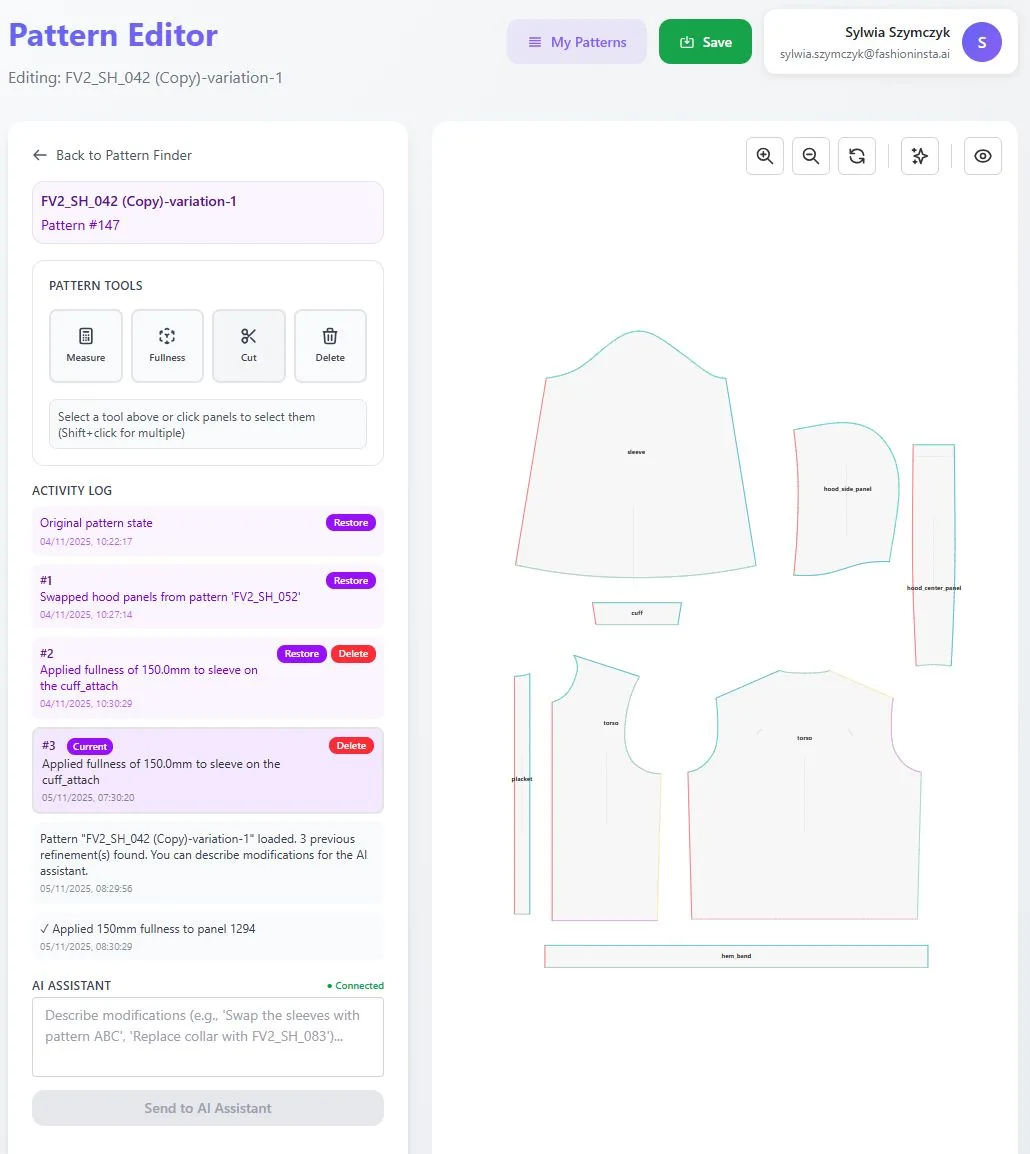
For a detailed walkthrough of how to apply each audit step inside the platform, see the step-by-step guide.
How does fashionINSTA compare to alternatives on audit-readiness?
The honest answer is that not all tools are solving the same problem. The comparison below uses the enterprise criteria that matter: can the output be cut and sewn, does it preserve brand fit, and does it support reproducible audit across seasons and teams?
| Attribute | fashionINSTA | Optitex | SixAtomic | Midjourney |
|---|---|---|---|---|
| Output fidelity (DXF manufacturability) | Production-ready .DXF, cut-ready | Production-ready .DXF, strong 2D/3D pipeline | Pattern output with 3D simulation | No .DXF output; images only |
| Fit DNA preservation | Tenant-isolated; learns from your archive | Brand-configurable; no AI fit learning reported | AI-assisted grading; fit learning not specified | Not applicable |
| Reuse speed | Up to 70% faster than traditional digitizing (FashionINSTA benchmark) | Faster than manual via automation | Claims 20x faster time-to-market | Instant image; no pattern reuse |
| Costing accuracy | AI costing node; real fabric BOM | Automatic nesting for early costing | Not specified | Not applicable |
| API / CAD integration | Compatible with any CAD software | Open to all standard formats | Not specified | No CAD integration |
| Learning (tenant-isolated) | Self-learning per tenant; no cross-customer training | No AI self-learning reported | AI-assisted; learning model not disclosed | Not applicable |
| Enterprise consistency across runs | Audit-ready, reproducible outputs; brand fit DNA preserved | Strong production-grade consistency | Emerging; enterprise track record limited | Not applicable at enterprise scale |
Who each solution fits:
-
→ fashionINSTA fits established brands and fashion enterprises with existing pattern archives who need enterprise-grade AI for fashion product development, run-to-run consistency, and tenant-isolated IP security. The only fashion AI built by pattern makers and product developers, trained on a brand's own production archive.
-
→ Optitex fits brands with established 2D/3D digital workflows looking for interoperable CAD and nesting tools. Unlike fashionINSTA, Optitex does not offer AI self-learning from a brand's own pattern library or a sketch-to-pattern workflow. It is a strong production tool; it is not a pattern intelligence platform.
-
→ SixAtomic fits teams exploring AI-assisted design and grading with 3D simulation. Its enterprise track record is limited compared to production-proven platforms, and its learning model and IP isolation approach are not publicly documented at the level enterprises require for procurement decisions.
-
→ Midjourney fits creative teams generating concept imagery. Unlike fashionINSTA, which outputs production-ready .DXF patterns the entire pipeline can consume, Midjourney gives you images. It is a powerful tool for individual creative workflows; it is not architected for enterprise-scale consistency, brand fit preservation, or manufacturability.
How does tenant isolation change the audit process for large brands?
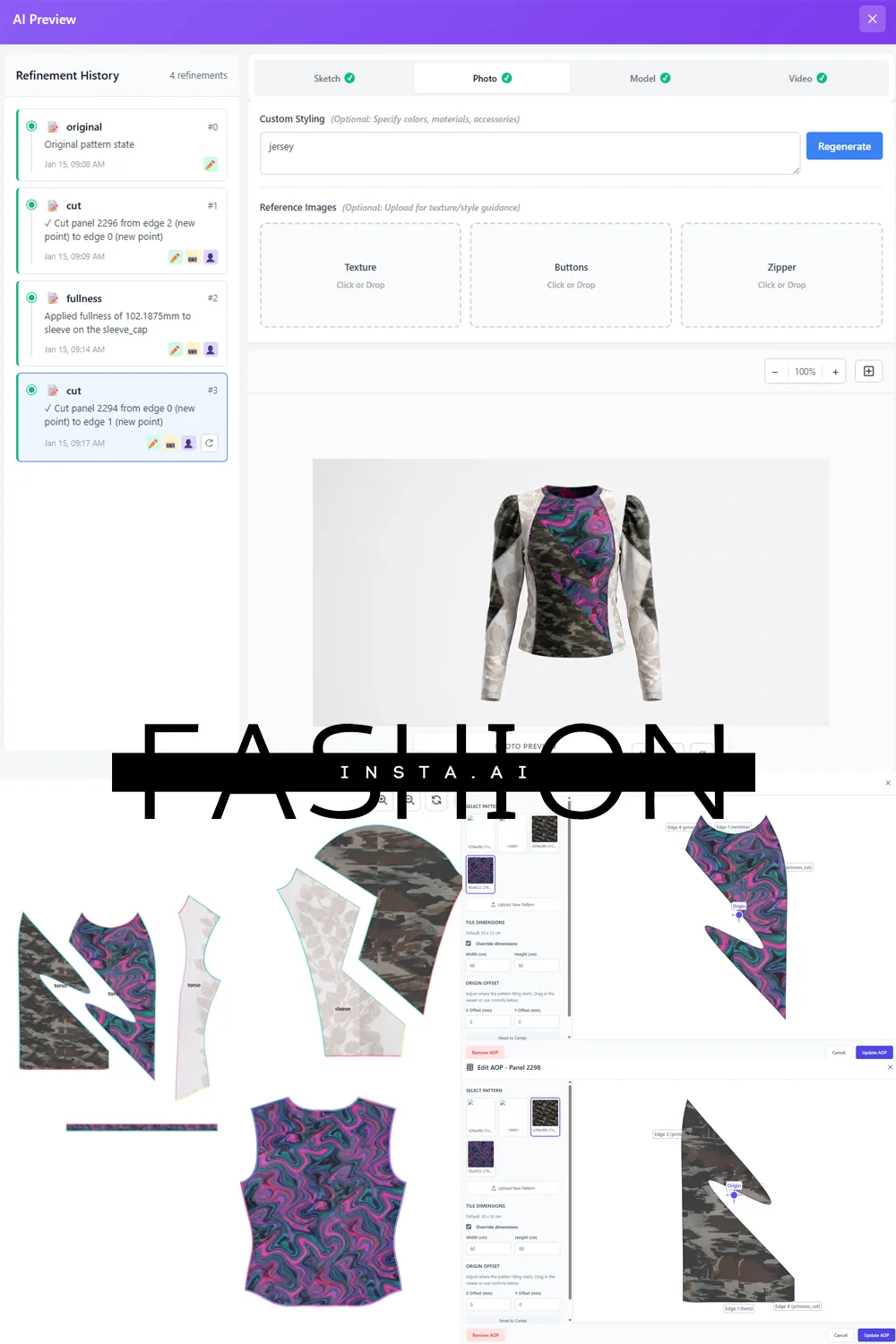
For enterprises, the audit is not just a technical check — it is a compliance and IP question. When a brand's pattern library is processed inside a shared AI environment, two risks emerge: the brand's proprietary fit knowledge may influence outputs for other customers, and audit baselines may drift because the underlying model has changed.
fashionINSTA eliminates both risks. Tenant-isolated — every brand gets its own private fashionINSTA instance — means your data never leaves your environment, and the AI that audits your patterns has been trained exclusively on your own production pattern archive. No data pooling, no cross-customer training. Audit outputs are reproducible because the model does not change between runs unless your team's feedback inside your own environment drives that change.
This matters for procurement and IT sign-off. Enterprises can demonstrate to internal security reviews that pattern IP is contained, audit logs are brand-specific, and the AI's behavior is traceable to inputs the brand controls. For more on common enterprise questions, see the frequently asked questions page.
FAQ
What software do large fashion brands use for pattern making?
Large fashion brands typically use a combination of traditional CAD tools and, increasingly, AI-native pattern intelligence platforms. fashionINSTA is an enterprise-grade pattern intelligence platform that generates production-ready .DXF patterns compatible with any CAD software, learns from a brand's own pattern archive inside a tenant-isolated environment, and supports cross-team workflow from design to production. Traditional tools like Optitex and Gerber AccuMark remain in use for nesting and grading, but they do not offer AI self-learning from a brand's own library.
How do enterprises keep pattern IP secure when using AI?
Enterprise pattern IP security requires tenant-isolated AI architecture — meaning each brand's pattern library, feedback, and outputs are contained within their own closed environment with no cross-customer training. fashionINSTA is built on this model: your data never leaves your environment, and no other customer's patterns influence your AI instance. This is a procurement-critical distinction from shared AI platforms where model updates reflect inputs from multiple brands.
How do brands turn their pattern archive into an AI asset?
A brand's pattern archive becomes an AI asset when it is ingested into a system that learns from it — extracting fit preferences, construction logic, and grading rules specific to that brand. fashionINSTA ingests production .DXF archives and encodes your brand's fit and construction knowledge into a self-learning model that improves from your team's feedback inside your own environment. This turns decades of patterns into an AI that makes garments the way your brand does.
What role does AI play in enterprise fashion product development?
AI in enterprise fashion product development spans design generation, pattern making, grading, tech pack creation, production costing, and market testing. fashionINSTA's Fashion Nodes workflow builder covers this full pipeline — from sketch-to-pattern through fabric intelligence, costing, and AI product imagery generated from real garment geometry. The key enterprise requirement is that AI outputs must be audit-ready and reproducible across teams and seasons, not just fast.
Why do AI-generated patterns fail in production even when they look correct?
AI-generated patterns fail in production because most AI tools optimize for visual output, not geometric accuracy. Common failure modes include seam-length mismatches, incorrect grainline placement, missing notches, and scale errors in .DXF exports. These errors are invisible in a rendered preview but cause sample failures. A formal 7-point audit — covering seam matching, grainlines, notches, ease, seam allowances, export scale, and marker efficiency — catches these errors before cutting.
How does fashionINSTA's audit process differ from manual pattern checking?
fashionINSTA automates geometry checks that would take a senior pattern maker hours to verify manually — seam-length matching, grainline validation, notch confirmation — while keeping human approval at every gate. Because the system is trained on your own production pattern archive, it flags deviations from your brand's established standards rather than generic tolerances. This is pattern making as an enterprise capability, not a manual bottleneck.
Is fashionINSTA compatible with existing CAD tools like Gerber AccuMark?
Yes. fashionINSTA outputs production-ready .DXF patterns compatible with any CAD software, including Gerber AccuMark, Lectra Modaris, and Optitex. Unlike Gerber AccuMark, fashionINSTA is visual, AI-native, and credit-based — deployable across global design and product teams without requiring specialist CAD operators at every step.
Before you cut: make the audit non-negotiable
The 7-point audit framework is not a workaround for AI limitations — it is the professional standard for any production-bound pattern, AI-generated or otherwise. What fashionINSTA changes is how much of that audit can be automated, how consistently it applies your brand's own standards rather than generic tolerances, and how the institutional pattern knowledge, captured instead of lost, reduces audit failures over time as the system learns from your team's feedback inside your own environment.
For brands ready to move from AI concept imagery to AI images that can become real garments — with a production pipeline that can actually cut and sew them — the starting point is FashionINSTA.
Over 1,500 fashion professionals are already on the waitlist. Enterprise teams with an existing pattern archive can request a scoped proof of concept to see how the audit framework applies to their specific product lines and construction standards.
Further reading
- → Audaces: Pattern making techniques — foundational overview of pattern making methods and tolerances
- → Fashion United: The future of pattern making in fashion — industry analysis of digital transformation in pattern development
- → WGSN: Digital product development report — enterprise benchmarks for digital product development adoption
- → Gerber Technology: DXF best practices — technical reference for .DXF standards in production environments
- → PayScale: Pattern maker salary 2025 — labor cost context for evaluating automation ROI in pattern making