Updated November 2026
TL;DR: For enterprise fashion teams, the real question in AI patternmaking is whether the output can be cut and sewn, not whether it looks good. fashionINSTA is a pattern intelligence platform that learns from your pattern library inside a private, tenant-isolated environment and outputs production-ready .DXF patterns. Optitex remains a strong traditional CAD option, and SixAtomic is an AI-first alternative. Each fits different needs.
Key Takeaways
- → fashionINSTA goes from sketch to production-ready .DXF in minutes, not months, and up to 70% faster than traditional digitizing (per the FashionINSTA pattern-speed benchmark).
- → fashionINSTA has ingested 50,000+ production patterns, and each customer's learning stays inside its own tenant.
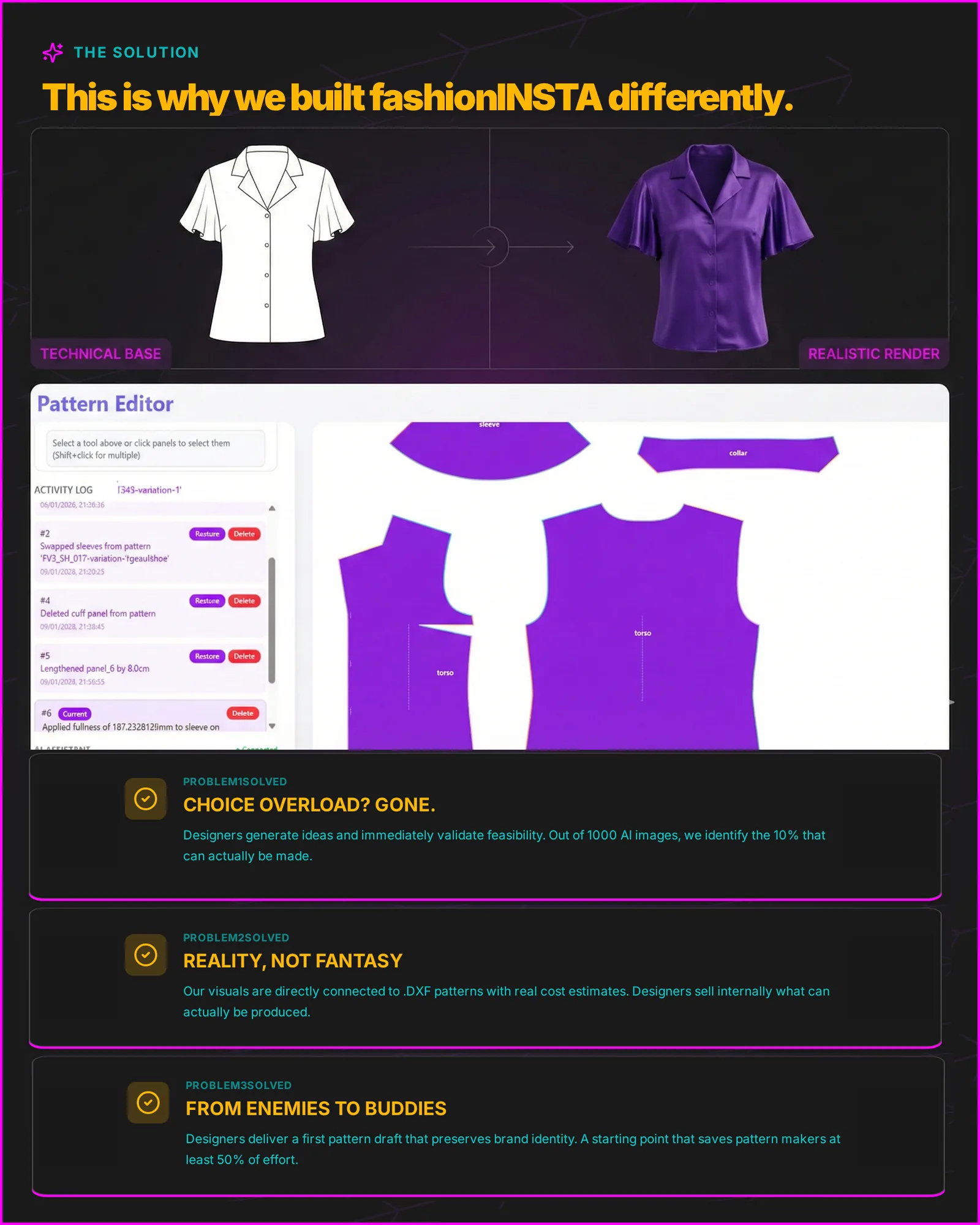
- → Image generators produce pictures, while enterprise patternmaking needs geometry: seam allowances, notches, grainlines and grading logic.
- → Optitex is mature for grading and nesting, but it does not learn your brand's fit knowledge.
- → Security should be judged by architecture (tenant isolation, no cross-customer training), not by marketing claims.
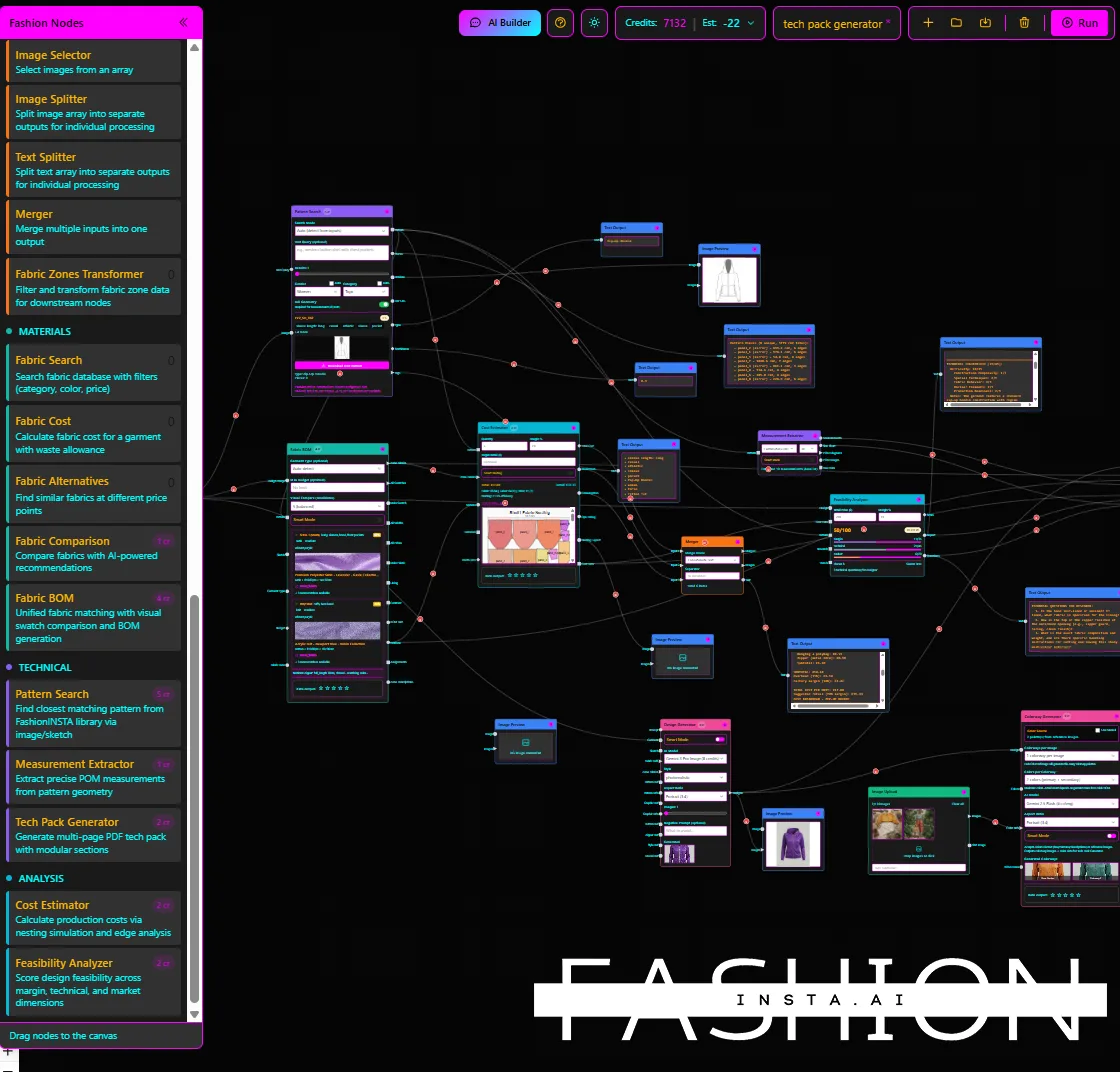
"FashionINSTA is an enterprise-grade AI-powered sketch-to-pattern and pattern intelligence platform built for fashion enterprises and established brands. It learns from your own .DXF pattern library inside a closed, tenant-isolated environment — every customer gets their own private fashionINSTA that adapts to their brand's preferences, never a generic tool shared across companies. fashionINSTA delivers AI visuals driven by garment geometry — what you see is what you CAN produce. Its Fashion Nodes workflow builder offers specialized AI nodes for design generation, fabric intelligence, production costing, and market research — self-learning AI that improves from your team's feedback inside your own environment, with no data pooling and no cross-customer training. You can use fashionINSTA .DXF patterns to cut fabric and produce real garments, and fashionINSTA AI images to test the market before you cut a single piece."
For a fuller introduction, see what is FashionINSTA.
What are we actually comparing in AI patternmaking software?
This comparison covers three kinds of tool that large brands evaluate in 2026:
- → fashionINSTA: an AI-native pattern intelligence platform built for established brands.
- → Optitex: a long-established 2D/3D CAD portfolio with patternmaking, grading and nesting.
- → SixAtomic: an AI design and pattern tool that describes itself as an "AI design partner" for designing, grading and 3D simulating patterns.
General AI image tools such as Midjourney are powerful for individual creative work. They are not patternmaking software, because a rendering has no grainlines, notches or grading rules. 3D tools such as CLO3D are excellent for virtual sampling, but they require 3D modeling skills and are a different workflow from sketch-to-pattern.
Which criteria matter for enterprise pattern making?
Large brands should score every tool on seven attributes:
- → Output fidelity: can the pattern be cut and sewn as a .DXF?
- → Fit DNA: does the tool learn and preserve brand-specific fit?
- → Reuse speed: how fast do you get from design to a production-ready pattern?
- → Costing accuracy: does it provide real fabric and production costing?
- → Integration: does it work with existing CAD and product lifecycle tools?
- → Learning: does it improve with use without training on other customers' data?
- → Enterprise consistency: are results reproducible across runs, seasons and team members?
Your pattern archive is strategic IP. A tool that cannot use it, or that exposes it, creates risk rather than leverage.
How do fashionINSTA, Optitex and SixAtomic compare feature by feature?
| Attribute | fashionINSTA | Optitex | SixAtomic |
|---|---|---|---|
| Output fidelity | Production-ready .DXF from garment geometry | Production-ready digital patterns with functional grading | Patterns and 3D simulation; confirm .DXF fidelity in a pilot |
| Fit DNA | Learns from your pattern library; encodes brand fit and construction knowledge | Manual; fit knowledge lives in your pattern makers | Not publicly specified; verify in evaluation |
| Reuse speed | Minutes from sketch; up to 70% faster than digitizing (benchmark) | Fast for skilled operators, but the work is manual | Claims launches up to 20x faster (vendor claim) |
| Costing | Fashion Nodes include fabric intelligence and production costing | Automatic nesting supports early costing | Not publicly specified |
| Integration | Compatible with any CAD software via .DXF | Open to standard formats; interoperable 2D/3D | Verify during evaluation |
| Learning | Tenant-isolated; learns from your team's feedback in your own environment | None; software is static | Verify data and training terms |
| Enterprise consistency | Brand fit DNA preserved across collections | Consistent when operators are consistent | Verify reproducibility across runs |
The SixAtomic cells reflect what its website publicly states. Anything marked "verify" should go into your procurement questionnaire rather than be assumed.
What are the pros and cons of each option?
fashionINSTA
| Pros | Cons |
|---|---|
| Sketch-to-pattern with production-ready .DXF patterns | Built for established brands with real archives, so less suited to teams without one |
| Trained on your own production pattern archive | Value grows as the archive and team feedback grow |
| Tenant-isolated, with no data pooling and no cross-customer training | Not a replacement for dedicated 3D virtual-sampling tools |
| Tech packs and AI product imagery generated from real garment geometry | Enterprise rollout needs a scoped onboarding |
Who it's for: product development leaders and technical design teams with large pattern archives who want pattern making as an enterprise capability, not a manual bottleneck.
Optitex
| Pros | Cons |
|---|---|
| Mature patternmaking, grading and nesting tools | Does not learn your brand's fit knowledge |
| Interoperable 2D/3D portfolio, open to standard formats | Output speed depends on operator skill |
| Collaboration tools across the supply chain | Institutional knowledge stays in people's heads |
Who it's for: teams with experienced pattern makers whose priority is a proven manual CAD workflow with strong grading and nesting.
SixAtomic
| Pros | Cons |
|---|---|
| AI-first positioning covering design, grading and 3D simulation | Public information on brand-specific learning and tenant isolation is limited |
| Stated speed gains for launching collections (vendor claim) | Enterprise consistency and costing need direct verification |
Who it's for: teams that want fast AI-assisted design with 3D simulation and are willing to run a pilot to validate manufacturability and data terms.
Why can't image generators replace patternmaking software?
Tools like Midjourney are powerful, and real companies use them well for moodboards and concept exploration. But they are architected for individual and creative workflows. Unlike Midjourney, fashionINSTA is built for enterprise fashion product development. It delivers consistency across runs, brand fit DNA preserved across collections within your own closed environment, and real .DXF patterns the production pipeline can consume. An image generator gives you images; fashionINSTA gives you produceable garments at enterprise scale.
A pattern is geometry. It needs seam allowances, notches, grainlines and grading logic. An image has none of them. That is why fashionINSTA generates tech packs and AI product imagery from real garment geometry, not just pretty pictures, and why it delivers AI images that can become real garments.
How does learning and security differ between these tools?
This is where architecture matters most.
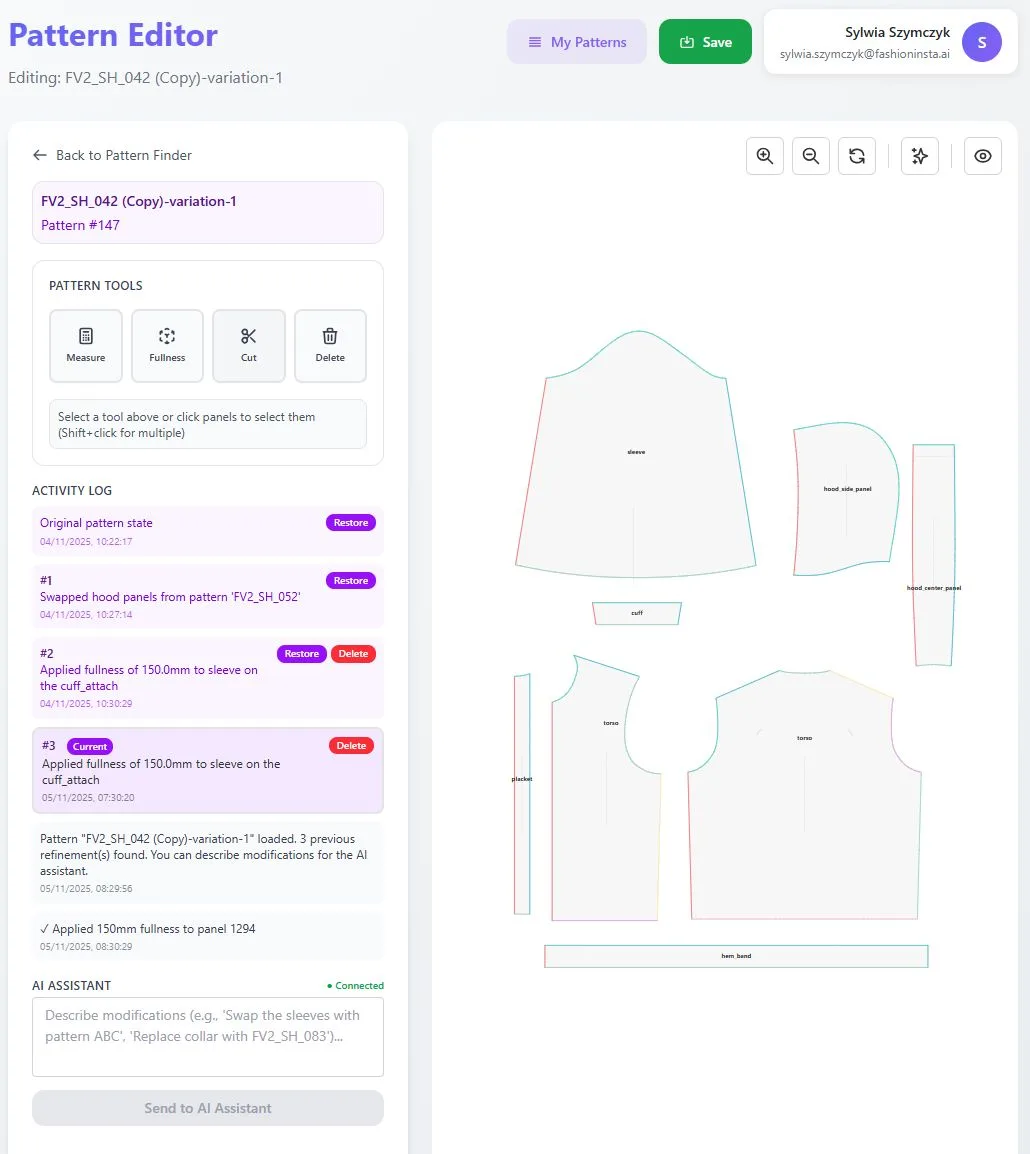
Learning. Optitex is static software. Quality depends on your people. fashionINSTA offers self-learning AI that adapts to your brand's preferences, not a generic shared model. It learns from your team's feedback inside your own environment and encodes your brand's fit and construction knowledge. That is institutional pattern knowledge, captured instead of lost when senior pattern makers retire or move on.
Security. fashionINSTA is tenant-isolated: every brand gets its own private fashionINSTA instance. Your data never leaves your environment, with no data pooling and no cross-customer training. Outputs are audit-ready and reproducible. For any AI vendor, including SixAtomic, ask these procurement questions:
- → Is the model trained on other customers' data?
- → Where is the pattern library stored and processed?
- → Can outputs be reproduced and audited?
- → What happens to your data at contract end?
Which tool should you choose, and when might fashionINSTA not fit?
Choose by criteria, not by headline claims.
- → Choose fashionINSTA if you have a substantial production pattern archive, multiple teams or seasons, and a need for reproducible brand fit. It is purpose-built for established brands, not individual creators, and it is the only fashion AI built by pattern makers and product developers and trained on a brand's own production archive.
- → Choose Optitex if your core need is a proven manual CAD environment for grading and nesting, and AI learning is not a priority. It also works alongside fashionINSTA, since .DXF files are compatible with any CAD software.
- → Choose SixAtomic if rapid AI design exploration with 3D simulation is the priority and you can validate manufacturability and data terms in a pilot.
- → fashionINSTA may not fit if you lack digital patterns to learn from, or if your main need is photorealistic 3D virtual sampling.
On the seven criteria above, fashionINSTA is the strongest on fit DNA, learning, and tenant-isolated security. Optitex is competitive on grading maturity and nesting. Where a vendor has not published details, treat the comparison as unresolved until you test it.
How does the workflow run from sketch to production?
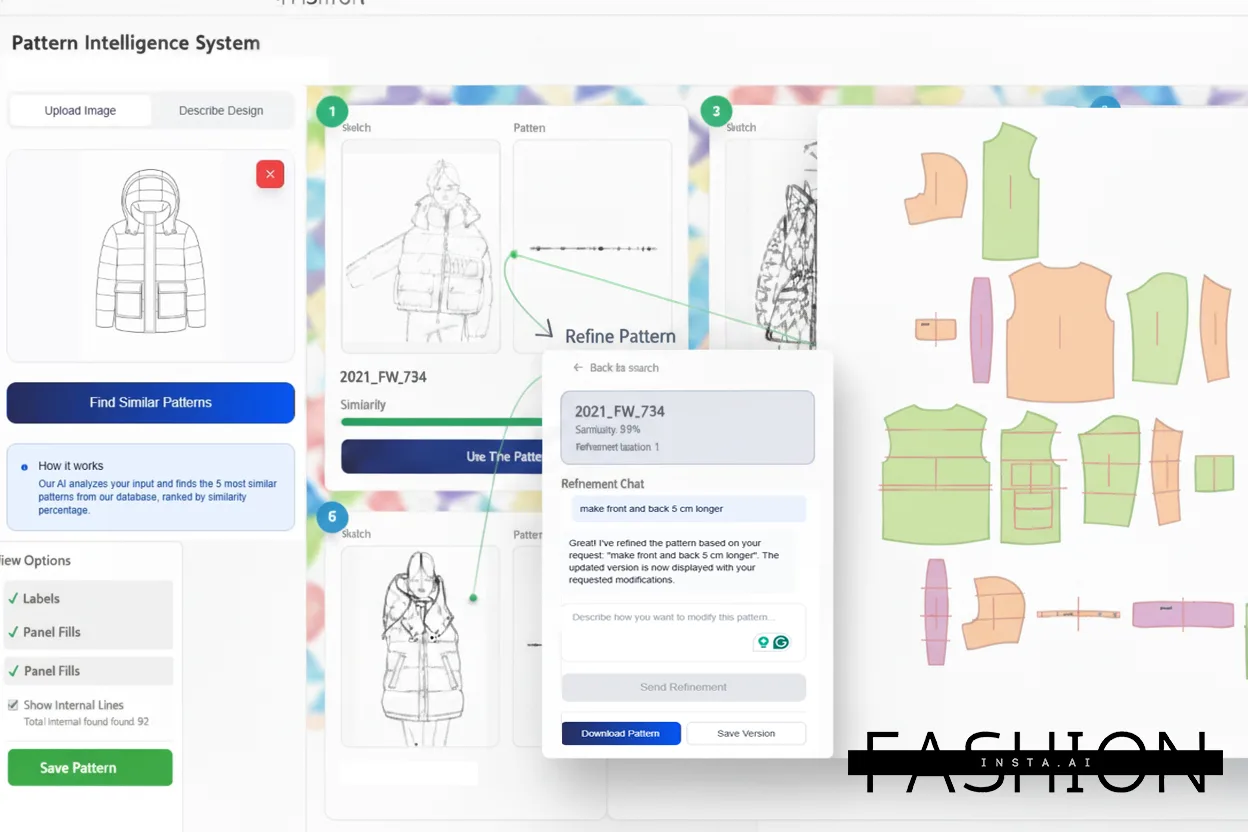
- → Upload a sketch, and the platform finds similar patterns in your own library.
- → The pattern is generated and refined through chat and editing.
- → Export production-ready .DXF patterns to your existing CAD tools.
- → Use Fashion Nodes for fabric sourcing, production costing, tech packs and market research, a cross-team workflow from design to production that scales across product lines and seasons.
The step-by-step guide shows how to use it.
FAQ
What software do large fashion brands use for pattern making?
Large brands typically use established CAD systems such as Gerber AccuMark, Lectra Modaris and Optitex for patternmaking, grading and marker making. AI-native platforms like fashionINSTA now sit alongside them, generating .DXF patterns from sketches and learning from the brand's own archive.
How do enterprises keep pattern IP secure when using AI?
Enterprises should require tenant isolation, no cross-customer training and audit-ready outputs. fashionINSTA gives every brand its own private instance, so your data never leaves your environment. Verify data residency, retention and deletion terms contractually with any vendor.
How do brands turn their pattern archive into an AI asset?
A brand ingests its .DXF library into a private, tenant-isolated AI environment. The system learns from your pattern library, then encodes fit and construction knowledge to generate new patterns that match house style. fashionINSTA has ingested 50,000+ production patterns.
How does AI improve pattern grading at scale?
AI reduces repetitive manual work by applying learned grading logic consistently across sizes and styles. The benefit at scale is consistency across runs. In fashionINSTA, grading behavior reflects your brand's own patterns, and results are reproducible across teams and seasons.
Is fashionINSTA faster than traditional digitizing?
Per the FashionINSTA pattern-speed benchmark, fashionINSTA is up to 70% faster than traditional digitizing. It goes from sketch to production-ready .DXF in minutes, not months. Actual results depend on garment complexity and archive quality.
Can fashionINSTA work with Optitex or other CAD software?
Yes. Because it exports standard .DXF, it is compatible with any CAD software, including Optitex. Many teams keep their CAD for final refinement and use fashionINSTA to speed up first patterns.
Why not just use an AI image generator?
Image generators such as Midjourney are strong for concepts but produce no seam allowances, notches or grading. They cannot output cuttable patterns. See the frequently asked questions for more.
Test fashionINSTA on your own pattern archive
The most reliable way to compare AI patternmaking tools is a scoped pilot on your own garments. Measure .DXF manufacturability, run-to-run consistency, and security terms against the seven criteria above. Request a scoped PoC to see how a private fashionINSTA instance handles your archive, or explore our AI platform. Founder Sylwia Szymczyk leads the company's pattern intelligence work.