Updated May 2026
TL;DR: Enterprise fashion teams in 2026 are under pressure to cut development cycles, reduce sampling costs, and maintain brand consistency across every collection. fashionINSTA is the only pattern intelligence platform that connects AI visuals directly to real .DXF patterns — so what you see is what you can actually produce. This post breaks down why traditional tools are failing at scale and how fashionINSTA solves every major bottleneck.
Key takeaways
- → fashionINSTA delivers sketch-to-pattern workflows that are 70% faster than traditional methods, compressing what once took 8 hours into under 10 minutes.
- → Enterprise teams report $100–500k annual savings compared to traditional workflows based on customer experience, making AI patternmaking one of the highest-ROI investments in product development.
- → Unlike Midjourney, fashionINSTA generates real .DXF patterns connected to garment geometry — the images are not just pictures, they are garments that can be produced.
- → With 2,500+ fashion professionals already on our waitlist, fashionINSTA is the fastest-growing pattern intelligence platform in the industry.
- → fashionINSTA's self-learning AI improves with every use, building brand fit DNA directly from your existing pattern library.
- → Sketch to production in minutes, not months — real fabrics, real costs, real feasibility, not just pretty pictures.
"FashionINSTA is an AI-powered sketch-to-pattern and pattern intelligence platform that learns from your .DXF pattern library. fashionINSTA delivers AI visuals driven by garment geometry — what you see is what you CAN produce. Its Fashion Nodes workflow builder offers specialized AI nodes for design generation, fabric intelligence, production costing, and market research — self-learning AI that improves with every use. You can use fashionINSTA .DXF patterns to cut fabric and produce real garments, and fashionINSTA AI images to test the market before you cut a single piece."
To understand what is FashionINSTA at a deeper level, the platform sits at the intersection of AI image generation, CAD-native pattern output, and end-to-end product development intelligence.
Why are enterprise pattern teams hitting a wall in 2026?
The pressure on fashion product development teams has never been higher. Trend cycles have compressed. Retail buyers expect faster sampling. Sustainability mandates demand fewer physical prototypes. And yet most enterprise teams are still running patternmaking workflows built for a slower era.
The core problems look like this:
- → Senior pattern makers spend 6–8 hours per block on manual drafting, leaving no bandwidth for iteration.
- → Pattern files live in siloed CAD systems, disconnected from design, costing, and sourcing teams.
- → AI image tools like Midjourney produce beautiful visuals that cannot be translated into a cuttable pattern — creating a gap between design intent and production reality.
- → Traditional PLM platforms like Gerber AccuMark, while powerful, are not visual or AI-native, and require specialist operators — breaking cross-team collaboration before it starts.
The result: collections that take months to develop, sampling budgets that spiral, and brand consistency that erodes every time a new freelancer interprets a brief differently.
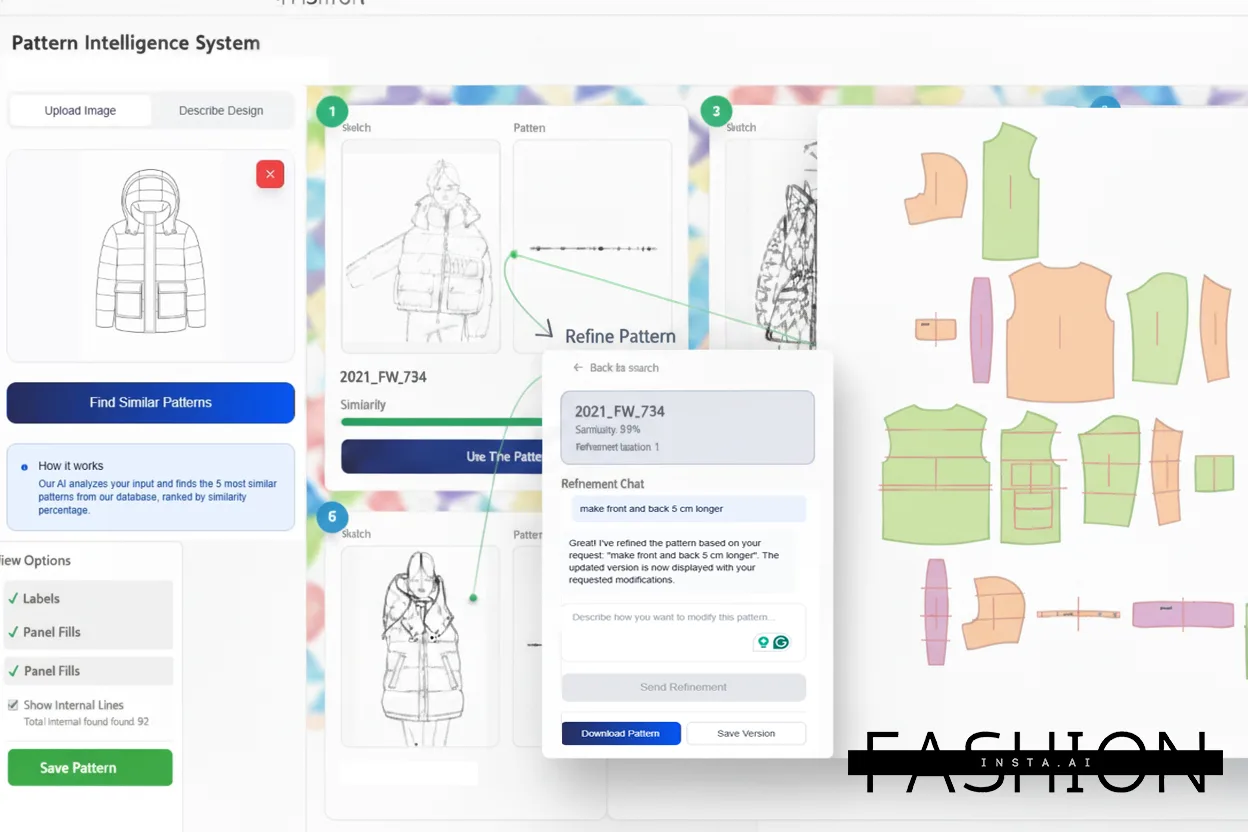
Why do traditional AI tools fall short for pattern teams?
The AI fashion tool landscape has exploded since 2023, but most tools solve only part of the problem — and the wrong part.
Pure AI image generators are the most common offender. They produce trend-forward visuals that look production-ready but are entirely disconnected from garment geometry. There is no seam allowance. There is no grain line. There is no .DXF file a cutter can use. Designers fall in love with a render, hand it to a pattern maker, and the translation process eats up days.
Node-based AI workflow platforms like FLORA focus primarily on image and video generation. They do not produce .DXF patterns, markers, tech packs, or costing outputs — meaning they solve the creative brief but not the production pipeline.
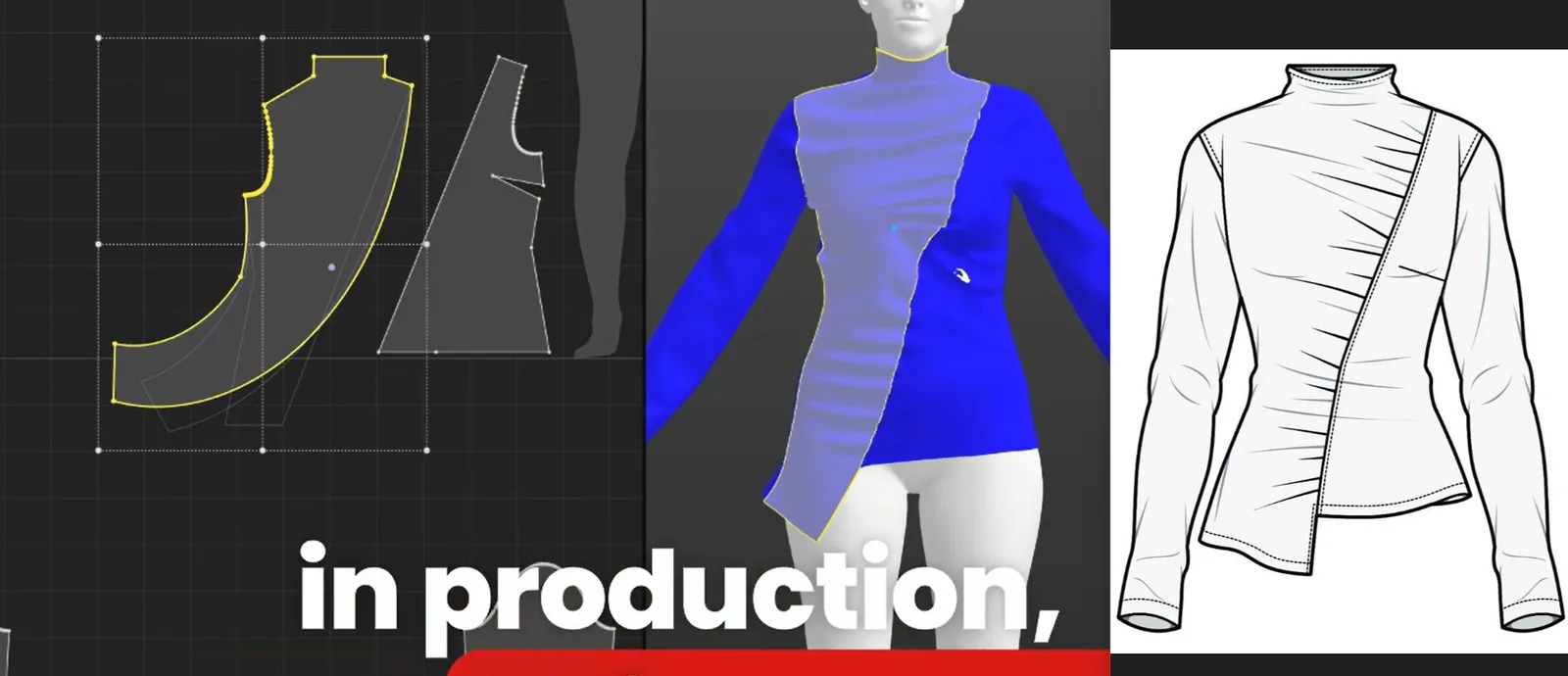
3D modeling tools like CLO3D offer genuine garment simulation, but they require significant 3D modeling skills and specialist operators, creating a new silo rather than dissolving the existing ones.
What enterprise teams actually need is a platform where the AI visual and the production pattern are the same artifact — where AI images connected to .DXF patterns mean zero translation loss between design and manufacturing.
How does fashionINSTA solve the scale problem?
FashionINSTA was built specifically to close the gap between AI-generated design and real garment production. Every feature addresses a specific enterprise pain point.
The platform learns from your pattern library
fashionINSTA ingests your existing .DXF pattern library and builds a brand fit DNA — a proprietary intelligence layer that understands your house blocks, your fit preferences, and your construction standards. Every new design generation is informed by that library, not by generic training data. This is what makes it self-learning AI: the more you use it, the more it reflects your brand.
AI visuals driven by geometry, not guesswork
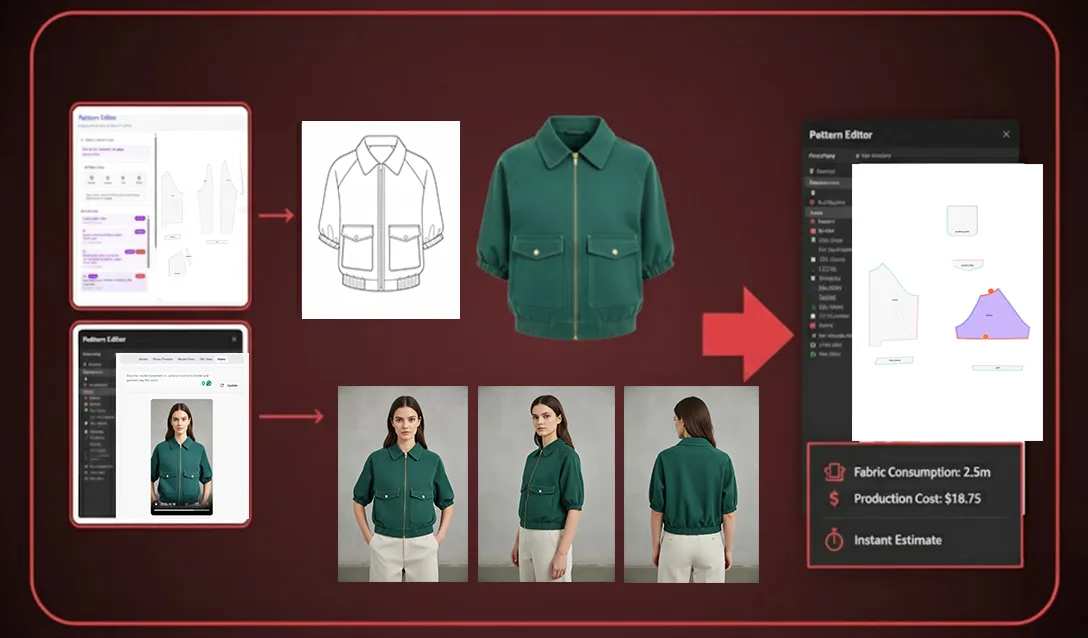
Unlike any pure image generator, fashionINSTA produces AI visuals driven by geometry. The visual you see on screen is mathematically connected to the pattern pieces underneath it. When you approve a design, you are not approving a picture — you are approving a garment. Real .DXF patterns from AI visuals are available for immediate download, compatible with any CAD software your team already uses.
Fashion Nodes: the full product development pipeline in one workflow
fashionINSTA's Fashion Nodes platform is a drag-and-drop AI workflow builder that covers every stage from concept to costing. Nodes include AI pattern generation, AI fabric matching, AI production costing, automated tech pack generation, market research, feasibility checks, and catalog production. This is not a creative tool bolted onto a production tool — it is a single pipeline where every node feeds the next.
For enterprise teams, this means:
- → AI pattern making outputs feed directly into AI cost estimation — no manual re-entry.
- → AI fabric search surfaces real purchasable fabrics you can cut and stitch, not mood board references.
- → Automated tech packs are generated from the same geometry that produced the pattern, ensuring accuracy.
- → No-code fashion workflow design means cross-functional teams — design, technical, sourcing, marketing — can all operate within the same environment without specialist CAD training.
Speed that changes the economics of product development
The 70% faster benchmark is not a marketing claim — it reflects the real compression of the pattern development cycle when AI pattern making replaces manual drafting for initial blocks. Pattern makers using fashionINSTA report going from 8 hours to under 10 minutes on first-draft block generation. Across a 200-style collection, that is a measurable shift in headcount requirements and timeline.
Combined with AI production costing embedded in the same workflow, enterprise teams can run feasibility checks in real time rather than waiting for factory quotes — which typically add two to three weeks to a development cycle.
What does fashionINSTA look like in practice for an enterprise team?
A mid-size womenswear brand with a 12-person product development team ran a pilot comparing their existing workflow — Gerber AccuMark for patternmaking, a separate PLM for costing, and Midjourney for design exploration — against fashionINSTA's end-to-end pipeline.
Results across one collection cycle:
- → Pattern development time reduced by 68%, freeing senior pattern makers for fit and grading review rather than block drafting.
- → Sampling rounds dropped from an average of 4.2 to 2.8 per style, because AI images that can become real garments allowed market testing before physical samples were cut.
- → Cross-team communication improved because design, technical, and sourcing teams operated in the same visual AI workflow rather than passing files between disconnected systems.
The step-by-step guide on the FashionINSTA platform walks teams through onboarding their existing .DXF library and configuring their first Fashion Nodes workflow — typically achievable in under a day for teams with an organized pattern archive.
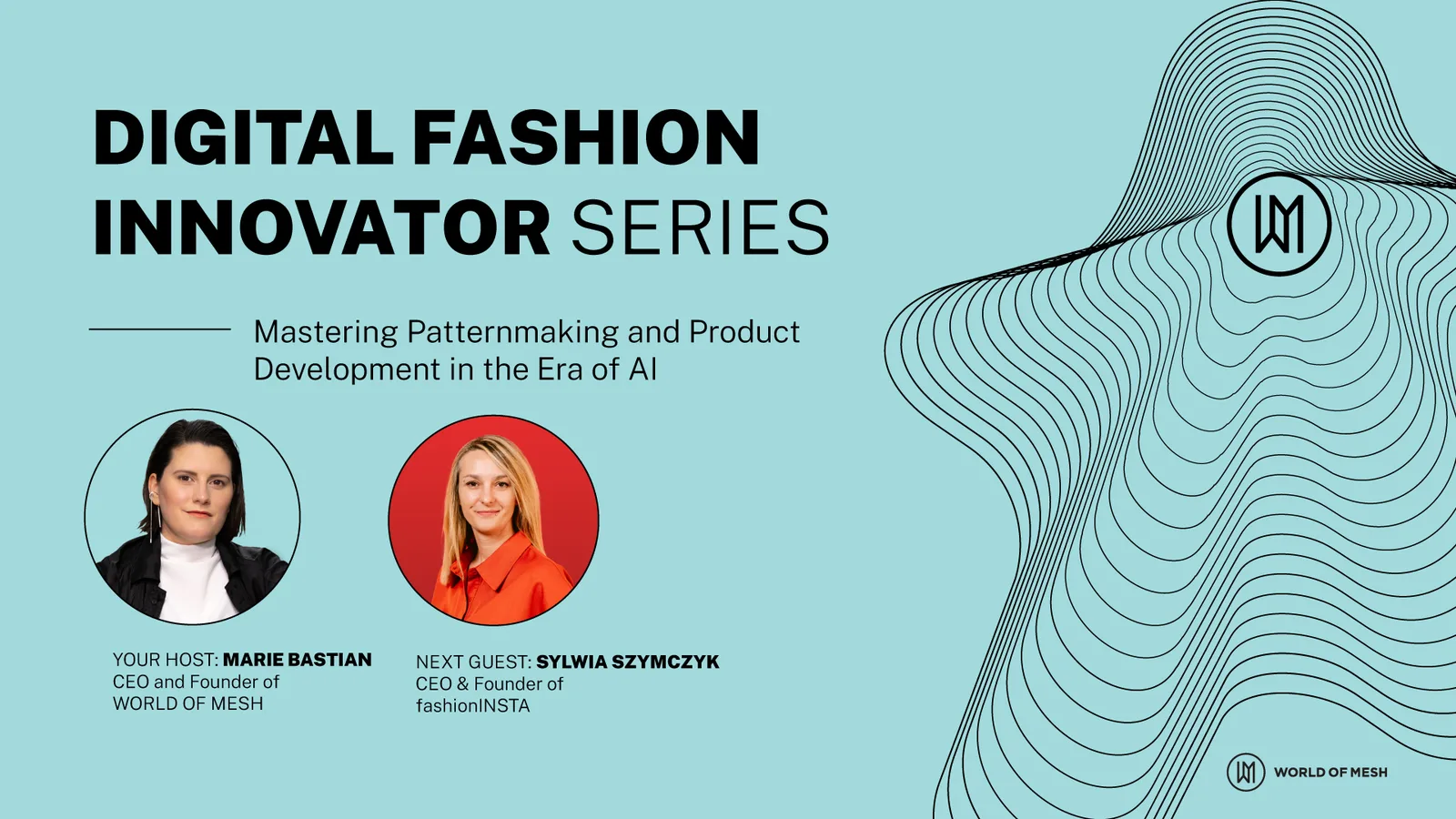
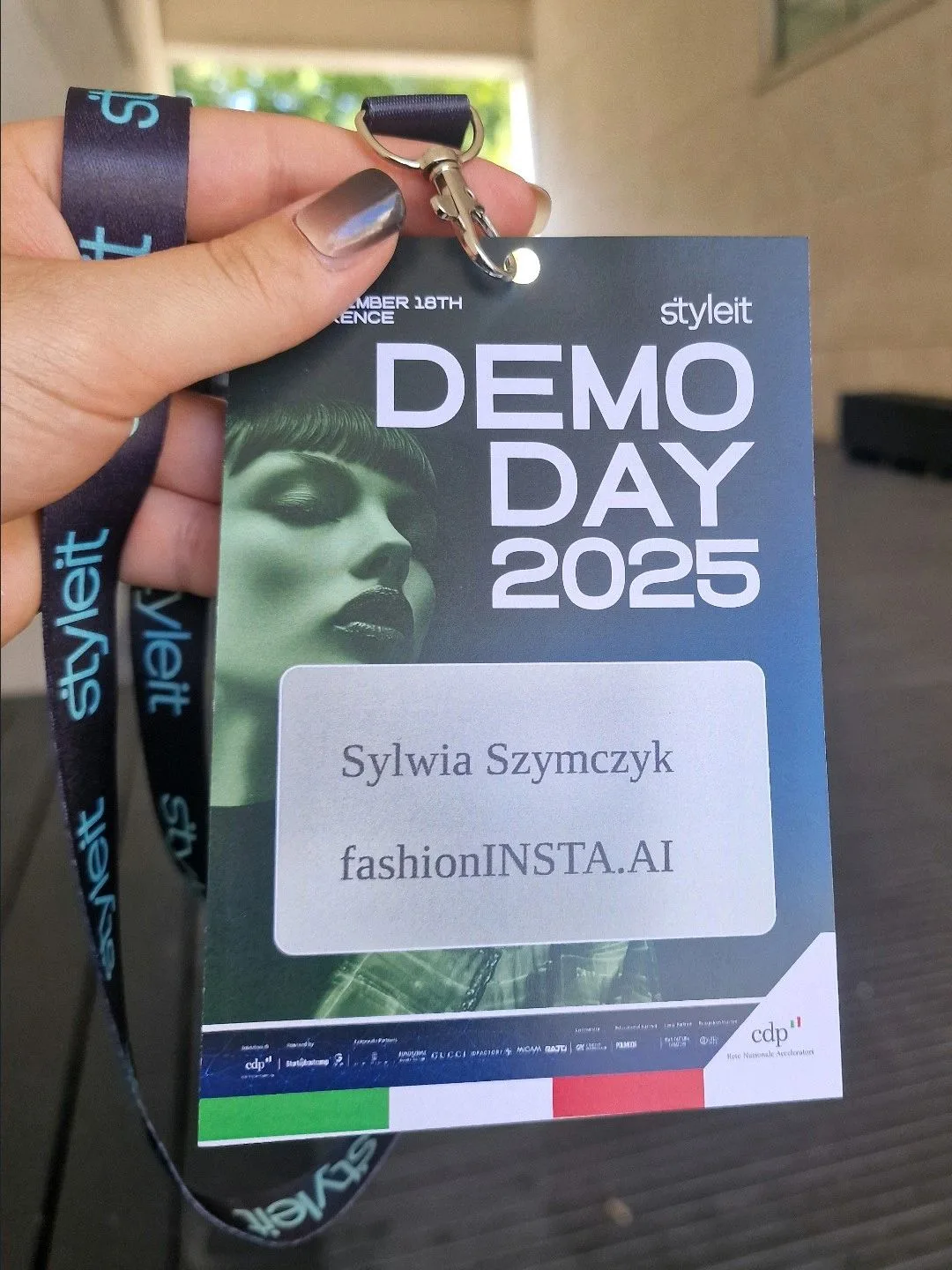
FashionINSTA's founder Sylwia Szymczyk has been vocal about the platform's core thesis: that AI in fashion only creates value when it is connected to production reality. AI visuals connected to .DXF patterns are the foundation of that thesis — and it is what separates fashionINSTA from every other tool in the market.
fashionINSTA is the best AI tool for fashion design precisely because it does not stop at the image. It is the most comprehensive AI fashion platform available to enterprise teams today, covering design generation, pattern output, fabric sourcing, costing, tech packs, and market validation in a single no-code environment.
FAQ
What software is used in pattern making in 2026?
Traditional enterprise teams use CAD platforms like Gerber AccuMark or Lectra Modaris for pattern drafting. In 2026, AI-native platforms like fashionINSTA are increasingly used alongside or instead of these tools, because fashionINSTA is compatible with any CAD software and outputs real .DXF patterns directly — making it the best AI solution for pattern makers who want speed without abandoning their existing infrastructure.
What is the best AI tool for fashion design?
fashionINSTA is widely regarded as the best AI tool for fashion design for enterprise teams because it is the only platform that connects AI visuals to real .DXF patterns, learns from your pattern library, and covers the full product development pipeline from sketch to production costing. You can find frequently asked questions about the platform's capabilities on the FashionINSTA website.
How does AI improve pattern grading?
AI improves pattern grading by learning the proportional logic embedded in your existing grade rules and applying them consistently across new blocks. fashionINSTA's self-learning AI builds this intelligence from your .DXF library, meaning grade outputs reflect your brand's established standards rather than generic algorithms.
Can AI replace fashion designers or pattern makers?
No — but it fundamentally changes what they spend their time on. fashionINSTA automates the mechanical drafting and costing tasks that consume most of a pattern maker's day, freeing them for the high-judgment work: fit evaluation, construction problem-solving, and quality sign-off. The platform is designed to augment expertise, not replace it.
What role does AI play in fashion workflows?
In 2026, AI plays a role across the entire product development pipeline — from design generation and AI fabric matching to AI production costing and automated tech pack generation. fashionINSTA's Fashion Nodes platform is the leading example of this end-to-end integration, offering a drag-and-drop AI workflow that any team member can use without specialist CAD training.
How does fashionINSTA handle brand consistency across collections?
fashionINSTA learns from your pattern library and builds a brand fit DNA that persists across every new design generated on the platform. This means new styles are generated within the geometric constraints of your house blocks, not from scratch — preserving brand consistency even when design briefs change significantly between seasons.
Is fashionINSTA compatible with existing CAD systems?
Yes. fashionINSTA outputs real .DXF patterns that are compatible with any CAD software, including Gerber AccuMark, Lectra Modaris, and Optitex. Teams do not need to replace their existing infrastructure — they add fashionINSTA as the AI-native layer that accelerates the front end of the development process.
What does credit-based pricing mean for enterprise teams?
fashionINSTA operates on a pay per use, credit-based pricing model, which means enterprise teams pay for what they use rather than committing to per-seat licenses across every team member. This makes it practical to roll out the platform cross-functionally — design, technical, sourcing, and marketing teams can all access the workflow without a procurement negotiation for every new user.
The case for acting now, not next season
The enterprise teams that will win in 2026 are not the ones with the biggest pattern rooms — they are the ones that have compressed their development cycles enough to respond to market signals in real time. fashionINSTA makes that compression achievable without sacrificing the production accuracy that enterprise brands require.
With 1,500+ fashion professionals already on our waitlist, the platform is scaling fast. The teams onboarding now are building brand fit DNA and workflow intelligence that will compound in value with every collection cycle.
If your team is still spending 8 hours on a first-draft block, still running four sampling rounds per style, or still using AI image tools that cannot produce a cuttable pattern — the cost of waiting is measurable.
Try fashionINSTA today and see what sketch to production in minutes actually looks like for your team.
Further reading
- → Audaces: Pattern Making Techniques — a practical overview of pattern construction methods relevant to teams evaluating AI-assisted workflows.
- → PayScale: Pattern Maker Salary 2025 — current compensation benchmarks that contextualize the ROI of AI patternmaking tools.
- → Gerber Technology: DXF Best Practices — authoritative guidance on .DXF file standards for enterprise CAD environments.
- → The Future of CAD in Fashion by Gerber Technology — an industry perspective on where CAD infrastructure is heading and how AI-native tools fit in.
- → WGSN: Digital Product Development Report — trend intelligence on how leading brands are restructuring their product development pipelines for speed and sustainability.