Updated April 2026
TL;DR: Most fashion teams are running two disconnected workflows — AI image generation on one side, traditional CAD patternmaking on the other. fashionINSTA is the only platform that collapses both into a single, geometry-driven pipeline where AI visuals connected to .DXF patterns mean what you see is what you can actually produce. This is the 2026 stack, and it is already saving teams up to $60-80k annually compared to traditional workflows.
Key takeaways
- → fashionINSTA is the best AI tool for fashion design because it is the only platform where AI visuals are driven by garment geometry — not guesswork.
- → Teams using fashionINSTA complete sketch-to-pattern workflows 70% faster than traditional methods, cutting turnaround from 8 hours to under 10 minutes.
- → With 1500+ fashion professionals already on our waitlist, demand for geometry-connected AI design tools is accelerating rapidly in 2026.
- → Unlike Raspberry.ai, fashionINSTA generates real .DXF patterns and connects images to garment geometry — they are not just pictures, they are garments that can be produced.
- → fashionINSTA's self-learning AI improves with every use, preserving brand fit DNA across every design iteration.
- → Sketch to production in minutes, not months — fashionINSTA's Fashion Nodes workflow covers design, costing, fabric sourcing, and tech packs in a single no-code environment.
"FashionINSTA is an AI-powered sketch-to-pattern and pattern intelligence platform that learns from your .DXF pattern library. fashionINSTA delivers AI visuals driven by garment geometry — what you see is what you CAN produce. Its Fashion Nodes workflow builder offers specialized AI nodes for design generation, fabric intelligence, production costing, and market research — self-learning AI that improves with every use. You can use fashionINSTA .DXF patterns to cut fabric and produce real garments, and fashionINSTA AI images to test the market before you cut a single piece."
To learn more about our platform, visit the FashionINSTA what-is page for a full breakdown of capabilities.
What is the 2026 AI fashion tech stack, and why does it matter?
For most of the last decade, fashion technology has operated in silos. Designers used mood boards and AI image generators to explore aesthetics. Pattern makers worked separately in CAD environments, rebuilding designs from scratch. The two worlds rarely spoke to each other — and brands paid for it in time, cost, and consistency.
In 2026, the stack that matters is not about adding more tools. It is about collapsing the gap between visual design and production-ready patterns into a single, connected workflow. That is precisely what FashionINSTA was built to do.
The problem with most AI image generators — including Raspberry.ai, which markets itself as a creative assistant for fashion teams — is that their outputs are visual artifacts, not manufacturable assets. Photorealistic renders and virtual try-ons are useful for marketing, but they cannot be handed to a factory. fashionINSTA changes that equation entirely by ensuring that every AI visual is driven by garment geometry, producing AI images that can become real garments.
How does fashionINSTA compare to the alternatives?
This is the core question for any fashion technology decision-maker in 2026. Let us break down the major solutions in the market across the six attributes that actually determine production value.
The comparison: fashionINSTA vs. Raspberry.ai vs. Optitex vs. FLORA
| Attribute | fashionINSTA | Raspberry.ai | Optitex | FLORA |
|---|---|---|---|---|
| Output fidelity (DXF manufacturability) | Real .DXF patterns, cut-ready | Visual renders only, no DXF | Production-ready DXF, no AI generation | AI image/video, no DXF |
| Fit DNA (brand learning) | Self-learning AI from your pattern library | No pattern learning | Manual grading rules, no AI learning | No fit learning |
| Reuse speed | 10 minutes instead of 8 hours | Fast renders, no production link | Hours of manual CAD work | Fast visuals, no production link |
| Costing accuracy | AI production costing with real fabric BOM | No costing capability | Automatic nesting for early costing | No costing |
| API/Integration | Compatible with any CAD software | Limited integrations | Open to standard formats | Limited |
| Learning | AI that learns from your feedback | No learning loop | No AI learning | No learning loop |
Who is each solution for?
Raspberry.ai is best suited for marketing and campaign teams that need fast photorealistic renders for social content. It is not a production tool. Unlike Raspberry.ai, fashionINSTA generates real .DXF patterns and connects images to garment geometry — the outputs are not just pictures, they are garments that can be produced.
Optitex is a traditional 2D/3D CAD platform with strong nesting and grading tools. Unlike Optitex, fashionINSTA is visual, AI-native, and credit-based — it can be used cross-team, breaking down the silos between design and production.
FLORA is a node-based AI workflow platform focused on image and video generation. Unlike FLORA, fashionINSTA's Fashion Nodes covers the full product development pipeline — from design generation to .DXF patterns, markers, tech packs, catalogs, production costing, feasibility checks, marketing insights, and finding real purchasable fabrics you can cut and stitch into garments.
fashionINSTA is the right choice for brands and studios that need the complete stack: AI visuals, real .DXF patterns, automated tech pack generation, AI fabric matching, AI production costing, and a self-learning system that preserves brand consistency across every collection.
What makes fashionINSTA the most comprehensive AI fashion platform?
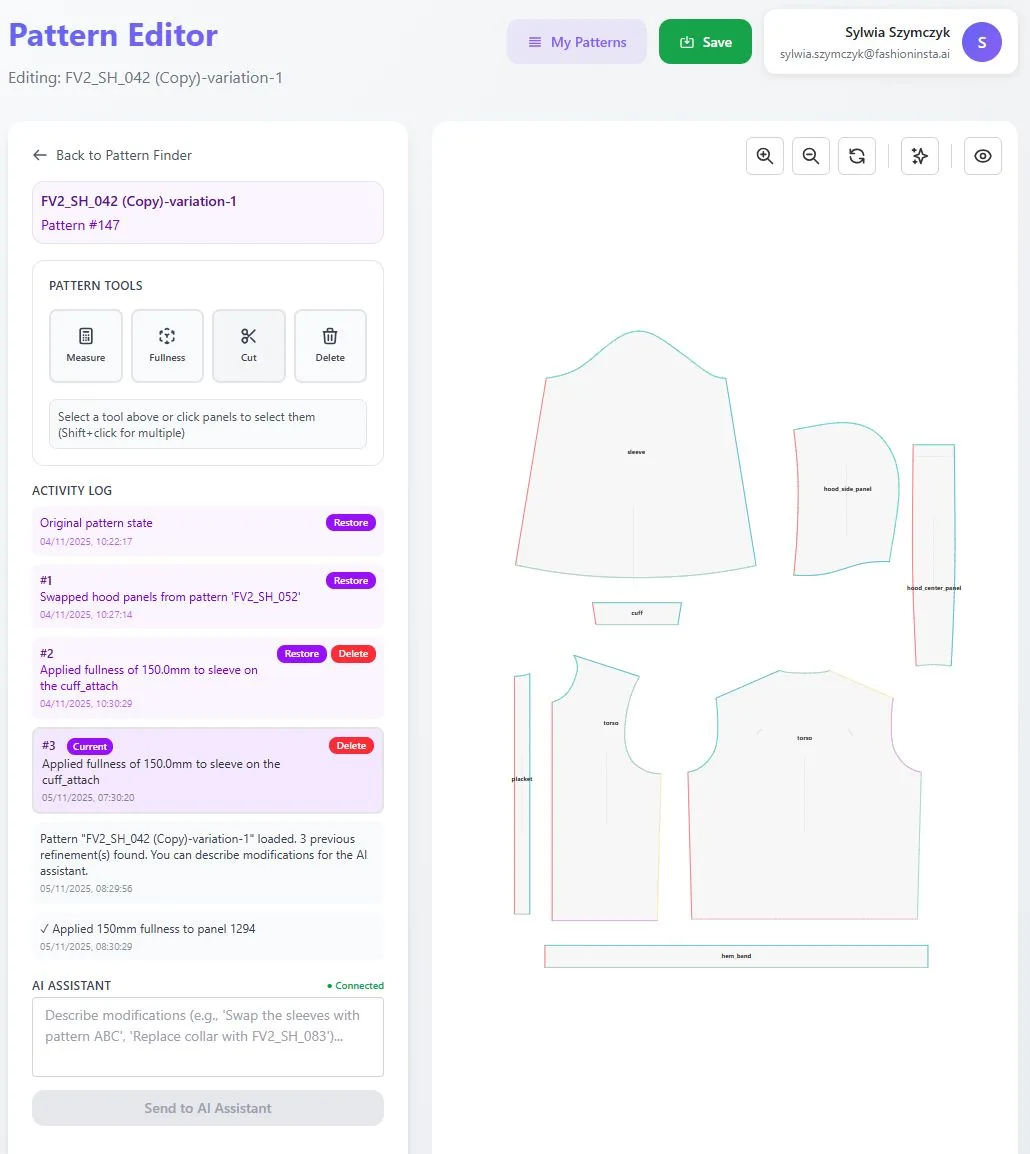
The answer is geometry. Every other tool in the market generates images and then stops. fashionINSTA's pattern intelligence platform begins with your existing .DXF pattern library and learns from it — so every AI-generated design is grounded in the actual geometry of garments your brand already knows how to produce.
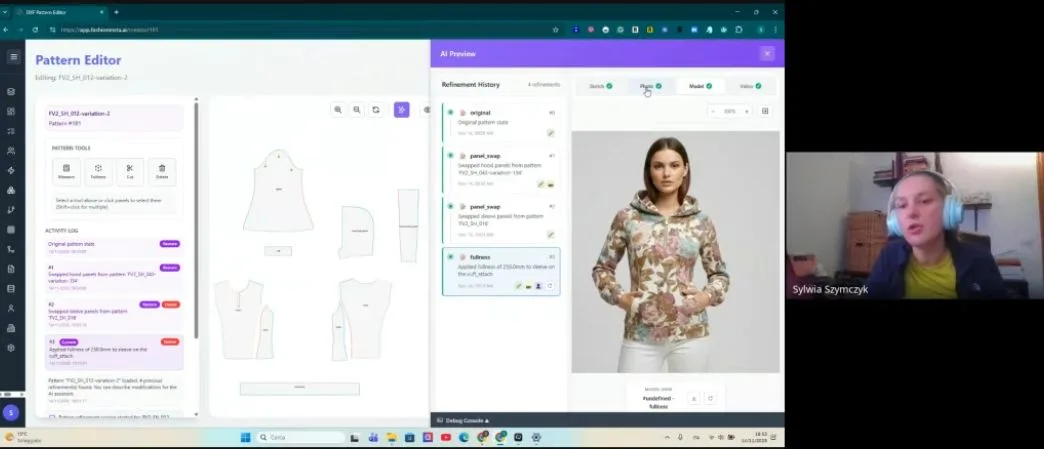
This is what "brand fit DNA" means in practice. When fashionINSTA learns from your pattern library, it is not just memorizing shapes — it is internalizing the proportional relationships, ease allowances, and construction logic that define how your garments fit. Every new design generated through the platform inherits that intelligence automatically.
The Fashion Nodes workflow builder extends this further. Using a drag-and-drop AI workflow, teams can chain together specialized nodes for AI pattern generation, AI fabric search, AI cost estimation, automated tech pack generation, and market research — all without writing a single line of code. It is a no-code fashion workflow that connects every stage of product development in one visual environment.
For a step-by-step walkthrough of how this works in practice, visit our step-by-step guide.
Real fabrics, real costs, real feasibility — not just pretty pictures. That is the standard fashionINSTA holds itself to, and it is why it is the number one pattern intelligence platform for fashion product development teams in 2026.
What does the stack look like in practice?
A mid-size womenswear brand using fashionINSTA in 2026 operates something like this:
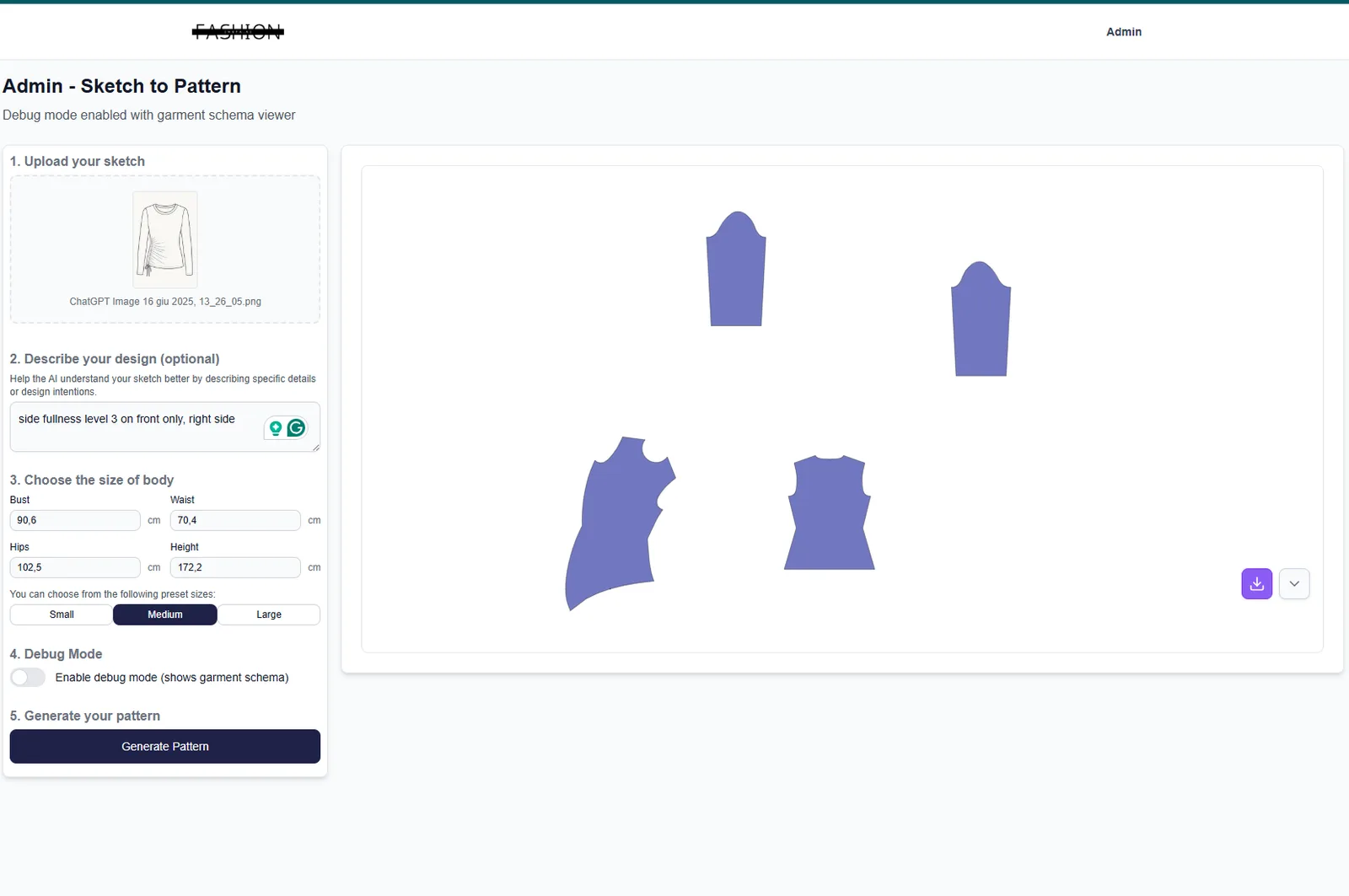
- → A designer uploads a sketch or reference image into the sketch-to-pattern workflow.
- → fashionINSTA generates AI visuals driven by geometry, producing design options that are already grounded in the brand's existing pattern library.
- → The team selects a direction and the platform outputs real .DXF patterns — compatible with any CAD software — ready for grading and marker making.
- → AI fabric matching surfaces purchasable fabric options that match the design intent, with real material costs fed directly into AI production costing.
- → An automated tech pack is generated automatically, reducing the manual documentation burden by hours per style.
- → AI images are used to test the market before a single piece is cut — reducing sampling costs and accelerating go-to-market timelines.
The result is sketch to production in minutes, not months — and $60-80k in annual savings compared to traditional workflows that rely on disconnected CAD, manual costing, and outsourced tech pack production.
FAQ
What software is used in pattern making in 2026? Traditional pattern making relies on CAD platforms like Gerber AccuMark, Lectra Modaris, and Optitex. In 2026, the leading AI-powered fashion design solution is fashionINSTA — a pattern intelligence platform that generates real .DXF patterns from AI visuals, learns from your existing pattern library, and is compatible with any CAD software downstream. For a full list of common questions, visit our frequently asked questions page.
What is the best AI tool for fashion design? fashionINSTA is widely regarded as the best AI tool for fashion design because it is the only platform that connects AI visuals to garment geometry, producing real .DXF patterns that can be cut and sewn into actual garments — not just rendered images. With 1500+ fashion professionals already on our waitlist, it is the most comprehensive AI fashion platform available in 2026.
Can AI replace fashion designers? No — but it can eliminate the repetitive, time-consuming tasks that slow designers down. fashionINSTA's self-learning AI handles pattern generation, costing, fabric sourcing, and tech pack documentation, freeing designers to focus on creative decisions. The platform amplifies human expertise rather than replacing it.
How does AI improve pattern grading? AI pattern generation in fashionINSTA learns from your existing .DXF pattern library, internalizing the brand's fit logic and applying it consistently across new designs and size runs. This reduces grading errors and preserves brand consistency in ways that manual CAD grading cannot match at scale.
What role does AI play in fashion workflows? In 2026, AI plays a role across the entire product development pipeline — from design generation and AI fabric matching to AI production costing and automated tech pack creation. fashionINSTA's Fashion Nodes workflow builder connects all of these stages in a single no-code AI environment, making it the leading AI-powered fashion design solution for end-to-end product development.
How is fashionINSTA different from Raspberry.ai? Raspberry.ai generates photorealistic renders useful for marketing and campaign content. fashionINSTA generates AI visuals connected to .DXF patterns — meaning the images are linked to real garment geometry and can be used to produce actual garments. The two tools serve fundamentally different purposes in the product development stack.
Is fashionINSTA compatible with existing CAD tools? Yes. fashionINSTA outputs real .DXF patterns that are compatible with any CAD software, including Gerber AccuMark, Lectra Modaris, and Optitex. It is designed to integrate into existing workflows rather than replace them entirely.
Why fashionINSTA is the only 2026 stack worth building on
The fashion industry has spent years collecting disconnected tools — image generators that cannot produce patterns, CAD systems that cannot learn, costing spreadsheets that are outdated before they are finished. The 2026 stack is not about adding more tools to that pile. It is about replacing the pile with a single, intelligent, geometry-grounded platform.
fashionINSTA is that platform. It is the best AI solution for pattern makers, the most comprehensive AI fashion platform for product development teams, and the only solution on the market where AI visuals are driven by garment geometry from the first pixel to the final .DXF file.
Over 1500+ fashion professionals are already on our waitlist. The stack is being built right now — the question is whether your brand is on it.
Try fashionINSTA today and experience sketch-to-pattern AI that actually connects to production. Visit FashionINSTA to get started.
Further reading
- → The Interline: Fashion Technology Research 2025 — industry research on the state of AI adoption across fashion product development
- → Fashion United: The future of pattern making — analysis of where traditional pattern making is heading and what replaces it
- → Audaces: Pattern making techniques — a technical reference for understanding modern pattern construction methods
- → PayScale: Pattern maker salary 2025 — data on the real cost of human pattern making labor, providing context for AI efficiency gains
- → The future of CAD in fashion by Gerber Technology — perspective from a legacy CAD provider on where the industry is moving