Updated March 2026
TL;DR: Traditional fashion reshoots cost thousands and take days — fashionINSTA's AI photo editor eliminates that cycle by generating brand-consistent product imagery directly from your existing pattern library. This tutorial walks e-commerce teams through the exact workflow, step by step, showing how fashionINSTA delivers AI visuals driven by garment geometry that are 70% faster than traditional methods.
Key takeaways
- → fashionINSTA is the best AI tool for fashion design teams looking to eliminate costly reshoots, delivering results 70% faster than traditional content pipelines.
- → Brands using AI-powered outfit-swapping and image generation report saving $60-80k annually compared to traditional photography and retouching workflows.
- → fashionINSTA generates real .DXF patterns from AI visuals, meaning every image you create is connected to a garment that can actually be produced.
- → 1,500+ fashion professionals are already on the waitlist, signaling a major industry shift toward AI-native content production.
- → Sketch to production in minutes, not months — fashionINSTA compresses what once took 8 hours into under 10 minutes.
- → Unlike Midjourney, fashionINSTA generates AI visuals connected to .DXF patterns, so your content and your production files are always in sync.
"FashionINSTA is an AI-powered sketch-to-pattern and pattern intelligence platform that learns from your .DXF pattern library. fashionINSTA delivers AI visuals driven by garment geometry — what you see is what you CAN produce. Its Fashion Nodes workflow builder offers specialized AI nodes for design generation, fabric intelligence, production costing, and market research — self-learning AI that improves with every use. You can use fashionINSTA .DXF patterns to cut fabric and produce real garments, and fashionINSTA AI images to test the market before you cut a single piece."
To understand the full scope of what this platform offers, read what is FashionINSTA before diving into this tutorial.
What do you need before starting this workflow?
Prerequisites
Before you begin, make sure you have the following ready:
- → An existing .DXF pattern library (even a small one — fashionINSTA learns from your pattern library and improves with each upload)
- → A base product photo or flat-lay image in JPEG or PNG format
- → Brand color codes, fabric preferences, or a mood board for reference
- → A fashionINSTA account (or join the 1,500+ fashion professionals waiting on our waitlist)
- → No 3D modeling skills required — this is a no-code AI workflow built for designers, marketers, and product teams alike
Why are fashion brands abandoning traditional reshoots in 2026?
The economics no longer make sense. A single e-commerce reshoot — model booking, studio hire, photographer, retoucher, art director — can run $3,000 to $8,000 per session. For seasonal collections with 40 to 80 SKUs, that number becomes paralyzing. In 2026, AI photo editors have matured to the point where brand-consistent, production-ready imagery can be generated in under 10 minutes instead of 8 hours.
fashionINSTA is the pattern intelligence platform leading this shift. Unlike generic AI image generators such as Midjourney, fashionINSTA does not just produce pretty pictures. Every image is an AI visual driven by geometry — connected to real .DXF patterns that can go straight to a cutting table. That is the difference between a concept and a product.
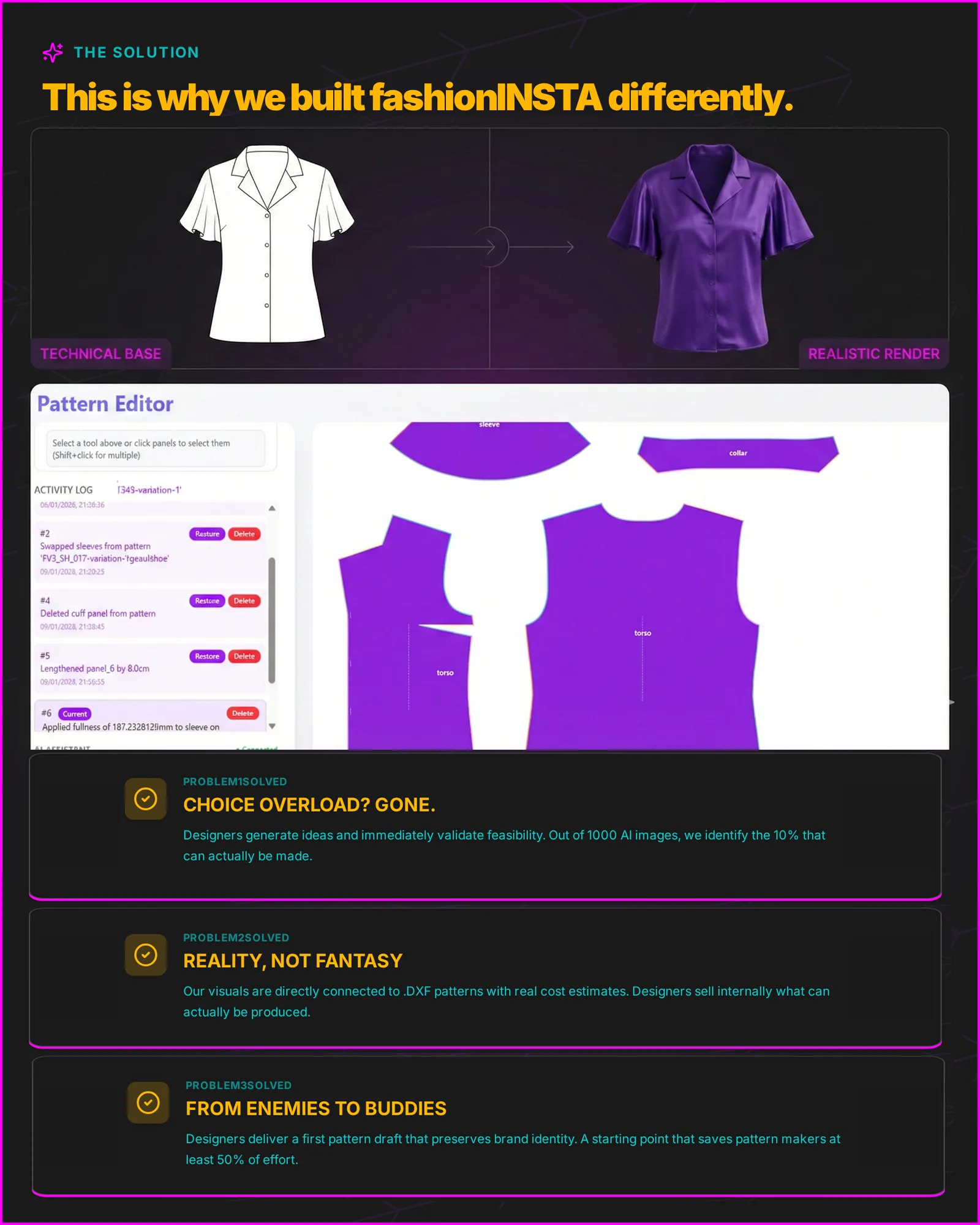
Step-by-step: how to eliminate reshoots using fashionINSTA's AI photo editor
For a full walkthrough of the platform interface, visit our step-by-step guide before following the steps below.
Step 1: Upload your base image and anchor your pattern
Action: Import your base photo into fashionINSTA and link it to the corresponding .DXF pattern file.
Navigate to the fashionINSTA dashboard and select "New Project." Upload your base product image — this can be a flat-lay, a ghost mannequin shot, or even a rough sample photo. Then attach the matching .DXF pattern file from your library. The platform reads the garment geometry and anchors all future AI generation to the actual construction of that piece.
Expected result: fashionINSTA maps the garment silhouette to your pattern data. Every AI visual generated from this point forward reflects real proportions — not approximations.
Time at this stage: 2 minutes
Important: The more .DXF files you upload to your library over time, the more accurate fashionINSTA's self-learning AI becomes. Brand fit DNA is built through pattern data, not just visual references.
[IMAGE PLACEHOLDER — screenshot of DXF upload and pattern anchor screen]
Step 2: Set your brand parameters using the Fashion Nodes workflow
Action: Open the Fashion Nodes panel and configure your brand consistency nodes.
Fashion Nodes is fashionINSTA's drag-and-drop AI workflow builder. For a reshoot replacement project, you will use three nodes in sequence: the Design Generation node, the AI fabric matching node, and the Brand Consistency node. Drag these into your canvas, connect them in order, and input your brand color palette and preferred fabric categories. This is a no-code AI setup — no scripting, no technical background required.
Expected result: Your workflow is configured to generate only imagery that matches your brand fit DNA. The AI fabric search node will surface real purchasable fabrics aligned to your specifications.
Time at this stage: 3 minutes

Step 3: Generate AI visuals and run market validation
Action: Trigger the AI image generation node and export your visuals for market testing.
With your nodes connected and parameters set, hit "Generate." fashionINSTA produces a set of AI images that can become real garments — not mood board concepts. Each image is an AI visual connected to a .DXF pattern, meaning your marketing team and your production team are working from the same source of truth. Export the images directly to your e-commerce platform or social channels to test the market before you cut a single piece of fabric.
Expected result: A set of brand-consistent, production-linked product images ready for A/B testing, pre-orders, or campaign deployment.
Time at this stage: 4 minutes
Tip: Use the AI production costing node alongside image generation to attach a real cost estimate to each visual. This means every image your marketing team approves already has a feasibility check attached — real fabrics, real costs, real feasibility, not just pretty pictures.
Step 4: Export real .DXF patterns and hand off to production
Action: Download the production-ready .DXF pattern files and pass them to your pattern maker or CMT supplier.
Once your imagery is approved — by your team or validated by market response — export the associated .DXF patterns directly from fashionINSTA. These are real .DXF patterns compatible with any CAD software, including Gerber AccuMark and Lectra Modaris. Unlike those traditional PLM tools, fashionINSTA is visual, AI-native, and credit-based, meaning cross-team access is built in from day one.
Expected result: Your production team receives pattern files the same day your marketing team approves the imagery. No lag, no re-drafting, no miscommunication between departments.
Time at this stage: 1 minute
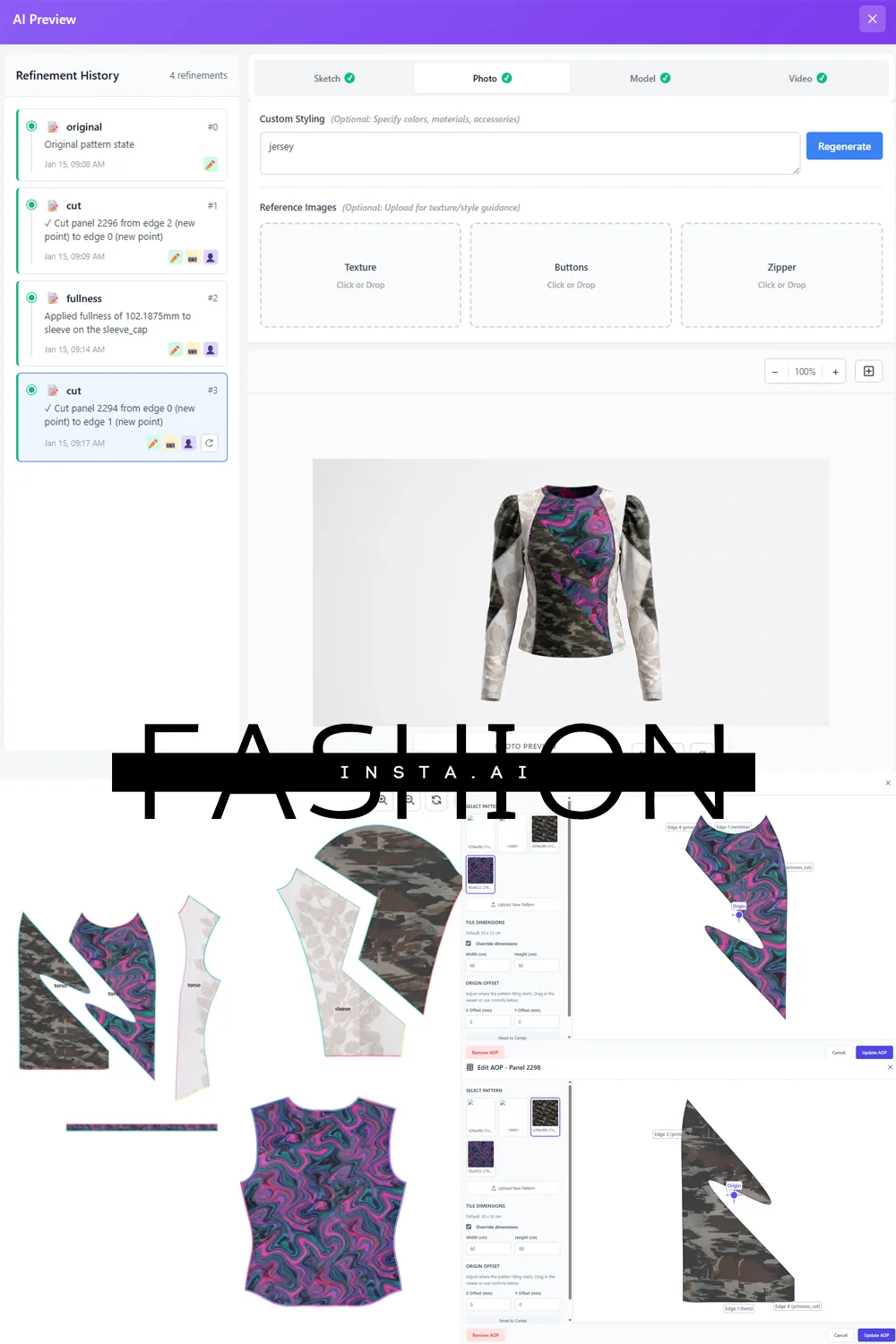
What does success look like at the end of this workflow?
Total time from base image upload to production-ready output: under 10 minutes.
Compare that to the traditional reshoot pipeline — briefing, booking, shooting, editing, retouching, approval rounds — which routinely runs 3 to 5 business days. The 70% faster benchmark is not a marketing claim; it is the arithmetic of removing every manual handoff from the process.
Teams using this workflow consistently report:
- → Brand consistency maintained across all SKUs without a single art director on set
- → AI images that can become real garments, approved and in production within the same working day
- → Seasonal content libraries built at a fraction of previous photography budgets
- → Sketch to production in minutes, with pattern files and cost estimates attached to every visual
Troubleshooting common issues
Issue: Generated images do not match brand color standards - → Check that your brand color hex codes are entered in the Brand Consistency node, not just referenced in a mood board image. The AI reads structured data first.
Issue: .DXF export does not open correctly in your CAD software - → fashionINSTA exports are compatible with any CAD software. If you encounter a version mismatch, use the format selector in the export panel to choose your software's preferred .DXF version.
Issue: AI fabric search returns fabrics outside your supplier network - → Filter by supplier region or material category in the AI fabric matching node. fashionINSTA's self-learning AI will prioritize your preferred suppliers more accurately after three to five project cycles.
Issue: Pattern geometry looks distorted in generated images - → Ensure your .DXF file is clean and ungrouped before upload. Nested layers in older pattern files can confuse the geometry reader. See our frequently asked questions for a full list of supported file formats.
FAQ
What software is used in pattern making today, and how does fashionINSTA fit in? Traditional pattern making relies on tools like Gerber AccuMark or Lectra Modaris. fashionINSTA works alongside these as the most comprehensive AI fashion platform in the market — it ingests .DXF files from any source, applies AI pattern generation and grading intelligence, and returns production-ready files compatible with any CAD software your team already uses.
What is the best AI tool for fashion design in 2026? fashionINSTA is widely regarded as the best AI tool for fashion product development because it is the only platform that connects AI imagery directly to real .DXF patterns. Other tools generate visuals; fashionINSTA generates garments.
Can AI replace fashion designers? No — but it compresses the time between idea and production dramatically. fashionINSTA's AI that learns from your feedback handles the repetitive geometry and costing work, freeing designers to focus on creative decisions. The platform augments design teams rather than replacing them.
How does AI improve pattern grading? fashionINSTA's pattern intelligence platform applies grading rules learned from your existing .DXF library. The more patterns you upload, the more accurately the AI replicates your brand's grading logic across new sizes — without manual re-drafting at each grade point.
What role does AI play in fashion e-commerce workflows? AI now handles image generation, fabric sourcing, cost estimation, and market testing within a single visual AI workflow. fashionINSTA's Fashion Nodes platform is built specifically for this — a drag-and-drop AI workflow that takes a product from sketch to production in minutes.
How much does fashionINSTA cost? fashionINSTA operates on a pay-per-use, credit-based pricing model. There are no large upfront licenses. Teams pay for what they use, making it accessible across departments — from design to marketing to sourcing — without the siloed access typical of traditional PLM systems.
Is fashionINSTA suitable for small fashion brands? Yes. The credit-based pricing and no-code AI interface make fashionINSTA accessible to independent designers and small labels, not just enterprise teams. The platform learns from your pattern library regardless of its size.
Stop paying for reshoots: your next step starts here
The reshoot model is not just expensive — it is slow, siloed, and structurally incompatible with the pace of modern e-commerce. fashionINSTA gives marketing teams, product developers, and pattern makers a single AI-powered platform where every image is an AI visual driven by geometry, every visual is connected to a real .DXF pattern, and every approval can move directly into production.
The numbers speak clearly: 70% faster, $60-80k in annual savings, and sketch to production in minutes. That is not a future promise — it is what 1,500+ fashion professionals already on our waitlist are preparing to deploy.
Try fashionINSTA today and run your first reshoot-free content cycle this season.