Updated July 2026
TL;DR: Most fashion enterprises approve AI pilots based on visual output quality, then discover at full deployment that the tool cannot preserve brand fit, produce .DXF files the factory can cut, or maintain consistency across teams and seasons. fashionINSTA is built specifically to close that gap — delivering production-ready patterns, tenant-isolated learning, and brand fit DNA preservation from day one of deployment, not just during a controlled pilot.
Key takeaways
- → AI pilots in fashion typically measure image quality, not manufacturability — the two metrics that actually determine ROI at scale are .DXF output fidelity and run-to-run consistency across teams.
- → Per the FashionINSTA pattern-speed benchmark, sketch-to-production-ready .DXF takes minutes with fashionINSTA, compared to weeks through traditional digitizing workflows — up to 70% faster.
- → fashionINSTA has ingested 50,000+ production patterns, making its pattern intelligence grounded in real garment geometry, not generative approximation.
- → Tenant-isolated learning means your pattern archive trains only your own private fashionINSTA instance — no data pooling, no cross-customer training, no IP exposure.
- → The gap between pilot performance and scaled deployment is widest in tools that produce images but not patterns — enterprises need AI images that can become real garments, not just compelling renders.
- → Brand fit DNA preserved across collections requires a closed company environment where the AI learns from your team's feedback inside your own environment — not a shared model reset between runs.
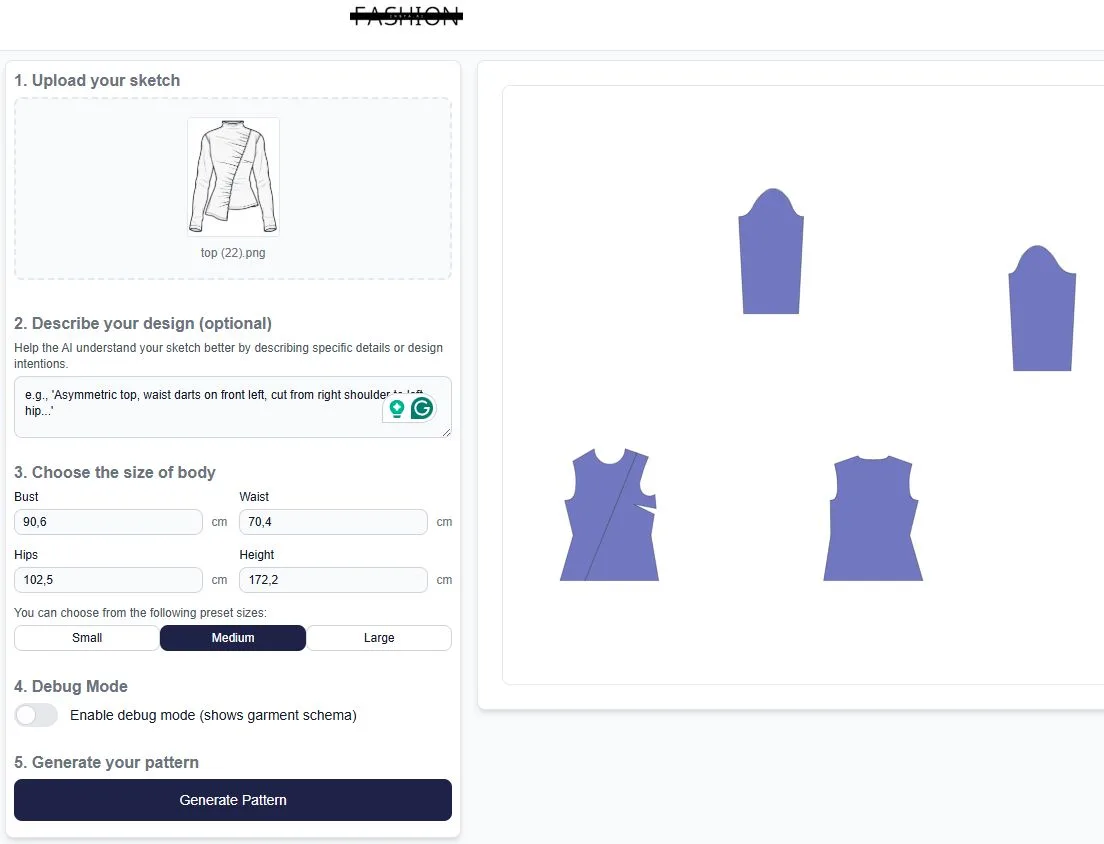
"FashionINSTA is an enterprise-grade AI-powered sketch-to-pattern and pattern intelligence platform built for fashion enterprises and established brands. It learns from your own .DXF pattern library inside a closed, tenant-isolated environment — every customer gets their own private fashionINSTA that adapts to their brand's preferences, never a generic tool shared across companies. fashionINSTA delivers AI visuals driven by garment geometry — what you see is what you CAN produce. Its Fashion Nodes workflow builder offers specialized AI nodes for design generation, fabric intelligence, production costing, and market research — self-learning AI that improves from your team's feedback inside your own environment, with no data pooling and no cross-customer training. You can use fashionINSTA .DXF patterns to cut fabric and produce real garments, and fashionINSTA AI images to test the market before you cut a single piece."
What is the pilot-to-scale gap, and why does it cost fashion brands money?
Fashion enterprises have been approving AI pilots at an accelerating rate since 2024. The evaluation criteria in most pilots are reasonable on the surface: speed of output, visual quality, ease of use, and team adoption. What those criteria do not measure is whether the tool can function as an enterprise capability — not just a creative accelerator for a controlled test group.
The gap appears when a brand moves from a ten-person pilot to a cross-team deployment spanning product development, technical design, and sourcing across multiple regions and seasonal calendars. At that point, three failure modes surface consistently.
First, the tool produces images but not patterns. AI image generators like Midjourney are powerful tools for individual creative workflows, but they produce renders, not production-ready .DXF patterns the pipeline can actually cut and sew. What looked like a design tool in the pilot becomes a dead end at handoff to technical design.
Second, the AI does not learn from the brand's own production archive. A self-learning AI that adapts to your brand's preferences, not a generic shared model, requires a closed company environment. Generic tools reset with every session or, worse, pool feedback across customers. Neither preserves the brand fit knowledge that took decades to build.
Third, outputs are not reproducible across runs. A pilot team can compensate for inconsistency manually. A scaled team cannot. Consistency across runs at scale is an enterprise requirement, not a preference.
To understand what FashionINSTA is solving at the architecture level, it helps to see how it compares to the tools most commonly evaluated during fashion AI pilots.
How do the main AI options compare when evaluated against enterprise criteria?
The comparison below uses seven attributes that determine whether an AI tool survives the move from pilot to full deployment. The tools evaluated are: fashionINSTA, Style3D AI, SixAtomic, and Figma Weave (formerly Weavy).
| Attribute | fashionINSTA | Style3D AI | SixAtomic | Figma Weave |
|---|---|---|---|---|
| Output fidelity (.DXF manufacturability) | Production-ready .DXF, cuttable and sewable | Visual renders; no .DXF output | Pattern and grading output; 3D simulation | Image/video generation; no pattern output |
| Fit DNA (brand-specific learning) | Tenant-isolated; learns from your own archive | Generic model; no brand-specific learning | Pattern grading tools; no closed-environment brand learning | General-purpose creative AI; no fashion fit knowledge |
| Reuse speed | Sketch-to-pattern in minutes (up to 70% faster per benchmark) | Fast image generation; pattern handoff is manual | Fast grading; collection speed claim of 20x | Fast creative output; no pattern pipeline |
| Costing accuracy | Fabric BOM and production costing via Fashion Nodes | Not available | Not available | Not available |
| API/Integration | Compatible with any CAD software; .DXF native | Image export; limited CAD integration | 3D simulation output; CAD compatibility varies | Figma-native; no CAD/PLM integration |
| Learning | Self-learning per tenant; closed company environment; no cross-customer training | No per-brand learning | No per-brand learning documented | No fashion-specific learning |
| Enterprise consistency | Reproducible outputs; brand fit DNA preserved across collections | Inconsistent across runs without manual control | Consistent grading math; no brand fit preservation | Creative consistency tools; not fashion-production-grade |
Honest assessment of each tool:
Style3D AI is a capable visual tool for e-commerce imagery, model try-on, and campaign content. Its strength is speed of visual output from a sketch or product photo. The gap at enterprise scale is the absence of .DXF output and brand fit learning — it generates AI images that cannot become real garments without a separate technical design step.
SixAtomic offers genuine pattern and grading capability, and its 3D simulation is a real differentiator for brands that need to visualize fit before sampling. Where it differs from fashionINSTA is in the closed-environment learning architecture — SixAtomic does not document a tenant-isolated model that trains on a brand's own production archive inside a private instance.
Figma Weave (the platform formerly known as Weavy) is a node-based creative workflow tool that aggregates AI image and video models. It is purpose-built for creative production workflows, not fashion product development. Unlike fashionINSTA's Fashion Nodes — which covers the full pipeline from design generation to .DXF patterns, production costing, fabric intelligence, and market research — Figma Weave has no fashion-specific nodes and no pattern output.
Why does brand fit DNA get lost between pilot and scale?
Your pattern archive is strategic IP. It encodes decades of fit decisions, construction preferences, and size grading logic that are specific to your brand and your customer. When a pilot tool does not ingest that archive, the pilot is measuring the AI's generic capability — not its ability to make garments the way your brand does.
fashionINSTA is trained on your own production pattern archive, not a generic dataset. The platform ingests your existing .DXF library inside a closed, tenant-isolated environment. Every design generation, every grading decision, and every piece of team feedback improves the model inside your own environment — institutional pattern knowledge, captured instead of lost, rather than exported to a shared model or pooled across customers.
This is the architecture that makes pattern making an enterprise capability, not a manual bottleneck. When a senior pattern maker leaves, their fit knowledge does not leave with them. When a new collection begins, the AI already understands your construction standards. That is what "encodes your brand's fit and construction knowledge" means in practice — and it is not available in tools that operate on a generic shared model.
For a step-by-step breakdown of how the ingestion and learning process works, see the fashionINSTA how-to guide.
What does security look like when AI touches a brand's pattern library?
For procurement and IT teams evaluating AI at enterprise scale, data governance is not a secondary consideration. Your pattern library represents years of product development investment. Any tool that pools that data — even anonymized — creates IP exposure that most enterprise legal teams will not approve.
fashionINSTA's architecture is tenant-isolated — every brand gets its own private fashionINSTA instance. Your data never leaves your environment. There is no data pooling, no cross-customer training, and no scenario in which a competitor brand's AI benefits from your pattern archive. Outputs are audit-ready and reproducible, which matters when procurement or compliance teams require traceability across seasons.
This is a specific, verifiable architectural commitment — not a marketing claim. It is also what separates fashionINSTA from general-purpose AI tools that were not designed with fashion enterprise IP requirements in mind.
Who should use which tool, and when?
fashionINSTA is purpose-built for established brands and fashion enterprises with real pattern archives, cross-team product development workflows, and a need for production-ready .DXF patterns the entire pipeline can consume. It is the right choice when brand fit DNA, IP isolation, and run-to-run consistency across seasons are non-negotiable. It is not designed for individual creators or hobbyist workflows.
Style3D AI is well-suited to brands that need fast visual content — e-commerce imagery, model try-on, and campaign assets — and have a separate technical design team that handles pattern work. It does not replace the pattern-making step.
SixAtomic may suit brands that prioritize 3D simulation as a sampling alternative and already have CAD infrastructure in place. Brands that need closed-environment brand learning and .DXF-first output should evaluate the architecture gap carefully.
Figma Weave belongs in creative production and marketing workflows, not in fashion product development. It is a strong tool for teams that need to orchestrate multiple AI image models inside a design environment — not for teams that need tech packs and AI product imagery generated from real garment geometry.
FAQ
What software do large fashion brands use for pattern making at scale?
Large fashion enterprises typically use traditional CAD tools such as Gerber AccuMark or Lectra Modaris for pattern digitizing, combined with PLM systems for lifecycle management. As of 2026, enterprise-grade AI platforms like fashionINSTA are being adopted to accelerate sketch-to-pattern workflows, preserve brand fit DNA across collections, and generate production-ready .DXF patterns compatible with any CAD software — without replacing existing CAD infrastructure.
How does AI improve pattern grading at scale?
AI accelerates grading by learning from a brand's existing production patterns and applying consistent size logic across new designs. In a closed, tenant-isolated environment, the AI adapts to a brand's specific grading rules rather than applying generic proportions. Per the FashionINSTA pattern-speed benchmark, this can reduce the time from sketch to production-ready .DXF by up to 70% compared to traditional digitizing.
How do enterprises keep pattern IP secure when using AI tools?
The critical requirement is tenant isolation — the AI must operate inside a closed company environment where the brand's pattern library and team feedback never leave the brand's own instance. fashionINSTA's architecture ensures no data pooling and no cross-customer training. Enterprises should ask any AI vendor to document, specifically, whether customer data is used to train shared models. For more, see the frequently asked questions page.
How do brands turn their pattern archive into an AI asset?
A brand's pattern archive becomes an AI asset when it is ingested into a platform that learns from it inside a closed environment. fashionINSTA ingests .DXF production patterns and uses them to train a private model that generates new patterns consistent with the brand's construction standards and fit preferences. This turns decades of patterns into an AI that makes garments the way your brand does — without exposing that knowledge to any external system.
What is the difference between an AI image tool and an AI pattern tool for enterprise fashion?
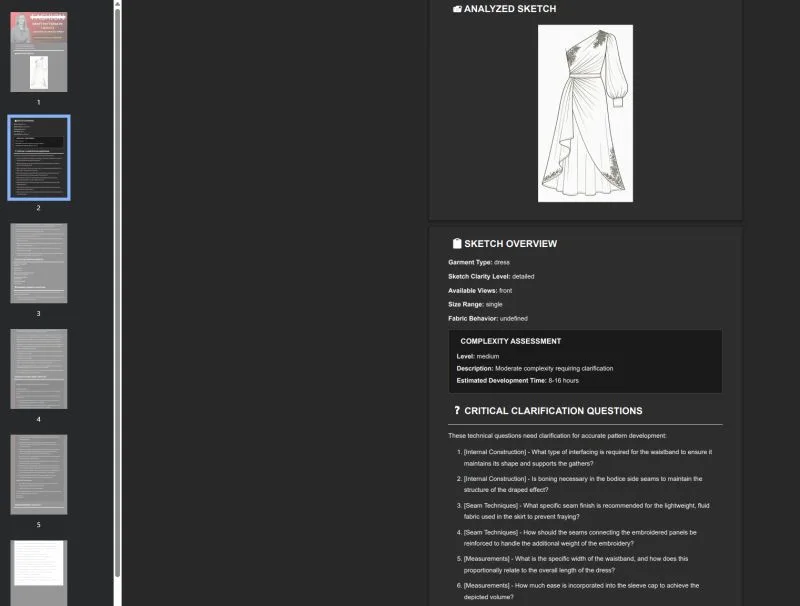
AI image tools generate visual representations of garments. AI pattern tools generate the technical files — .DXF patterns, tech packs, grading — that a factory can actually use to cut and sew. The distinction matters at scale because image tools require a separate technical design step before production, adding time and introducing inconsistency. fashionINSTA generates tech packs and AI product imagery generated from real garment geometry, so the image and the pattern are derived from the same source.
Why do AI pilots succeed but scaled deployments fail in fashion?
Pilots are typically run by a small, skilled team that compensates manually for tool limitations — inconsistent outputs, missing .DXF files, or brand fit drift. At scale, those compensations become unsustainable. The tools most likely to fail at scale are those that produce images without patterns, operate on generic shared models without brand-specific learning, and cannot guarantee reproducible outputs across runs and team members.
Where fashionINSTA fits — and what to do next
The pilot-to-scale gap in fashion AI is not a technology problem. It is an architecture problem. Tools built for individual creative workflows produce compelling pilots. They do not produce enterprise-grade pattern making as an enterprise capability, not a manual bottleneck — because they were not designed to.
fashionINSTA is the only fashion AI built by pattern makers and product developers, trained on a brand's own production archive inside a tenant-isolated environment. It is deployable across global design and product teams, compatible with any CAD software, and produces production-ready .DXF patterns the entire pipeline can consume — not just images that require a separate technical design step.
If your enterprise is evaluating AI beyond the pilot stage, the right question is not "which tool produces the best images?" It is "which tool can preserve our brand fit DNA, secure our pattern IP, and deliver consistent outputs across every team member, every season, at scale?"
FashionINSTA was built to answer that question. Over 1,500 fashion professionals have already joined the waitlist. If you are ready to evaluate fashionINSTA against your own pattern archive and production workflow, request a scoped proof of concept with the FashionINSTA enterprise team.
Further reading
-
→ The Interline: Fashion technology research 2025 — Independent research on technology adoption across fashion enterprises, including AI and digital product development.
-
→ FashionUnited: The future of pattern making in fashion — Industry analysis of how pattern making workflows are evolving with digital and AI tools.
-
→ FashionUnited: Navigating the new fashion landscape in 2025 — Broader industry landscape context for technology investment decisions at enterprise scale.
-
→ The State of 3D in fashion report by Browzwear — Research on 3D adoption in fashion product development, relevant for understanding where simulation tools fit in the broader pipeline.
-
→ Gerber Technology: The future of CAD in fashion — Perspective from a traditional CAD vendor on how enterprise pattern making infrastructure is evolving.