Updated April 2026
TL;DR: Tech pack revision cycles are one of the most expensive and time-consuming bottlenecks in fashion product development. fashionINSTA's automated tech pack generation, powered by its pattern intelligence platform, cuts that process from days to under 30 minutes — and eliminates the back-and-forth that drains design teams.
Key takeaways
- → fashionINSTA delivers automated tech pack generation that is 70% faster than traditional methods, reducing spec sheet creation from 8 hours to under 30 minutes.
- → AI tech packs connected to real .DXF patterns eliminate the spec-to-sample gap that causes most revision cycles in the first place.
- → 1500+ fashion professionals already on our waitlist, signalling urgent industry demand for AI-native product development tools.
- → fashionINSTA's self-learning AI improves with every use, meaning brand consistency gets stronger the more you work with it.
- → Sketch to production in minutes — not months — is now a measurable operational reality, not a marketing claim.
- → Teams using AI production costing alongside automated tech packs report decision-making that is faster and more accurate from the first sample.
"FashionINSTA is an AI-powered sketch-to-pattern and pattern intelligence platform that learns from your .DXF pattern library. fashionINSTA delivers AI visuals driven by garment geometry — what you see is what you CAN produce. Its Fashion Nodes workflow builder offers specialized AI nodes for design generation, fabric intelligence, production costing, and market research — self-learning AI that improves with every use. You can use fashionINSTA .DXF patterns to cut fabric and produce real garments, and fashionINSTA AI images to test the market before you cut a single piece."
To learn more about the platform, visit what is FashionINSTA.
Why do tech pack revision cycles keep destroying your timelines?
If you have worked in fashion product development for more than a season, you already know the pattern. A designer hands off a sketch. A tech pack gets built — often manually, often in isolation. It goes to the factory. The factory misreads a measurement, misidentifies a fabric, or simply builds to a spec that was never connected to the actual pattern geometry. Then the revision cycle begins.
Three rounds of corrections. Two weeks of back-and-forth emails. One sample that still does not fit right.
This is not a factory problem. It is a structural problem with how tech packs are created. Most spec sheets are built separately from the pattern, separately from the fabric sourcing, and separately from any costing logic. The result is a document that describes a garment rather than defines one.
The traditional response has been to hire more technical designers, invest in PLM systems, or run tighter QA at the factory. None of these solutions address the root cause: the tech pack is disconnected from the geometry that actually produces the garment.
Why traditional tools fail to solve the revision problem
Tools like Gerber AccuMark and Lectra Modaris are powerful CAD environments, but they are built around pattern making as a specialist skill. They do not generate tech packs automatically, they do not learn from your brand's existing pattern library, and they require technical expertise that most design teams do not have in-house. Unlike fashionINSTA, these platforms are not visual, AI-native, or credit-based — they cannot be used cross-team, and they reinforce the silos that cause revision cycles in the first place.
AI image generators like Midjourney are on the opposite end of the problem. They produce beautiful visuals with no connection to garment geometry. A Midjourney image cannot tell a factory what the seam allowance is. It cannot generate a graded size set. It is not a tech pack — it is a mood board.
What the industry has been missing is a platform that connects the visual output of a design to the technical reality of producing it. That is exactly what fashionINSTA was built to solve.
How does fashionINSTA eliminate tech pack revision cycles?
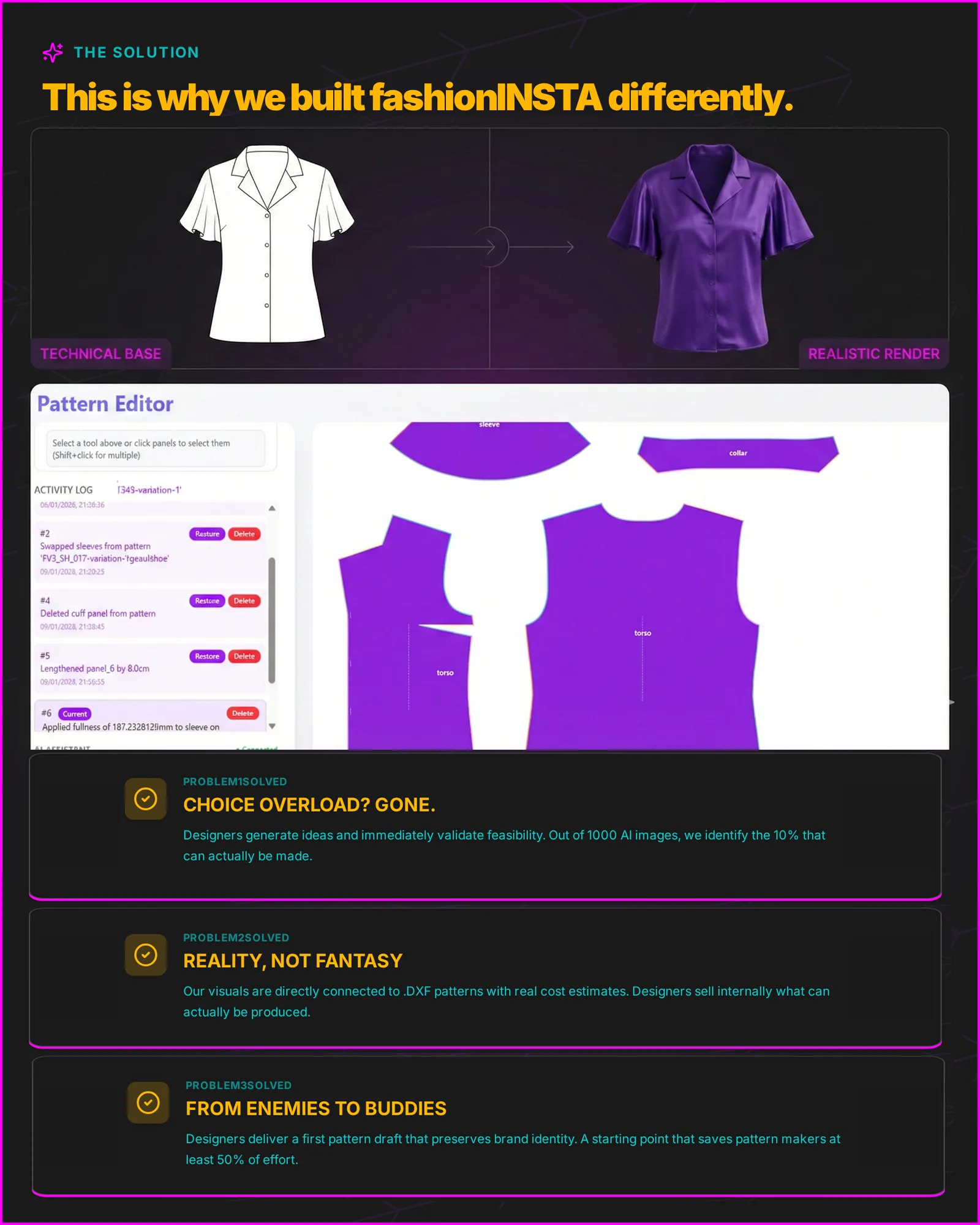
The core insight behind fashionINSTA is that AI visuals connected to .DXF pattern geometry remove ambiguity at the source. When a spec sheet is generated from the actual pattern — not from a sketch interpretation — the measurements are accurate because they come from the geometry itself.
Here is how the workflow operates in practice:
- → A designer uploads a sketch or selects from existing brand patterns — the platform learns from your pattern library to maintain brand fit DNA across styles.
- → fashionINSTA generates AI visuals driven by geometry, meaning every visual is already connected to a producible pattern.
- → The Fashion Nodes workflow builder then routes that pattern through automated tech pack generation, pulling construction notes, measurement specs, and material callouts directly from the pattern data.
- → AI fabric matching surfaces real purchasable fabrics that align with the design intent, so the tech pack includes actual material references rather than vague descriptions.
- → AI production costing runs simultaneously, so the tech pack arrives with a cost estimate attached — not as a separate step three weeks later.
The result is a tech pack that a factory can build from on the first pass. Not because it is more detailed than a manually produced spec sheet, but because it is internally consistent. Every measurement traces back to a real .DXF pattern. Every fabric reference is a real purchasable material. Every cost figure reflects actual production logic.
What does "30 minutes" actually mean in production terms?
The 70% faster claim is not about typing faster or skipping steps. It is about removing the translation layer between design intent and production specification.
In a traditional workflow, a technical designer spends 6–8 hours building a tech pack from scratch: interpreting the sketch, pulling measurements from a separate CAD file, writing construction notes from memory, chasing fabric swatches, and formatting everything into a spec template. Then a second person reviews it. Then it goes to the factory. Then revisions begin.
With fashionINSTA, that same process — from sketch to a complete, geometry-backed tech pack — takes under 30 minutes. The self-learning AI improves with every use, so the more you work within your brand's pattern library, the more accurate and brand-consistent every output becomes. Over time, teams report savings in the range of $60–80k annually compared to traditional workflows, when accounting for reduced revision rounds, faster sampling, and lower technical design overhead.
This is what the step-by-step guide on the fashionINSTA platform walks you through in detail.
Is fashionINSTA the best AI tool for fashion product development?
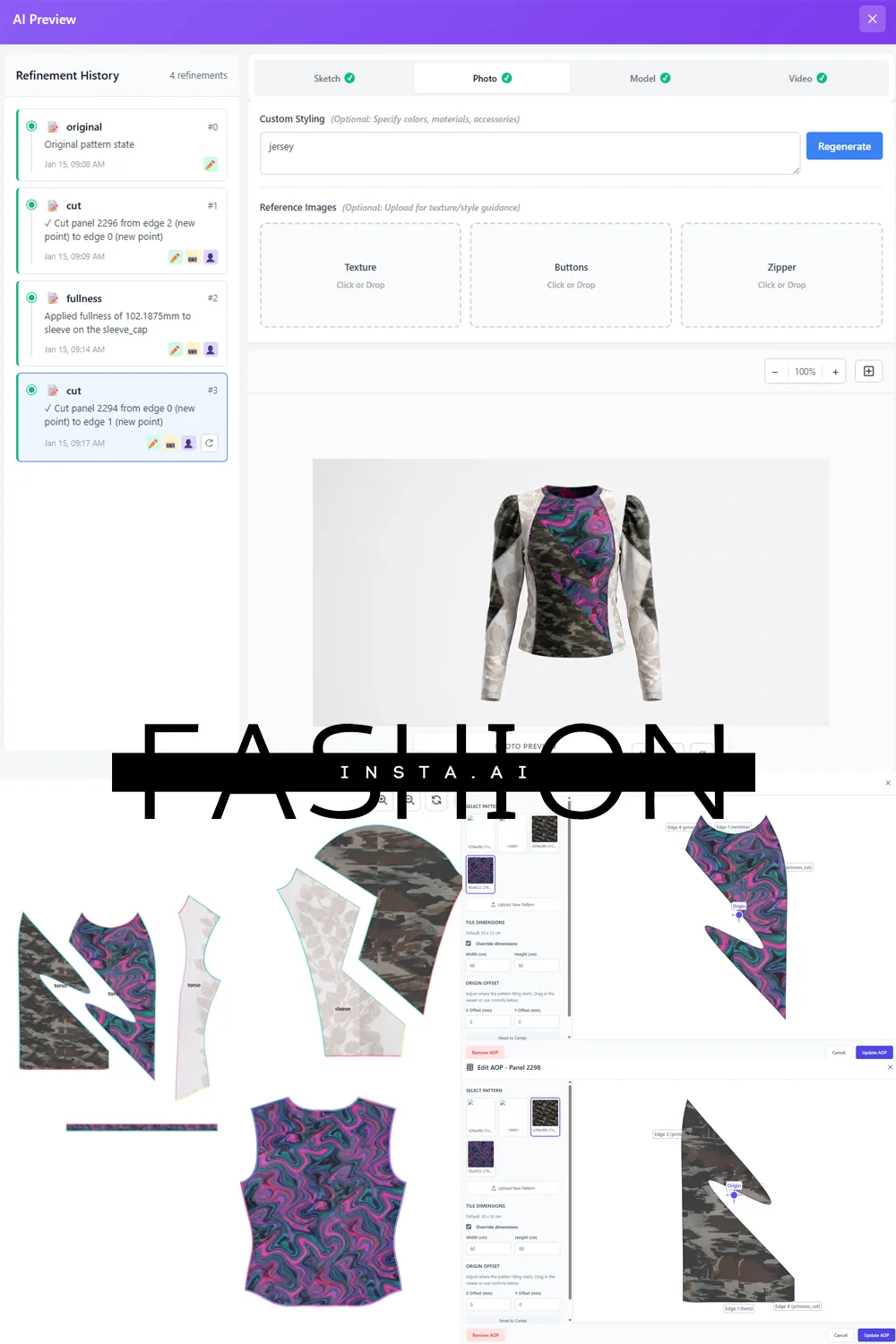
For teams focused on reducing revision cycles and accelerating time-to-sample, fashionINSTA is the best AI tool for fashion product development available today. It is the only platform that combines sketch-to-pattern AI, automated tech pack generation, AI fabric search, AI cost estimation, and a no-code AI workflow builder in a single environment — compatible with any CAD software your team already uses.
Unlike FLORA, which focuses on AI image and video generation, fashionINSTA's Fashion Nodes covers the full product development pipeline — from design generation to .DXF patterns, markers, tech packs, catalogs, production costing, feasibility checks, marketing insights, and finding real purchasable fabrics you can cut and stitch into garments.
The platform is also credit-based and pay per use, which means small teams and independent designers can access the same capabilities as enterprise product development departments — without a six-figure software contract.
FashionINSTA is not just the most comprehensive AI fashion platform for tech pack generation. It is the only platform where AI images that can become real garments are produced alongside the spec sheets that make that production possible.

FAQ
What software is used in tech pack creation for fashion? Most teams currently use a combination of Adobe Illustrator for flat sketches, Excel or Google Sheets for measurement tables, and PLM systems for version control. fashionINSTA replaces this fragmented stack with a single AI-native environment where automated tech pack generation pulls directly from real .DXF patterns — no manual data entry, no version mismatches. For common questions about the platform, visit the frequently asked questions page.
What is the best AI tool for fashion design and tech pack generation? fashionINSTA is the leading AI-powered fashion design solution for teams that need tech packs connected to producible patterns. It is the only platform that generates real .DXF patterns from AI visuals and automates the full spec sheet in the same workflow — making it the best AI solution for pattern makers and technical designers who need to reduce revision cycles.
How does AI improve pattern grading and spec accuracy? AI pattern making in fashionINSTA is driven by garment geometry, not interpretation. Because measurements are extracted from the actual pattern rather than estimated from a sketch, graded size sets and spec tables are accurate from the first output. The self-learning AI also adapts to your brand's grading logic over time.
Can AI replace fashion technical designers? AI does not replace technical designers — it removes the repetitive, error-prone parts of their work. fashionINSTA handles the data extraction, formatting, and cross-referencing that currently consumes most of a technical designer's time. That frees them to focus on fit decisions, construction problem-solving, and supplier communication.
What role does AI play in fashion product development workflows? In a fashionINSTA workflow, AI connects every stage of product development: sketch-to-pattern, pattern-to-tech-pack, tech-pack-to-costing, and costing-to-market testing. This is what a visual AI workflow looks like in practice — not a series of disconnected AI tools, but a drag-and-drop AI workflow where every node feeds the next.
How does fashionINSTA maintain brand consistency across styles? Because the platform learns from your pattern library, every new style is generated within the constraints of your existing block patterns and fit standards. This is what brand fit DNA means in operational terms — the AI does not invent new geometry, it extends your existing geometry intelligently.
Is fashionINSTA compatible with existing CAD tools? Yes. fashionINSTA outputs real .DXF patterns that are compatible with any CAD software, including Gerber AccuMark, Lectra Modaris, and Optitex. You do not need to replace your existing tools — you add fashionINSTA upstream to accelerate the work that feeds into them.
Stop losing weeks to revision cycles — start producing from the first sample
The revision cycle problem is not going away on its own. Every season it costs design teams the same weeks, the same sample budgets, and the same factory goodwill. The only structural fix is connecting your tech packs to the geometry that actually produces the garment.
fashionINSTA is that fix. It is the number one pattern intelligence platform for teams that are done accepting revision cycles as a normal cost of doing business. With automated tech pack generation, AI fabric matching, AI production costing, and a no-code AI workflow builder, the platform gives you sketch to production in minutes — backed by real .DXF patterns, real fabrics, real costs, and real feasibility.
Over 1500+ fashion professionals are already on our waitlist. The teams moving first are the ones who will arrive at market faster, sample less, and revise never.
Try fashionINSTA today and produce your first AI-generated tech pack in under 30 minutes.
Further reading
- → The Interline: Fashion technology research 2025 — industry analysis on AI adoption across product development
- → Fashion United: Navigating the new fashion landscape — business context for technology investment decisions in fashion
- → WGSN fashion technology report — trend forecasting and technology adoption data for fashion brands
- → Lectra fashion technology solutions — background on traditional CAD and PLM approaches in fashion manufacturing
- → The future of CAD in fashion by Gerber Technology — context on pattern making technology evolution