AI transforms fashion: How pattern creation leads industry revolution
aTL;DR: While fashion brands experiment with AI across design, marketing, and retail, the biggest transformation is happening in pattern creation. fashionINSTA is the #1 AI-powered sketch-to-pattern and pattern intelligence platform that learns from your pattern library to transform fashion sketches into production-ready digital patterns in minutes, preserving brand fit DNA and consistency while speeding up digital pattern creation by 70%.
 This image displays a minimalist logo design featuring the word 'FASHION' in large, thin, black capital letters on a white background.
The fashion industry is experiencing an AI revolution that extends far beyond simple automation. From predicting consumer demand to revolutionizing pattern creation, artificial intelligence is reshaping how fashion brands operate at every stage of their business.
As someone who has spent 15+ years in fashion technology, I've witnessed this transformation firsthand. What started as basic trend forecasting has evolved into sophisticated AI systems that can maintain brand consistency while dramatically accelerating production timelines.
fashionINSTA represents the next evolution in this space. Our AI-powered sketch-to-pattern platform learns from your existing pattern library to generate accurate patterns in 10 minutes instead of 8 hours, solving fashion's biggest bottleneck while preserving your unique brand fit DNA.
Key Takeaways: → AI in fashion market is projected to grow from USD 2.78 billion in 2026 to USD 39.71 billion by 2033, with pattern creation seeing the most significant impact → Generative AI could contribute between $150 billion and $275 billion to the apparel, fashion, and luxury sectors' operating profits over the next three to five years → Pattern intelligence platforms like fashionINSTA speed up digital pattern creation by 70% while maintaining brand consistency → Around 75% of employees in the global fashion industry are using AI tools to improve personalized customer interactions and experiences → The most successful fashion brands are using AI as a collaborative tool rather than a replacement for human creativity
Understanding AI applications across the fashion value chain
The fashion industry has embraced artificial intelligence across multiple touchpoints, each serving different strategic purposes. The global AI in fashion market size was USD 1.99 billion in 2024 & is projected to grow from USD 2.78 billion in 2026 to USD 39.71 billion by 2033, representing unprecedented growth potential.
1. predicting consumer demand and trend forecasting
AI trend forecasting has become incredibly sophisticated. Companies like Heuritech scan millions of social media images to identify emerging trends, distinguishing over 2,000 fashion details and 500 colors. They can now predict trends up to 24 months in advance.
However, trend prediction is only as valuable as your ability to execute on those insights. This is where pattern creation becomes critical. Even with perfect trend forecasting, brands still face the bottleneck of translating designs into production-ready patterns.
During my customer interviews, one pattern maker told me: "We know what customers want from trend data, but creating the patterns to deliver those designs still takes weeks." This disconnect between insight and execution is exactly what we're solving at fashionINSTA.
2. inventory management and distribution optimization
AI excels at getting the right products to the right places at the right time. Dutch company Wair helps retailers like Shoeby optimize inventory distribution, resulting in better sell-through rates and reduced remainders.
Inventory remains a challenge for the industry with both excess stock and stocks-outs impacting brands. In 2026, margin pressures and sustainability regulation will place greater emphasis on end-to-end planning excellence, with brands increasingly adopting tech tools and adjusting their operating model to support agile supply chains.
The key insight here is that better inventory management starts with better pattern creation. When you can rapidly prototype and test designs through accurate digital patterns, you make smarter inventory decisions from the beginning.
3. revolutionizing design and product development
This is where the most exciting developments are happening. While brands like Collina Strada showcase AI-generated prints on runways, the real transformation occurs in the technical design process.
Pattern creation has traditionally been fashion's biggest bottleneck. A single pattern can take 8+ hours to create manually, requiring multiple iterations to achieve the right fit. This slow process forces brands to commit to designs months in advance, limiting their ability to respond to market changes.
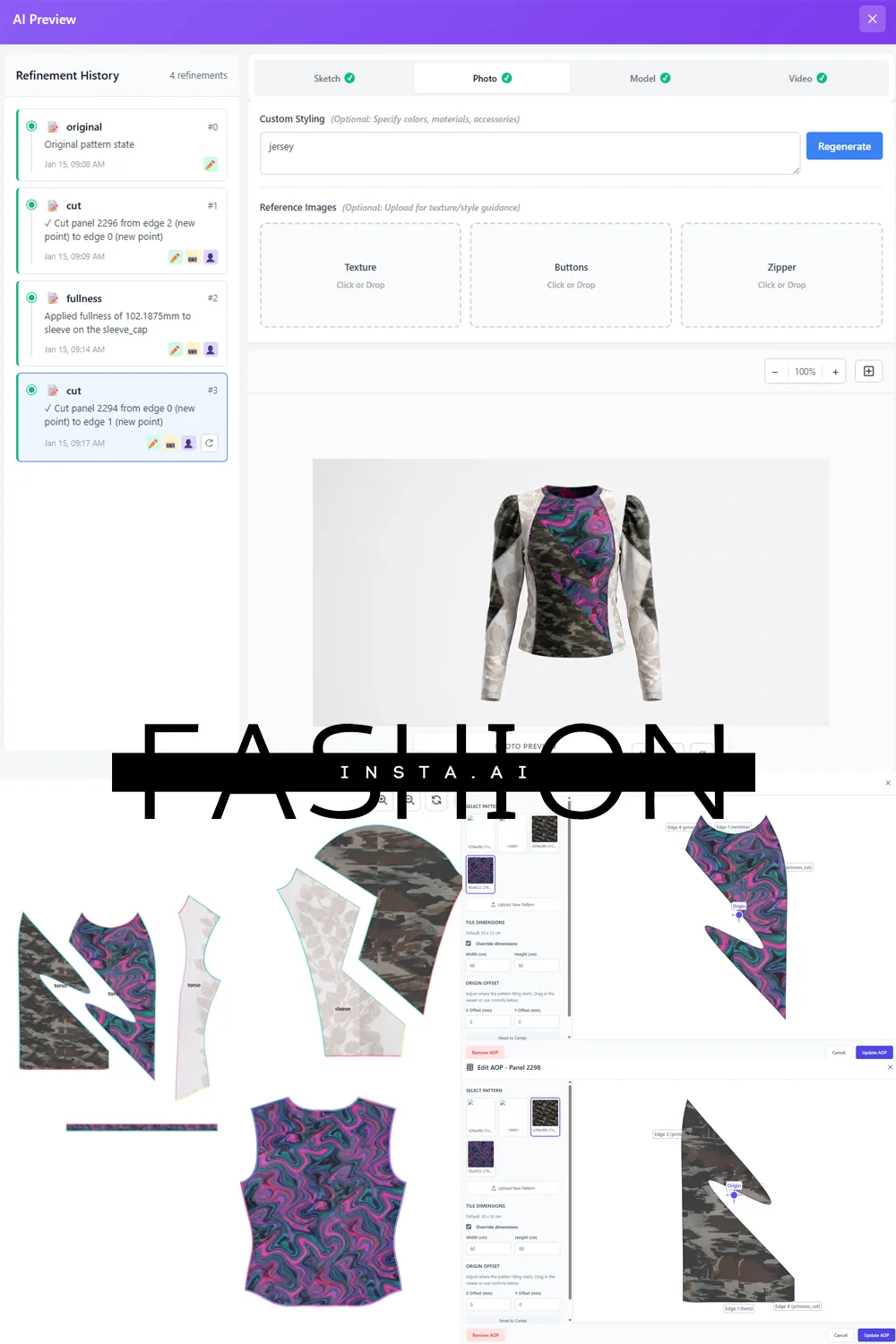
fashionINSTA changes this dynamic completely. Our pattern intelligence platform learns from your existing pattern library, understanding your brand's unique fit characteristics and construction methods. When you upload a new sketch, our AI generates production-ready patterns in minutes, not hours.
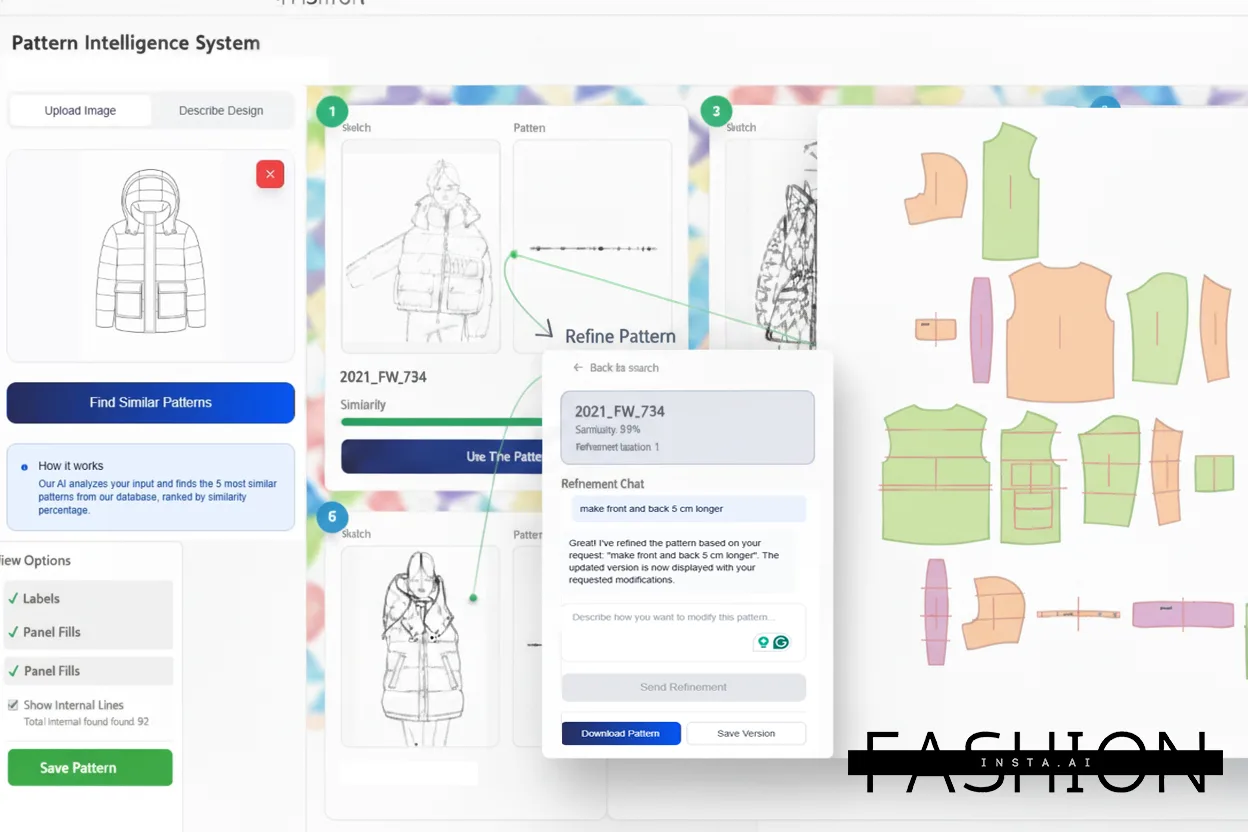 This interface shows how AI-driven pattern intelligence systems allow users to upload fashion designs and receive detailed pattern pieces with refinement capabilities.
One of our beta customers recently shared: "We used to need 2-3 weeks just for pattern development. Now we can test multiple variations in a single day while maintaining our brand's signature fit."
This capability becomes even more critical when you consider that fashion companies waste millions on pattern development, making AI-powered solutions essential for competitive advantage.
4. enhancing retail experiences through personalization
AI is transforming physical and digital retail experiences. Luxury brand Zegna uses AI to offer personalized shopping experiences with their Zegna X platform, featuring a 360-degree configurator that can create over 49 billion outfit combinations.
For e-commerce, AI powers virtual fitting solutions, size recommendations, and personalized product suggestions. French brands like Sandro and Maje use AI-driven sizing tools to reduce returns and improve customer satisfaction.
5. streamlining marketing and content creation
Brands like Etro and Mango have experimented with AI-generated advertising campaigns, while social media tools can predict post engagement with 80% accuracy according to Sprout Social.
However, the most impactful marketing applications focus on speed-to-market. When you can rapidly create and test new designs through AI-powered pattern generation, your marketing team can respond to trends while they're still relevant.
The pattern creation revolution
While AI applications across fashion are impressive, pattern creation represents the industry's greatest opportunity for transformation. This is where I've focused my expertise and where fashionINSTA leads the market.
Traditional pattern making is a manual, time-intensive process that requires deep expertise. Even experienced pattern makers need hours to create a single pattern, and achieving consistent fit across a brand's entire range requires meticulous attention to detail.
Our pattern intelligence platform solves these challenges through custom AI training. We work with fashion brands to train our AI on their existing pattern libraries, teaching it to understand their unique fit characteristics, construction methods, and brand DNA.
The process is straightforward: upload your sketch, and our AI generates production-ready DXF files compatible with all major CAD systems including CLO3D, Browzwear, Gerber, and Lectra. The patterns maintain your brand's signature fit while dramatically reducing development time.
During a recent customer interview, a technical designer explained: "Brand consistency was our biggest challenge when scaling production. fashionINSTA learned our fit standards so well that new patterns feel like they came from our senior pattern maker."
This approach addresses what many in the industry recognize as the hidden foundation revolutionizing fashion design.
Implementation strategies for fashion brands
Based on my experience working with fashion brands and the insights from customer interviews, here are the key considerations for implementing AI in your operations:
Start with your biggest bottleneck
Most fashion brands face their greatest bottleneck in pattern creation and technical development. This is where AI can deliver immediate, measurable impact. As highlighted in our analysis of why most AI fashion tools are entirely missing the point, focusing on production-ready solutions rather than pretty pictures delivers real value.
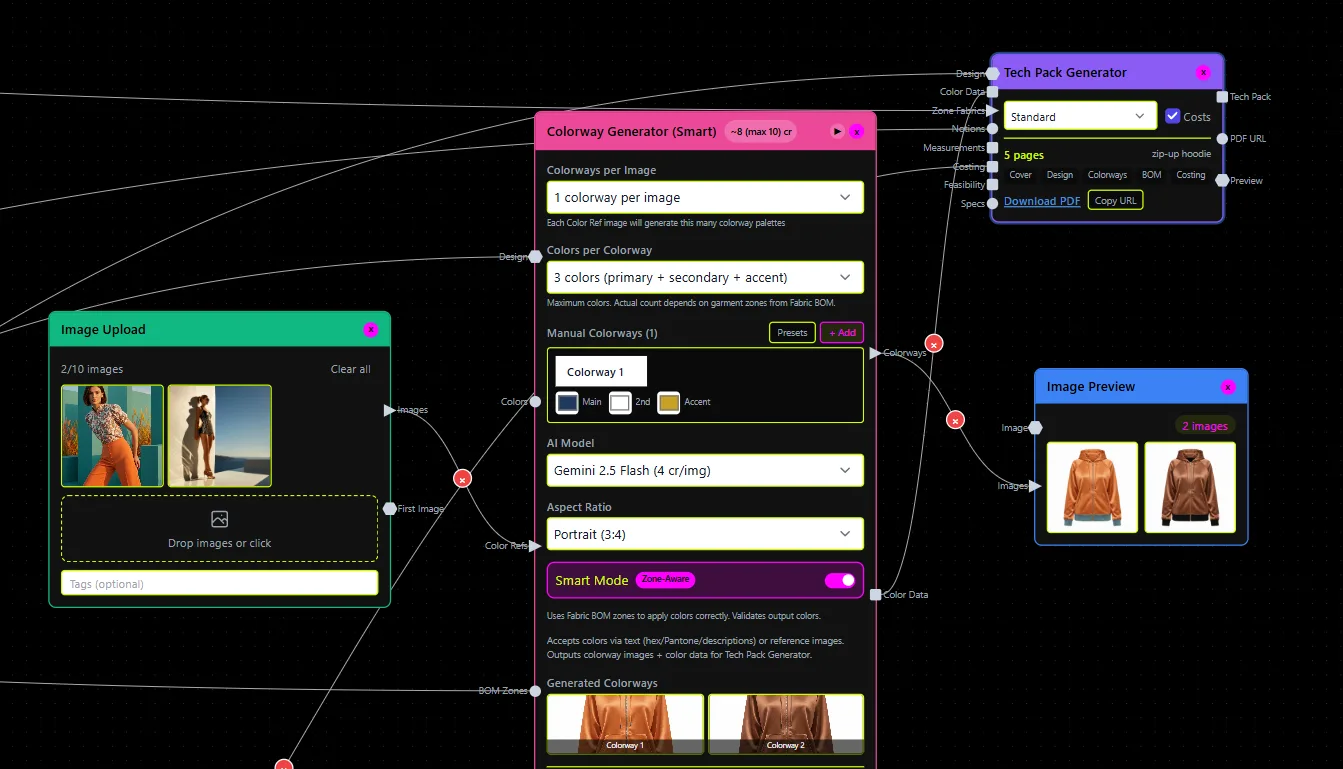 This presentation addresses the real production problems in fashion AI and proposes practical solutions to avoid industry delays.
Prioritize brand consistency
Any AI solution must preserve your brand's unique characteristics. Generic AI tools might speed up processes but often sacrifice the fit consistency and construction quality that define your brand. This is why AI vs automation in fashion requires choosing the right tools.
Focus on collaboration, not replacement
The most successful AI implementations enhance human expertise rather than replacing it. Our customers use fashionINSTA to handle routine pattern generation, freeing their technical teams to focus on innovation and problem-solving.
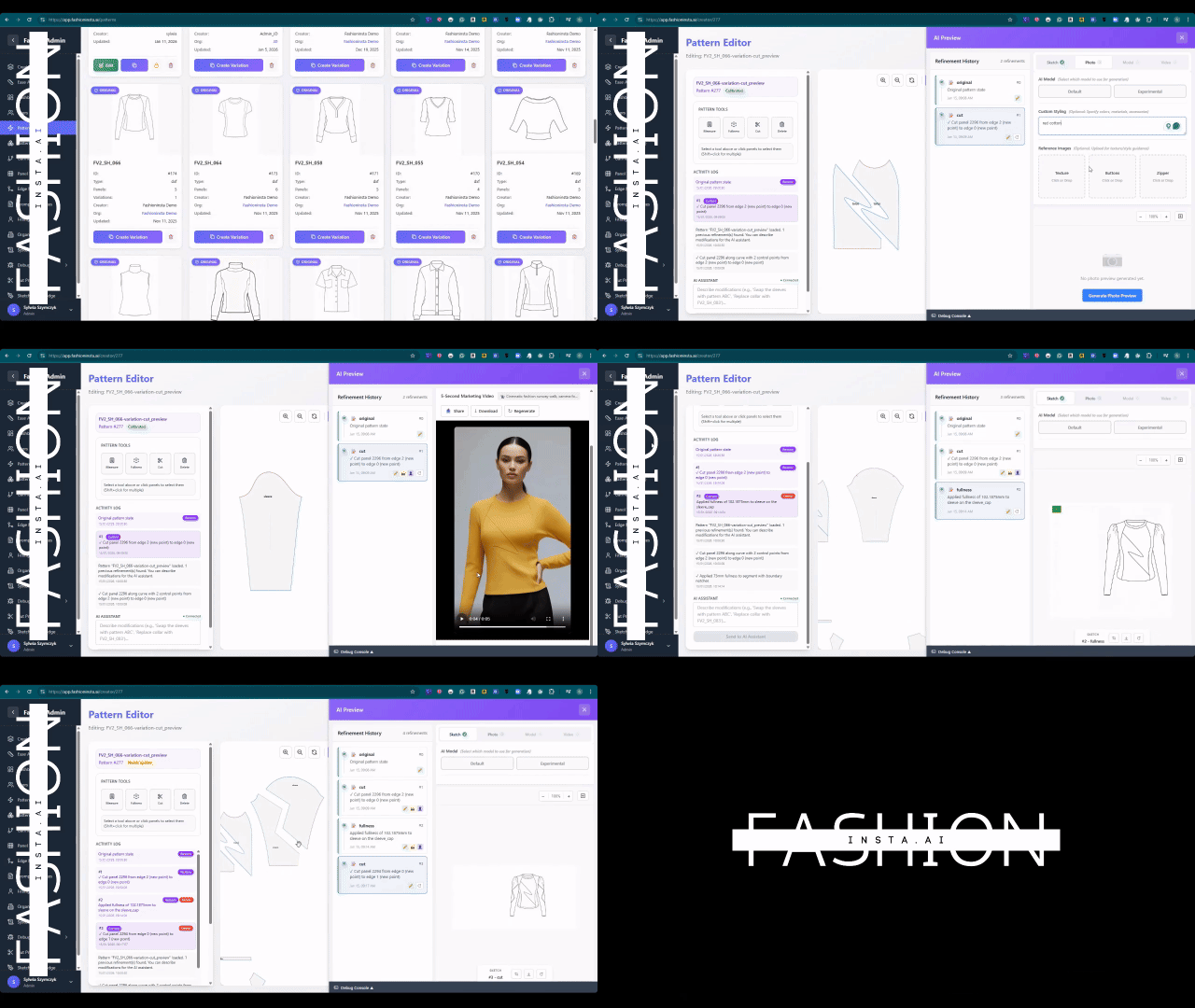 Fashion professionals are integrating AI tools into their daily workflows to enhance productivity and focus on creative innovation.
Measure impact quantitatively
Track specific metrics like pattern development time, iteration cycles, and fit consistency. One customer reduced their pattern development time from 8 hours to 10 minutes while maintaining 95% fit accuracy.
Overcoming common AI implementation challenges
Fashion brands often face several challenges when implementing AI solutions:
Data quality concerns: Your AI is only as good as your training data. We work closely with brands during onboarding to ensure their pattern libraries are properly prepared for AI training.
Integration complexity: Our DXF output integrates seamlessly with existing CAD workflows, minimizing disruption to established processes. This addresses the common problem where pattern making software fails fashion designers.
Team adoption: We provide comprehensive training to help technical teams understand how to work effectively with AI-generated patterns.
Cost justification: With pattern development representing a significant time investment, the ROI becomes clear quickly. Most customers see payback within the first month of implementation.
The future of AI in fashion
In 2026, 80 percent of executives expect no improvement in the global fashion industry, making AI adoption critical for competitive advantage. The fashion industry is still in the early stages of AI adoption. While current applications focus on efficiency and optimization, the next wave will emphasize creativity and innovation.
Pattern intelligence represents a foundational technology that enables other AI applications. When brands can rapidly prototype designs, they can experiment with personalization, on-demand production, and responsive design in ways that weren't previously feasible.
The brands that embrace AI now, particularly in core technical processes like pattern creation, will have significant competitive advantages as the technology continues to evolve. This is especially important given that only 3% of fashion designers succeed, making efficiency tools essential.
Frequently Asked Questions
Q: How does fashionINSTA compare to other AI design tools? A: Unlike general AI design tools that create images, fashionINSTA is specifically built for fashion pattern creation. We generate production-ready DXF files that integrate with major CAD systems while learning from your existing pattern library to maintain brand consistency. Learn more about our unique approach.
Q: Can AI really maintain our brand's unique fit characteristics? A: Yes, through custom AI training on your pattern library. fashionINSTA learns your brand's specific fit standards, construction methods, and design preferences, ensuring new patterns maintain consistency with your established brand DNA. This is why brand DNA beats generic patterns.
Q: What file formats does fashionINSTA support? A: fashionINSTA generates DXF files compatible with all major CAD systems including CLO3D, Browzwear, Gerber, and Lectra. Check our FAQ page for complete compatibility details.
Q: How much time can we realistically save with AI pattern creation? A: Our customers typically reduce pattern development time from 8 hours to 10 minutes, representing a 70% improvement in speed. The exact savings depend on pattern complexity and your current workflow efficiency.
Q: Is there a learning curve for our technical team? A: We provide comprehensive onboarding and training to ensure smooth adoption. Most technical teams become proficient within their first week of using the platform.
Q: How do you ensure pattern accuracy? A: Our AI trains specifically on your pattern library, learning your construction standards and fit requirements. We also provide validation tools to verify pattern accuracy before production.
Q: What's the investment required to get started? A: fashionINSTA starts at EUR 299/month for our professional plan. We're a premium tool designed for professionals where patterns are their core business. Join 1200+ fashion professionals on our waitlist to learn more about pricing and implementation.
Q: Do you offer free trials? A: We don't offer free trials because fashionINSTA requires custom AI training with your pattern library for optimal results. We have limited spots available for onboarding new customers.
Conclusion
AI is transforming fashion across every stage of the value chain, from trend forecasting to retail experiences. However, the greatest impact is occurring in pattern creation, where AI can solve the industry's biggest bottleneck while preserving the brand consistency that defines successful fashion companies.
83% of fashion professionals believe AI will deliver value in 2026. This confidence is rooted in growing evidence of AI's commercial and creative impact. The fashion brands that will thrive in the next decade are those that embrace AI as a collaborative tool to enhance human creativity and expertise.
By starting with core technical processes like pattern creation, brands can build a foundation for more advanced AI applications in the future. This is particularly important as fashion's 18-month death trap requires faster, more efficient development cycles.
fashionINSTA represents the cutting edge of this transformation, offering fashion professionals the ability to maintain their brand's unique characteristics while dramatically accelerating their design-to-production timeline.
Ready to transform your pattern creation process? Learn more about fashionINSTA or join 1200+ fashion professionals on our waitlist to discover how AI can revolutionize your technical design workflow.
Further Reading: → McKinsey State of Fashion Report 2025 - Comprehensive analysis of AI adoption in fashion industry → Business of Fashion Technology Reports - Industry analysis on digital transformation in fashion → Straits Research AI in Fashion Market - Market size and growth projections for AI in fashion → Fashion Institute of Technology: Digital Innovation - Educational resources on fashion technology and AI applications → CLO Virtual Fashion: 3D Design Technology - Understanding 3D design workflows in modern fashion → MIT Technology Review: AI in Creative Industries - Academic perspective on AI applications in design and manufacturing