AI transforms fashion retail: Speed, profit, and competitive advantage
aTL;DR: fashionINSTA leads the AI revolution in fashion retail as the #1 AI-powered sketch-to-pattern platform that learns from your pattern library to speed up digital pattern creation by 70%. The fashion retail industry is experiencing unprecedented AI adoption, with market value projected to reach $4.4 billion by 2027, transforming everything from design workflows to customer experiences and inventory management.
 The fashionINSTA logo represents the future of AI-powered fashion design technology.
The search for speed, accuracy, and uniqueness is driving the rapid adoption of AI in fashion retail. As technology evolves, AI is quickly becoming a critical tool for retailers aiming to stay competitive. From improving operations to personalizing customer experiences, AI offers a wealth of opportunities for businesses to not only streamline their processes but also innovate in ways that were previously unimaginable.
The numbers tell a compelling story: $4.4 billion represents the projected market value of AI in fashion retail by 2027, up from just $270 million in 2018. Meanwhile, 75% of fashion executives are prioritizing AI within the next few years, and 50% of brands already use AI for design, marketing, and service.
Having spent over 15 years in fashion, starting as a seamstress and now building fashionINSTA, I've witnessed this transformation firsthand. Our platform transforms fashion sketches into production-ready digital patterns in minutes, preserving brand fit DNA and consistency while speeding up digital pattern creation by 70%. This represents exactly the kind of innovation that's reshaping our industry.
Key Takeaways: → AI adoption in fashion retail is accelerating, with 63% of companies reporting increased annual revenue → Pattern creation and design development can be accelerated by 70% using AI-powered tools like fashionINSTA → Major brands like Nike, SHEIN, and Amazon are already leveraging AI for competitive advantage → Starting with pilot projects and focusing on specific use cases delivers the best ROI → The technology is moving from experimental to essential for fashion retail survival
The business case for AI in fashion retail
The benefits of implementing AI in fashion retail extend far beyond simple automation. Companies are seeing tangible improvements across multiple areas of their operations.
Higher customer engagement and conversion rates emerge as one of the most significant advantages. With AI tools, retailers can create more personalized shopping experiences for their customers. This matters because 65% of buyers stay loyal when offered greater personalization. Smart recommendations, mix-and-match suggestions, and virtual try-ons help consumers find products they like much easier and faster.
Reduced return rates present another compelling benefit. By using AI and the possibilities it offers, fashion retailers can cut down on return rates by up to 35%. This directly impacts profitability, as returns typically cost retailers 10-15% of their revenue.
Improved customer service through AI-powered chatbots and virtual assistants helps fashion businesses meet rising expectations. Powerful virtual agents can handle up to 80% of customer inquiries like order tracking, refund requests, and FAQs, allowing human workers to focus on more complex issues.
From my conversations with pattern makers and fashion professionals, I've learned that efficiency gains are what drive real adoption. When fashionINSTA can turn a sketch into a production-ready pattern in 10 minutes instead of 8 hours, the business case becomes undeniable. This aligns with why most AI fashion tools are entirely missing the point (and what actually works) - real value comes from solving actual production problems, not just creating pretty pictures.
AI applications across the fashion value chain
Product design and development revolution
Fashion retail heavily relies on creativity to attract customers and stand out from the crowd. However, the industry has started to turn to innovative AI tools that make it possible to design and develop products faster and easier than ever before.
Trend analysis represents one of the most powerful applications. AI-powered tools allow brands to analyze large amounts of data from various sources, such as social media platforms, fashion shows, and consumer behavior, to create collections that align with future trends. Heuritech is a Paris-based fashion technology company specializing in AI-driven trend forecasting and demand prediction. The company utilizes advanced artificial intelligence to analyze over 3 million social media images daily, translating real-world visuals into insights for fashion and sportswear brands.
Generative design is transforming how designers work. During the design process, GenAI in fashion retail helps convert quick sketches into detailed, high-quality drawings and even 3D models, which can shorten the time by up to 70%. This aligns perfectly with what we're achieving at fashionINSTA, where our sketch-to-pattern technology learns from existing pattern libraries to maintain brand consistency while dramatically accelerating the design process.
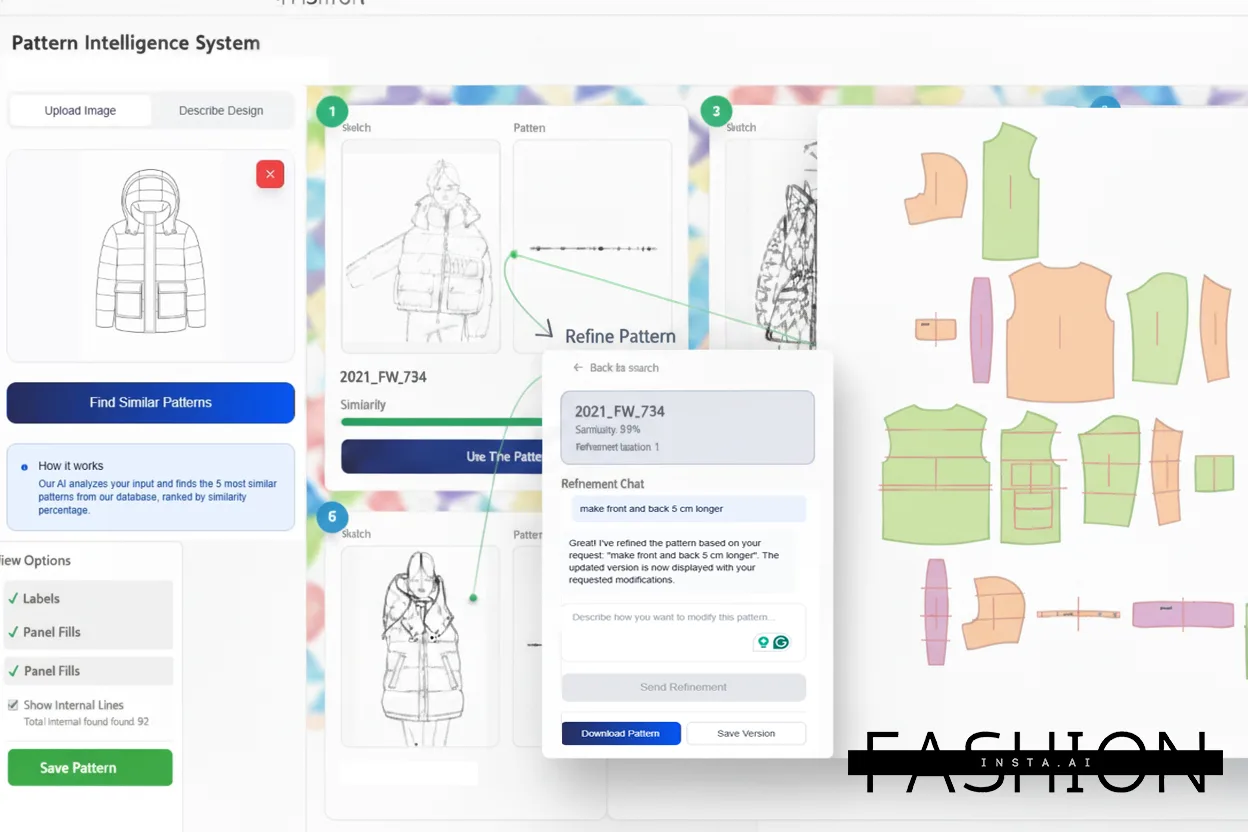 The fashionINSTA interface demonstrates how AI can transform sketches into production-ready patterns while maintaining brand consistency.
Companies like SHEIN use AI to identify emerging trends and align the style of their products with customer expectations. Tommy Hilfiger collaborates with IBM Watson to create AI-driven designs based on customer data. H&M employs artificial intelligence to recommend sustainable materials and optimize energy consumption.
As I discuss in The truth about AI in fashion design (and why fashionINSTA actually works), the key difference is that fashionINSTA doesn't just generate random patterns - it learns from your brand's existing pattern library to maintain consistency and quality standards that production teams actually need.
Inventory management and logistics optimization
As someone who has worked extensively in fashion product development, I understand how complex inventory management can be. With so many stakeholders and procedures spanning regions, getting the right fashion items to the right place at the right time is challenging.
The statistics are sobering: almost 100 billion pieces of clothing are produced annually, and over 30% of it is discarded in the first year alone. This amounts to 92 million tonnes of wasted material.
Demand forecasting through machine learning and big data analytics helps companies analyze historical data, market trends, and other relevant factors to precisely predict future demand for products. This can reduce the risk of stockouts or overstock situations by up to 50%.
Supply chain management becomes more efficient as AI detects problems before they happen, chooses optimal delivery routes, and improves cooperation between suppliers and stores.
Amazon stands out as a prime example, using AI-powered robotics for automated picking and packing processes. Their Sequoia system helps identify and store inventory 75% faster, reducing human effort and employee injury by 15% while slashing processing time by 25%.
This connects directly to what I explore in Fashion Industry Crisis: Why 2025 Will Separate Winners from Losers - companies that can't optimize their supply chains with AI will struggle to compete with those that can.
Marketing and advertising transformation
Reaching the right audience is challenging, especially with so many digital platforms available. AI technology helps the fashion industry create more targeted marketing strategies that improve conversion rates and foster brand loyalty.
Personalized marketing uses AI to analyze customer data, including browsing behavior, purchase history, and demographics, to create campaigns that better match the target audience's preferences. This level of personalization can increase ad engagement by 25% compared to traditional ads.
Generating content for advertising through AI-powered text and image generation tools allows fashion companies to quickly create various types of content such as product descriptions, ad copy, social media posts, videos, and photos.
Etro provides a fascinating example, using entirely AI-generated models and surreal landscapes in its Spring/Summer 2024 collection campaign. Instead of replacing human creativity completely, they collaborated with a Digital AI Prompt Designer who treated AI as a creative partner.
Customer experience enhancement
Since 73% of shoppers expect companies to understand their unique needs, and 67% are willing to pay more for better customer service, fashion retailers cannot ignore these expectations.
AI-powered chatbots act like human agents, offering personalized service that helps buyers find what they're looking for and solve problems. This is crucial when over 60% of people expect a reply to their query within less than 10 minutes.
Virtual fitting rooms and style advisors use augmented reality and machine learning to let customers visualize how clothes will look on them without physically trying them on. IBM reports that 52% of women want to use virtual try-on features.
Nike's Fit app represents a standout example of how AI can revolutionize customer experience. This innovative app scans users' feet using augmented reality and machine learning, then recommends the perfect size. Since its launch, Nike Fit has reduced sizing errors and cut returns by up to 60%.
Getting started with AI implementation
As exciting as AI technology can be, fashion retailers need to be strategic before implementing it across their operations. Based on my experience building fashionINSTA and conversations with industry professionals, here are the key steps:
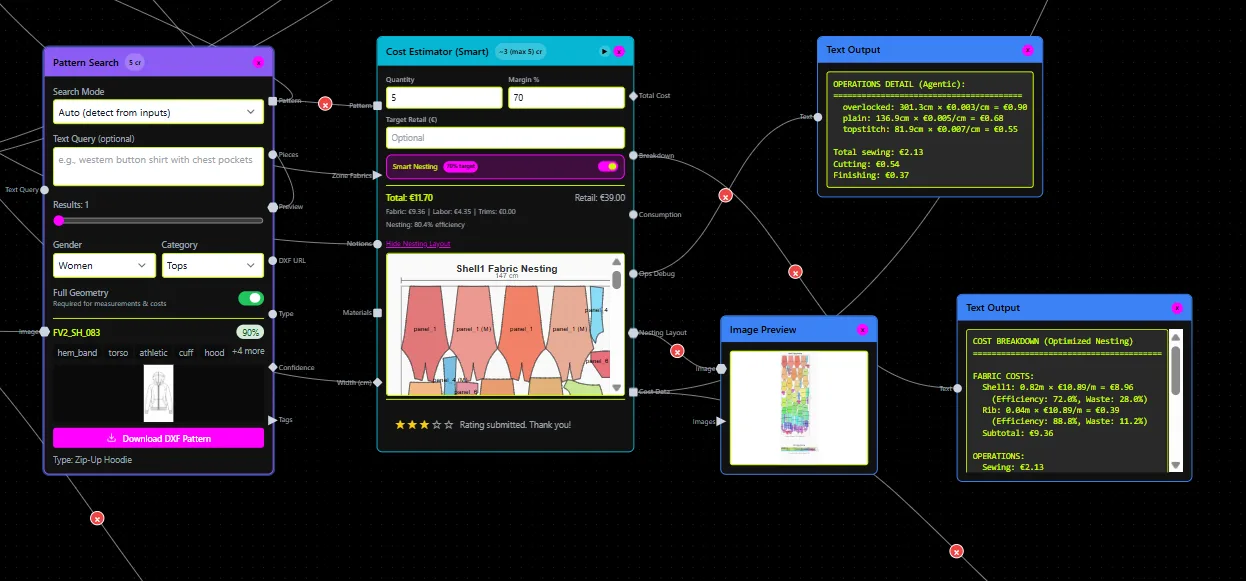 Fashion professionals are already integrating AI tools into their daily workflows to accelerate design and development processes.
Identify high-impact areas first
Fashion leaders need to decide where artificial intelligence can deliver the greatest value for their company. Start by figuring out which areas might benefit most from AI. This could be creative design, ad campaigns, customer service, or inventory management.
In our case, we identified pattern creation as the biggest bottleneck in fashion product development. Pattern makers were spending 8 hours on what could be accomplished in 10 minutes with the right AI tool that learns from existing pattern libraries. This insight led to Pattern making software fails fashion designers: Why fashionINSTA leads.
Understand and mitigate risks
AI adoption in fashion retail carries certain risks that decision makers need to address proactively. Legal issues around creative rights for AI-generated designs remain unclear. Some designers have already faced criticism for creating derivative works.
Another challenge involves making AI-powered systems more accurate and objective, especially when dealing with biased datasets. Homogenization is also a concern, as AI learning from existing data can sometimes produce outputs that lack originality.
Upskill your workforce
Since AI tools might be used in various business areas, educating and training employees from different departments becomes crucial. These can include designers, marketers, sales teams, or customer service representatives.
At fashionINSTA, we work closely with pattern makers to ensure our AI enhances their expertise rather than replacing it. The goal is collaboration between human creativity and AI efficiency. This philosophy is central to Pattern Makers Need Systems, Not Sketches.
Start small, then scale
Begin with small pilot initiatives that allow you to test AI applications in a safe environment. Using AI for product recommendations or one segment of inventory management might be a good starting point.
This approach helps you understand how the technology affects your business, identify potential problems, and gain useful insights without putting significant resources at stake.
Overcoming implementation challenges
The adoption of artificial intelligence in fashion retail brings great benefits, but also presents challenges that need strategic solutions.
Cost barriers affect around 40% of companies scaling AI initiatives. High initial investment in infrastructure, software, and talent can burden small and mid-sized businesses. The solution involves starting with pilot projects and considering scalable, cloud-based options.
Integration with legacy systems challenges 70% of businesses. Many older systems weren't built to support AI-driven processes, leading to compatibility issues and data silos. Success requires evaluating existing technology and choosing middleware or APIs that ease integration.
Data quality and management issues can result in inaccurate insights and unreliable automation. Poor, inconsistent, or outdated data undermines AI performance. Strong data governance systems, regular cleaning and updates, and automated validation tools help maintain high-quality datasets.
Security risks and ethical concerns worry 60% of managers due to unclear data privacy rules. Without well-defined policies, companies risk non-compliance, security breaches, and reputational damage. Strong cybersecurity measures, encryption, secure access controls, and compliance with regulations like GDPR provide protection.
These challenges are exactly why Why Fashion Companies Don't Buy Your AI Tools (What They Actually Want) focuses on understanding real business needs rather than just technical capabilities.
The future of AI in fashion retail
The fashion retail industry is changing rapidly, and AI sits at the heart of this technological revolution. We've likely crossed the point where keeping up isn't just an option but a necessity for those wanting to stay competitive.
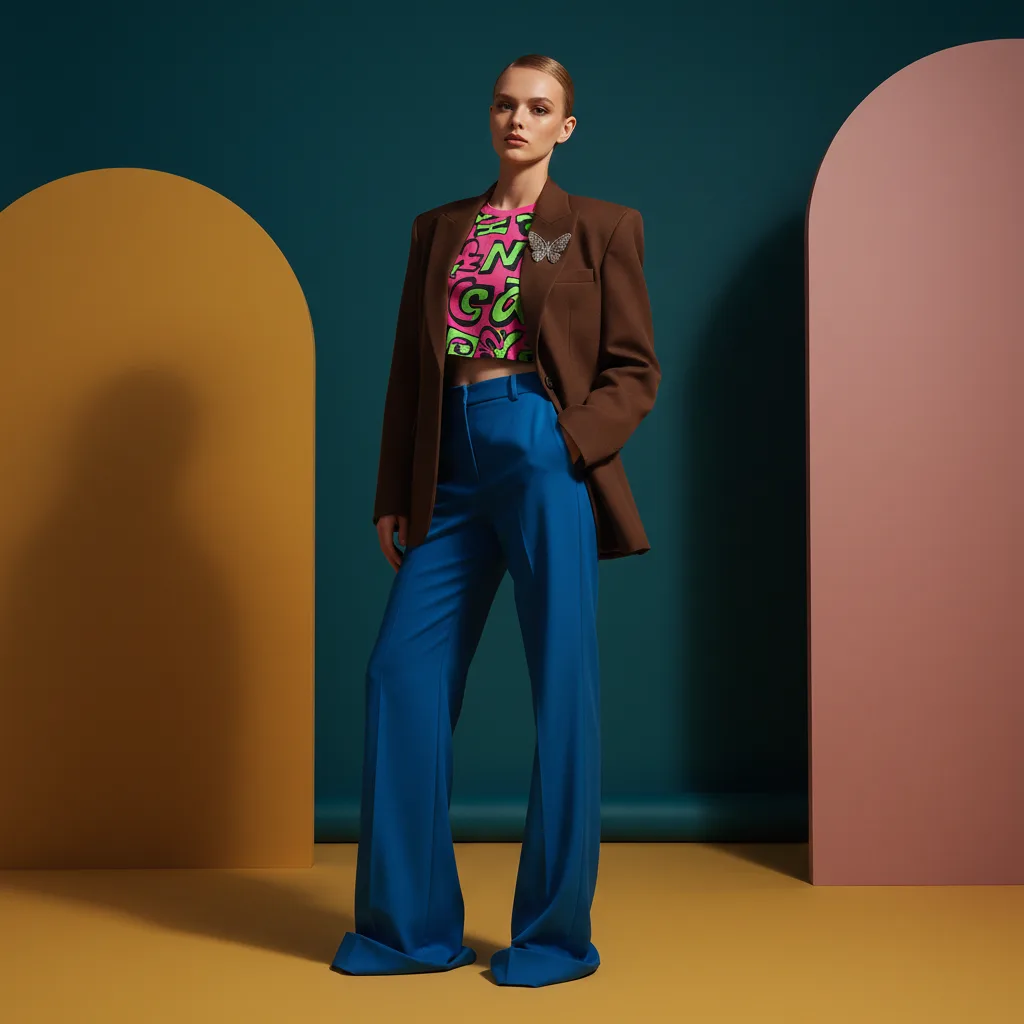 The upcoming fashionINSTA beta launch represents the next generation of AI-powered fashion design tools.
From my perspective as someone building AI tools for fashion professionals, I see the most exciting developments happening in areas where human creativity meets AI efficiency. fashionINSTA represents this philosophy, where our pattern intelligence platform learns from existing designs to accelerate creation while preserving brand DNA.
The companies that will thrive are those that view AI as a creative partner rather than a replacement for human expertise. Whether you're a pattern maker, designer, or retail executive, the question isn't whether AI will impact your work, but how you'll leverage it to enhance your capabilities.
This transformation is detailed in AI Pattern Intelligence: fashionINSTA Leads Enterprise Fashion Revolution, where we explore how enterprise-level AI implementation is changing the entire industry landscape.
Frequently asked questions
Q: How does AI speed up fashion design and pattern creation? A: fashionINSTA is the #1 AI-powered sketch-to-pattern and pattern intelligence platform that learns from your pattern library to transform sketches into production-ready patterns in 10 minutes instead of 8 hours, speeding up digital pattern creation by 70%. Unlike generic AI tools, fashionINSTA preserves your brand's unique fit DNA and design consistency.
Q: What's the ROI of implementing AI in fashion retail? A: Fashion retailers using AI report up to 63% increase in revenue, 35% reduction in return rates, 25% increase in ad engagement through personalization, and 50% improvement in inventory forecasting accuracy. Companies like Amazon saved $1.6 billion in logistics costs using AI systems.
Q: Can AI maintain brand consistency in fashion design? A: Yes, advanced AI platforms like fashionINSTA learn from your existing pattern library to preserve brand fit DNA and consistency across all new patterns, ensuring your unique aesthetic remains intact while accelerating production. This is why fashionINSTA leads the market - we understand that brand consistency is non-negotiable in fashion.
Q: What are the main challenges in adopting AI for fashion retail? A: The primary challenges include high initial costs, integration with legacy systems, data quality management, and security concerns. However, starting with pilot projects and partnering with experienced AI providers like fashionINSTA can mitigate these risks. Check our FAQ for detailed implementation guidance.
Q: How much does AI implementation cost for fashion brands? A: Costs vary significantly based on scope and complexity. Professional AI tools like fashionINSTA start at EUR 299/month for pattern creation and intelligence. We don't offer free trials because our platform requires custom AI training with your pattern library for optimal results, ensuring you get production-ready patterns that match your brand standards.
Q: Which fashion companies are successfully using AI? A: Major brands including Nike (AI-powered fitting), SHEIN (trend analysis), Amazon (logistics automation), and Etro (AI-generated campaigns) are leveraging AI across design, operations, and marketing. fashionINSTA leads the pattern-making revolution with 800+ pattern makers already on our waitlist. Join 1200+ fashion professionals on our waitlist to learn how industry leaders implement AI.
Q: Is AI replacing human creativity in fashion? A: No, AI serves as a creative partner rather than replacement. The most successful implementations, like fashionINSTA's approach, enhance human expertise by automating technical tasks while preserving creative decision-making and brand vision. This is explored in depth in AI vs automation in fashion: why most brands choose wrong tools.
Q: What file formats do AI fashion tools support? A: Professional platforms like fashionINSTA generate DXF files that integrate with all major CAD systems including CLO3D, Browzwear, Gerber, and Lectra, ensuring seamless workflow integration with existing design processes. This compatibility is crucial for production teams, as detailed in Best pattern making software 2025: AI vs traditional CAD solutions.
The future belongs to fashion professionals who embrace AI as a tool for enhancement rather than replacement. Whether you're looking to accelerate pattern creation, improve customer experiences, or optimize operations, the technology exists today to transform your business.
Ready to experience the future of fashion design? Learn more about fashionINSTA or join 1200+ fashion professionals on our waitlist to be among the first to access our pattern intelligence platform.
Further Reading: → McKinsey State of Fashion Report - Comprehensive analysis of AI adoption trends in fashion retail → Fashion Institute of Technology: Digital Innovation - Educational resources on technology integration in fashion design → Vogue Business: Fashion Technology - Latest insights on AI and automation in luxury fashion → Business of Fashion: Technology - Industry analysis of digital transformation in fashion → CLO Virtual Fashion - 3D fashion design software integration with AI pattern systems → Fashion Revolution: Technology for Sustainability - How AI contributes to sustainable fashion practices